
You Never Knew Your Voice Until AI Threatened It
The thing eroding your writing is also the first thing that’s ever made you see it clearly. That changes everything.

Yesterday I told you about a pattern that’s been repeating for 10,000 years: every great tool kills something valuable, and the people who survive the trade-off are the ones who build the fix before the loss becomes invisible.
Today’s the part where the pattern breaks.
Because the fix for AI isn’t like the fixes that came before. It’s better. And I don’t think anyone’s talking about why.
Writing killed memory. So humans built schools. The fix replaced what was lost. Electricity killed the stars. So humans built observatories. Again, the fix recovered what vanished.
But AI killing voice? That trade-off does something the others never did.
It forces you to see the thing you’re losing. For the first time. With terrifying precision.
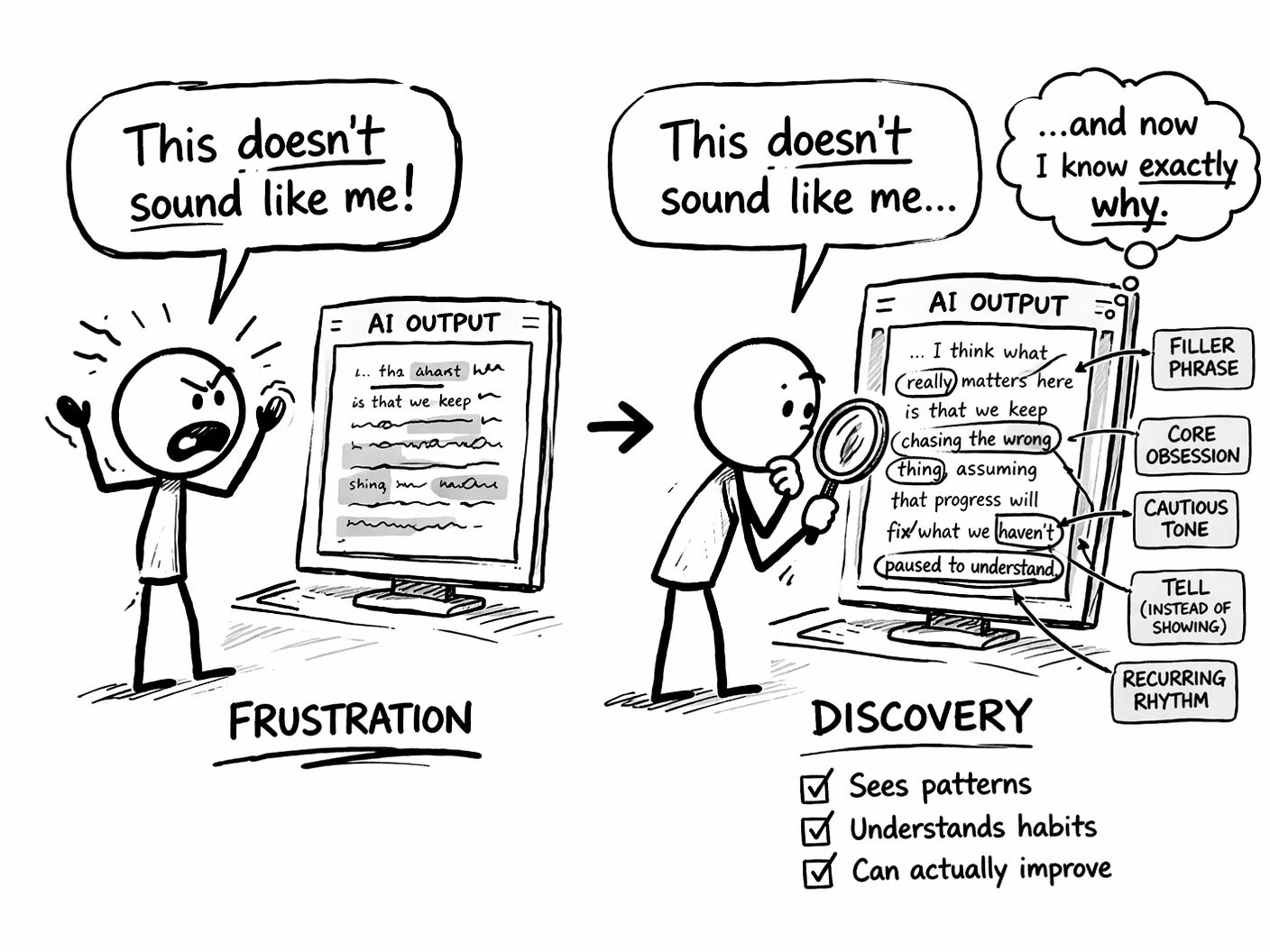
Think about it. Before writing became widespread, nobody thought of memory as a skill. It was just... how brains worked. You remembered things because that’s what humans did. The loss only became visible after the tool arrived and the capacity started fading.
Voice works the same way. Pre-AI, no writer on earth needed to articulate what made their writing distinctly theirs. You just wrote. Your rhythms, your word choices, the way you build an argument, the hundred tiny decisions you make per paragraph that you’ve never once made consciously. All of it invisible. All of it running below the surface like background music you stopped hearing decades ago.
And then AI showed up. And it could approximate you. Close enough to be useful. Far enough to be unsettling. Like hearing your own voice on a recording for the first time and thinking, “Is that what I sound like?”
(Except the recording is writing your newsletter for you and it’s pretty good and that’s somehow worse.)
That gap between what AI produces and what you would have produced is the most valuable information you’ve ever had about your own writing. Not because it shows you what AI gets wrong. Because it shows you what makes you different. Every place the AI drifts from how you’d actually say it is a fingerprint you didn’t know you were leaving.
Most creators react to this gap with frustration. “AI doesn’t sound like me.” Correct. And in that complaint lives a map you’ve never drawn.
There’s a comforting narrative going around that humanity will rebel against AI slop. People will crave imperfection. Guitar squeaks. Handmade chairs. “Unsimulated humanity” as the luxury good of the decade. It’s a gorgeous story. It’s the kind of thing you want to believe while reading a physical book you bought specifically so people could see you reading a physical book.
It’s also completely beside the point.
The real opportunity isn’t rebellion. It’s the fact that AI has given you, for the first time in the history of writing, a reason and a method to understand your own voice with mechanical precision.
No writer before you has ever had this. Not one. Every writer who ever lived operated on instinct alone. They couldn’t articulate their patterns because nothing ever demanded it. There was no machine to teach. No approximation to compare against. No gap to map.
You have all three.
Rebellion is a weekend hobby. It’s not a production schedule. The creator who rejects AI entirely is making a principled stand while getting outproduced fifty-to-one by slop factories that don’t care about principles. The algorithm rewards volume with the same mechanical indifference that the universe rewards everything: without opinion, without mercy, and without the slightest interest in whether you made it by hand.
Principled. Exhausted. Buried.
(There’s probably a beautiful eulogy someone could write about the creator who chose purity over reach. AI would write a great one. Which is, I think, the joke the universe has been building toward this whole time.)
But the creator who uses the threat as a mirror? Who sits with the gap between their voice and AI’s approximation and maps it? Who documents the sentence rhythms, the vocabulary fingerprints, the structural habits, the weird little tics that no algorithm chose for them?
That creator ends up knowing their own voice with a precision that no writer in history has ever had. Not as a defensive move. As a discovery. A new capability that didn’t exist before AI made it necessary.
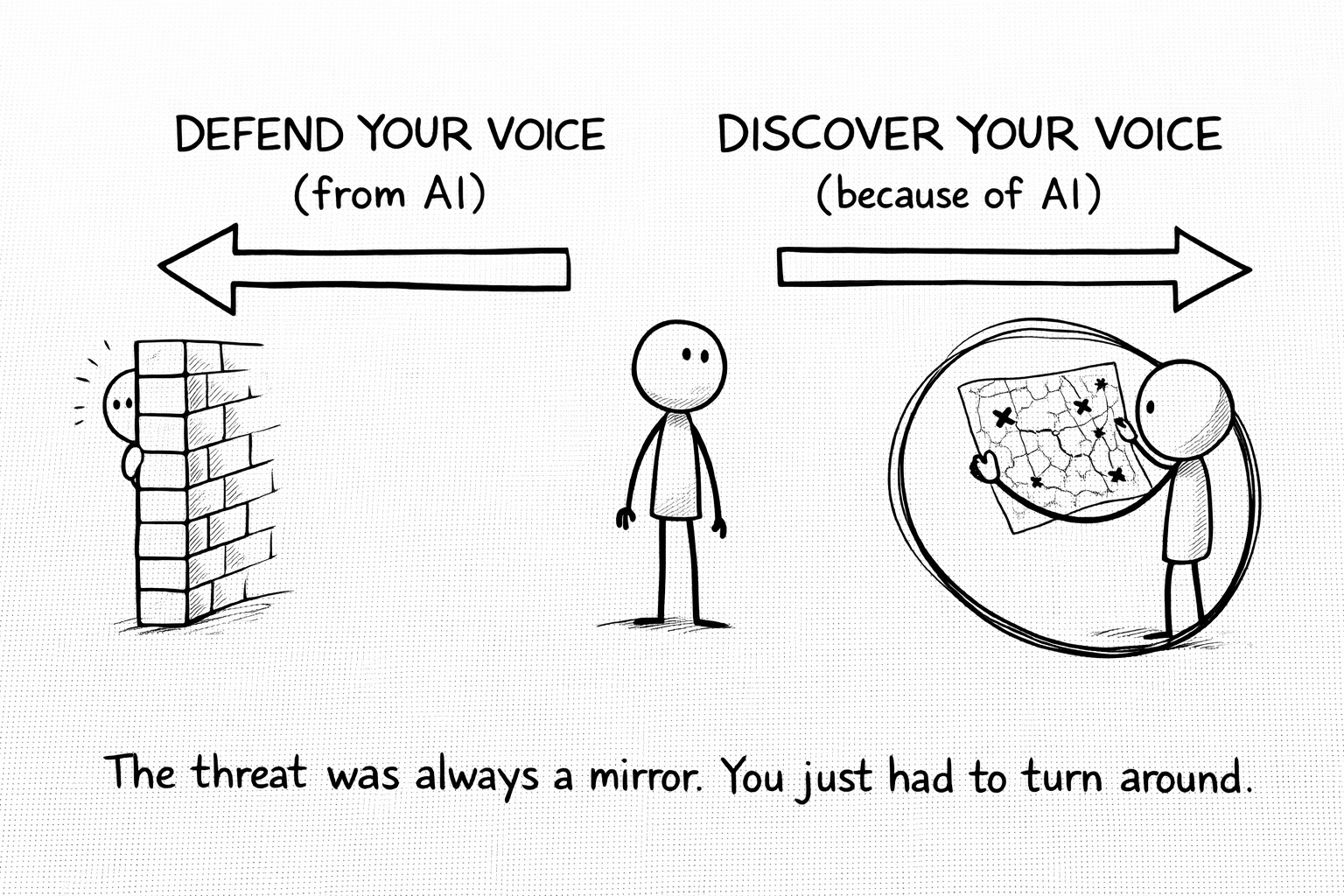
(I call this mapped document a Voiceprint, because apparently I’m the kind of person who names things while other people just use them. There’s likely a clinical term for that. Several, probably. But even if you never touch my framework, the principle holds: AI handed every writer alive a mirror they never asked for. The ones who look into it and document what they see will write with more self-knowledge than any generation before them. The ones who smash the mirror and go back to instinct alone are choosing to know less about themselves than their tools do. Which is a choice. Just not a great one.)
The renaissance everyone keeps predicting? I want it too. But it won’t be a rebellion against AI. It’ll be a generation of writers who understood themselves better because of AI. Who used the threat as a lens. Who discovered their own patterns with a precision that would’ve been unnecessary (and impossible) without the very tool that forced the question.
Same 10,000-year pattern. Tool arrives. Something valuable is threatened. Humans build the fix.
But this time, the fix isn’t recovery. It’s discovery. And that’s never happened before.
🧉 What’s one word or phrase you use constantly that AI never seems to pick up? The thing that keeps disappearing from drafts no matter how many times you add it back.
AI didn’t just threaten your voice. It made you see it. For the first time. With a clarity no writer before you has ever had. The only question is whether you’ll map what you find or pretend you never looked.
Crafted with love (and AI),
Nick “Pattern Recognition Problems” Quick

PS... If you want to start mapping what the mirror shows you, the Voiceprint Quick-Start Guide walks you through documenting the patterns that make you recognizable. Not aspirational adjectives. Mechanical fingerprints AI can follow. Get it here:

PPS... Socrates would’ve hated this post. Plato would’ve already restacked it. (Like this, comment below, and subscribe for more unsolicited historical analogies.)
Nick, I am so SO curious about where this is all heading and totally loving the ride so far! I've seen a few "document your voice using my method" posts around these parts lately, and I have found them so disturbing. I doubt those authors even have a writing voice apart from AI, the posts have been classic AI slop and nothing they said made me want what it was they offered. However, your approach is something else and utterly fascinating!
This is a nice take on an AI capability that's often left unacknowledged: Without AI, there is no machine to teach and discovering your voice wasn't possible before.
Also, about your question, I couldn't think of a specific word/phrase at the top of my head right now, but I'll put it in a concept that when I super simplify a phrase or sentence, and I plug it into AI, it professionalizes it somehow or makes it politically correct, I guess.
When I simplify, really simplify something, like grade 5 (or even lower) level readability, it's intentional. But, AI corrects it anyways and puts it differently. :)