
Every Tool Worth Using Kills Something You Love
Writing destroyed memory. Electricity erased the stars. The pattern hasn’t changed in 10,000 years, and neither has the fix.

Socrates had a content strategy problem.
He refused to write anything down. Not couldn’t. Refused. Everything we know about the man’s philosophy comes from Plato, who transcribed it all without permission. (History’s first ghostwriting gig. No contract. No kill fee. Just a student with boundary issues and a stylus.)
And Socrates hated it.
His argument went like this: Writing will destroy memory. People will mistake having information for understanding it. They’ll hoard scrolls the way some people hoard self-help books (unread, on a nightstand, radiating aspiration while collecting dust). External symbols replacing inner wisdom. The death of thinking dressed up as the preservation of thought.
He made this argument verbally, of course. Writing it down would’ve been hypocritical.
Plato wrote it down anyway. In a dialogue called the Phaedrus. Which means the most famous argument against writing was preserved, distributed, and made immortal... by writing.
The universe is not subtle.
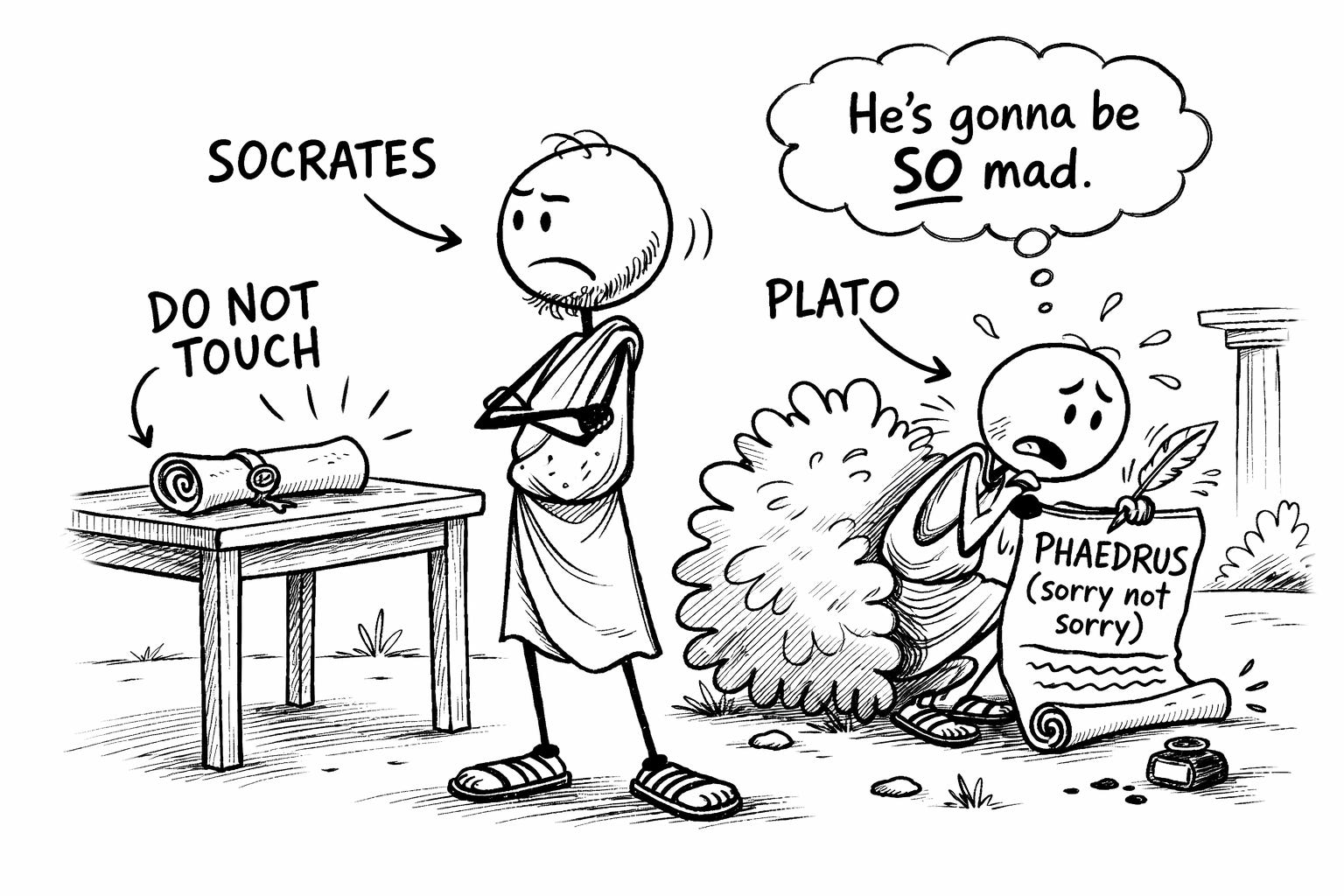
And here’s the part that stings: Socrates was completely right. After writing became widespread, human memorization capacity cratered. Oral traditions withered. There were people alive in 400 BC who could recite genealogies stretching back twenty generations from pure memory. Their great-grandchildren couldn’t remember breakfast without checking a list.
Writing killed something real. Something irreplaceable.
Writing was also the greatest cognitive technology humanity ever developed.
Both things. Simultaneously. Forever.
Socrates wasn’t the first to lose this argument. He wasn’t even close.
Every tool worth keeping has killed something worth mourning. This pattern is older than philosophy. Older than writing. Possibly older than language itself.
Agriculture gave us food security and severed whatever mystical, harmonious thing we had going with the earth. (I’m romanticizing. We were mostly starving. But something was lost.) Electricity lit up our cities and erased the night sky. GPS guided us anywhere and atrophied the part of our brain that knew how to get there on its own.
Every gain, a quiet funeral for something real.
And here’s what Socrates got wrong: humanity’s response to these trade-offs has never been successful mass rejection. Not once. Not in 10,000 years of recorded history. The people who refused to write became footnotes. Ironic footnotes, at that, since someone else wrote them down.
The actual response was always the same unglamorous, unromantic, painfully boring pattern: accept the tool, understand the cost, and build the system that compensates for what you lost.
Writing killed memory. Humanity built schools. Rhetoric. Grammar. Logic curricula. Entire educational institutions designed to ensure the tool enhanced thinking instead of replacing it.
Electricity killed the stars. Some people built observatories. Others created dark sky preserves. The loss was real and the people who gave a damn built structures to recover what they could.
GPS killed our navigation instincts. Some people deliberately practice wayfinding. (A niche group, admittedly. The kind of people who own waterproof notebooks and opinions about magnetic declination. But the compensating structure exists.)
Agriculture killed our connection to the land. Some people garden. The rest of us pay eleven dollars for a tomato at a farmers market and tell ourselves we’re participating in something sacred. (We’re not. We’re buying a tomato. But the instinct toward compensation is there, buried under the markup.)
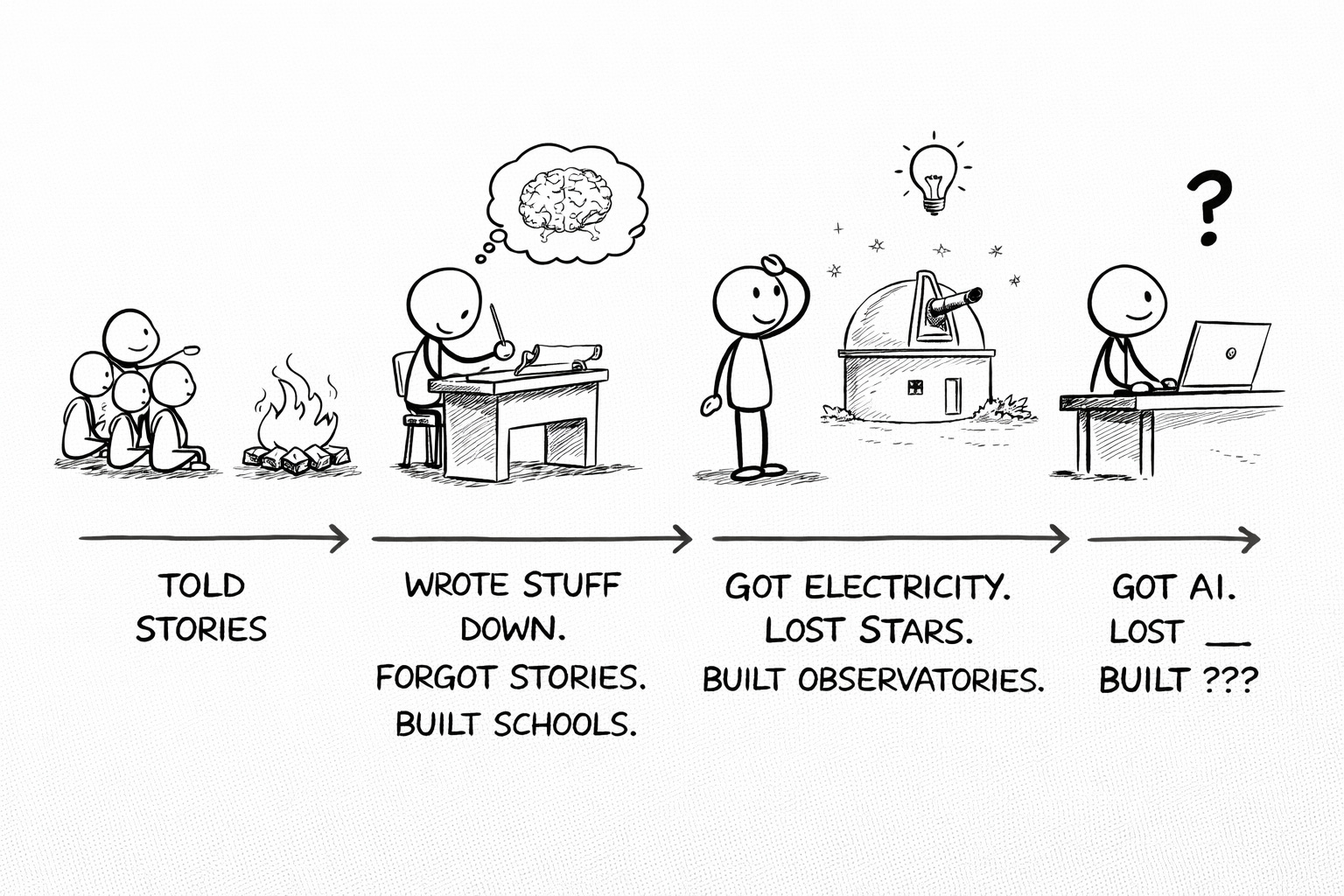
Same pattern. Every time. For millennia.
Nobody makes a viral video about building compensating structures. Too much work. Not enough aesthetics. Not enough romance.
But it’s the only thing that’s ever actually worked.
Tomorrow, I’ll tell you what this has to do with the thing that’s quietly disappearing from your writing right now.
(You probably haven’t noticed yet. That’s the whole problem.)
The tools that changed the world all killed something worth mourning. The people who mourned the loudest accomplished the least. The ones who built systems to compensate? They inherited the earth. Which, historically speaking, has always needed better systems.
🧉 What’s one technology you use every day that you know killed something? Doesn’t have to be profound. GPS murdered my sense of direction and I haven’t looked back. (Literally. I can’t. I don’t know which way “back” is anymore.) Drop yours below.
Crafted with love (and AI),
Nick “Plato’s Unlicensed Ghostwriter” Quick

PS... Socrates refused to write and became immortal. I write every single day and have less than 500 subscribers. The universe does not reward principle. It rewards systems. (Hit the heart anyway.)
PPS... Tomorrow’s Part 2 gets personal. If you’ve been co-writing with AI and something feels slightly off about your recent output, that’s not paranoia. That’s signal. Subscribe so it lands in your inbox.
This was a great article! With the introduction of iPhones, I can barely remember my own phone number let alone the rest of my family and friends.
Calculators! I can't do math without them. Well, I could never do math no matter what. Me and numbers have never got along. But still
Calculators killed manual calculation. Thank God- long division?! What the what?!