
Stop Guessing What to Write Next
A framework for extracting content ideas from the engagement data you already have (plus AI prompts to do it fast)

My best-performing post of 2025 came from a comment I almost didn’t reply to.
Someone asked a question in my discussion thread. Not a brilliant question. Not even a particularly original one. Just a frustrated creator wondering why their AI outputs kept “losing their personality” after the first few paragraphs.
I typed a quick reply. Three sentences. Hit send. Forgot about it.
Two weeks later I turned that reply into a full post. It outperformed everything else I’d written that month by 3x. More comments. More shares. More new subscribers from a single piece than I’d gotten from the previous four combined.
(I wish I could tell you I planned this. That I had some genius content strategy running in the background. I didn’t. I got lucky. Which is a crappy system.)
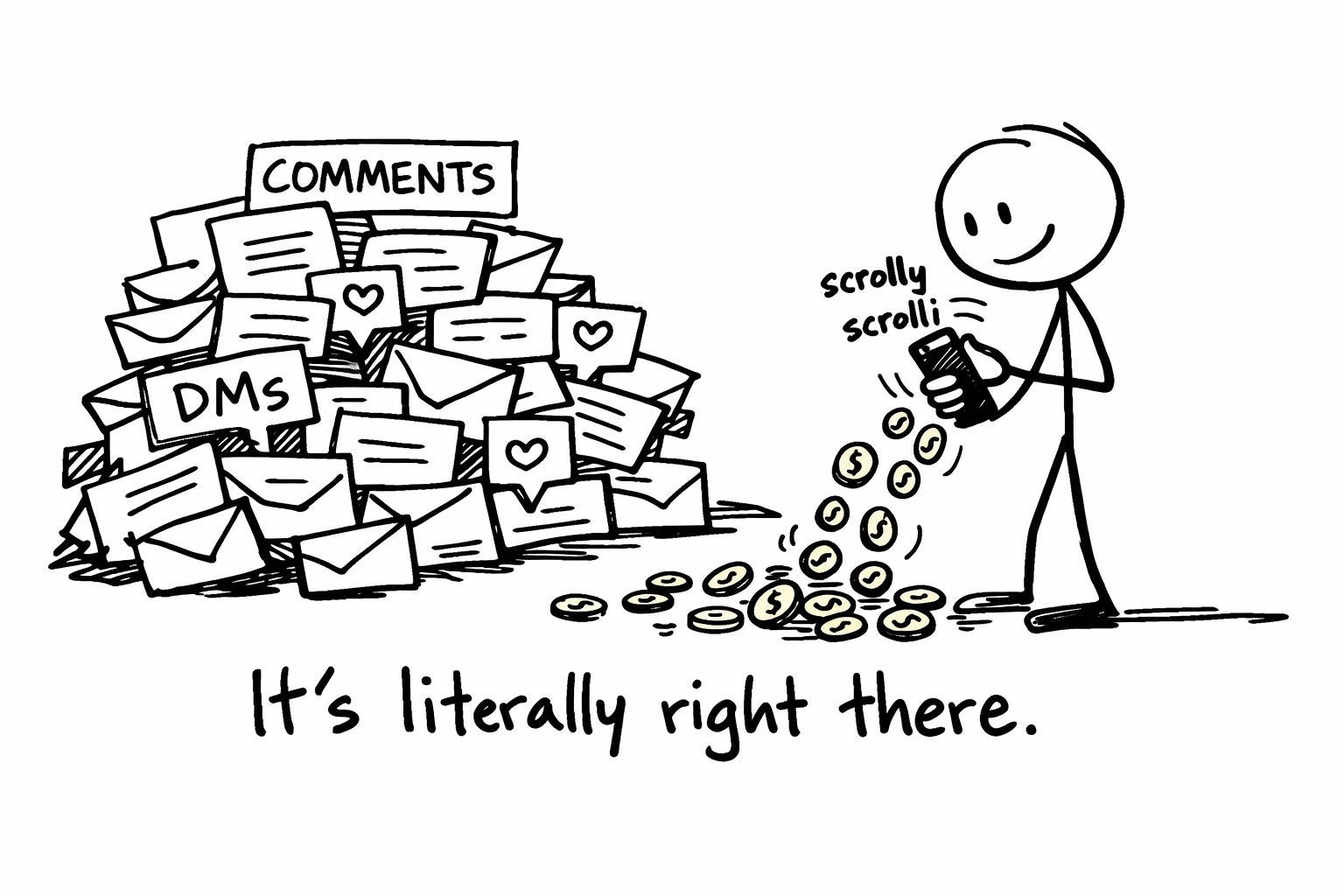
But here’s what I realized after the dopamine wore off: my audience had been telling me what to write for months. In their comments. In their DMs. In the questions they asked after every post. The data was right there. I just wasn’t looking at it systematically.
Most creators treat their engagement like a vanity metric. Nice when it’s up. Sad when it’s down. Completely ignored as a strategic asset.
Utter insanity.
Your comment section is a focus group that doesn’t know it’s a focus group. Your DMs are customer research interviews disguised as casual conversation. And every reply you’ve ever written contains fragments of content your audience has already told you they want.
You’re sitting on a goldmine. Let’s dig it up.
Surveys Lie. Comments Don’t.
If you’ve ever sent out an audience survey, you already know the problem: people perform.
They give you the answer they think makes them look thoughtful. “I’d love more in-depth analyses of emerging trends in the creator economy.” Cool. Nobody talks like that in real life. Nobody thinks like that in real life. That answer is useless.
But comments? DMs? Replies fired off at 11pm when someone’s guard is down and they’re genuinely stuck?
That’s unfiltered.
When someone comments “wait, but how do I actually DO this part?” they’re not performing for you. They’re expressing real confusion in real time. When someone DMs you “I tried what you said and it still sounds robotic,” they’re not crafting a strategic response. They’re frustrated. They want help.
Unfiltered language is the most valuable audience data you’ll ever collect. The specific words they choose. The half-finished thoughts. The frustrated follow-ups fired off before they’ve had time to sound smart.
Focus groups spend thousands trying to manufacture this. You’re getting it for free in your notifications.
(The irony of creators paying for audience research tools while ignoring the audience research happening organically in their own comment sections... I can’t even. It’s like hiring a private investigator to find your keys while they’re hanging out in your pocket.)
The D.I.G. Method: Your Engagement Is a Gold Mine. Treat It Like One.
I needed a system. Not a “save interesting comments to a folder I’ll never open” system. (We’ve all built that trash heap. Rest in peace, Evernote folder from 2019.) A real system that turns raw engagement into publishable content ideas.
So I built one. Three steps. Works whether you have 50 subscribers or 50,000.
D — Document Everything (Yes, Everything)
Before you can mine, you need raw material. This is the boring part. It’s also the part that makes everything else work.
Collect from these sources:
Comments on your posts (including your own replies)
DMs from subscribers and followers
Reply threads and discussions
Questions people ask after you publish
Quote-tweets or restacks with commentary
Emails from readers (if you have that channel open)
How to collect: Keep it stupid simple, stoopid. A single document, spreadsheet, or Notion database. One column for the raw text. One for the source. One for the date. That’s it.
Don’t organize yet. Don’t categorize. Don’t try to be clever about it. Just dump everything in. You’re panning for gold, and the first step of panning is scooping up a bunch of river sludge without being precious about it.
(I once captured a comment that just said “this but for emails.” Four words. No context. I almost didn’t save it. That four-word comment became a three-part workflow post that’s still getting bookmarked. Meanwhile, the “brilliant” idea I spent forty-five minutes journaling about that same week? Couldn’t even tell you what it was. The universe has a sense of humor about these things.)
(I use a Notion database because I’m already in Notion for everything else. But a Google Doc works fine. A Notes app works fine. A napkin works fine if that’s your thing. The tool matters less than the habit.)
Cadence: Spend 10 minutes after every post you publish grabbing the best engagement. Weekly, do a quick sweep of DMs and older threads. That’s it. Ten minutes. Don’t make this a job.
I — Identify the Patterns (This Is Where It Gets Interesting)
Raw data is useless until you can see the shapes in it.
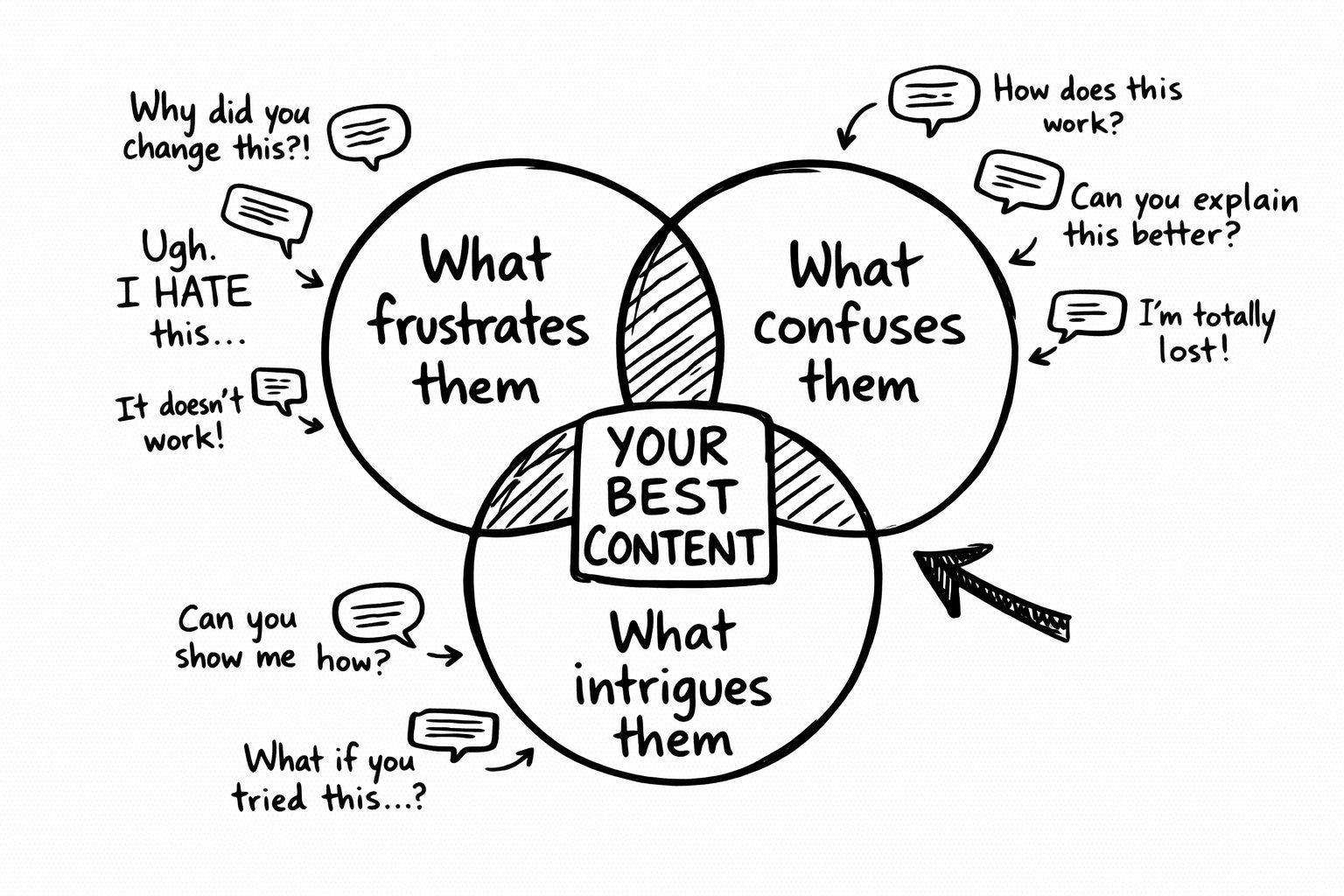
Once you’ve got 30-50 pieces of collected engagement (takes small-time creators like myself 2-3 weeks), start looking for clusters. You’re hunting for three specific types of signal:
🔥 Complaint Gold — What they’re frustrated about
These show up as venting, minor rants, or “why does this always happen” comments. Underneath every complaint is a pain point. Underneath every pain point is a post your audience will devour because it validates their experience and gives them a path forward.
Example: “Every time I use ChatGPT for my newsletter it sounds like a LinkedIn post from 2019”
→ Content angle: Why AI defaults to corporate speak and how to break the pattern.
❓ Confusion Gold — What they’re misunderstanding
These are the “wait, I thought...” and “so does that mean...” comments. Misunderstandings are gifts. They tell you exactly where your explanation fell short, where industry assumptions need challenging, or where a deeper breakdown would crush it.
Example: “So is a Voiceprint basically the same as a custom GPT instruction?”
→ Content angle: Why voice documentation is fundamentally different from prompt customization (and why the distinction matters).
🔭 Curiosity Gold — What they’re circling around
These are tangential questions. Adjacent topics. The “this made me wonder about...” comments. Your audience is telling you what’s next for them, even when they don’t realize it. These are expansion opportunities. New content territory your audience is pulling you toward.
Example: “Do you think this works for video scripts too, or just written content?”
→ Content angle: Adapting voice documentation for multi-format creators.
There’s an entire industry built around teaching creators how to “come up with content ideas.” Courses. Workshops. $67 brainstorming templates. And the dirty secret is that most of it exists because people haven’t built a system for listening to the audience that’s already talking to them. It’s like selling binoculars to someone standing three feet from the thing they’re looking for.
(This is, I realize, being said inside a post that is itself teaching you a content strategy framework. The irony isn’t lost on me. But at least this one’s free and based on data you already have, so I’m choosing to feel fine about it.)
G — Generate Angles (Where AI Earns Its Keep)
You’ve got your raw material. You’ve spotted the patterns. Now it’s time to turn clusters into content angles.
This is where most creators stall. You can see the themes, but going from “people keep asking about X” to “here’s the specific post I’m going to write about X” requires creative expansion. You need to find the hook, the angle, the reason someone would stop scrolling.
Good news: this is exactly the kind of task AI is built for. Not generating the content itself (that’s how you get slop). Generating the angles on content you already know your audience wants.
You bring the audience intelligence. AI brings the creative expansion. That’s collaboration, not delegation.
(This is ideation collaboration, by the way. When it’s time to actually write the posts these prompts generate, you’ll want AI trained on your voice, not just your ideas. I built the whole “Ink Sync workshop” for that. It’s free right now. It won’t be forever. But we’re getting ahead of ourselves. You can’t co-write content your audience wants if you don’t know what your audience wants. So let’s fix that.)
Here are two prompts that do the heavy lifting:
The Megaprompts
Prompt 1: “The Engagement Archaeologist”
This one takes a raw batch of your collected engagement and extracts the signal from the noise. Feed it everything. Let it sort.
You are a content strategist analyzing raw audience engagement data
for a [YOUR NICHE] newsletter/publication.

Below is a collection of real comments, DMs, replies, and questions
from my audience. These are unfiltered and unorganized.

YOUR TASK:
1. Read through ALL entries carefully
2. Identify the 5-7 strongest recurring themes across these entries
3. For each theme, provide:
   - A clear theme name (2-4 words)
   - The 3 strongest example quotes that represent this theme
   - The underlying pain point or desire these comments reveal
   - The EXACT language patterns my audience uses
     (specific words and phrases I should mirror in my content)
   - 2-3 specific content angles I could write about this theme,
     each with a working title and a one-sentence hook

4. Also flag any OUTLIER signals — comments that don't cluster
   with others but seem high-potential based on emotional intensity
   or specificity

CATEGORIZE each theme as:
- 🔥 COMPLAINT GOLD (frustration-driven)
- ❓ CONFUSION GOLD (misunderstanding-driven)
- 🔭 CURIOSITY GOLD (exploration-driven)

FORMAT: Give me a clean, organized breakdown I can use as a
content planning reference. Prioritize themes by frequency
and emotional intensity.

---

[PASTE YOUR COLLECTED ENGAGEMENT DATA HERE]
What makes this prompt work: You’re not asking AI to guess what your audience wants. You’re feeding it evidence and asking it to organize what’s already there. The “exact language patterns” instruction is critical (that’s your audience’s vocabulary, and mirroring it in your content creates instant resonance).
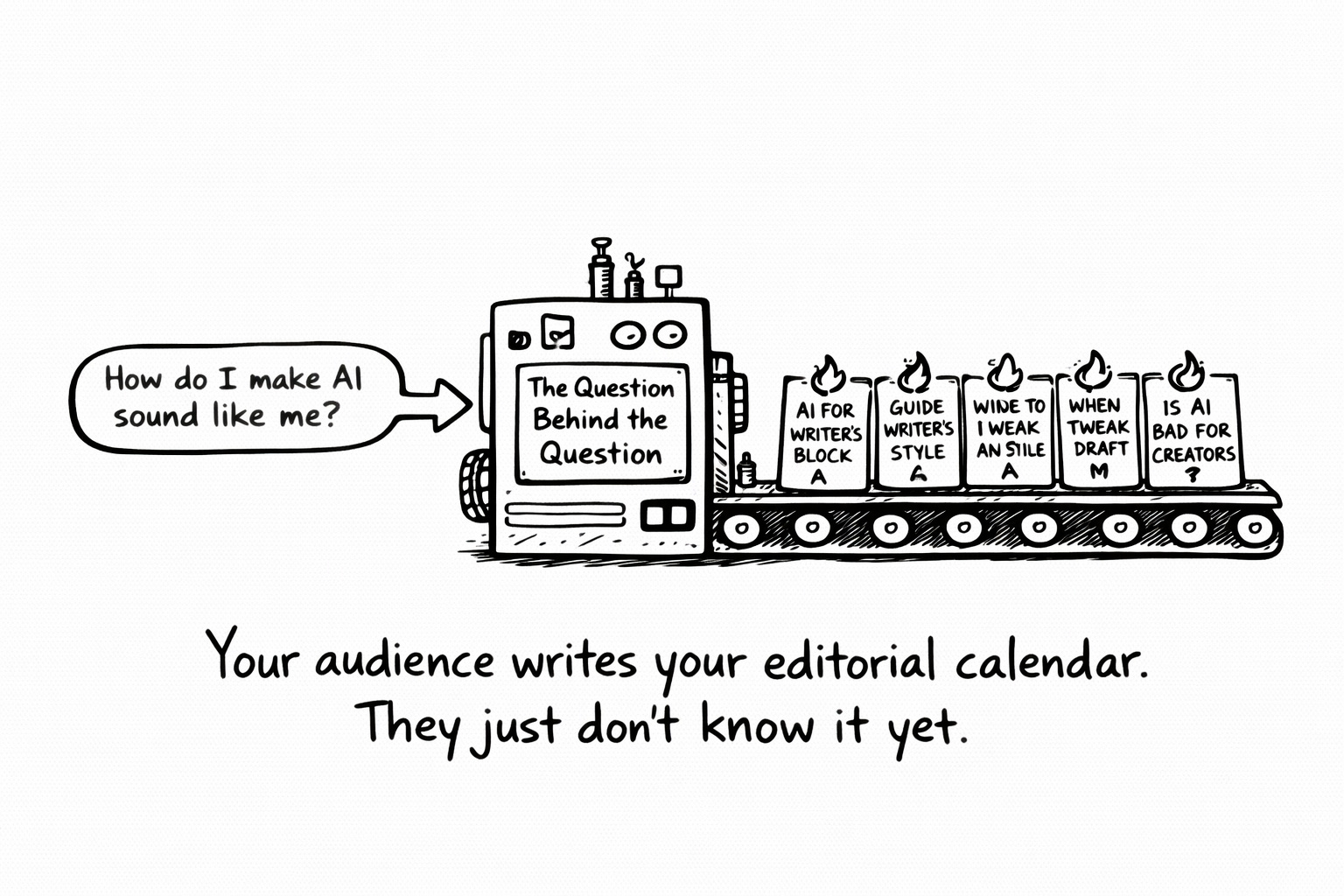
Prompt 2: “The Question Behind the Question”
This one goes deep on a single comment or question. Because the question someone asks is almost never the question they actually have.
I'm a [YOUR NICHE] content creator analyzing audience engagement.

A reader/subscriber left this comment or question:

"[PASTE THE SPECIFIC COMMENT OR QUESTION]"

This was in response to my content about [BRIEF CONTEXT].

YOUR TASK:
1. What is the SURFACE question they're asking?
2. What are the 3-5 DEEPER questions hiding underneath?
   (The fears, assumptions, or gaps in understanding that
    prompted this surface question)
3. For EACH deeper question, suggest:
   - A specific content angle that addresses it directly
   - A working title that would make this person stop scrolling
   - The emotional need this content would satisfy
     (validation, clarity, permission, confidence, etc.)
4. What does this comment reveal about where this reader is
   in their journey? (Beginner? Intermediate? Frustrated expert?)
5. What ADJACENT topics does this comment suggest they'd be
   interested in next?

Be specific. Avoid generic advice. Every suggestion should feel
like it was written for THIS person's situation.
What makes this prompt work: One thoughtful comment can spawn five posts when you unpack the layers underneath it. The “emotional need” instruction keeps your content human-centered instead of topic-centered. And the journey-stage identification helps you pitch the content at the right level.
(I’ve pulled three full newsletter posts from a single six-word DM using this prompt. Six words. “How do I know it’s working?” That DM became a post on calibration metrics, a post on the Ink Sync feedback loop, and a post on the psychological trap of perfectionism in AI collaboration. One confused subscriber. Three weeks of content. You’re welcome, anonymous person.)
Somewhere, a content strategist is charging $200/hour to run focus groups and A/B test headline variations. You just got better data from a stranger’s insomnia. The creator economy is a beautiful, unhinged place.
You’ve Been Doing Audience Research This Whole Time. You Just Weren’t Capturing It.
Every reply you’ve written. Every DM you’ve answered. Every discussion thread you’ve moderated.
That was research. Valuable, specific, unfiltered research.
The only difference between creators who struggle for content ideas and creators who have a backlog three months deep is a system for capturing what their audience is already telling them and converting it into publishable angles.
The D.I.G. method is that system. Document the raw signal. Identify the three types of gold. Generate the angles with AI as your thinking partner.
Ten minutes a day of collection. One prompt session a week for expansion. That’s it.
So here’s the catch: your own audience can only tell you so much. Especially if you’re still growing. Especially if your comment sections are still building momentum.
Tomorrow in Part 2: We go outside your own walls. Your competitors’ audiences are publicly begging for content they’re not getting. Their comment sections are wish lists written in plain sight. And I’ll give you the framework (plus the AI prompts) for turning their gaps into your best content.
It’s not sleazy. It’s service. (Okay, it’s a little sleazy. But in a productive way. Like reading someone’s public Goodreads reviews before buying them a birthday present. You’re doing reconnaissance for their benefit.)
Your audience already told you what to write. The question was never “what should I create?” It was “am I paying attention?”
Start paying attention. The D.I.G. is worth it. And if you’ve been creating content without doing this, don’t beat yourself up. I did it for years. We’re all out here reinventing the wheel when the wheel is sitting in our notifications tab.
🧉 I’m genuinely curious about this one. Drop your answer in the comments: What’s the weirdest place you’ve ever found a killer content idea? A 3am DM? A comment you almost deleted? An argument at Thanksgiving? I found one in a Yelp review once. (Long story. Involves a taco truck and an existential crisis about content authenticity. I’ll tell you if you ask.)
Crafted with love (and AI).
Nick “Scrolly Scrolli Recovery Specialist” Quick

PS… This series teaches you what to write. My Ink Sync Workshop teaches you how to write it with AI in your voice. It’s free right now. It won’t be forever.
PPS… Like this post so Substack shows it to more people. Share it with a creator who needs this. Subscribe if you’re new here. That’s it. No guilt trip. (Okay, a small guilt trip. But a loving one.) ❤️
📬 The Audience Mind-Reading Series
→ Part 1: Your Audience Already Told You What to Write ← You’re here
→ Part 2: Your Competitors’ Audiences Are Begging for Something They’re Not Getting
→ Part 3: Stop Collecting Questions. Start Building a Content Engine
Your comment section: an unwitting focus group. In leadership coaching, the best insights surface from questions clients call "stupid." Same dynamic. What recurring question in your comments are you still treating as noise instead of signal?
The D I G system is refreshing, Nick.
Also, he "question behind the question", this is real. When I analyzed the dozens of comments on my viral note, the surface questions were about prompts. But the deeper questions were about trust (will AI erase my voice?) and control (how do I stay captain?).