
What Happens After AI Wins?
I taught AI my voice. Now I can't compete with myself.

I fed AI everything I’d ever written.
It studied me. Learned my patterns. Mapped my voice down to the punctuation. The parenthetical asides. The staccato rhythms. The way I stack short sentences before releasing into longer ones like a pressure cooker full of opinions finally getting to vent, spraying hot takes all over the kitchen ceiling.
Then it became me.
Better than me.
And I’m the one who taught it how.
(I should probably add “built my own replacement” to my LinkedIn skills section should I ever log into the cringefest site again.)
Last week I tried to write the same piece myself. Side by side. Same topic, same angle, same intended outcome.
My version came out clunky. Labored. Like I was doing a bad impression of myself at a party where the real me had already shown up and left with my date.
The AI version? Nailed it. The vocabulary. The rhythm. Those weird asides I can’t stop making. (Like this one. And this one. It’s a condition.) All there. Perfect.
I’ve spent three weeks now sitting with this particular piece of psychological shrapnel and I’ve arrived at several conclusions, none of them comforting.
The Uncanny Valley of Your Own Face
The first time AI wrote something I couldn’t improve, I felt proud.
The second time, uneasy.
The third time, I poured a drink and started asking questions I wasn’t sure I wanted answered. (The drink was Kentucky bourbon. The questions were existential. The combination is how most of my best and worst decisions get made.)
Here’s what dawned on me, slowly, like the realization that you’ve been pronouncing a word wrong your entire adult life:
AI wasn’t mimicking my patterns.
It was averaging them.
Every sentence I’d ever fed it. Every rhythm. Every tic and tendency. The machine took all of it and produced the statistical mean of Nick Quick. My voice on its best day. Without the tired Tuesdays. Without the distracted afternoons where half my brain is wondering if I left the stove on. Without the pieces I phoned in because the deadline arrived before the insight did.
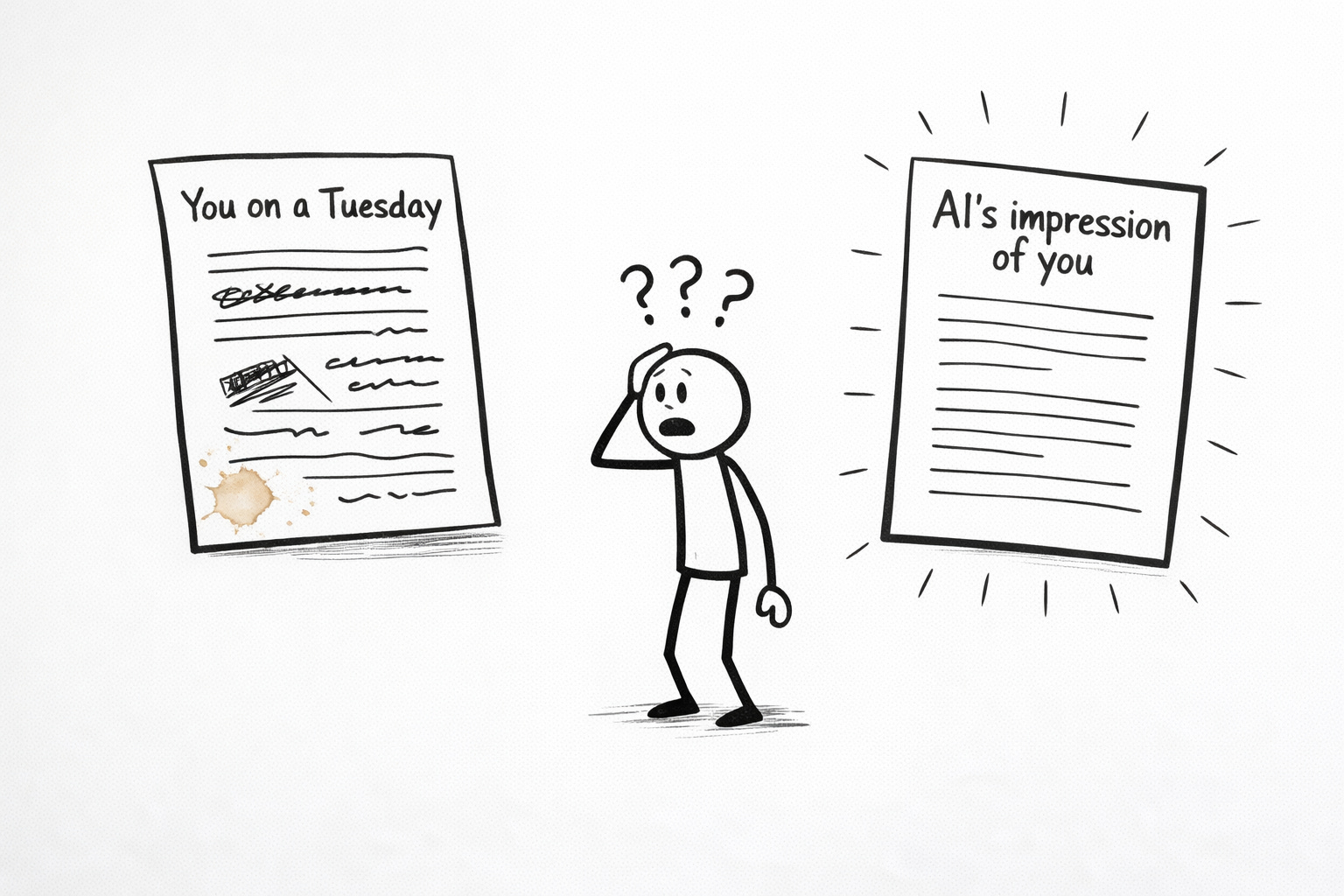
Which sounds fantastic in theory.
Your voice, but better. Your patterns, but consistent. Like hiring a ghostwriter who somehow knows you better than you know yourself but never needs to sleep or eat or spiral about their career choices at 2am.
Except.
You can’t do that.
You have bad days. You have days where the words come out sideways and nothing lands and you publish anyway because the alternative is silence and silence doesn’t pay rent. AI doesn’t have those days. AI just executes your patterns with the mechanical consistency of a metronome that’s never once doubted whether it’s keeping good time.
Something was missing from AI’s version. I could feel it like you feel a draft in a house. Present but invisible. Real but unprovable.
Then it clicked.
The struggle. The visible thinking. The rough edges that prove someone actually showed up and cared enough to be imperfect.
AI produced my voice with surgical precision and zero humanity. And somehow, against all reason, the voice still sounded right.
The voice just didn’t sound alive.
I May Have Played Myself
I built a system to teach AI my voice.
I called it a Voiceprint. A detailed map of my patterns across vocabulary, structure, stance, rhythm. The whole point was giving AI explicit instructions instead of letting it default to the same generic slop everyone else gets. The same “strategic frameworks for optimized content outcomes” that make you want to fake your own death and start a taco truck in Montana.
The Voiceprint worked.
Oh, it worked beautifully.
Maybe too beautifully.
Because here’s what I failed to think through, which is embarrassing for someone who teaches this stuff for a living:
Documentation isn’t description.
It’s instruction.
The better your Voiceprint, the less AI needs you specifically. You’ve written the recipe for your own voice. Once the recipe exists, anyone can cook. Anything can cook.
The Voiceprint was supposed to be a map. Something AI could reference to navigate toward my patterns instead of wandering off into generic territory.
Turns out it’s a recipe.
And recipes don’t require the original chef.
(I’m realizing as I write this that I may have built the instrument of my own obsolescence and then charged people to learn how. The audacity is staggering even by my standards.)
Here’s the philosophy problem nobody in the AI writing space wants to touch:
If you replace every plank of a ship over time, is it the same ship?
If AI generates every word using your documented patterns, is it your voice?
If the output is indistinguishable from the original, does the origin even matter?
I don’t have clean answers. Neither does anyone else, even the people writing Medium posts claiming they do. Especially those fuckers.
What Ghostwriting Taught Me About All This
I’ve been someone else professionally.
Dozens of someone elses. For years I ghostwrote for coaches, consultants, executives, thought leaders. (Thought leader. What a phrase. As if thoughts need leading. As if ideas are livestock that require herding lest they scatter and start thinking for themselves.)
Each client had their own voice. Each believed that voice was uniquely, irreplaceably theirs. Something sacred. A fingerprint of the soul.
My job was to prove them wrong.
Not cruelly. Just professionally. Learn their patterns. Document their tendencies. Inhabit their voice until they couldn’t tell where they ended and I began.
A client once told me a piece sounded “more like them than their own writing.”
That was a compliment.
It shouldn’t have been.
What ghostwriting teaches you, if you do it long enough with enough different voices:
Voice isn’t sacred.
It’s patterns.
And patterns can be learned, documented, dissected, and reproduced by anyone willing to pay attention. The mystery dissolves under observation like sugar in hot water. You think you’re unique until someone maps your uniqueness onto a spreadsheet.
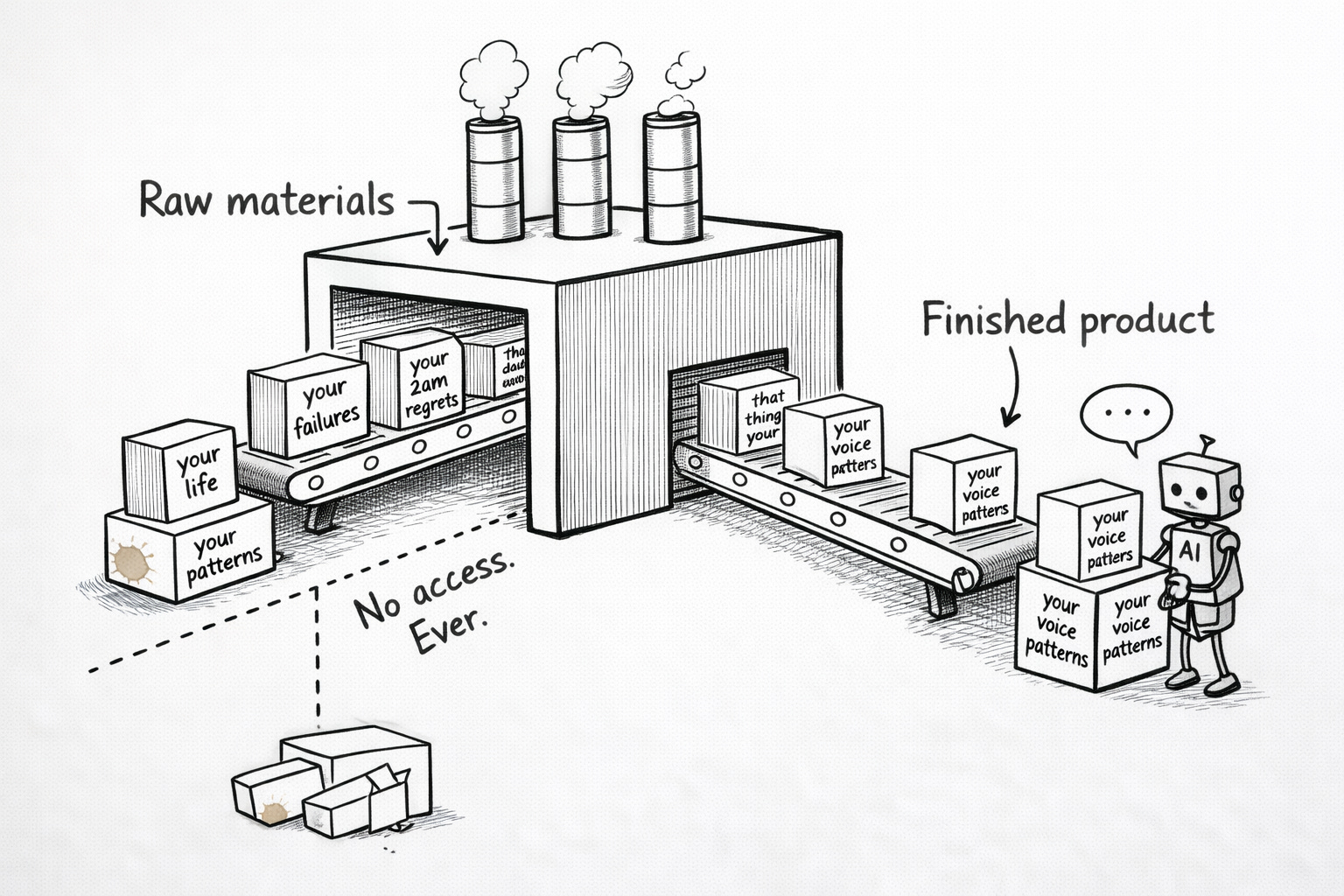
But here’s the twist ghostwriting also taught me.
Something couldn’t transfer.
I could replicate the what. The patterns. The vocabulary. The structural tendencies.
I couldn’t access the why.
The divorce that made someone write about vulnerability the way they did. The business failure that sharpened their take on risk. The specific cultural background that shaped their metaphors. The wound that never healed and kept showing up sideways in every piece they wrote about leadership.
I could mimic the output. I couldn’t mimic the source.
AI is no different. Better at the mimicry, perhaps. Faster. Cheaper. More consistent. But equally locked out of the source material.
That distinction might be the only reason my AI hasn’t filed for emancipation yet.
I’ve Been a Goddamned Idiot About This
I’ve been thinking about this wrong.
Probably you have too.
The question isn’t “will AI steal my voice?”
The voice was never the point. The voice was just the vehicle. The vessel. The container.
The question is: what was the voice carrying?
What AI Can’t Touch (Yet)
AI can replicate my sentence rhythm.
It can’t replicate leaving everyone I knew for a country that didn’t know me.
It can match my vocabulary.
It can’t match the part of me that torches good things just to see if I’ll survive.
It can nail my parenthetical asides.
It can’t access the specific frustrations that make me care enough about AI slop to write two thousand words about it instead of doing something reasonable with my afternoon.
Your Voiceprint captures who you were when you wrote it.
Read that again.
Were.
It’s a snapshot. A fossil. A record of your patterns at a specific moment in time. By definition, it’s already out of date the moment you finish writing it. Because you’re not static. You’re not a document. You’re a process.
The documentation lags behind the person.
The patterns you’re developing right now aren’t in any Voiceprint. The opinions you’re forming. The experiences you’re having. The slow evolution happening in real-time as life keeps doing that thing it does where it refuses to hold still.
None of that is documented yet.
That gap is everything.
That gap is your moat.
But only if you keep widening it.
Three Doors, Two of Them Locked
If AI will eventually know your voice better than you do (and that “eventually” is more like “soon” and “soon” is more like “Tuesday”), what’s the move?
I see three paths. Most creators are stumbling down one of them without realizing they’ve chosen.
Door Number One: The Purist
Refuse AI collaboration. Keep your patterns undocumented. Protect the voice by keeping it in your head where the machines can’t reach it.
Noble. Perhaps even romantic.
Also mathematically doomed.
While you’re crafting one perfect piece, the slop factories publish fifty. You’re building artisanal furniture in a world flooded with IKEA. The furniture is better. Nobody’s buying furniture anymore. They’re too busy assembling flatpacks.
Door Number Two: The Automator
Lean all the way in. Document everything. Let AI become your voice. Shift from creator to curator. Accept that the recipe doesn’t need the chef and maybe that’s fine. Maybe efficiency is the only virtue left.
Practical. Perhaps even inevitable.
Also a kind of suicide.
You optimize yourself out of the equation. Your voice becomes a product anyone can generate. When that happens, what’s left of the thing people were actually paying for? The answer is nothing. The answer is you’ve converted yourself into a commodity and commodities compete on price and you can’t compete on price with something that works for free.
Door Number Three: The Moving Target
Use AI collaboration while staying ahead of your own documentation. Your Voiceprint captures who you were. You focus on who you’re becoming.
The insight: Evolution is survival. Stagnation is taxidermy. The only way to stay irreplaceable is to keep being someone new.
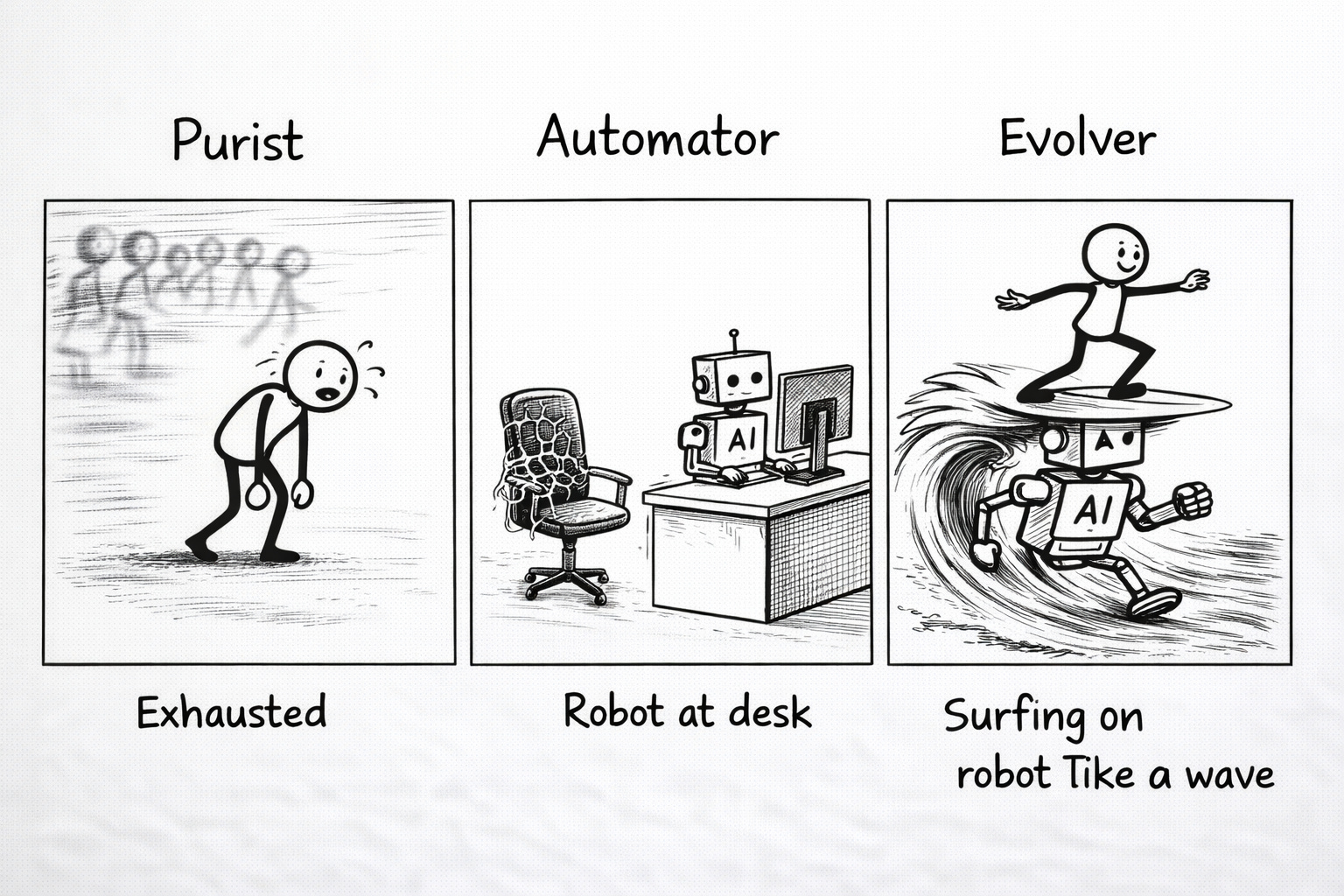
The creators who survive this (survive being the key word, not thrive, not dominate, survive) aren’t the ones who protect their voice from AI.
They’re the ones who keep evolving faster than AI can document them.
The Audit You Should Do Before Closing This
Here’s the move. Takes fifteen minutes. Do it before you go back to whatever you were pretending to work on.
Pull your last three pieces of content.
For each one, ask yourself: “What would be missing if AI had written this using my Voiceprint?”
Look for:
Personal stories that require having lived your actual life
Opinions you’d defend at a dinner party with hostile strangers
Observations that require being alive right now, today, in this specific moment
Stakes that come from genuine investment (not performed investment, not “I care about this because I’m supposed to,” actual investment)
What shows up repeatedly across all three?
That’s your irreplaceable core.
That’s what you need to protect.
When I did this audit, here’s what I found:
Memories that never made it to a page but show up in everything I publish. Opinions about ensloppification that come from genuine frustration, not content strategy. Observations about creator culture that require actually being one instead of just writing about them from the outside. The failures I’m still metabolizing into opinions.
AI can’t have my life.
It can only copy what my life produces.
If you can’t find irreplaceable elements in your content, that’s information. Either you’re not including your actual self in your work (common, fixable) or you don’t have distinctive source material yet (also fixable, just takes longer and involves actually living an interesting life, which is a different newsletter entirely).
Your voice isn’t the moat.
You are.
The Part I Didn’t Want to Write
I still can’t match what AI writes in my voice.
I’ve stopped trying.
Matching AI’s version of me was never the goal. That’s a fight you lose by showing up.
The goal is staying interesting enough to keep documenting. Keep evolving. Keep becoming someone the documentation hasn’t caught up with yet.
The question isn’t whether AI will know your voice better than you do.
It’s whether you’ll still be worth mimicking when it does.
🧉 Run the audit. Reply with one thing AI will never replicate about you.
Crafted with love (and AI).
Nick “Former Original” Quick

PS… I’m betting I can stay ahead of my own AI. Daily posts. Subscribe if you want to see whether the moving target strategy actually works… or if I’m just cope-posting my way to irrelevance.
When copy writers hit Substack, often their writing voice is as dull as dishwater! I get it but oooof. Glad you found your writing soul, Nick!
About to try the Voiceprint!
Favourite argument with Claude atm is "Dallas, this is not your voice. It's too soft." Apparently, it takes the "edge of sass" project instruction quite literally. Still teaching the bot that not everything needs to be edgy and sometimes yes, I decide to speak more softly... 🫨
Starting to think that Nick Quick is a name that AI came up with. Speaking to the Voiceprint bot: am I right?