
147 Content Ideas and Nothing to Publish
The Signal Stack method for turning raw audience intelligence into content pillars that practically write themselves

I have a Notion database with 147 content ideas in it.
Want to know how many of them I’ve published?
Eleven.
The other 136 sit there like a museum exhibit of good intentions. Some are genuinely brilliant. (At least I thought so at 2am when I added them.) Some are three words that meant something once and now read like a stranger’s grocery list. “Voice + tempo + the pizza thingy???” I have no idea what past me was talking about. Present me resents that fuçker.
(This is my third time admitting something embarrassing in three days. At this point the series should be called “Nick’s Public Accountability Journal.” But it’s working, so let’s keep going.)
Here’s what most creators won’t admit: generating ideas isn’t the hard part. We’re creative people. Ideas are the easy part. We have too many of them. That’s the actual problem.
The problem is the pile.
Ideas accumulate. They sit in documents, spreadsheets, Notes apps, voice memos you recorded while driving that you’ll definitely listen to later. (You won’t.) They pile up until the list itself becomes overwhelming, and then you do what every creator does with an overwhelming list: you ignore it entirely and go back to guessing what to write next.
A list isn’t a system. A list is a guilt trip formatted as bullet points.
Over the last two days, you’ve generated more raw content ideas than most creators produce in six months. You’ve mined your own engagement. You’ve mapped your competitors’ gaps. You’ve got D.I.G. data and Gap Map insights sitting in your collection system.
Right now, that’s a pile. Today we turn it into a pipeline.
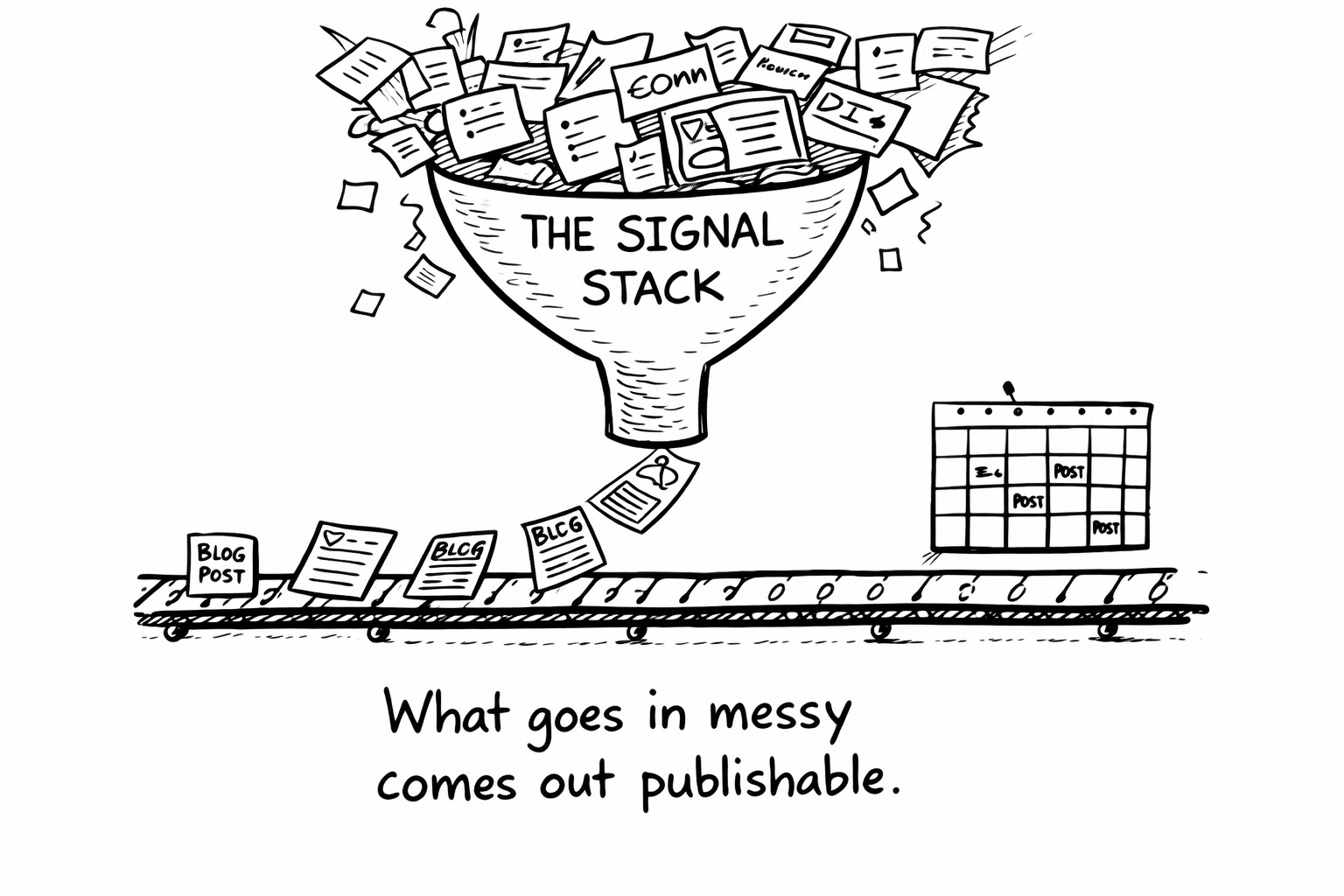
Why Every Content Idea List You’ve Ever Made Is Just a Compost Heap Without a Garden
Let’s look at the decomposition timeline.
Week 1: You start the list. You’re excited. Every idea gets written down with care. Some have notes. Some have links. You’re organized. You’re disciplined. You’re a professional.
Week 3: The list has forty entries. You’ve published from it twice. Some of the older entries don’t make sense anymore. You add three more anyway because you had a good brainstorm session. The list grows.
Week 6: Seventy entries. You haven’t opened the document in four days. When you need to write something, you stare at the list for ten minutes, feel overwhelmed, close it, and write about whatever’s on your mind that morning. The list is technically still there. Functionally, it’s lawn furniture.
Week 10: The list has fully composted. You know it. You’ll never delete it because that feels like admitting defeat. So it just... exists. A pile of organic material with no garden attached.
(I’ve composted at least five of these lists across different tools. Notion. Google Docs. Obsidian Notes. A physical notebook I bought specifically for content ideas that now holds exactly one page of writing and serves as a coaster. The notebook cost twelve dollars. The coaster works great.)
The failure pattern is always the same: ideas go in but there’s no mechanism for them to come out in any organized way. There’s no sorting. No prioritizing. No sequencing. No connection between “I had a thought” and “this publishes on Thursday.”
You don’t need more ideas. You need plumbing.
The Signal Stack: Turning Raw Material Into a Self-Sustaining Pipeline
Four layers. Each one solves a specific failure point of the traditional idea list. You build them once, then maintain with minimal effort.
Layer 1 — Capture: One Intake, Not Seven
First rule: everything goes to one place. Not “comments go here, DMs go there, Gap Map data goes in that other spreadsheet.” One. Place.
The tool doesn’t matter. Notion, Airtable, Google Sheets, Obsidian, whatever. Pick one. Use it. The discipline is non-negotiable. If your signals are scattered across Notion, Google Docs, Apple Notes, a Slack DM you starred six weeks ago, and a screenshot you took on the crapper of an Arby’s bathroom, you don’t have a system. You have five small piles of guilt instead of one useful one.
What goes in:
Everything from your D.I.G. process (Part 1)
Everything from your Gap Map research (Part 2)
New signals as they come in (ongoing comments, DMs, questions)
Random ideas you have (yes, these too, but they go in the same system)
The minimum fields:
Raw signal (the actual comment, question, or idea)
Source (your comments, competitor X, DM, random thought)
Date added
Cluster (leave blank for now)
That last field is where the magic happens. But not yet.
Layer 2 — Cluster: Let Your Audience Reveal Your Pillars
Most content strategies start backwards. Creator sits down, picks 3-5 “content pillars” based on what they think their audience wants, and builds from there. Sounds logical. Usually wrong.
Because you’re guessing. You’re choosing pillars based on your assumptions, your competitors’ categories, or some content strategist’s blog post about “niching down.” And then you spend months trying to force your content into boxes you drew before you had data.
The Signal Stack flips it. You collect signals first. Then you let the clusters emerge from the data.
Go through your captured signals (you should have 40-80+ from Parts 1 and 2 alone) and start grouping. Don’t overthink the categories. Look for signals that are about the same underlying topic, pain point, or desire.
The 3-Strike Rule: If a theme shows up in 3 or more signals from different sources (not three comments on the same post), it’s a pillar. If it shows up once or twice, it’s a one-off idea. One-offs are fine. They just don’t get pillar status.
(When I first ran this exercise, one of my pillars turned out to be “permission to use AI without guilt.” I didn’t expect that. I thought my audience was past the guilt phase. Turns out a huge chunk of them were still whispering “I’m one of the good ones” while secretly wondering if they were cheating. The data doesn’t care about your assumptions. It just shows you what’s true. Sometimes that’s uncomfortable. Write about it anyway.)
You’ll probably end up with 4-6 pillars, which is the sweet spot. Under four and you’re lumping too broadly. Over seven and you’re splitting hairs. If you landed on twelve, you didn’t build a content strategy. You built a spreadsheet to hide behind.
Name them for internal use, not for your audience. These are your organizational categories, not your Substack section headers. Keep them functional. “AI voice problems” is better than “The Authenticity Paradox in Human-Machine Creative Collaboration.” (If you name your internal categories like TED talk titles, I can’t help you. That’s between you and your therapist.)
Layer 3 — Sequence: Build the Journey Within Each Pillar
Here’s where amateurs stop and professionals keep going.
A pillar isn’t a bucket you randomly pull from. It’s a sequence. Your audience has a journey within every topic. Some readers are just discovering the problem. Some understand the problem and want the solution. Some have tried solutions and want advanced tactics.
If you publish randomly within a pillar, you’ll hit the wrong reader at the wrong time. Your beginner post lands on an advanced reader’s screen and they bounce. Your advanced post lands on a newcomer and they’re lost.
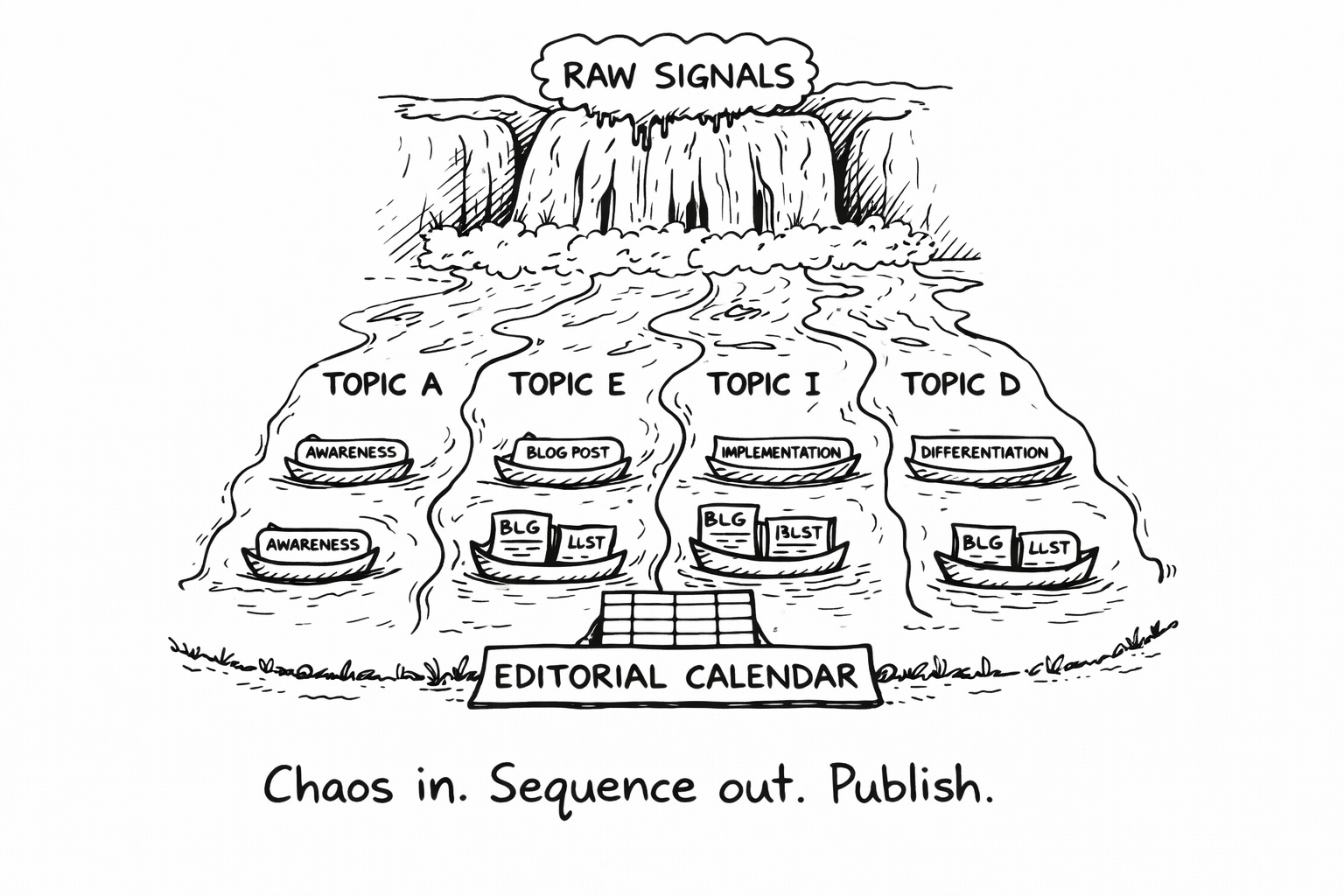
Within each pillar, sort your signals into four stages:
Awareness → “I didn’t even know this was a problem.” Content that names the pain. Makes the reader feel seen. Validates their frustration. This is the “mother of pearl, that’s me” content. It’s powerful because most people don’t act on problems they haven’t named yet. You name it, they trust you.
Education → “Okay, I see the problem. What’s the solution?” Content that teaches your methodology. Frameworks. Mental models. The why behind your approach. Most creators never leave this stage. They publish their nineteenth “here’s my framework for X” post because frameworks feel authoritative and get LinkedIn engagement. (Meanwhile their audience is screaming “we get the concept, show us the damn steps.” But the steps are harder to write. So... another framework it is.)
Implementation → “I understand the solution. How do I actually do it?” Step-by-step walkthroughs. Prompts. Templates. Workflows. The how in painful detail. This is the hardest content to write because it requires you to actually have a process, not just opinions about processes. It’s also the content that builds the most loyalty, because people remember who gave them the thing that worked.
Differentiation → “I’m doing it, but how do I do it better than everyone else?” Advanced tactics. Nuance. Edge cases. The refinements that separate good from great. Most creators never make it here because they’re stuck publishing their fourteenth awareness post about why consistency matters. (Ironically, the one thing they’re consistent about is writing about consistency.)
Not every pillar needs equal representation at every stage. But the awareness-to-differentiation flow gives you a publishing logic. You’re not just writing about a topic. You’re walking your audience through it.
Layer 4 — Activate: Pull, Don’t Push
The whole point of this system is that when it’s time to write, the decision is already made.
No staring at a blank page. No “what should I write about this week?” No opening the 147-idea compost heap and scrolling until your eyes glaze over.
The activation process:
Look at your content calendar. What’s the next open slot?
Which pillar is due for a post? (Rotate through pillars so your audience gets variety.)
Within that pillar, which stage is next in the sequence?
Pull the top signal from that stage. That’s your post.
The decision tree takes thirty seconds. Because the hard work (collecting, clustering, sequencing) already happened. You’re not ideating anymore. You’re executing.
The difference between “what should I write?” and “which pre-validated idea am I writing?” is the difference between standing in front of an open fridge hoping for inspiration and ordering off a menu you already designed. One of those people eats handfuls of Fruity Pebbles straight from the box for dinner. The other one eats well. Consistently. Without the existential crisis.
(If this sounds unsexy compared to the romantic image of inspiration striking at 7am like clockwork... good. Inspiration is a terrible business model. Systems are a great one. Ask anyone who’s published consistently for more than six months. They’ll tell you the same thing while suppressing a visible twitch.)
Maintenance cadence: Spend 15 minutes at the start of each week adding new signals from the past seven days, assigning them to clusters, and slotting them into the sequence. That’s it. The system feeds itself because your audience never stops giving you data. Every post generates comments. Every comment is a new signal. The pipeline refills automatically.
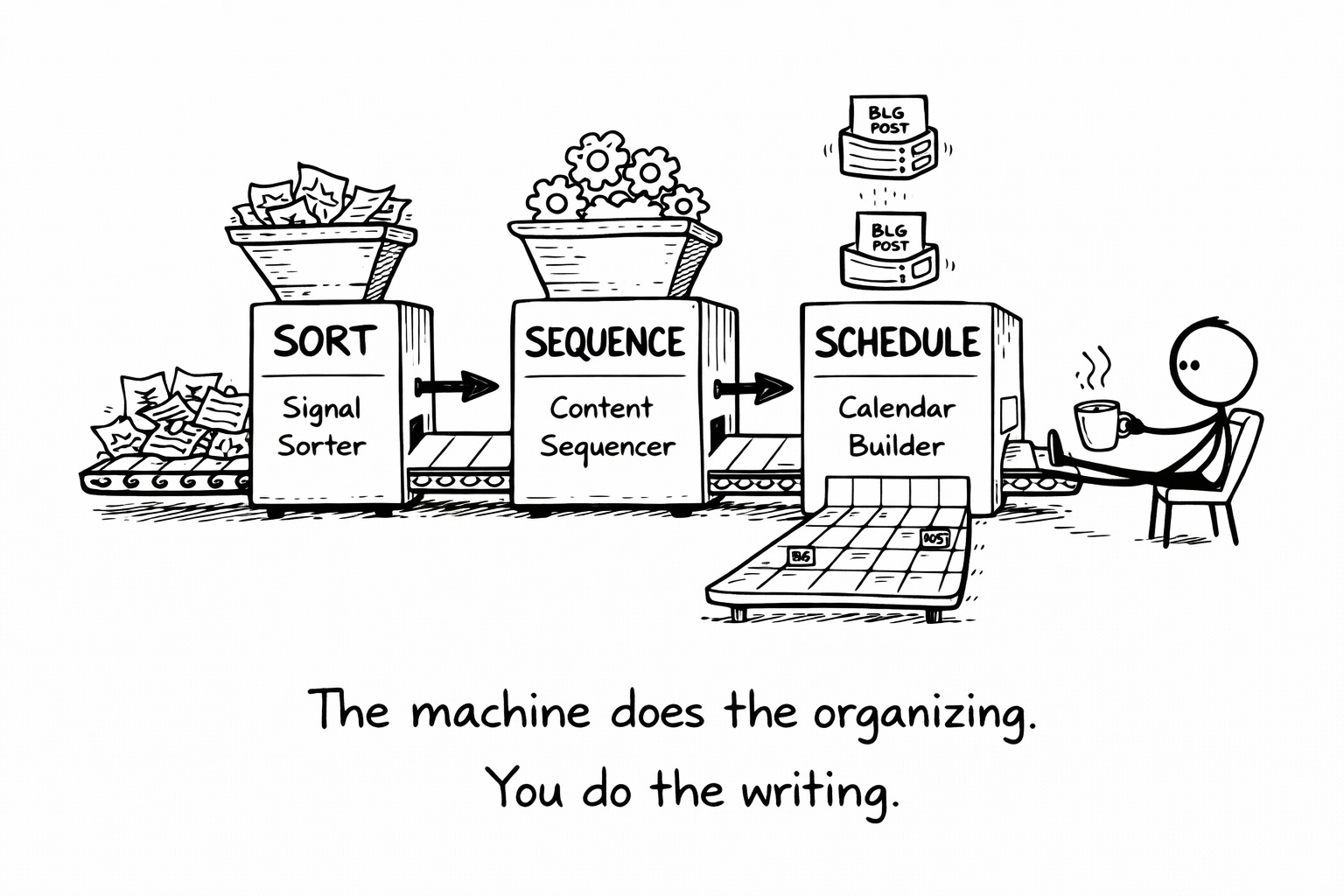
The Megaprompts
Three prompts this time. Because we’re building an entire system, not just mining for insights.
Prompt 1: “The Signal Sorter”
This takes your raw dump of everything you’ve collected from Parts 1 and 2 and clusters it into suggested pillars. Let AI see the patterns you might miss.
You are a content strategist helping organize raw audience
intelligence into a structured content system.

Below is a collection of audience signals — comments, questions,
DMs, competitor gap insights, and content ideas I've gathered
from my own engagement AND from analyzing gaps in my niche.

My niche: [YOUR NICHE]
My core topics: [LIST YOUR 2-3 MAIN TOPIC AREAS]

YOUR TASK:
1. Read through ALL signals carefully
2. Identify the natural clusters — themes that multiple signals
   group around. Look for underlying topics, pain points, or
   desires that connect seemingly different comments.
3. Suggest 4-6 content pillars based on these clusters.
   For each pillar:
   - Proposed pillar name (functional, 2-4 words)
   - The 5-8 signals that belong in this cluster
     (quote them directly)
   - The core audience need this pillar serves
     (one sentence)
   - Why this qualifies as a pillar, not a one-off
     (what pattern makes it recurring?)

4. Flag any ORPHAN signals that don't cluster naturally.
   For each orphan, tell me:
   - Whether it's a strong one-off post idea
   - Whether it might cluster with more data
   - Or whether it's noise I can safely ignore

5. Note any signals that could belong in MULTIPLE pillars
   (these are often your strongest content ideas because
   they sit at intersections)

Be specific. Avoid generic pillar names like "Tips" or
"Advice." Every pillar should feel like a distinct territory
my audience keeps returning to.

---

[PASTE ALL YOUR COLLECTED SIGNALS FROM PARTS 1 AND 2 HERE]
What makes this prompt work: You’re not asking AI to invent your content pillars. You’re asking it to find the pillars that already exist in your data. The orphan detection prevents good ideas from getting lost, and the multi-pillar signal flag identifies your highest-potential content (intersection topics generate the most engagement because they serve multiple audience needs simultaneously).
(Run it. Then sit with the results for ten minutes before you argue with them. Your first instinct will be “that’s not right, my audience doesn’t care about that.” Your first instinct is wrong. The data is right. This is the part where ego meets evidence. Evidence wins.)
Prompt 2: “The Content Sequencer”
Take one pillar from the Signal Sorter output and map its signals into a publishing sequence. This turns a cluster into a journey.
I have a content pillar for my [YOUR NICHE] newsletter:

PILLAR NAME: [NAME]
CORE AUDIENCE NEED: [ONE SENTENCE DESCRIPTION]

Here are the audience signals that belong in this pillar:

[PASTE THE SIGNALS FOR THIS SPECIFIC PILLAR]

YOUR TASK:
1. Sort each signal into one of four content stages:

   AWARENESS — Reader doesn't yet recognize the problem or
   opportunity. Content should name the pain, validate the
   frustration, or reveal something they hadn't considered.

   EDUCATION — Reader sees the problem, wants to understand
   the solution. Content should teach methodology, frameworks,
   or mental models. The WHY behind the approach.

   IMPLEMENTATION — Reader understands the solution, wants
   exact steps. Content should provide workflows, prompts,
   templates, walkthroughs. The HOW in full detail.

   DIFFERENTIATION — Reader is already implementing, wants
   to level up. Content should cover advanced tactics, edge
   cases, nuance, and refinements.

2. For each signal, provide:
   - Which stage it belongs to (and why)
   - A specific post concept that addresses this signal
   - A working title and one-sentence hook
   - Suggested format (deep-dive, tactical post, tutorial,
     framework breakdown, case study, etc.)

3. Arrange all posts within each stage from foundational
   to advanced

4. Suggest a recommended publishing ORDER across all four
   stages — the sequence a reader would ideally encounter
   these posts in

5. Identify any STAGE GAPS — stages where you have few or
   no signals. These are blind spots where I may need to
   create content proactively rather than reactively.

Be specific with titles and hooks. Every suggestion should
feel like a post I could start drafting tomorrow.
What makes this prompt work: The four-stage framework prevents the random-bucket problem. Your pillar doesn’t just have ideas in it. It has a sequence. And the stage gap detection is crucial (if you have twelve implementation signals and zero awareness signals, you’re writing for people who already get it while ignoring the people who haven’t found you yet).
If you’re keeping score at home, you’ve now run two prompts that did more for your content strategy than every brainstorming session you’ve ever had combined. Two prompts. No whiteboard. No sticky notes. No “what if we ideated on our core value propositions.” Just data in, structure out. It’s almost annoying how well it works. Like finding out the diet that actually works is just “eat less, move more.” You wanted it to be complicated. It’s not. It’s just a pain in the ass to do consistently. Which is why you need the third prompt.
Prompt 3: “The Editorial Calendar Builder”
The final step. Take your sequenced pillars and turn them into an actual publishing schedule.
I publish [YOUR FREQUENCY — e.g., "daily" or "twice per week"]
on my [YOUR NICHE] newsletter.

I have the following content pillars, each with sequenced post
ideas at four stages (Awareness, Education, Implementation,
Differentiation):

[PASTE YOUR SEQUENCED PILLAR OUTPUTS FROM PROMPT 2 —
 REPEAT FOR EACH PILLAR]

YOUR TASK:
1. Create an 8-WEEK editorial calendar that:
   - Rotates through pillars so no single topic dominates
   - Alternates between content stages (don't stack four
     awareness posts in a row)
   - Balances deep-dives with tactical/shorter posts
   - Builds momentum — earlier weeks should hook new readers,
     later weeks should deepen loyalty
   - Leaves 1-2 "flex slots" per month for timely/reactive
     content

2. For EACH calendar entry, provide:
   - Publish date (or slot number if dates aren't set)
   - Pillar name
   - Content stage (A / E / I / D)
   - Post title
   - One-sentence hook
   - Post format (deep-dive / tactical / tutorial /
     framework breakdown / case study)
   - The original audience signal this post answers
     (quote it)
   - Estimated word count range

3. After the calendar, provide:
   - A "NEXT UP" list of 10 post ideas that didn't make the
     8-week cut, ranked by priority for weeks 9+
   - Any pillar imbalances you noticed (one pillar
     overrepresented, one underrepresented, etc.)
   - Suggested series or multi-part content opportunities
     you spotted in the data

FORMAT: Present the calendar as a clean weekly grid I can
use as a working document. Make it immediately actionable,
not theoretical.
What makes this prompt work: Long enough to build momentum. Short enough to stay flexible. Flex slots so the calendar doesn’t become a prison. And every post stays tethered to the audience signal that inspired it, which is the entire point of this series.
(Three prompts, three layers of the system built. Run them in order. Takes about an hour total. At the end of that hour you’ll have more publishing clarity than most creators get from a $2,000 content strategy consultant. I can say that because I used to be a content strategy consultant. The prompts are better than I was. Humbling.)
The System in Motion (And the Piece That’s Still Missing)
Let’s take stock.
Day 1: You stopped ignoring your own comment section. (Progress.) Day 2: You started reading other people’s comment sections on purpose instead of by accident. (Growth.) Day 3: You built the system that turns all of it into a pipeline that feeds itself. (Maturity. Or at least a reasonable impression of it.)
You now know what your audience wants, where the gaps are, and when to publish each piece.
That’s a content strategy built on evidence, not intuition. On data your audience handed you, not topics you pulled from thin air. On a system that sustains itself, not a list that rots in six weeks.
Meanwhile, somewhere right now, a creator with ten times your following is staring at a blank Google Doc wondering what to write about this week. They’ll spend an hour brainstorming, pick something that feels right, publish it, get mediocre engagement, and do the whole thing again next week. They have the audience you want and no system for serving it. You have the system. The audience will follow.
But I’d be lying if I told you the job was done.
Knowing what to write is half the problem. The other half is writing it in a voice that sounds unmistakably like you. Because the fastest way to waste perfectly researched, audience-validated content ideas is to hand them to AI and get back something that sounds like it was written by a committee of middle managers who recently discovered enthusiasm.
You just built a system that tells you exactly what your audience wants. That’s the hard part most creators never solve. But if you feed those perfect topics into AI without training it on your voice, you’ll get content that’s strategically brilliant and stylistically indistinguishable from every other AI-assisted newsletter in your niche. The right content, in the wrong voice, is just well-targeted slop. And well-targeted slop is still slop. (I have published well-targeted slop. It got great open rates. Nobody replied. Nobody shared it. It just... existed. Like elevator music with solid SEO.)
That’s what the Voiceprint and Ink Sync process is for.
The Voiceprint documents your patterns (the VAST framework: Vocabulary, Architecture, Stance, Tempo). The Ink Sync Workshop is the calibration loop that trains AI to follow those patterns through iterative Feed → Reflect → Correct cycles. Together, they’re how you go from “AI-assisted content” to “content that sounds like me, produced sustainably.”
The Voiceprint Quick-Start Guide is free. The Ink Sync Workshop is free for now but moving behind the paid wall soon. (Yes, I’m pitching at the end of a three-part series I gave you entirely for free. It’s called a funnel. I’m not subtle about it. If you want to lock in access before it moves, grab it now. If you want everything I’m building in the Voiceprint Vault, become a paid subscriber. Either way, I respect you.)
You spent three days building the engine. Don’t fuel it with slop.
🧉 What’s your current content idea graveyard look like? Notion database? Google Doc? Physical notebook that’s now a coaster? Give me the tool and the approximate body count.
Crafted with love (and AI),
Nick "The Compost Whisperer" Quick

PS… Three-day series. Three frameworks. Seven prompts. Zero brainstorming sessions required ever again. If that sounds too good to be true, run them first and argue with me after. I’ll wait.
PPS… Free subscribers get the frameworks. Paid subscribers get the Voiceprint Vault and everything I’m building inside it. Either way, if this series helped you, send it to one creator who’s still brainstorming from scratch. They’ll thank you. I’ll thank you. Everybody wins except the blank page.
📬 The Audience Mind-Reading Series
→ Part 1: Your Audience Already Told You What to Write
→ Part 2: Your Competitors’ Audiences Are Begging for Something They’re Not Getting
→ Part 3: Stop Collecting Questions. Start Building a Content Engine. (← You’re here)