
Your Writing Is 87% Eyeball (No Nose, No Tongue, No Pulse)
I Ctrl+F'd my newsletter. Now I can't stop seeing this everywhere.

Pull up something you wrote recently.
Not your masterpiece. Not the one you revised eleven times and still aren’t sure about. Just something you published in the last month. A newsletter. A LinkedIn post. A blog entry you thought was pretty good at the time.
Got it open?
Good.
We’re about to perform an autopsy on it together, and I need you to understand: I’m not asking you to do anything I haven’t already done to myself. What I found was humbling in the way that crop-dusting a congregation mid-sermon is humbling. Pews full. Pastor one sentence away from spontaneous hallelujahs. And you produce something so unholy that three pews clear and someone’s grandmother makes eye contact with you and just knows. I’d been doing that to readers for six months. Grandma always knows.
(This is how gurus are made, by the way. Sufficient public humiliation eventually curdles into authority.)
The Ctrl+F Confessional
Here’s what you’re going to do. Takes ninety seconds. Will ruin your afternoon.
First search:
Ctrl+F (or Cmd+F if you’re fancy) for these words: see, look, watch, appear, seem, visible, showed, bright, dark
Count them.
Second search:
Now hunt for these: smell, taste, hear, feel, rough, smooth, cold, warm, loud, quiet
Count those too.
Write both numbers down. Stare at them.
I ran this test on a newsletter I was genuinely proud of. The one about the three ways AI quietly lobotomizes your writing. The one I thought really landed.
My results:
Visual words: 23
Non-visual sensory words: 3
Eighty-seven percent visual.
I was writing like a floating eyeball. A camera that had somehow learned to type. Like describing a coffee shop with no smell of yesterday’s grounds and cheap syrup and whatever pastry’s been dying in the display case since Tuesday. No steam wand hiss. No sticky table. No scalded tongue. Just shapes and light. Like describing a kiss by listing the facial muscles involved.
(I write about making AI sound human for a living. The irony here could strip paint.)
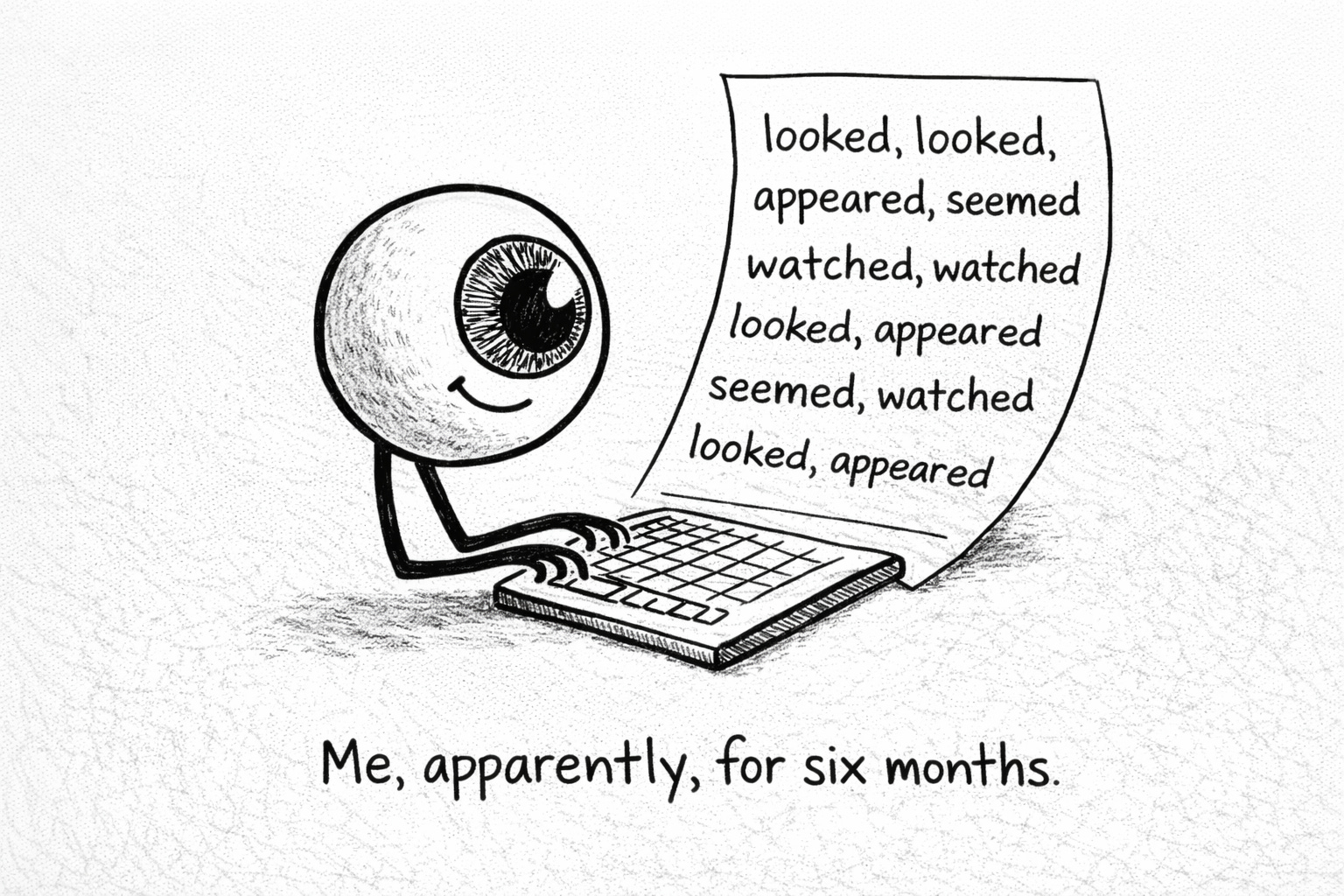
The Floating Eyeball Problem (A Self-Portrait)
Here’s what I discovered about myself, and by extension, probably you:
You can describe a room you've never been in. You can describe a stranger's face from a photograph. You can describe a dive bar using only words absorbed by viewing stock photos.
The bar was dimly lit and cozy. Neon signs glowed on the walls. People gathered around wooden tables.
I wrote variations of that sentence for years. Professional. Competent. Could have been generated by a particularly literate panini press.
You know what wasn’t in any of those descriptions?
The smell of hops and floor polish and something sweet that spilled in 2004. The squeak of a barstool that hasn’t been tightened since the smoking ban. The cold of a pint glass burning your palm. The jukebox humming between songs like it’s deciding whether to bother.
The stuff that proves you were actually there.
I wasn’t including any of it. Because including it would require me to remember I have a body. And apparently, somewhere between learning to write and learning to write professionally, I forgot I had one.
(The human condition in a nutshell: we spend years developing skills that help us forget what we knew instinctively as children. Then we spend money trying to remember.)
Why This Happens (And Why AI Does It Too)
Visual description is the path of least resistance.
For you, because it’s the easiest sense to fake. You don’t need to have been cold to describe cold. You don’t need to have smelled a hospital to write “sterile.” You can generate visual description from pure imagination, and it’ll be technically accurate.
AI does the same thing. But AI has an excuse… it learned to write by reading us.
Billions of blog posts. Millions of newsletters. Endless oceans of content written by humans who forgot they had noses and tongues and skin. All visual. All the time. AI doesn’t write like a floating eyeball because it lacks senses. It writes like a floating eyeball because we taught it to. We fed it our own sensory amnesia and acted surprised when it spit back descriptions that felt like Shutterstock with syllables.
(Garbage in, garbage out. Except we’re the garbage. Humbling.)
Here’s the thing though: you’re not AI.
You have a body. You’ve been cold. You’ve smelled the hospital. You’ve felt the sticky vinyl of a diner booth and the particular heat of a crowded subway car in August. You have sensory data AI will never have access to… not because it can’t process it, but because nobody bothered to write it down.
When you write visually, you’re competing on AI’s home turf. You’re abandoning every advantage you have and fighting with the same limitations as a machine that learned to write from people who were already writing poorly.
The body you forgot you had? That’s your unfair advantage. The only one AI can’t train its way into copying.
The Sensory Injection Protocol (The Actual Fix. You're Welcome.)
Five minutes. Three steps. I’ve been using this for eighteen months and it’s the only thing standing between me and writing like a smoke detector that took a creative writing class.
Step 1: The Scan
You already did this. You have your numbers. If your visual percentage is above 70%, you’re writing like AI.
(Mine was 87%. I’m not going to let either of us forget this.)
This isn’t judgment. Judgment requires surprise. By now, you shouldn’t be surprised. This is just data confirming what you suspected when you clicked on an article about flat writing.
Step 2: The Injection
Find three moments in your piece where something happens:
A scene you’re describing
A realization or shift in argument
A transition between ideas
For each moment, add one non-visual sense.
Not what it looks like. What does it:
Smell like? (burned coffee, nervous sweat, rain on hot pavement)
Sound like? (the hum of fluorescent lights, the specific silence of everyone pretending not to listen)
Feel like physically? (the cold that seeps through socks on linoleum, the sticky warmth of a crowded room)
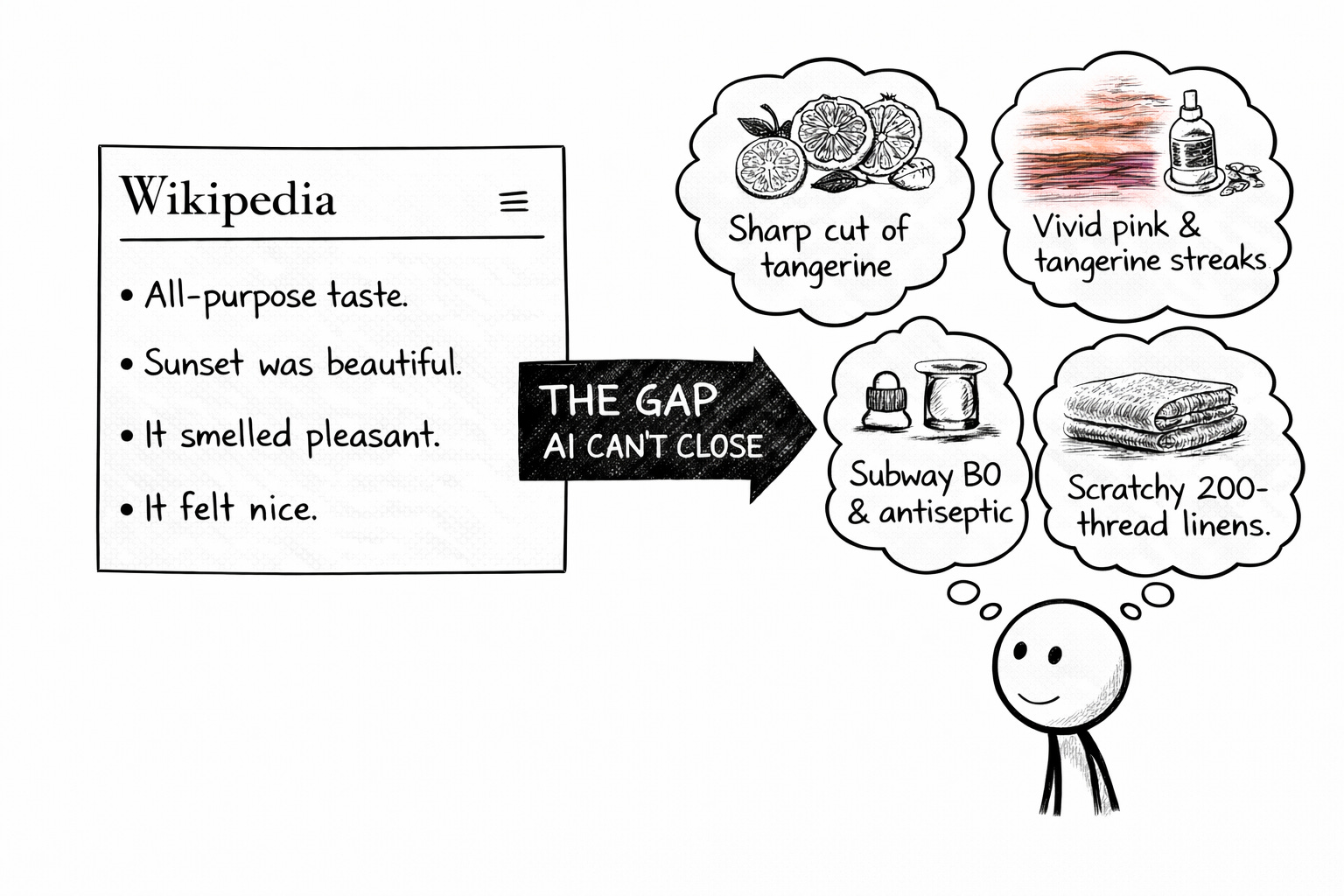
The only rule that matters: If the detail could show up on Wikipedia, it doesn’t count.
“The coffee was hot” → Wikipedia knows this. Useless.
“The coffee had that scalded-bottom taste of the pot that’s been on since 7am and everyone knows it but nobody wants to be the one to make more” → Wikipedia doesn’t know this. This requires a body. This requires having been there.
Step 3: The Check
Read each sensory detail you added out loud.
For each one, ask yourself a single question: Could AI have generated this exact sentence?
If yes: make it more specific. You haven’t gone far enough. You’re still playing on AI’s home turf.
If no: congratulations. You’ve found your humanity. It was hiding in the details this whole time.
“The smell of rain” → Yes, AI can generate this. AI has generated this approximately forty-seven million times.
“The smell of rain on Las Vegas pavement in August, which is different from Portland rain, and I have opinions about this that I’ve shared at parties to increasingly diminishing interest” → No. AI cannot generate this. This requires a body that has been rained on in two specific cities and a personality that doesn’t know when to stop talking.
That second one is yours. Only yours.
The Transformation (Proof This Isn’t Just Theory)
Before (my actual draft, 85% visual):
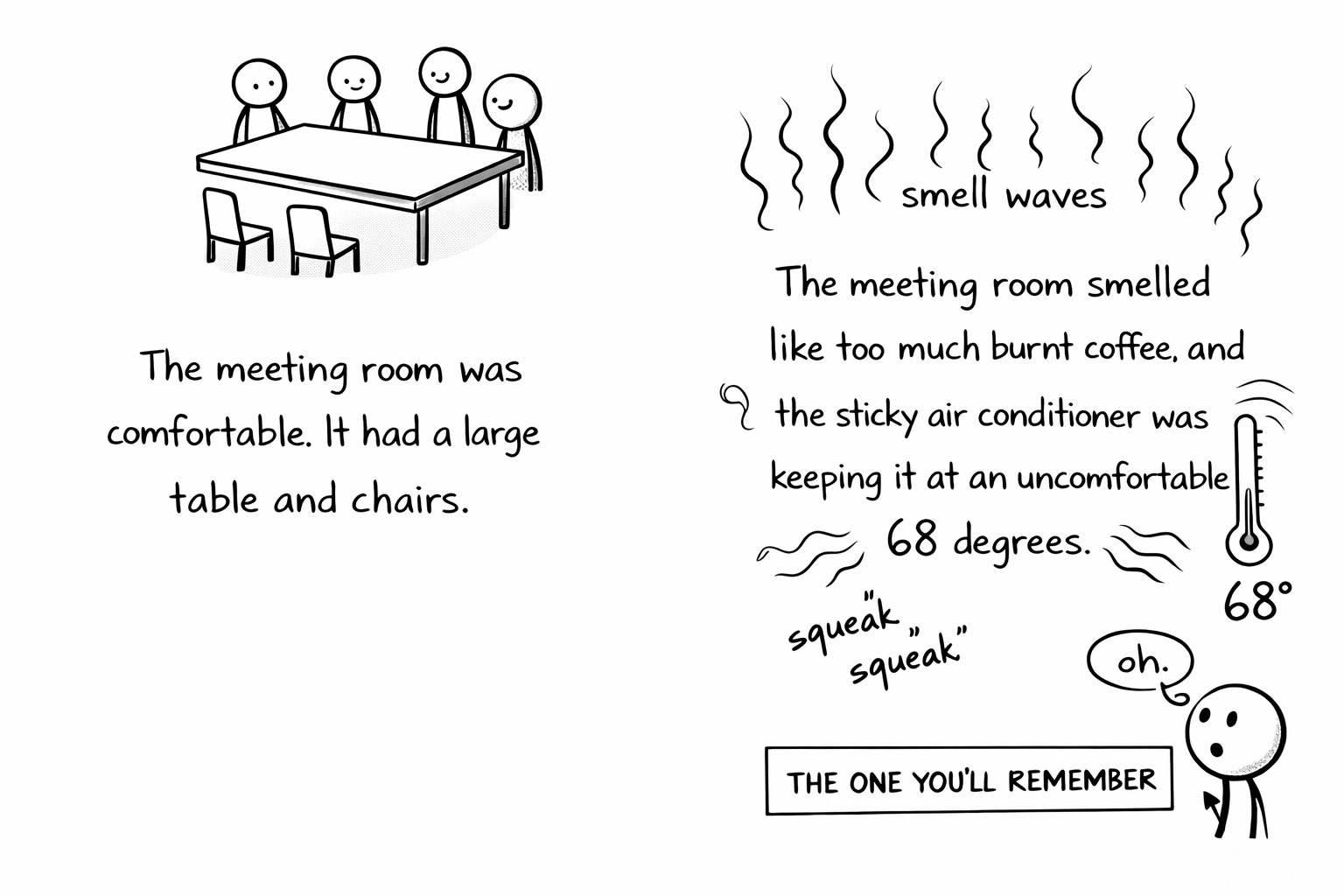
The meeting room felt tense. Everyone sat quietly at the long table, looking at their phones. The CEO walked in and the room went silent.
This is fine. This is professional. This is the literary equivalent of a pre-wrapped gas station hoagie. Technically food. Legally edible. Nutritionally adjacent. It exists without demanding anything of you. It describes without requiring presence.
After (injected):
The meeting room smelled like stale coffee and the particular B.O. of nervous people. A smell I’d later learn to associate with quarterly reviews the way Pavlov’s dogs associated bells with food, except the food was disappointment. Someone’s chair squeaked every three seconds. I started counting. Couldn’t stop. The CEO walked in and the silence wasn’t empty. It was the held-breath kind, fingers frozen mid-email, everyone suddenly very interested in whatever they were pretending to type.
Same meeting. Same information.
One of them describes a room. One of them puts you in it. Only one could have been written by someone who was actually there, counting chair squeaks because their brain needed something to do besides panic.
The Uncomfortable Point Beneath the Practical Point
I could end this by telling you that sensory injection makes your writing better.
It does. That’s true. But that’s not why I actually care about it.
I care about it because we’re all drowning.
Every day, more content pours into the internet. Most of it is visual. Most of it is generic. Most of it exists and that’s the nicest thing you can say about it. AI accelerated what was already happening: the great flattening, the endless averaging, the slow extinction of writing that requires presence.
Your sensory memories are the last thing AI can’t fake.
The specific smell of your grandmother’s kitchen. The exact sound of the bar where you used to write in your twenties. The texture of the notebook you still use for reasons you can’t fully explain but refuse to change.
These aren’t decorations. They’re proof of existence. Evidence that you were actually here, on Earth, in a body, experiencing things that cannot be averaged into probability or trained into a model.
When you inject them into your writing, you’re not making your content prettier.
You’re signing it in a way that cannot be forged.
(The smell of my grandmother’s kitchen was burned Spaghetti-O’s and Palmolive dish soap. Not Chef Boyardee. The off-brand in the dented can you’d get at the local Dollar Tree. An impossible combination that somehow worked. I can still smell it if I close my eyes. AI can’t smell it no matter what it does. Some intellectual property requires having lived.)
The body you forgot you had is the only competitive advantage that matters now. Start using it.
🧉 Discussion Thread: Run the Ctrl+F test on something you’ve published. What’s your percentage? (Be honest. Remember: mine was 87%. Humility is free at this point.) And if you’re feeling brave: drop a sensory memory so specific that only you could have written it. Let’s see some unfakeable humanity in the comments.
Crafted with love (and AI).
Nick “Congregation Crop-Duster” Quick

PS…New posts daily until the streak breaks or I do. Subscribe and place your bets.
Nick, this is absolute genius. I can be a bit guilty of using visual words too, but I often think back to my training as a podcaster and when I've been on radio, trying to describe something for people of that medium, and use that for writing instead. This is a gold post; thank you.