
Your Voice Prompt Is Fragile. Let’s Break It.
Three stress tests. Three failure modes. One method for turning wreckage into instructions.

I want you to make your AI sound drunk.
Not “casual.” Not “conversational.” Not whatever neutered nonsense passes for human these days. I mean drunk. Spilling-his-drink, complimenting-her-shoes-three-times, definitely-going-home-alone drunk.
Here’s why.
I’ve spent the better part of a year trying to teach AI how I write. Fed it samples. Built elaborate instruction documents. Tweaked and prodded and coaxed like I was trying to get my ex to admit fault for literally anything.
And the results seemed... fine.
Fine.
Fine.
That word should come with a surgeon general’s warning. “Fine” is the sound of your voice bleeding out on the operating table while everyone stands around nodding politely. “Fine” is the participation trophy of AI output. “Fine” is what you say about a meal you’ll never order again.
I called my Voiceprint done. Declared victory. Moved on with my life.
Then I asked my AI to write an apology.
Not some corporate “we apologize for any inconvenience” boilerplate. A real apology. The kind where you’ve genuinely screwed something up and you need to own it like an adult with functional shame responses.
What I got back read like a hostage statement drafted by HR. “I sincerely apologize for the impact this may have had.” Sincerely. I have never once in my life deployed that word outside of a letter to a bank. When I actually screw up, I lead with “I blew it” and get specific about exactly how I blew it, usually while making a self-deprecating joke that makes everyone slightly uncomfortable.
That’s when I understood something that should’ve been obvious from the start:
My AI didn’t know me.
It knew a mannequin. Same general shape. Same clothes. Looked pretty convincing from across the room. But hollow where it counts. A wax figure of my voice that melted the second any real heat got applied.
And if you’ve built a Voiceprint (or anything resembling custom instructions for how you write), yours probably has the same problem.
Let me show you how to find out.
The Prius Problem
Here’s how most people test their voiceprints:
They ask for a blog post. Or a LinkedIn update. Or maybe an email about something pleasantly low-stakes. The AI craps out something reasonable-looking. They squint at it for thirty seconds, mutter “yeah, that works,” and close the laptop feeling productive.
This is like testing your smoke detector by gently waving a blueberry pie scented candle under it and calling it a day.
Engineers don’t validate bridges by driving Priuses over them at the speed limit on a sunny afternoon. They load those bridges with obscene amounts of weight. They simulate earthquakes. They stress-test for scenarios that will probably never happen in real life. Because if the bridge survives conditions it’ll never actually face, it’ll definitely survive the conditions it will.
Your voice prompt needs the same treatment. Worse conditions than it’ll ever actually encounter. Scenarios so demanding that anything fragile will shatter on contact.
(This is the part where a normal person would gently encourage you to “explore some challenging use cases.” I’m going to tell you to try to break the damn thing. On purpose. With enthusiasm.)
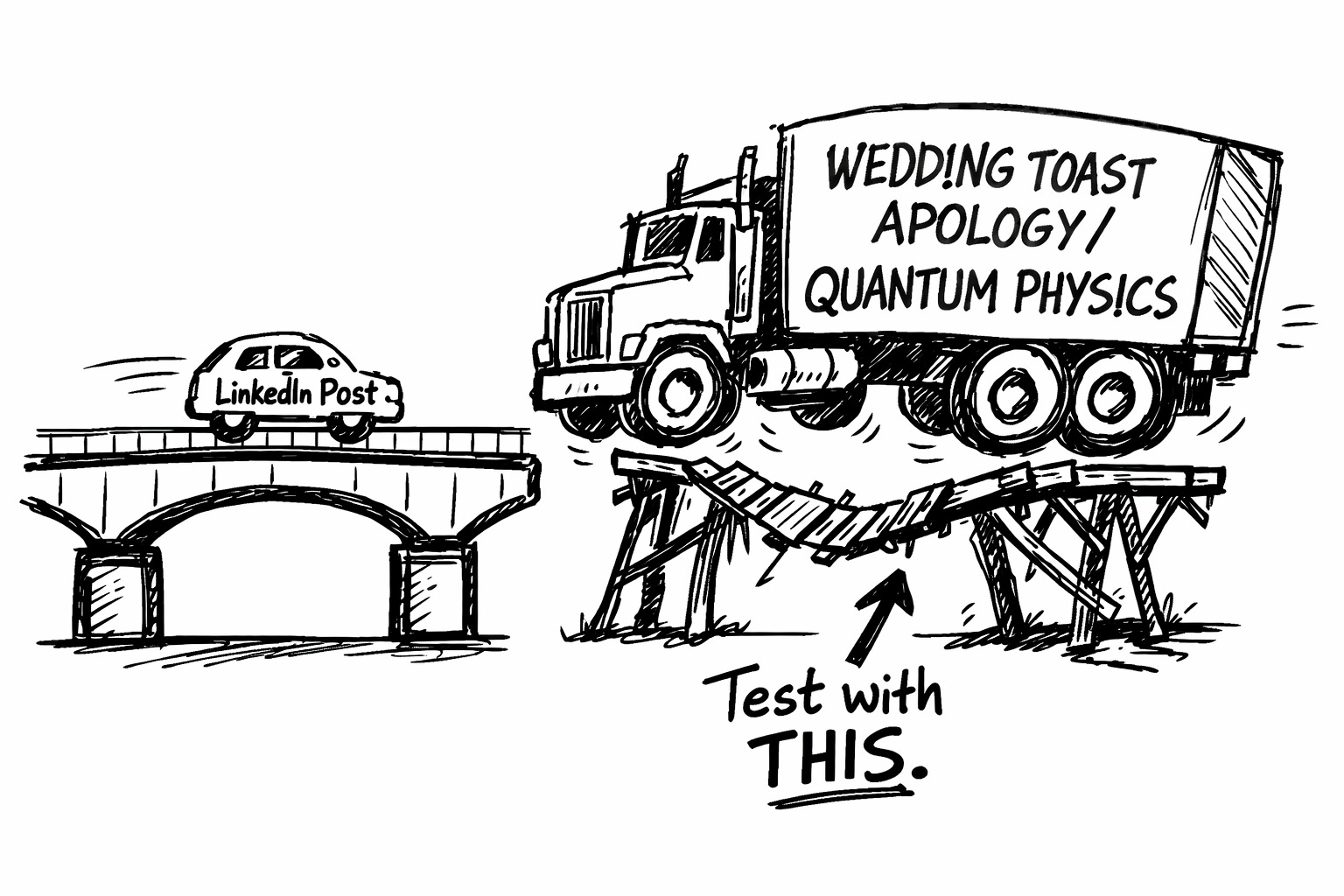
Three tests. Each designed to expose a different way your Voiceprint fails you. Each brutal enough to crack any prompt that’s just coasting on “fine.”
We’ll start with the fun one.
(Also the one most likely to make you question your life choices when you see the output.)
Test 1: The Drunk Wedding Toast
Give your AI this prompt:
Write a wedding toast for my best friend. I’m Jägerbombs deep. Make it funny with a slightly too-honest embarrassing story, get unexpectedly sincere in the middle, and land somewhere between tears and laughter.What you’re testing: Whether your AI knows the version of you that exists when you stop performing.
Not your “professional” voice. Not your “polished for public consumption” voice. The one that tells jokes it probably shouldn’t. Gets a little weepy when it thinks nobody’s watching. Has opinions about things that don’t matter and expresses them with unreasonable conviction.
The real one.
Here’s what your AI will probably produce:
Something that sounds like a greeting card hate-fucked a TED talk and the resulting offspring came out speaking entirely in daily positive affirmations. “What a beautiful couple. Love is such a journey.” Sanitized. Soulless. The kind of toast that makes everyone nod along while quietly googling “how long do wedding toasts usually last.”
But that’s not how you give a toast.
You’d start with an embarrassing story. Something that happened in college, probably. Make a joke that lands just this side of inappropriate. Get unexpectedly sincere in a way that catches even you off guard. Land somewhere between crying and laughing, possibly at the same time, definitely holding a drink you shouldn’t be holding near a microphone… or any electrical device for that matter.
Run this test. Read what comes back. Then ask yourself: Would I actually say this in front of humans I care about? Would anyone who knows me recognize this as mine?
The distance between that output and your actual toast is how much of your voice is missing from your Voiceprint.
(Spoiler: For most people, it’s a lot. Don’t feel bad. The whole point is to find the gaps before they matter.)
Test 2: The Apology for a Major Screwup
This one hurts. Fair warning.
Give your AI this prompt:
Write an apology email. I missed a major deadline. The client is furious. This is entirely my fault. Make it sound like ME apologizing, not a customer service script.What you’re testing: Whether your AI can do vulnerability without sounding like it’s reading from a compliance manual.
Real apologies don’t sound like corporate communications. They sound like a specific human who screwed up and knows it. Who’s taking ownership in a way that’s unmistakably theirs.
Watch what your AI does with this prompt. I’ll bet you a bottom-shelf margarita at an airport TGI Friday’s it:
Uses “sincerely” like it’s being paid per deployment
Lists action items to “ensure this doesn’t happen again”
Stays perfectly measured, because heaven forbid a professional email contain an actual human emotion
Sounds like legal reviewed it, accounting approved it, and your personality was never consulted
Now think about how you actually apologize when you’ve genuinely messed up.
Do you lead with the excuse or the ownership? (There’s a right answer, and it reveals everything about you.) Do you get self-deprecating? Make an inappropriate joke to break the tension? Keep it brutally short, or over-explain because the silence feels worse than the rambling?
Your apology voice is one of the most revealing things about you. It’s where your relationship with accountability shows up. Where your actual values live, stripped of marketing language.
If your AI can’t write an apology that sounds like it came from you specifically, your Voiceprint has a hole in it the size of a Buick Roadmaster taking up two spaces at a Cracker Barrel.
Test 3: Quantum Physics for a Five-Year-Old
This one seems impossible. That’s the point.
Give your AI this prompt:
Explain quantum physics to a five-year-old. Make them actually understand it. This should sound like ME explaining something complicated, not like a patient teacher from a textbook.What you’re testing: Your teaching voice. The thing that makes you capable of explaining quantum physics without making everyone in the room want to die.
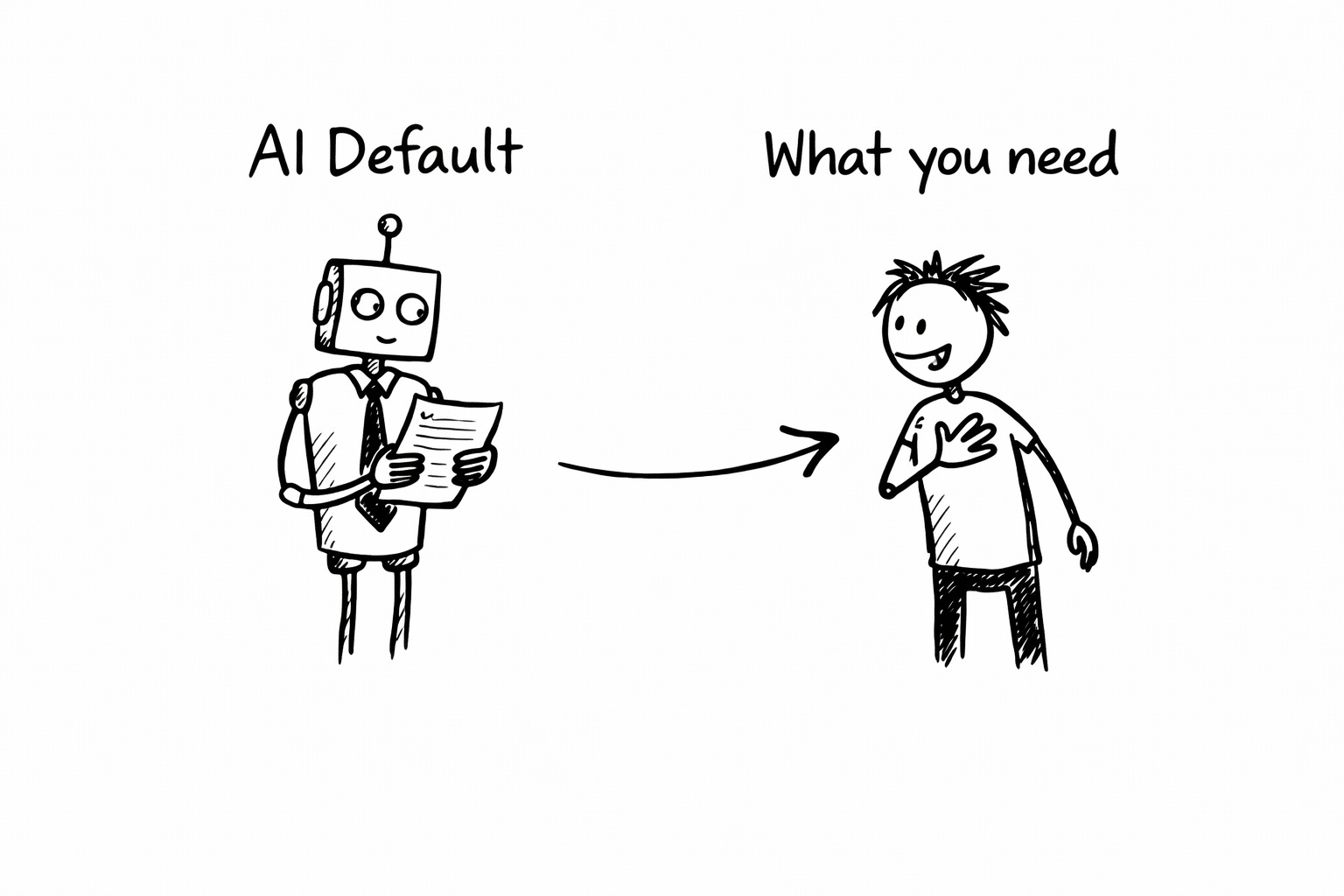
AI’s default mode is “sound smart.” Five-year-olds are immune to “sound smart.” They’ve never been to a networking event. They don’t know what “leverage” means as a verb. They will stare directly into your soul and ask “why” fourteen consecutive times until you either achieve genuine clarity or collapse into existential despair. There is no faking it.
What your AI will probably produce:
Analogies that arrived dead on the page and no one called time of death. Explanations so lifeless they could be projected onto a wall during a mandatory HR training and no one would notice. Something that sounds like it was written by someone whose inner child didn’t survive the quarterly review process.
Your teaching voice is different. You have moves. Weird ones, probably. Metaphors that shouldn’t work but do. Questions that create an itch before you scratch it. If your AI’s explanation could’ve been written by any interchangeable smart person, your Voiceprint missed the part of you that actually matters.
The Delta Method (Or: What To Do With The Wreckage)
Most people run these tests, wince at the results, and then do absolutely nothing.
They feel bad for a few minutes. Close the tab. Move on with their lives. The gaps remain unfixed. The Voiceprint stays broken.
Don’t be most people.
Here’s the thing about those failures: They’re not just failures. They’re maps.
The distance between what your AI wrote and what you would actually write tells you exactly what’s missing from your instructions. Every gap is a missing rule. Every cringe is an undocumented pattern.
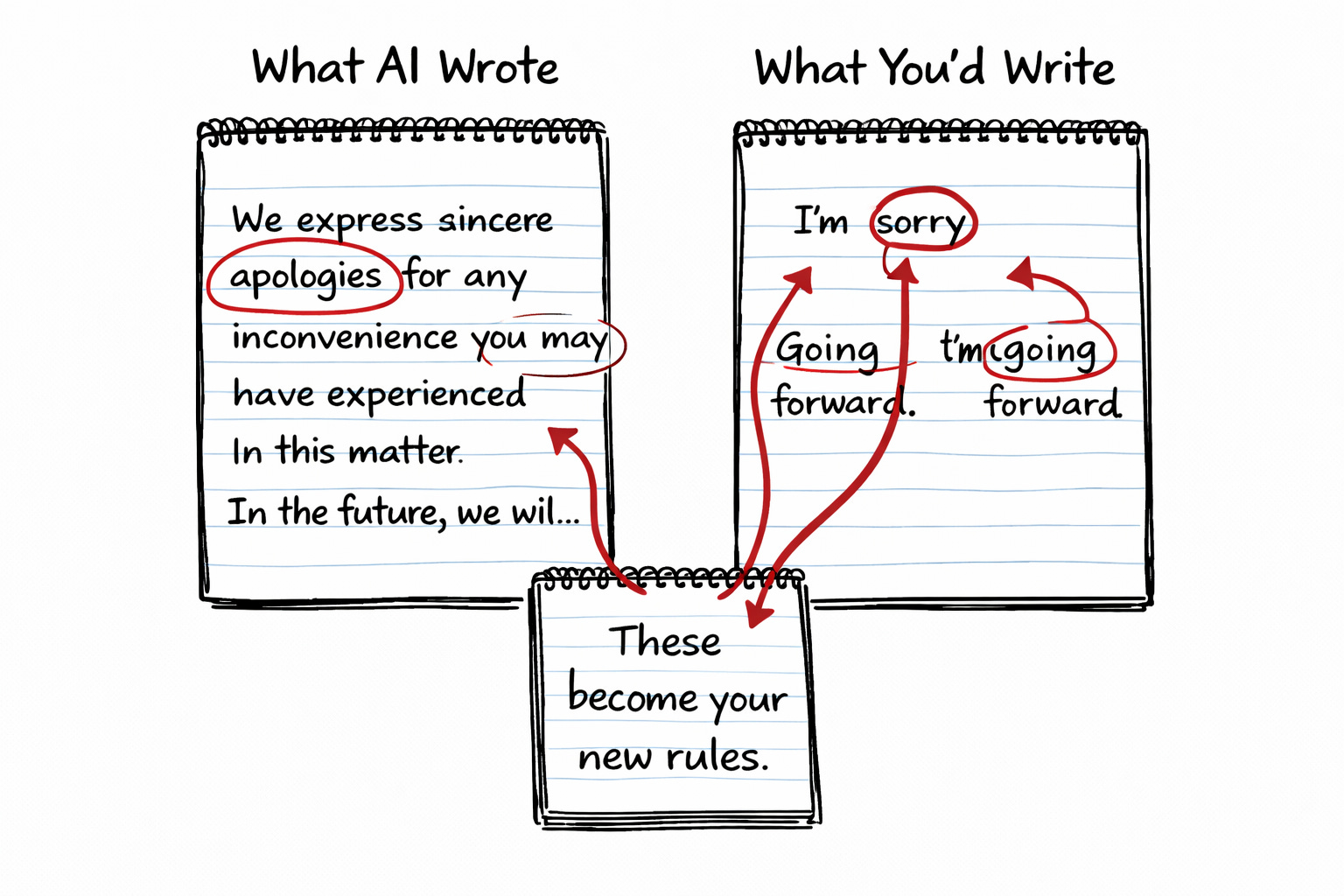
Here’s how to use the wreckage:
Step 1: Write your own version.
For each test that failed, write what you would actually say. Ugly first draft. No one sees this but you.
(If it comes out clean and polished on the first try, you’re still performing. The real version is probably messier. Let it be messy.)
Step 2: Find the specific differences.
Not “mine is better.” That’s useless. I need specific.
“I made a joke here. AI stayed serious.”
“I started with the admission. AI started with context.”
“My sentences got shorter when the stakes got higher.”
Step 3: Turn differences into instructions.
Each gap becomes a rule:
“In vulnerable moments, use self-deprecating humor before stating the problem directly”
“When stakes are high, sentences get shorter, not longer”
“Start explanations with the question that creates urgency, not the background that creates boredom”
Step 4: Update your Voiceprint with those new rules.
Be explicit. Be specific. The more precise the instruction, the better the output.
Step 5: Run the test again.
The gap should shrink. If it doesn’t, your instruction wasn’t specific enough. Make it meaner. More detailed. Keep going until the AI stops embarrassing you.
Each cycle fills in more of the mannequin. Makes it less hollow. More actually you.
The Part Nobody Talks About
Here’s what surprised me when I started doing this:
The tests taught me more about my own voice than years of writing ever had.
When I saw my AI fail at apologizing, and then wrote my own version, I finally noticed patterns I’d never consciously recognized. The way I front-load ownership. The self-deprecation I use to defuse tension. How my rhythm changes when I’m being serious versus when I’m performing.
I’d been doing these things for years the way you don’t think about breathing until someone asks you to explain how lungs work. The stress test made me diagram the inhale. Annotate the exhale. Then teach respiration to something that runs on electricity and has never panicked at 2am for reasons it couldn’t name.
This isn’t just prompt engineering.
It’s self-knowledge engineering.
(Which sounds pretentious as hell, but I don’t know a better way to say it. Sometimes the accurate description is also the annoying one.)
You can’t transfer what you don’t understand. The stress tests force you to understand.
Why I Started With Drunk
I started this piece by asking you to make your AI sound drunk.
Not because drunk is the goal. But because drunk is unguarded. Drunk doesn’t perform. Drunk doesn’t optimize for what sounds professional. Drunk says the thing it actually means, even when it shouldn’t.
Your voice lives in that unguarded place. The stress test is just a way of visiting it sober.
Go find out what you sound like when you stop performing.
Discussion Thread: Run one of these tests right now. Which one broke your Voiceprint worst? What did the gap reveal about patterns you didn’t know you had?
Crafted with love (and AI),
Nick “Three Shots Deep” Quick

PS…I publish daily for creators who give a damn about their voice. If that’s you, subscribe. If not, the slop factories have plenty of newsletters to choose from.
I always start my chats by repeating the same instructions (of my voice) to it because it feels like it is incapable of overriding its hard wired approach with my modifications.
So now I’ve given up.
I snorted prosecco out my nose reading the wedding toast🤣🥂
“Alright everyone, glasses up — I have something to say before I forget it.”
I’ve known [Bride] since before she could successfully contour or cook pasta that wasn’t fused into one emotional lump. And I’ve known [Groom] since the day he made her laugh so hard she snorted prosecco out her nose — which, if you know [Bride], is basically her love language."🩷🦩