
Your Voice Is a Chord, Not a Note (Here's Why That Matters)

Play a single note on a piano.
Now play a chord—four notes together.
The difference between those two sounds? That's the difference between training AI on vocabulary alone versus training it on your complete voice.
Most people treat voice like a single note. One frequency. One pattern.
But your voice is a chord. Four distinct layers vibrating together to create something unmistakable.
Miss any one layer, and the whole composition falls flat.
The Single-Note Mistake
I learned guitar in Junior High. (Barely. Enough to butcher "Smells Like Teen Spirit" at sock hops.)
But I learned something valuable: The same four chords sound completely different depending on how you play them.
Strum pattern matters.
Timing matters.
Dynamics matter.
The space between notes matters.
It's not just what notes you play. It's how you play them—and that "how" operates on multiple levels simultaneously.
Your writing voice works the same way.
When you feed AI writing samples and say "learn my style," you're essentially handing it sheet music and hoping it figures out tempo, dynamics, and feeling on its own.
It won't.
Because those elements live on separate layers that need separate training.
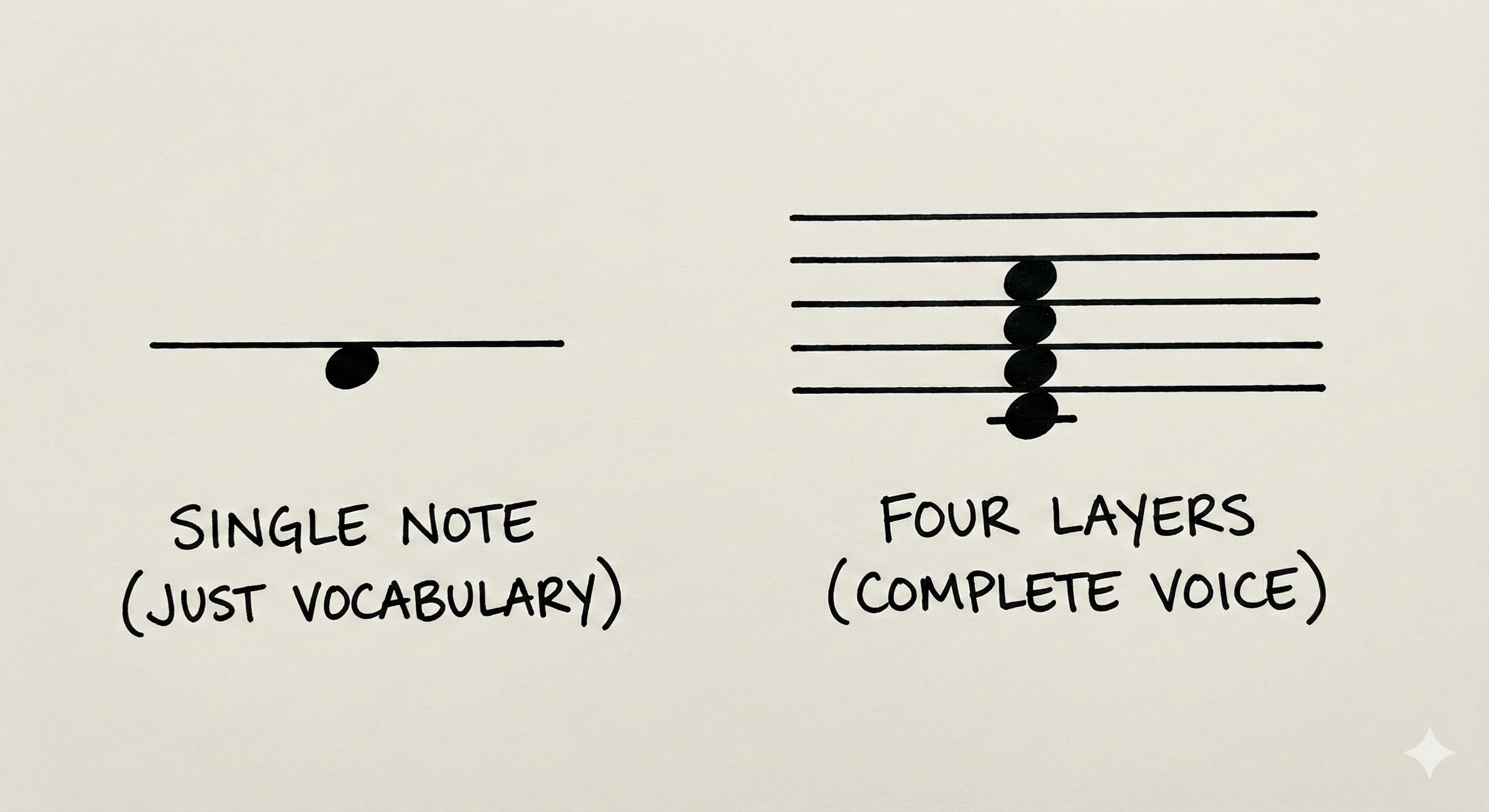
The Four Layers of Voice Architecture
Think of your voice like a building with four floors.
Each floor serves a different function. Each floor needs different materials. But they all rest on the same foundation and support the same roof.
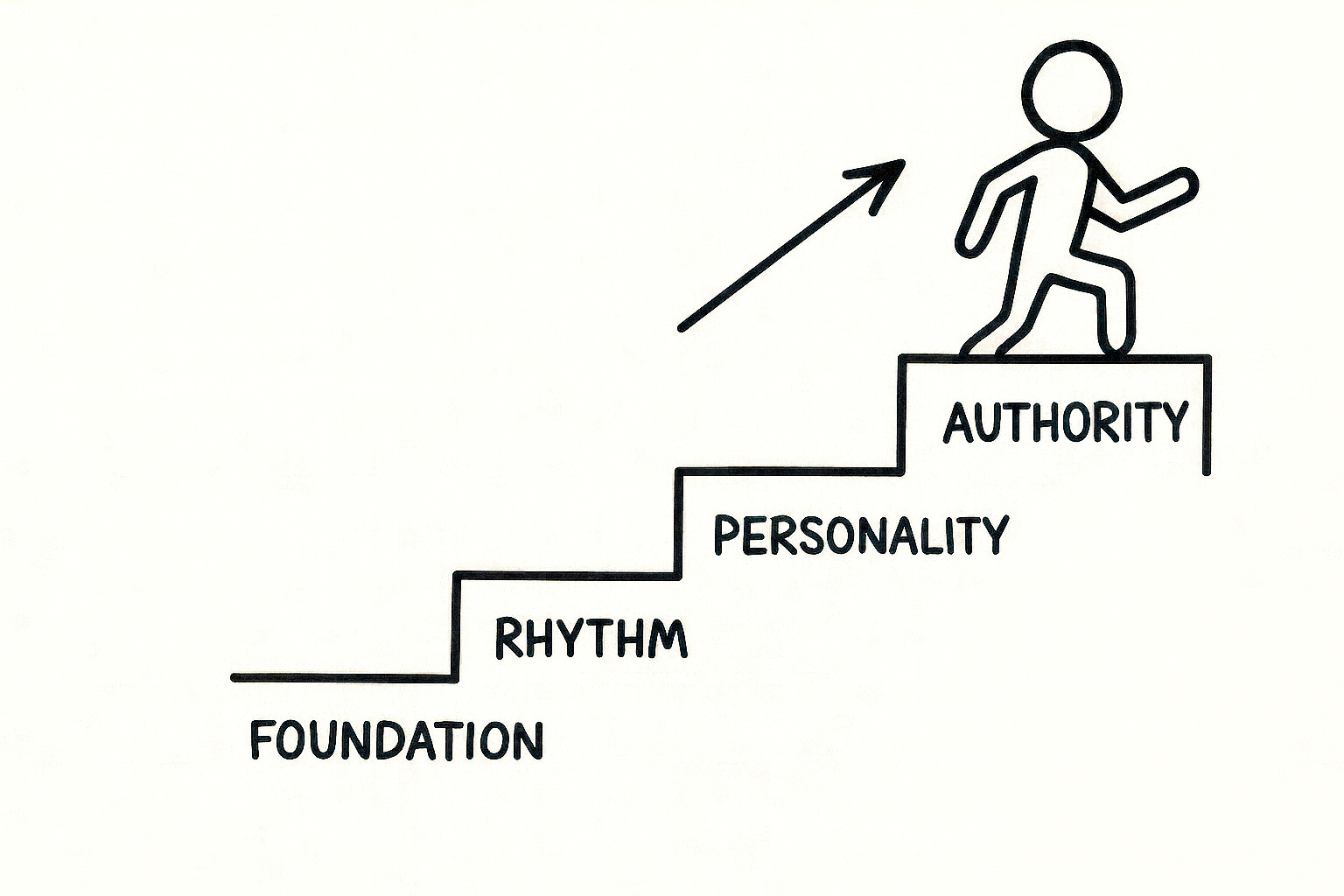
You can't skip floors. You can't build floor four without floors one through three underneath it.
Let me walk you through the architecture:
Layer 1: The Foundation (Surface Patterns)
This is the concrete and steel. The literal building blocks.
What it includes:
Vocabulary (your word choices)
Grammar patterns (how you structure sentences)
Punctuation style (your comma philosophy, em dash addiction, etc.)
Think of this as the notes you play. Essential. But not sufficient.
A musician can read sheet music perfectly and still produce lifeless music if they ignore tempo, dynamics, and feeling.
Same with writing. Surface patterns without the other three layers produce technically correct but emotionally dead content.
Most people stop here. They feed AI writing samples, AI captures vocabulary and structure, and they wonder why outputs feel robotic.
Because surface is maybe 25% of your voice. Not 100%.
Training prompt for Foundation Layer:
Analyze these writing samples at the surface level:
1. Top 50-75 words I use most frequently (excluding common articles/prepositions)
2. My sentence structure patterns (average length, complexity, variation)
3. Grammar quirks that break conventional rules (fragments, starting with conjunctions, etc.)
4. Punctuation preferences and patterns (em dashes, ellipses, semicolons, etc.)
5. How I use formatting (line breaks, bold, italics)

Create a surface-level style guide based on these patterns.
Layer 2: The Rhythm Section (Tempo and Flow)
This is where writing becomes music.
Rhythm is pacing. Cadence. The tempo you set and how you vary it.
It's the difference between:
"We launched. It failed. We tried again."
And:
"We launched—poured six months of work into a product nobody wanted—watched it crash and burn in spectacular fashion, learned exactly nothing the first time around, and somehow convinced ourselves that iteration two would be different."
Same information. Completely different rhythm. Completely different emotional impact.
What rhythm includes:
Sentence length variation (when you go short vs. long)
Paragraph structure (1-sentence punches vs. multi-sentence blocks)
Strategic repetition (for emphasis or momentum)
White space usage (breathing room for readers)
Speed changes (urgent staccato vs. contemplative elaboration)
Think of rhythm as the tempo and dynamics in music. You can play the right notes at the wrong tempo and completely change the feel.
AI that misses your rhythm sounds like a metronome—technically correct, emotionally flat.
Training prompt for Rhythm Layer:
Map the rhythm and pacing patterns in my writing:
1. When do I use short sentences vs. longer complex ones? What triggers the shift?
2. How do I structure paragraphs? (Single sentence, 2-3 sentences, longer blocks?)
3. Where do I use repetition for effect vs. variation for interest?
4. How do I create "breathing room"? (Line breaks, white space, paragraph breaks)
5. When do I accelerate (short punchy sentences) vs. decelerate (elaborate clauses)?

Document these as rhythm rules for maintaining my natural pacing.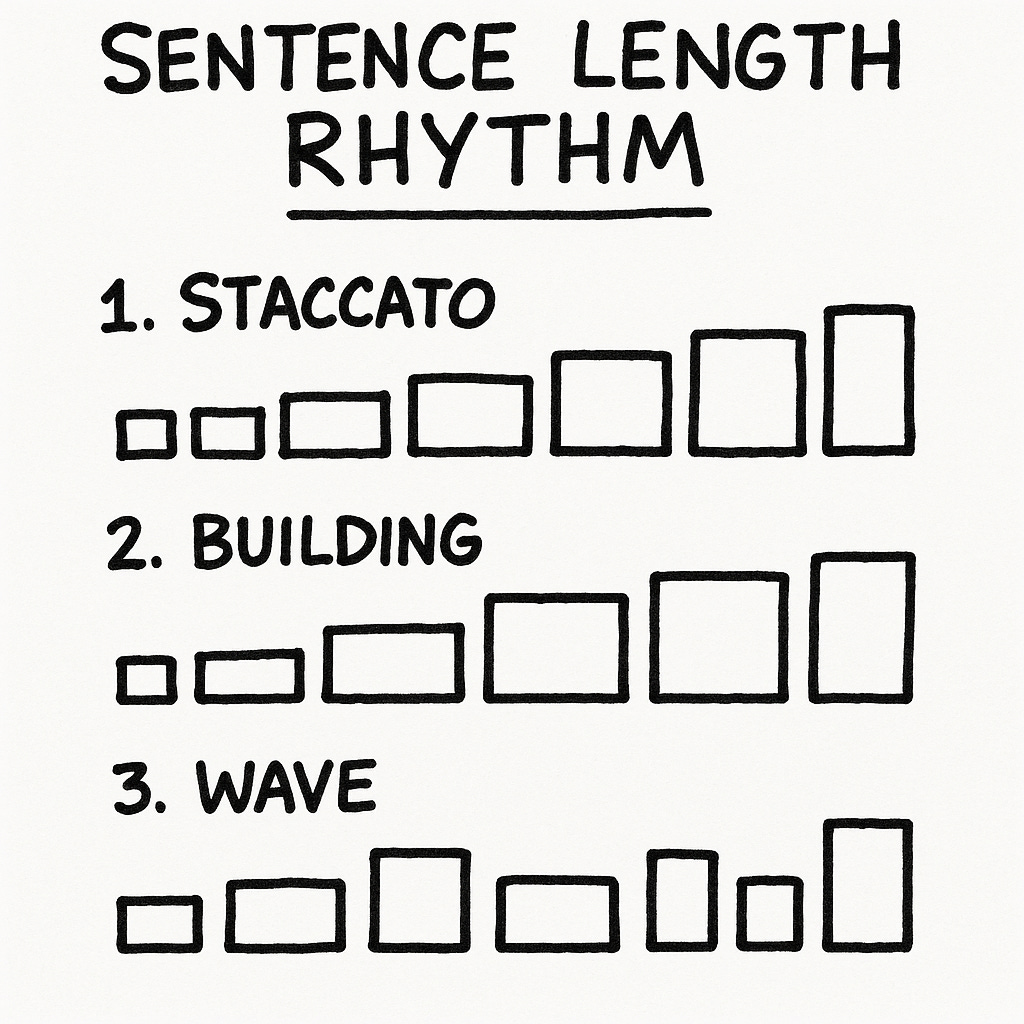
Layer 3: The Personality Filter (Tone Color and Timbre)
In music, this is called tone color or timbre. It's why a C note on a piano sounds different from a C note on a guitar—even at the same pitch and volume.
In writing, this is your personality fingerprint.
What it includes:
Humor style (dry, self-deprecating, absurd, dark, etc.)
How you show vulnerability (when and how you share struggles)
Point of view (first person, we-focused, observer stance)
Quirks and idiosyncrasies (parenthetical asides, em dash pivots, etc.)
Cultural references you gravitate toward
This is the layer that makes readers think "only [YOUR NAME] would say it this way."
For me? I use parentheses like I'm leaning in to share a conspiratorial aside. I drop em dashes mid-sentence—like this—when my brain takes a sharp turn. I deploy self-aware humor that shows strength through vulnerability, not insecurity masquerading as relatability.
These aren't writing flaws to fix. They're signature moves to preserve.
Training prompt for Personality Layer:
Extract the personality fingerprints from my writing:
1. What's my humor style? Provide specific examples and patterns.
2. How do I show vulnerability or acknowledge struggles?
3. What punctuation quirks convey personality? (Parentheticals, em dashes, ellipses)
4. What metaphors, analogies, or cultural references do I favor?
5. What patterns make my writing distinctly "mine" regardless of topic?

Document these as a personality profile for voice preservation.
Layer 4: The Authority Arrangement (How You Position the Performance)
Here's the layer most people never consciously think about:
You have a specific way of establishing credibility. A specific relationship you build with your audience.
Some writers perform solo on stage with spotlight. (Expert addressing audience.)
Others jam in a circle with the audience. (Peer sharing discovery.)
Still others teach from a podium. (Authority instructing students.)
None is better. They're just different. And AI that mismatches your arrangement destroys the credibility you've built.
What authority includes:
How you establish expertise (credentials vs. experience vs. results)
Your use of evidence (heavy research vs. personal anecdotes vs. both)
Confidence level (bold claims vs. careful hedging)
How you acknowledge limitations
Your positioning relative to reader (peer, guide, expert, teacher)
I position as fellow-explorer-sharing-field-notes. Not guru-on-mountain dispensing wisdom. I lead with experience over credentials. I acknowledge limitations openly. I say "here's what worked for me" not "here's what the research definitively proves."
That's my authority arrangement. Yours is probably different.
Get this wrong, and even perfect surface/rhythm/personality feel off-brand.
Training prompt for Authority Layer:
Analyze how I establish and maintain authority:
1. Primary credibility source (experience, credentials, results, research)?
2. Balance of data/research vs. personal stories and anecdotes
3. Confidence patterns (when I make bold claims vs. when I hedge)
4. How I acknowledge uncertainty or limitations
5. Relationship with reader (peer, guide, expert, performer)?

Map these patterns as an authority guide for maintaining my credibility style.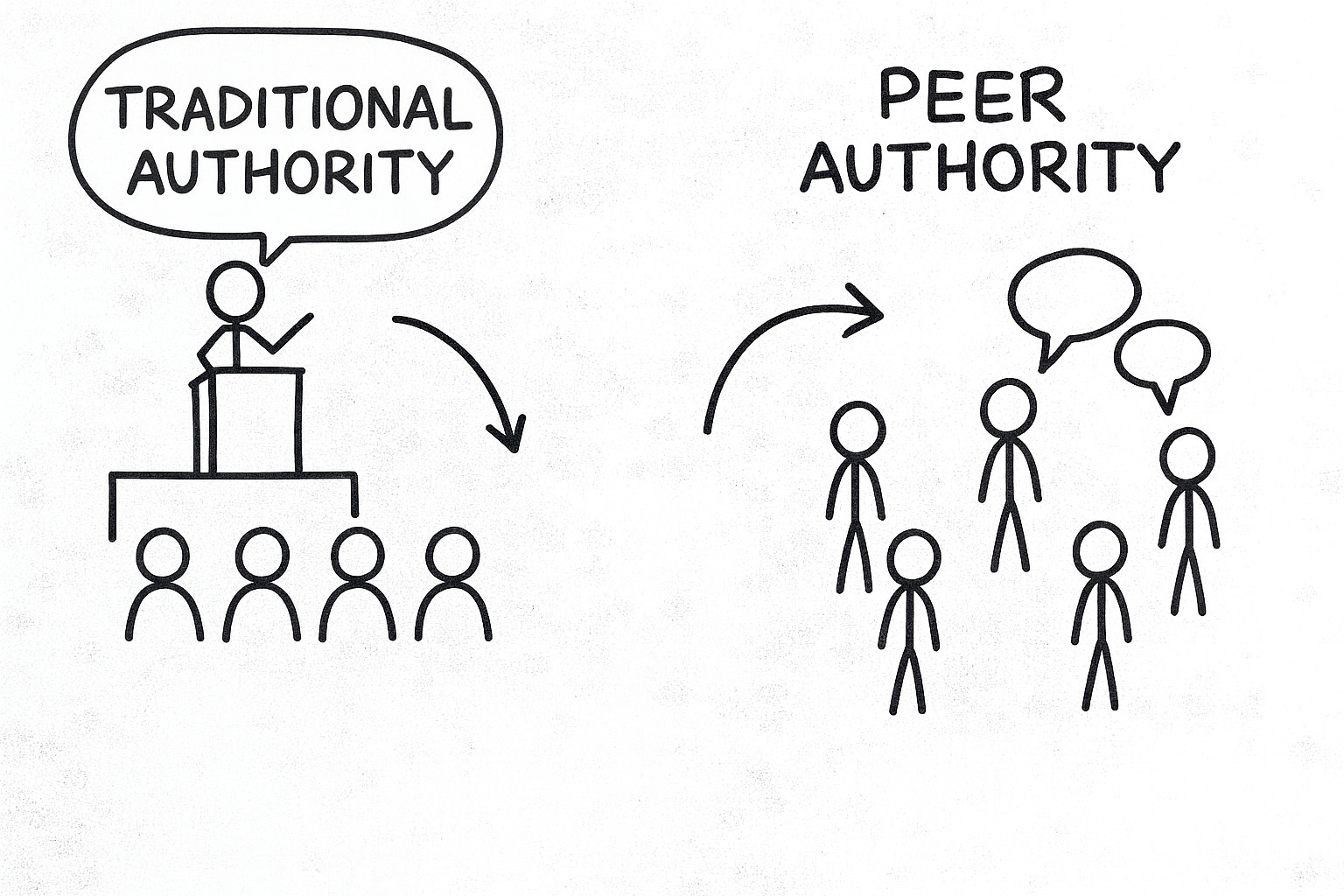
Training the Complete Chord
Here's what I learned after six months of frustration:
You can't train all four layers simultaneously and expect AI to parse them correctly.
(I tried. It was like giving someone four instruments and saying "figure it out.")
Instead, train each layer separately. In sequence. Let AI master one layer before adding the next.
Week 1: Foundation (surface patterns)
Test outputs. Verify AI captured vocabulary and structure.
Week 2: Rhythm (pacing and flow)
Test again. Verify rhythm matches your natural cadence.
Week 3: Personality (quirks and tone)
Test again. Verify the "you-ness" comes through.
Week 4: Authority (credibility style)
Final test. Verify reader relationship feels authentic.
By week four, you're not training a parrot to mimic words.
You're training a musician to play your chord—all four notes simultaneously, in harmony.
What This Actually Looks Like
Let me show you the difference.
Single-layer training (vocabulary only):
"I tried using AI to write content. The results were technically correct but felt generic. The vocabulary was right but something was missing."
Four-layer training (complete voice):
"I spent three hours feeding ChatGPT my best work, convinced this time would be different. (Spoiler: it wasn't.) The vocabulary was perfect—same words I'd use, same sentence structures—but reading it felt like watching someone wear my clothes. Technically accurate. Emotionally wrong."
See the difference?
Same information. Same topic. Completely different feel.
The second version has:
Surface: My vocabulary and structure
Rhythm: My natural pacing (short-long-short pattern, parenthetical aside)
Personality: Self-deprecating humor, em dash pivot, "spoiler" quirk
Authority: Experience-based credibility, vulnerable positioning
That's the chord. All four notes playing together.
Your Next Move
Don't try to capture all four layers perfectly on attempt one.
(I sure as hell didn't.)
Start with Foundation. Use the prompt I shared. Document what AI identifies.
Then move to Rhythm once you're comfortable with surface patterns.
Personality and Authority take more self-awareness, but the prompts will guide you.
Train one layer at a time. Test outputs after each layer. Watch the quality compound.
By layer four, you won't be getting "almost me" content from AI.
You'll be getting "wait, did I actually write this?" collaboration.
That's when you know you've captured the chord, not just the notes.
Bold closing thought: Your voice isn't a single pattern—it's four layers playing in harmony. Train the chord, not just the melody.
Question: If your voice is a chord, which of the four notes do you think is your strongest? And which needs the most work? Share your self-assessment below.
Crafted with love (and AI),
Nick "Four Floors, No Elevator" Quick
PS…Want more on collaborating with AI without losing your voice? Subscribe for new posts every Sunday and Wednesday.