
Your Competitors’ Audiences Are Begging for Help
How to find the questions readers are asking that nobody in your niche is answering

The Audience Mind-Reading Series — Part 2 of 3
Yesterday in Part 1, we mined your own engagement for content gold using the D.I.G. Method. Today we mine everyone else’s.
My biggest subscriber spike of the year came from answering someone else’s audience.
A creator in my space published a solid post about AI writing workflows. Good stuff. Well-written. The comments were on fire. And buried about fifteen replies deep, someone asked a very specific question about maintaining voice consistency across longer pieces.
Forty-two likes on that comment. Three reply threads underneath it. The original author? Never responded.
Not because they’re lazy. Probably because they get two hundred comments and can’t answer everything. Totally understandable. But that question sat there. Forty-two people publicly agreed they wanted the answer. Nobody gave it to them.
So I wrote the post.
I didn’t copy anything. I didn’t even reference the original article. I just answered the question that forty-two people had raised their hand for. Published it on a Wednesday. It became my most-shared piece that month.
(I’d love to pretend I had a sophisticated system for finding this. I didn’t. I was procrastinating. Scrolling other people’s comment sections instead of writing my own stuff. Productive procrastination is still procrastination, but at least this time it paid rent.)
That accident became a method. And the method works whether you have ten subscribers or ten thousand, because you’re not relying on your own audience size. You’re reading rooms that already exist.
This Isn’t Stealing. It’s Showing Up Where Nobody Else Will.
Let’s kill the guilt upfront, because I know some of you felt it the second you read “competitors’ audiences.”
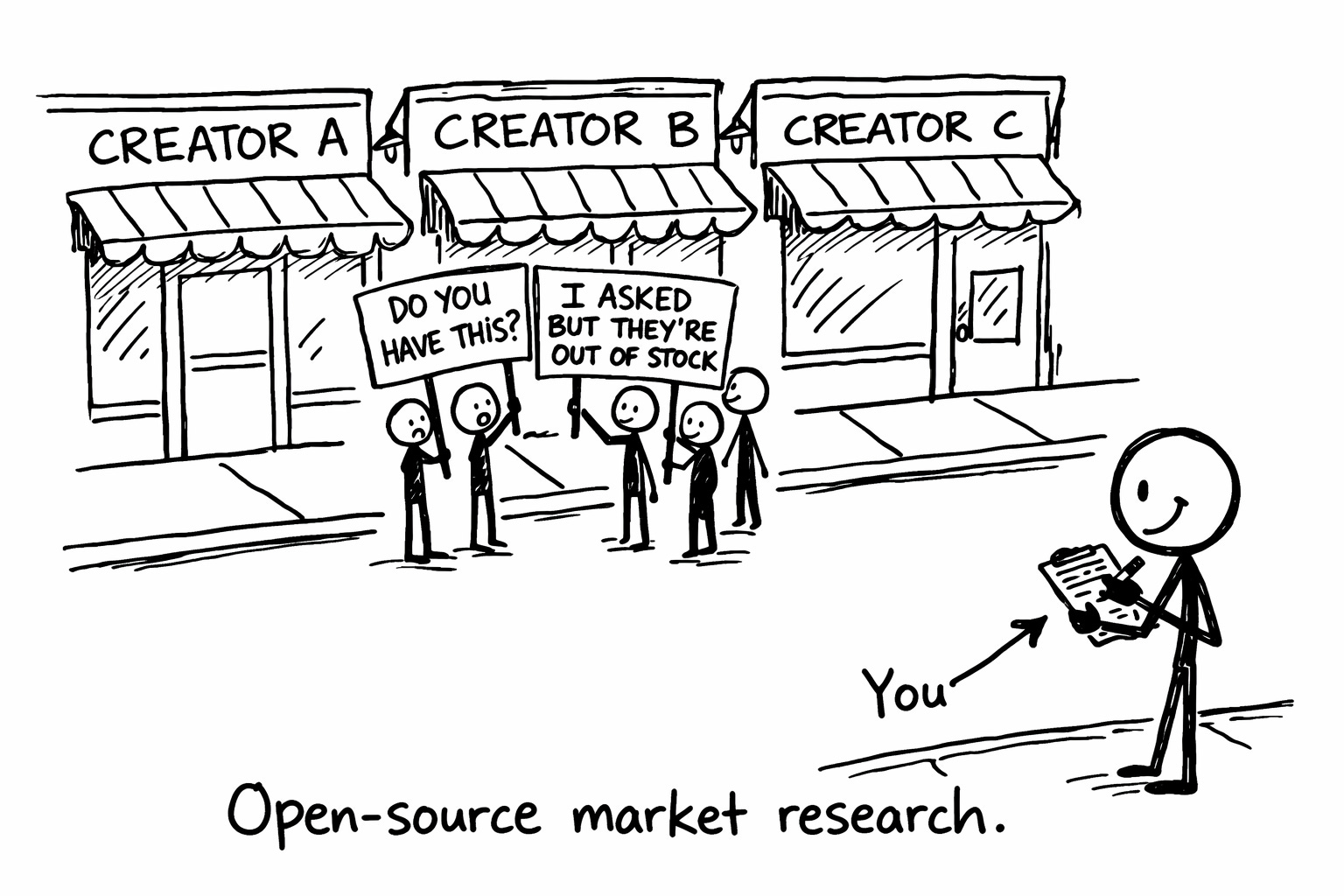
You’re not copying content. You’re not poaching subscribers. You’re not doing anything the creators you’re studying would even object to. Their readers asked a question publicly. On the open internet. And nobody answered it.
You’re not stealing the question. You’re serving the person who asked it.
There’s a meaningful difference between reverse-engineering someone’s content (sketchy, uncreative, the fast lane to becoming a slop factory yourself) and reverse-engineering their audience’s unmet needs (smart, ethical, and exactly how market research has worked in every industry since industries existed).
Restaurants don’t feel guilty about noticing that the place next door has a thirty-minute wait for brunch and no vegan options. They add vegan brunch to their menu. That’s not espionage. That’s paying attention.
(If you still feel weird about it, congratulations, you have more ethical concern about answering a public question than most people have about reposting someone’s entire article with “So true 🔥” as the caption. Your guilt is misplaced. Redirect it toward something that deserves it.)
The Gap Map: Four Steps to Content They’re Craving
Yesterday we mined inward with the D.I.G. Method. Today we map outward. Same principle (your audience tells you what to write), bigger data set (everyone else’s audience tells you too).
Step 1: Pick Your 5-7 Recon Sources
You need creators to study. Not random ones. Strategic ones.
Choose creators who are:
In your niche or an adjacent one
Actively publishing (at least weekly)
Getting genuine engagement (real comments, not just “🔥🔥🔥” from bots)
Slightly larger than you (their audience is who you’re growing toward)
Good but not comprehensive (the gaps are easier to spot)
Avoid:
Direct competitors who cover your exact angle (you want gaps, not mirrors)
Mega-publications with thousands of comments (too noisy, too hard to parse)
Creators whose audience doesn’t overlap with yours at all
(I keep a running list of seven. I rotate one or two out every month as my niche evolves. You don’t need to monitor the whole internet. You need to monitor the right corners of it.
How did I find my original seven? I wish I could say I ran a strategic competitive analysis. What actually happened is I noticed whose comment sections I was already lurking in at midnight instead of sleeping. Turns out my procrastination habits were a better market research strategy than anything I could have designed on purpose. Your doomscrolling has been training you for this. Congratulations.)
Step 2: Harvest the Signals
Spend 20-30 minutes per creator. Read their three most recent posts. Skip the content itself (for now). Go straight to the comments.
You’re hunting for:
Questions with high engagement (likes, replies, agreement) that the author didn’t answer
“I wish you’d cover...” comments (they’re literally writing your editorial calendar for you)
Respectful disagreements (these reveal angles the creator chose not to take)
Confused follow-ups (”Wait, so does that mean...?” signals where the explanation fell short)
The most specific comments (vague praise is useless; specific reactions are gold)
Copy the good ones into the same collection system you built yesterday with D.I.G. Same format. Raw text, source, date. But add one column: the creator/publication it came from.
Step 3: Map the Gaps
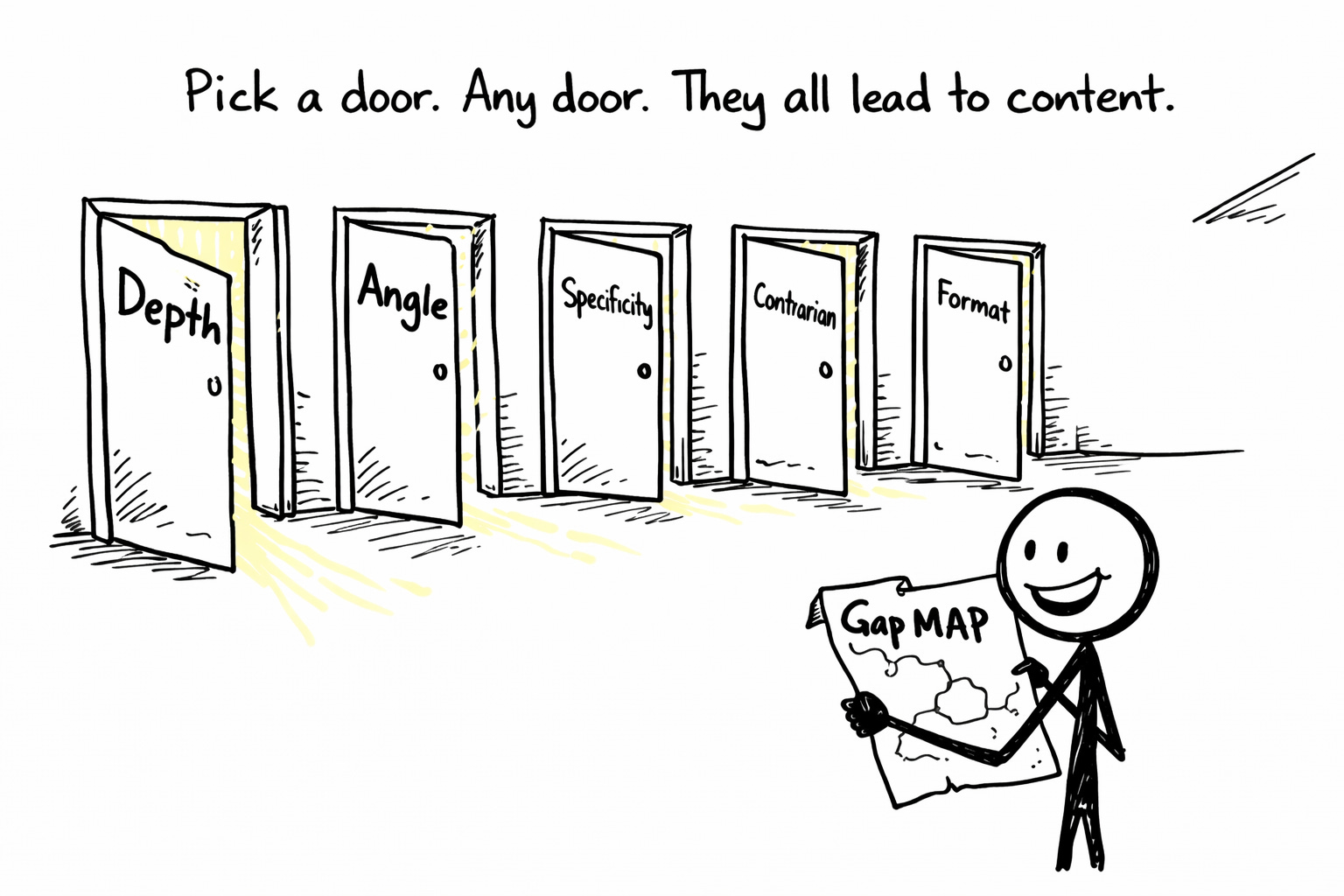
Now categorize. You’re looking for five specific types of gap. These aren’t random. Each one translates directly into a content strategy.
The Five Gap Types:
1. Depth Gaps — They covered a topic at the surface. Their audience wanted the deep dive.
This is the most common gap and the easiest to fill. Look for comments like “Can you go deeper on this?” or “I’d love a full breakdown of [subtopic].” The original creator gave them the appetizer. You serve the full meal.
2. Angle Gaps — They covered what happened. Their audience wanted how or why.
A creator might explain a concept without teaching how to implement it. Or they cover the trend without explaining the mechanics underneath. Different angle, same topic, massive opportunity.
3. Specificity Gaps — They gave general advice. Their audience wanted the exact workflow.
“Tips for better AI writing” vs. “The exact 7-step process I use to edit every AI draft before publishing.” Same territory. Wildly different value. Most creators default to general because specific is harder. It requires you to actually have a process, not just opinions about processes. Their audiences beg for specific. And the comments prove it. Every “but how do I actually do this?” translates roughly to “I didn’t come here for vibes. I came here for a workflow. You gave me vibes.”
4. Contrarian Gaps — They hold a popular position. A credible counter-take would resonate.
This one takes guts. But when you see a comment section where 30% of the replies are pushing back on the creator’s thesis, that’s a sign. There’s an audience for the other side of that argument. If you can make it credibly (not just contrarian for clicks), you’ve got a post that generates heat.
(You can smell the difference between someone who genuinely disagrees and someone who’s being contrarian because they saw a tweet that said “hot takes = engagement.” The first one has evidence. The second one has a podcast with eleven listeners and opinions about everything.)
5. Format Gaps — They write essays. Their audience wants frameworks, templates, or walkthroughs.
Sometimes the content is fine. The packaging is the problem. Look for comments like “Is there a checklist for this?” or “Can you make a template?” Those readers are telling you exactly what format to deliver the same ideas in.
(Some creators will write 4,000 words on a topic their audience needed a checklist for. Your audience asked for directions. You wrote them a travelogue. 4,000 words. Beautiful prose. They’re still lost.)
Step 4: Position Your Content
You’ve found the gaps. Now fill them. But not generically. Strategically.
For every gap you’ve identified, ask three questions:
Can I credibly cover this? (If it’s outside your expertise, pass. Filling a gap with thin content just creates a new gap.)
Does my audience care about this too? (A gap in someone else’s coverage only matters if it overlaps with your readers’ interests.)
What’s my angle? (Don’t just cover the missing topic. Cover it your way. Through your methodology. With your voice. The gap is the opportunity. Your Voiceprint is what makes it yours. And if you haven’t documented your Voiceprint yet, my free Voiceprint Quick-Start Guide walks you through it. But we’ll get there. Right now we’re focused on finding the gaps worth filling.)
If all three answers are strong, congratulations. You just found a high-confidence content idea that comes pre-validated by an existing audience.
Most creators will never have that. Not because the data doesn’t exist. Because they’d rather brainstorm for an hour than read a comment section for ten minutes. One feels creative. The other actually works.
The Megaprompts
Prompt 1: “The Gap Mapper”
Feed this a batch of comments from a competitor’s post (or several posts) and let AI find what’s missing.
You are a content strategist performing a gap analysis on audience
engagement from a publication in the [YOUR NICHE] space.

Below is a collection of comments, replies, and questions from
[COMPETITOR/PUBLICATION NAME]'s recent content. I want to find
content opportunities they're NOT serving.

YOUR TASK:
1. Read through ALL the comments carefully
2. Identify what the audience is asking for, requesting, confused
   about, or pushing back on that the original content did NOT
   adequately address
3. Categorize each gap as one of these five types:
   - DEPTH GAP: They covered it at surface level, audience
     wanted more
   - ANGLE GAP: They covered WHAT, audience wanted HOW or WHY
   - SPECIFICITY GAP: They gave general advice, audience wanted
     exact steps
   - CONTRARIAN GAP: A meaningful portion of the audience
     disagrees or wants the other side
   - FORMAT GAP: The content is fine but audience wants it
     delivered differently (template, checklist, walkthrough, etc.)

4. For EACH gap you identify, provide:
   - Gap type
   - The 2-3 strongest comments that reveal this gap
     (quote them directly)
   - The unmet need in one sentence
   - A specific content angle I could write to fill this gap
   - A working title and one-sentence hook for that content
   - Confidence level (HIGH / MEDIUM / LOW) based on how many
     comments support this gap

5. Rank all gaps by confidence level and potential impact.

IMPORTANT: I'm not trying to copy their content. I'm trying to
serve the needs their content revealed but didn't fulfill.

---

[PASTE COMMENTS FROM COMPETITOR'S CONTENT HERE]
What makes this prompt work: The five gap types give AI a specific lens to analyze through instead of generating vague observations. The confidence ranking based on comment frequency keeps you focused on validated opportunities, not hunches. And the explicit “I’m not trying to copy” instruction keeps the outputs oriented toward original angles.
Prompt 2: “The Angle Generator”
Different use case. You already know the topic a competitor covered. You want fresh angles they missed entirely.
A content creator in my niche ([YOUR NICHE]) recently published a
piece about:

TOPIC: [DESCRIBE THE TOPIC]
THEIR ANGLE: [BRIEFLY DESCRIBE HOW THEY APPROACHED IT]
THEIR AUDIENCE: [DESCRIBE WHO READS THEM]

MY ANGLE/EXPERTISE: [DESCRIBE YOUR UNIQUE POSITIONING]
MY AUDIENCE: [DESCRIBE WHO READS YOU]

YOUR TASK:
Generate 7 alternative angles on this SAME topic that:
1. Don't overlap with the original creator's approach
2. Play to MY specific expertise and positioning
3. Would appeal to both their audience AND mine
4. Range from safe (low-risk, educational) to spicy
   (contrarian, provocative)

For EACH angle, provide:
- A working title (scroll-stopping, specific)
- The core argument or thesis in 2-3 sentences
- Why this angle works (what need it fills)
- Heat level: 🟢 Safe / 🟡 Warm / 🔴 Spicy
- Which gap type it fills (Depth / Angle / Specificity /
  Contrarian / Format)

Rank them by a combination of originality and audience demand.
Avoid generic angles anyone could write. Every suggestion should
feel like it could ONLY come from someone with my positioning.
What makes this prompt work: The “heat level” spectrum gives you range. Sometimes you want a solid educational piece. Sometimes you want to start a productive fight. This prompt gives you both from the same topic. And the instruction to filter through your positioning means the angles come back tailored, not generic.
(Fair warning: the 🔴 Spicy suggestions will occasionally be too spicy. AI sometimes mistakes “contrarian” for “inflammatory.” Use your judgment. If an angle would make you enemies instead of earning you an audience, dial it back. Productive disagreement is a strategy. Burning bridges is a hobby.)
Two Down. One to Go.
Yesterday you learned to mine your own engagement with D.I.G. Today you learned to map the gaps in your competitive landscape.
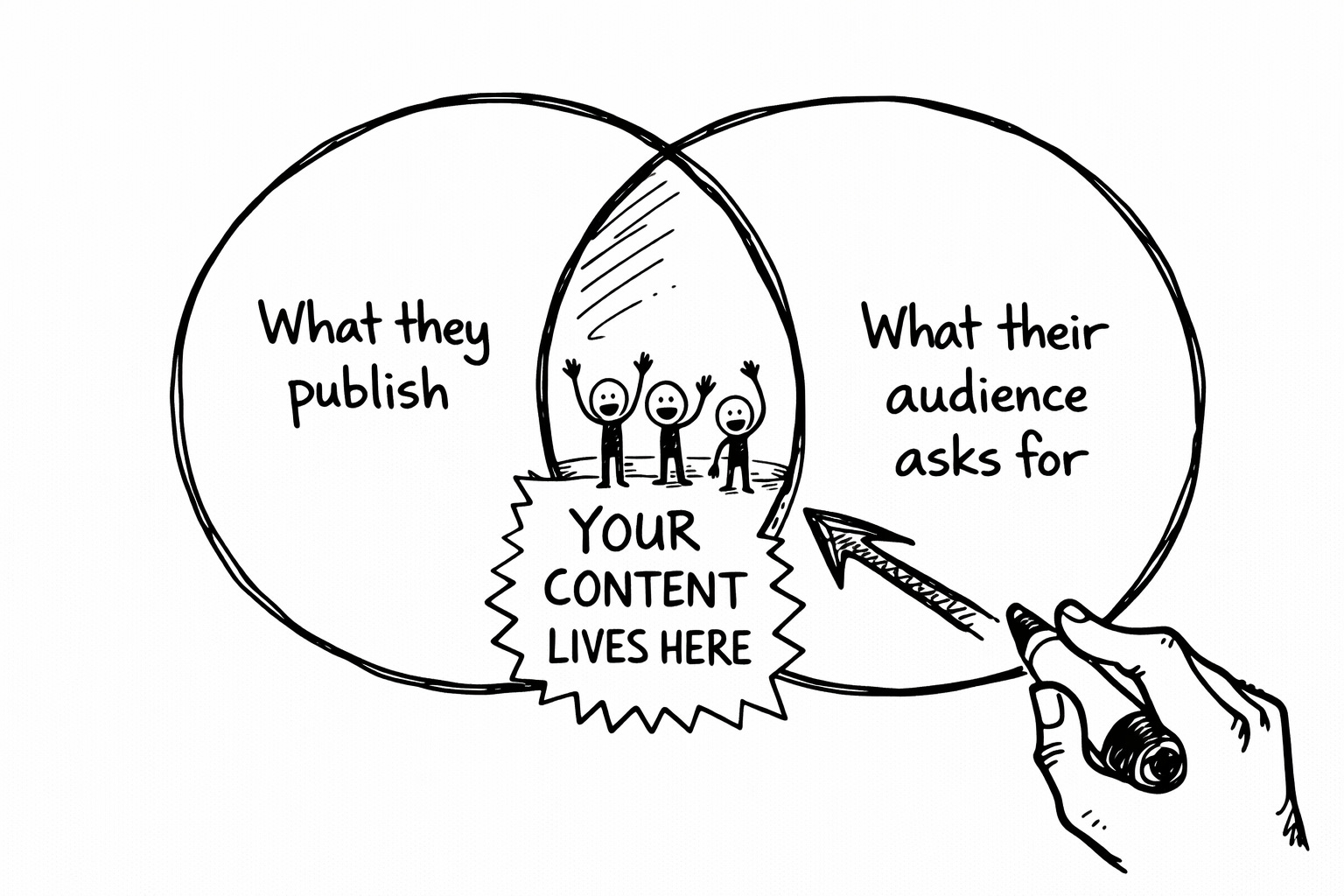
Which means you now have two streams of validated content ideas flowing. Your own audience’s signals and the unmet needs you found in other creators’ comment sections.
Congratulations. You just generated more usable content ideas in two days than most creators pull from six months of journaling, three vision boards, and a $200 brainstorming retreat that was really just a weekend at an Airbnb with good lighting.
So you’ve got the raw material. Great.
But here’s the problem with raw material: it’s raw. A pile of gold nuggets isn’t a necklace. And a pile of content ideas isn’t a content strategy.
Tomorrow in Part 3: We build the system. The Signal Stack method turns everything you’ve collected from Parts 1 and 2 into organized content pillars, a sequenced editorial calendar, and a self-sustaining pipeline that keeps feeding itself long after this series ends. Plus three more prompts that do the organizational heavy lifting for you.
No more “what should I write about?” ever again. That question dies tomorrow.
The best content ideas aren’t invented. They’re overheard. In your own comment sections. In other people’s. In the gap between what got published and what got asked. The skill is learning to listen systematically.
And then, you know... actually writing the thing. Which is where the real work starts.
🧉 Have you ever found a content idea in someone else’s comment section? Did you actually write it? Drop it below… I’m curious how many of us have been doing this accidentally before it had a framework and a dumb acronym.
Crafted with love (and AI),
Nick "I Read Your Comments So You Don't Have To" Quick

PS… Finding the right content ideas is step one. Writing them in your voice is step two. If you don’t have your voice documented yet, grab my free Voiceprint Quick-Start Guide. It walks you through the VAST framework so you can start mapping your patterns before you hand anything to AI.
PPS… Like this post so Substack shows it to more people. Share it with a creator who needs this. Subscribe if you’re new here. That’s it. No guilt trip. (Okay, a small guilt trip. But a loving one.)
📬 The Audience Mind-Reading Series
→ Part 1: Your Audience Already Told You What to Write
→ Part 2: Your Competitors’ Audiences Are Begging for Something They’re Not Getting (← You’re here)
→ Part 3: Stop Collecting Questions. Start Building a Content Engine
Had never considered this before - thanks Nick for the idea! Makes total sense!
Drops tomorrow