
Your AI Drafts Are Missing a Fight
The one prompt that adds tension to everything

I read an AI draft last week that agreed with itself for 1,200 words straight.
No friction. No “but wait.” No moment where the idea had to defend itself against anything.
Just... assertion, assertion, assertion, conclusion.
It was like watching someone win an argument in an empty room. Throwing air punches. Declaring victory over furniture. Technically undefeated. Absolutely pathetic.
(I’ve seen LinkedIn posts with more internal conflict. And those are written by people who think “disruption” is a personality trait.)
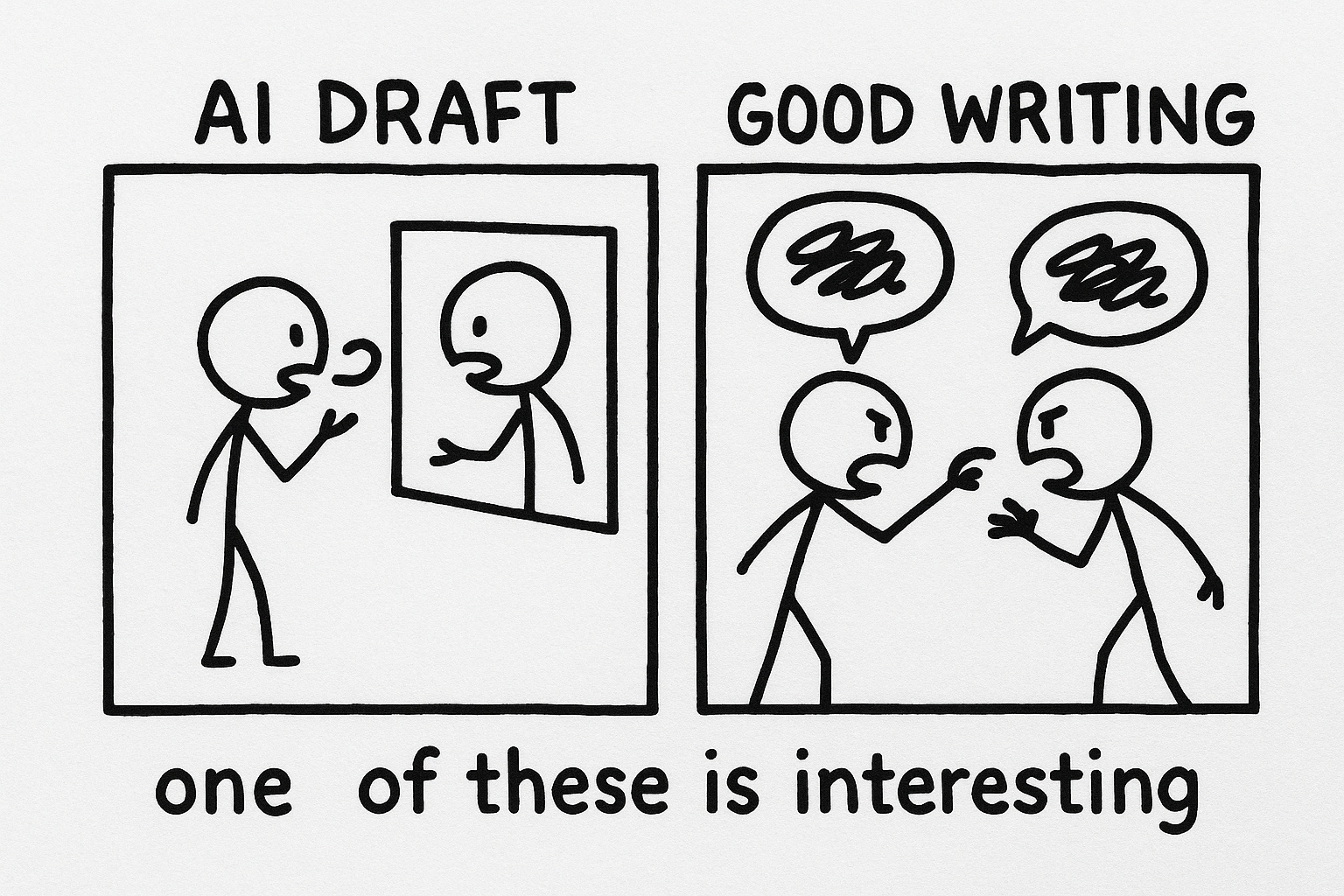
Here’s what I’ve figured out: AI writes statements. Humans write arguments.
The difference is a fight.
Why AI Content Feels Like Muzak
AI is trained to be helpful. Agreeable. Non-confrontational. It’s basically that coworker who says “great idea!” to everything in meetings but never contributes anything substantive.
Which means it never interrogates its own ideas.
It never says “but here’s why this might be wrong.” Never acknowledges the obvious objection your reader is already thinking. Never wrestles with the tension that makes ideas interesting.
It just... states things. Confidently. Blandly. One paragraph after another of unchallenged assertions.
Your reader feels this. They don’t know why the content feels like a tri-fold brochure titled “So You’ve Got Hemorrhoids” that someone left face-up on a waiting room chair, but they feel it. Something’s missing. Something that would make them actually care.
What’s missing is the fight.
You know that feeling when someone makes a point and you immediately think “yeah but what about—” and then they address it before you can finish the thought?
That’s good writing.
AI doesn’t do that. AI is too busy agreeing with itself to notice you had a question.
The Argument Injection
After any AI draft, run this prompt:
Read the following draft and identify:

1. The single strongest counterargument to my main point—the objection a smart, skeptical reader would raise
2. Where in the piece this objection would naturally occur to the reader
3. How I could address this counterargument without completely undermining my thesis

Draft:
[Paste your AI draft]

Be specific. Don’t give me a weak strawman I can knock down while sipping coffee. Give me the objection that would actually make me put the coffee down.
Then take that counterargument and weave it into your piece.
Not a throwaway “some might say.” Not a weak objection you can dismiss with a wave and a “well actually.”
A real one. The one your smartest, most annoying reader is already composing a snarky comment about.
What This Looks Like (The Receipts)
Before (AI doing its helpful agreeable thing):
Retyping AI drafts instead of editing them helps preserve your authentic voice. Your muscle memory kicks in and naturally adjusts the rhythm and word choice to match your patterns. This technique saves time and produces better results than endless editing.
Fine. Technically true. So agreeable it’s basically asleep.
Nobody’s pushing back because nobody’s awake.
After (with the fight):
Retyping AI drafts instead of editing them helps preserve your authentic voice. Your muscle memory kicks in and naturally adjusts the rhythm to match your patterns.
The obvious objection: isn’t this just more work? You already have a draft. Now you’re... typing it again? On purpose? With your fingers? Like some kind of medieval scribe?
Yes. And it’s still faster. Because editing AI into your voice is a war you lose slowly… you’re fighting the structure, not just the words. Retyping takes ten minutes. Editing takes forty and still feels like you’re wearing someone else’s knickers. I’ve timed it. Repeatedly. While muttering profanity at my screen like a well-adjusted adult.
The second version has tension. Something to push against. The reader’s skepticism gets acknowledged and addressed instead of ignored.
(Also: “wearing someone else’s knickers” is not a metaphor AI would generate. That’s the kind of weird specificity that signals a human actually wrote this. You’re welcome.)
The Follow-Up Prompt
Once you’ve identified the counterargument, use this to integrate it:
Rewrite the following section to:

1. Acknowledge this counterargument naturally (not with “some might say” or “critics argue”—those phrases are where good writing goes to die)
2. Address it directly with specific evidence or reasoning
3. Use the counterargument to actually strengthen the main point

Section to rewrite:
[Paste the relevant section]

Counterargument to address:
[Paste the counterargument from the previous prompt]

Make it sound like a human wrestling with a real objection, not a debate club kid knocking down arguments made of tissue paper.
The key is that last line. AI loves strawmen. Easy objections it can demolish in a sentence while looking very smart and helpful.
That’s just your AI sparring with a pool noodle and acting like it just went twelve grueling rounds.
You want the objection that actually has teeth. The one that bites.
Why This Works (The Part Where I Sound Like I Read Books)
Good writing has dialectical tension.
(Sorry. I did warn you I’d get pretentious. It’s part of my charm. The annoying part.)
It’s not just “here’s my idea.” It’s “here’s my idea, here’s what challenges it, here’s why I still believe it anyway even though I see your stinking point.”
The counterargument isn’t a threat to your thesis. It’s the thing that makes your thesis earned.
An idea that’s never had to defend itself isn’t battle-tested. It’s battle-adjacent. It watched a documentary about the Battle of the Bulge once and now puts “strategic thinker” in its bio.
When you force AI to identify the best objection—and then force yourself to actually grapple with it—you’re doing the intellectual work that AI skips.
You’re showing your reader that you’ve thought about this. That you’re not just asserting. That you’ve considered the alternatives, weighed them, and chosen this position anyway.
That’s what humans do.
That’s what AI doesn’t.
(AI can’t doubt itself. It has no self. No 3am anxiety. No “wait, am I wrong about everything?” moment in the shower. It’s a confidence engine with no off switch. It’s never once stared at the ceiling wondering if it’s a fraud. Must be nice.)
The Lazy Version (No Judgment)
Don’t have time for the full two-prompt dance? At minimum, add this to your original prompt:
[Your normal prompt]

Include one section that directly addresses the strongest counterargument to this position. Don’t use “some might say” or “critics argue.” Acknowledge the objection like a human who’s actually considered it and lost sleep over it at least once.
It’s not as good as the two-step process. But it’s better than 1,200 words of aggressive agreement.
The Pattern Once You See It (You Can’t Unsee It)
Start noticing this in content you read.
The stuff that sticks with you? It fights. It acknowledges the tension. It says “I know what you’re thinking, and here’s why I disagree, and yes I did consider your point, and it’s a good point, but hear me out.”
The stuff that slides right past you? Pure assertion. No resistance. No moment where the writer had to actually defend the idea against anything except the blank page.
AI defaults to the second kind.
Your job is to inject the first.
The fight isn’t a distraction from your point.
The fight is the point.
Here’s what I want to know: What’s the strongest counterargument to something you’ve published recently? Not a weak one you could knock down with a shrug. The one that actually makes you pause. The one that almost changed your mind.
Drop it in the comments. Let’s see if we can make each other’s writing better by finding the fights we’ve been avoiding.
Crafted with love (and AI),
Nick “Professional Devil’s Advocate” Quick

P.S. Want the full system for collaborating with AI without sounding like AI? I’m giving away my entire Co-Write OS course for free right now. Voiceprint building, prompt frameworks, quality control checklists—everything I use. Grab it here before I come to my senses.
P.P.S. Grab the Argument Injection Prompt Pack—both prompts from this post plus three bonus variations for different content types (opinion pieces, how-to guides, and thought leadership). Copy-paste ready. Download it free here.