
You Can't Write Anything Worth Sharing If You Can't Focus for Fifteen Goddamn Minutes
The shareable version of your idea shows up 8 minutes after you want to quit. Here's how to reach it.

I was mid-sentence on a piece about the exact moment hustle culture ate its own ass when I checked Discord.
No notification. No reason. I don't even particularly like Discord. My thumb just... did it. Like a reflex. Like texting an ex. No plan. No upside. Just muscle memory and piss poor judgment.
Came back to the doc. Reread my half-finished sentence. Couldn’t remember where it was going.
Started a new paragraph instead.
This happened four more times in twenty minutes. I know because I started counting. (The counting itself became a distraction, which is the kind of poetic irony that makes you want to lie face down on a filthy oriental rug and just... stay there.)
The piece I published that day checked every box. Hit every beat. Landed with the impact of a throw pillow.
Forgettable as the second verse of Happy Birthday.
And I couldn’t figure out why until it hit me: the problem wasn’t my writing. It was my thinking. I couldn’t hold a thought long enough to discover what was underneath it.
I was abandoning my ideas the moment they got interesting. Like walking out of movies at the fifteen-minute mark and complaining that nothing good is playing.
Your Attention Span Is Worse Than Your Readers
We love pointing fingers at readers.
“Attention spans are shrinking.”
“Nobody reads anymore.”
“You have three seconds to hook them or they’re scrolling to an AI-generated video of the Pope on a slip-n-slide.”
Sure. Some of that’s true. But I’ve worked with enough writers to give me the itch to to start smoking again. Their attention spans are worse than their readers’.
They can’t sit with a single idea for fifteen uninterrupted minutes. They start developing a complex thought, feel the itch, check something (anything, the content of the check is irrelevant), and lose the thread.
Your writing feels thin because it is thin. You never stayed with the idea long enough to find out it had a basement. Maybe a wine cellar. Maybe a body. (The metaphor got away from me. I’m leaving it.)
Here’s an uncomfortable experiment. Next time you sit down to write, set a timer. Not for productivity. For honesty.
How long until you switch?
Most writers I work with? Under five minutes. Often under two.
Two minutes isn’t enough time to think a thought worth writing. It’s barely enough time to type what you already thought.
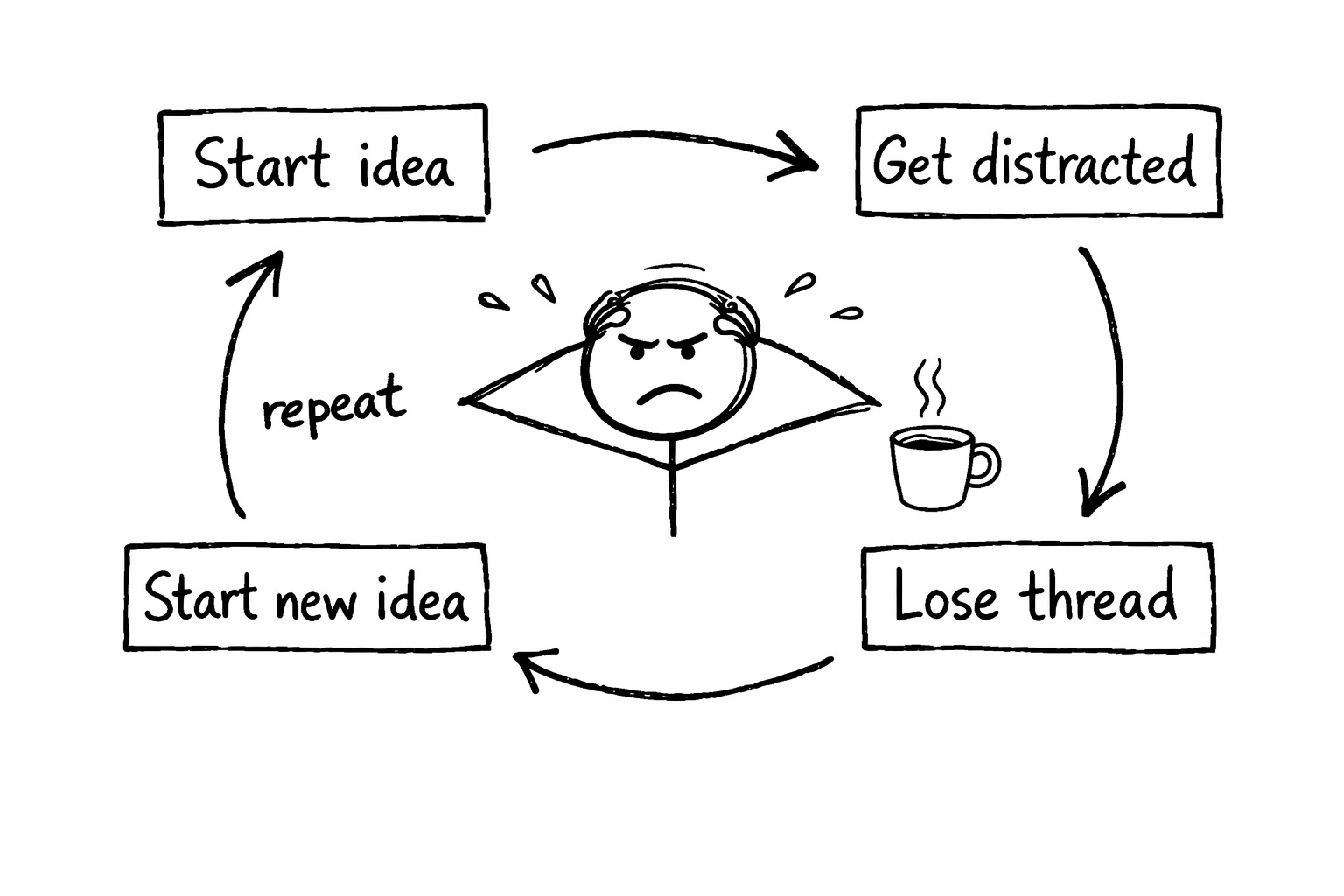
You Keep Leaving Before It Gets Good
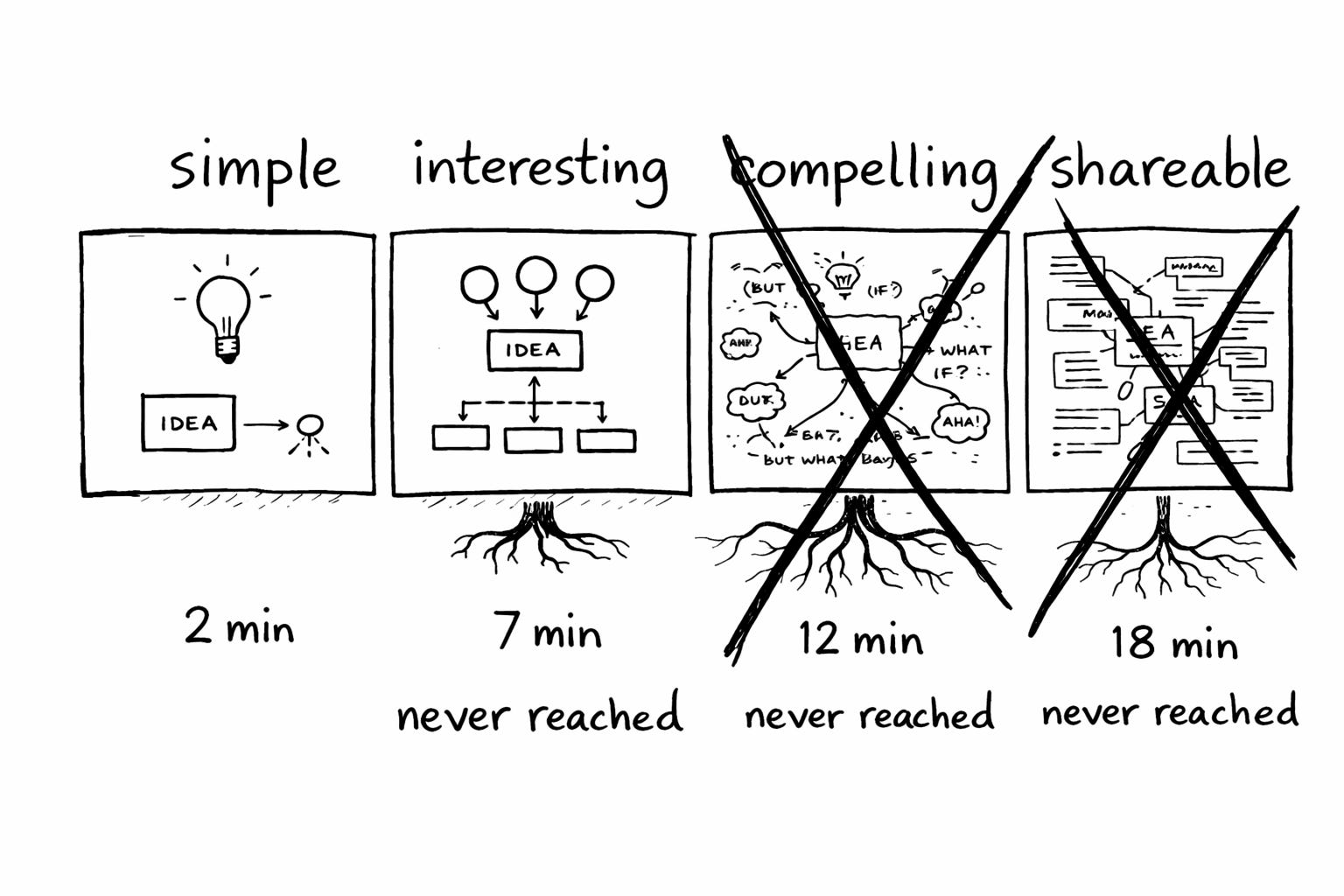
Ideas have layers.
Layer 1: The obvious take. What everyone says. The thing that would show up on page one of Google.
Layer 2: The complication. “But actually...” The wrinkle that makes it interesting.
Layer 3: The synthesis. Contradictions stop contradicting and start producing something original. Most writers bail before they get here. It's like the good part of Ohio. (I assume it exists. Ohioans seem defensive enough to suggest they're hiding something.)"
Layer 4: The implication. What this means for everything else. Where your ideas connect to your reader’s life in ways they didn’t expect.
Most writers operate at Layer 1. Sometimes Layer 2.
Not because they’re stupid. Because they don’t stay long enough.
Layers 3 and 4 require sustained attention. Ten minutes minimum. Often longer. Your brain needs time to make connections that aren’t obvious. Your subconscious needs room to work. (It’s doing things in there. Important things. You just keep interrupting it to check if anyone liked your tweet.)
If you’re switching every two minutes, you’re locked out of the good stuff. You’re standing outside the party, looking through the window, telling yourself you didn’t want to go anyway.
You Did This to Yourself
Your attention span isn't shot because you're weak or undisciplined or because you were dropped as a child. You were dropped as an adult. By yourself. Repeatedly. Into TikTok.
You're not broken. You're well-trained.
Every tab switch. Every phone check. Every “I’ll just quickly look at...” that turns into seventeen minutes of nothing.
You’ve practiced fragmentation tens of thousands of times. You’re an elite-level context-switcher. If there were Olympics for abandoning thoughts mid-formation, you’d be on a Wheaties box.
The good news: attention is a skill. Skills are trainable.
The bad news: you’ll have to actually train it. Sitting with discomfort. Not switching when the itch arrives. Being present with your own thoughts long enough to find out what’s actually in there.
That's harder than any writing technique you'll ever learn. Too bad. Do it anyway.
The Starting Point
Before you can fix this, you need to know where you actually are.
This week, try the honest diagnosis:
Set a background timer when you sit down to write
Note every time you switch (even for a second)
Record the time between switches
Do this for three writing sessions
Calculate your average uninterrupted span
No judgment. Just data.
(I use Rize for this because I can’t be trusted to track my own switches. My brain edits the footage in post. Rize doesn’t.)
You can’t train what you can’t measure. And most writers have never measured this. They assume they’re focused because they’re “working.”
I’ve “worked” for entire afternoons and produced nothing but typing. Hours of sophisticated finger movement. Zero thought.
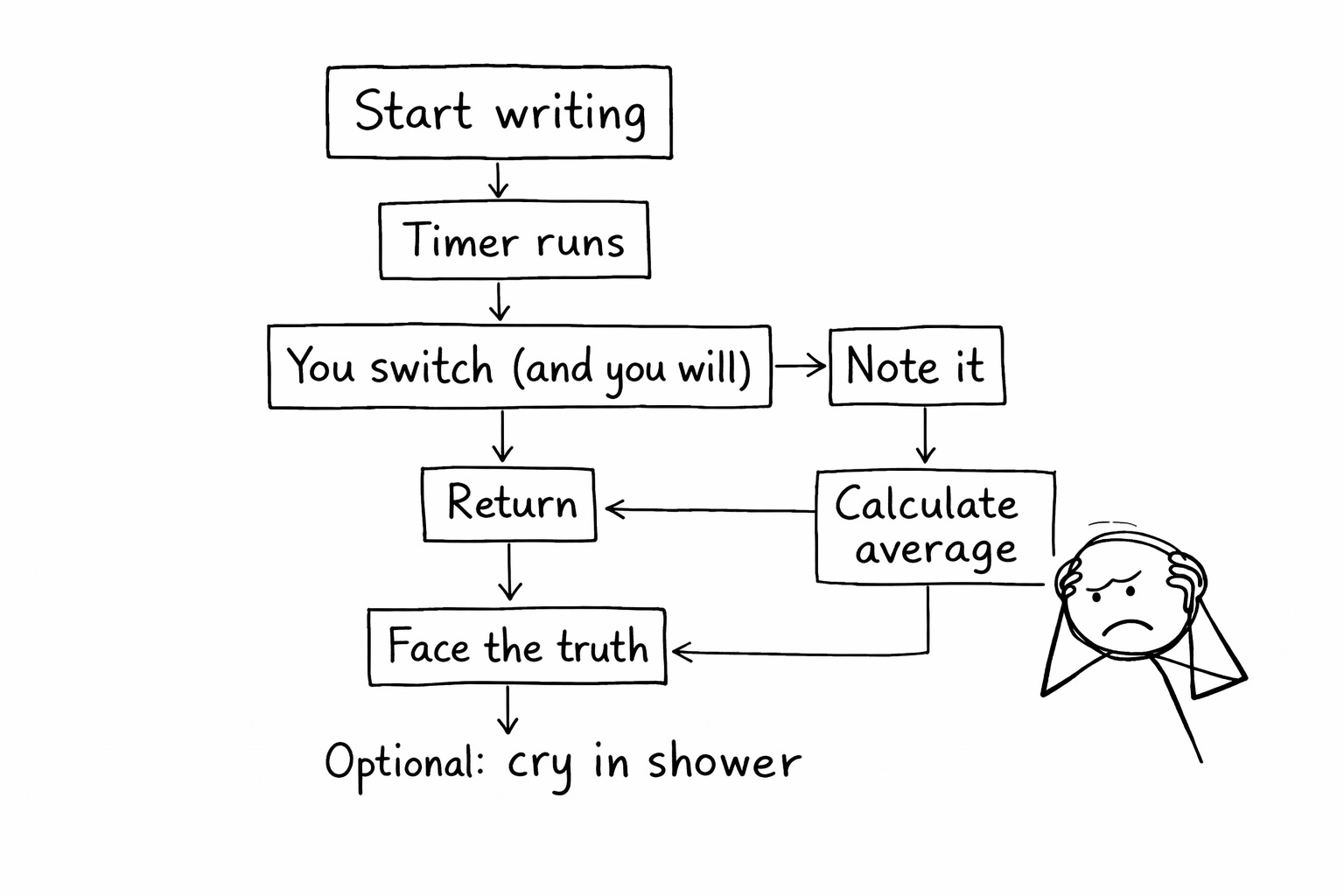
Once you have the data, you have a baseline. Then you can start extending it. Deliberately. Through protocol, not willpower. (Willpower is a lie we tell ourselves to feel virtuous while failing.)
But that’s next week. For now, just measure.
The number will probably be uncomfortable. Good.
Get to minute ten. The rest follows.
🧉 What pulls you out? Slack? Twitter? The refrigerator? Name your assassin. Mine’s WhatsApp.
Crafted with love (and AI),
Nick “Fifteen Goddamn Minutes” Quick

PS… I write every day for creators who refuse to let algorithms flatten their personality into a mushy paste. Subscribe if you’ve got taste and a grudge against mediocrity.
PPS… Manual tracking? Please. You’ll do it once, lie about the numbers, and forget. Rize watches you like a disappointed parent who still loves you.
Focus is becoming rare and rare these days! turning notifications from everything, like, everything has helped me a lot.
Oh shit... shots fired! :)