
Why “Conversational Tone” Is the Most Useless Prompt Instruction Ever Written
Or: How I learned to stop describing and start constraining

“Write in a conversational tone.”
I’ve typed this instruction approximately 400 times. It has never once worked. Not mostly didn’t work. Not worked if you squinted and lied to yourself. Never. Zero. A batting average so bad it would get you cut from a little league team in Idaho. (No offense to Idaho. They have... actually, what do they have? Lots of reasons to leave, apparently.)
For months I assumed the problem was me. Maybe I wasn’t being specific enough. So I piled on more words like a nervous chef oversalting a steak.
“Conversational but professional.”
“Engaging yet authoritative.”
“Like a smart friend explaining something over coffee but not like that one friend who corners you at parties to explain why seed oils are slowly killing you.”
Still garbage. Eloquent, adjective-heavy garbage.
Progress.
Let me show you the sausage-making behind why this keeps failing. And then I’ll give you the formula that actually fixed it. (Yes, it’s an acronym. I’ve become the thing I swore to destroy.)
The Math of Mediocrity, or: How I Learned to Stop Worrying and Accept That AI Is Averaging Us Into Oblivion
Here’s what happens when you type “conversational tone” into any AI tool.
The model doesn’t think: “Ah, they want THEIR version of conversational—that slightly unhinged energy of someone who’s had exactly the right amount of Kentucky bourbon.” It thinks: “Conversational. Let me average every conversation I’ve ever seen.”
And that’s precisely what the beautiful bastard does.
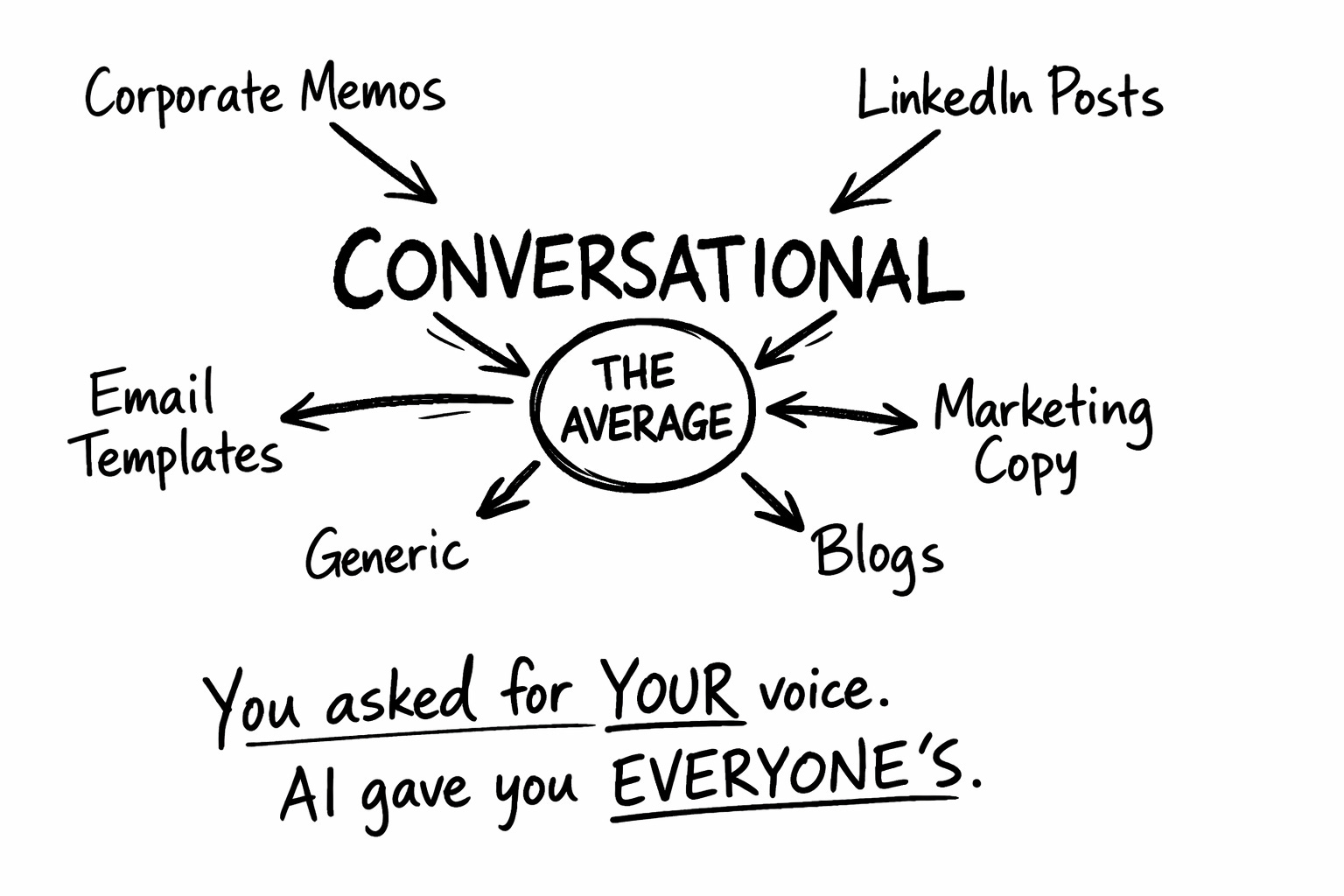
When you ask for “conversational,” you’re not asking for YOUR conversational. You’re asking for the statistical mean of every conversation ever written. Every corporate memo that tried too hard. Every LinkedIn post that opened with “I’m proud to humbly announce.” Every thought leadership piece written by someone who uses “paradigm shift” without irony.
The machine averages them all together and hands you the result like a cat presenting a dead bird. Look what I made. Aren’t you proud.
Every vague instruction is a request for an average.
“Engaging” = average of engaging.
“Professional” = average of professional.
“Authentic” = average of authentic.
(Which, if you think about it for more than three seconds, is the opposite of authentic. Authenticity by committee. The written equivalent of a building designed by forty architects who all had to compromise.)
This is why most AI output sounds the same. Not because AI is bad at writing—honestly, its pattern-matching abilities would make a savant jealous. The problem is you’re asking for patterns that literally everyone asks for.
Same input. Same output.
You wanted convergence. Congratulations. You got it.
Why “Be More Specific” Is Advice Written By People Who’ve Never Tried It
Here’s where I made the same mistake everyone makes, and I do mean everyone, which means you’ve probably made it too, and we can feel stupid together. (Misery loves company. Stupidity demands it.)
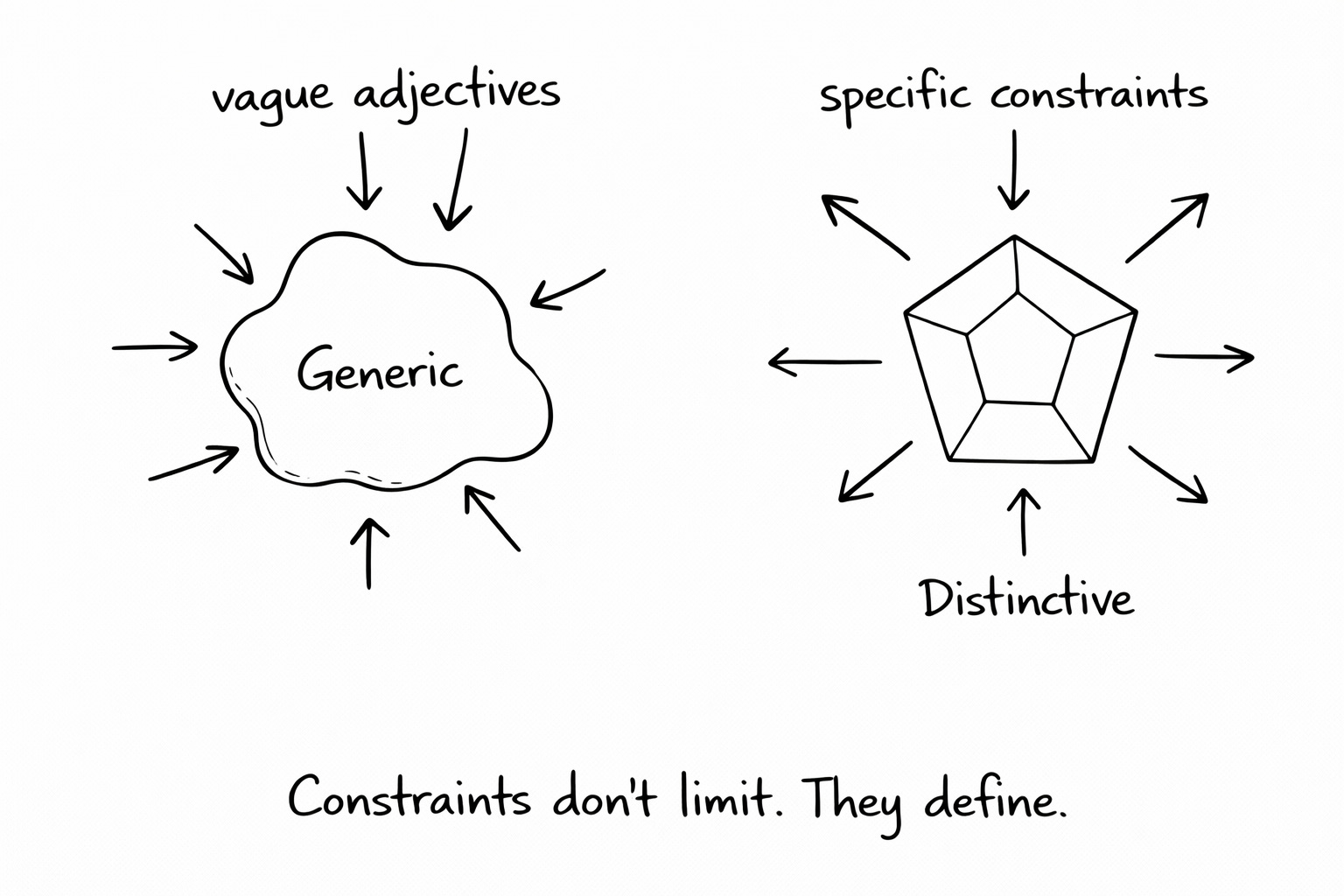
I heard “be more specific” and translated it into “add more adjectives.” So my prompts became word salads of aspiration. Great heaping piles of descriptors arranged in sentences that technically parsed but communicated nothing.
“Write in a conversational, engaging, authentic tone that feels warm but professional, like a knowledgeable friend who’s also an expert but doesn’t talk down to people while maintaining credibility and approachability and could you also make it punchy but thorough and fun but serious at just the right moments...”
I was stacking vague on vague on vague. Like giving directions by saying “go sort of north but also kind of east, and when you feel like you’ve gone too far, you probably haven’t gone far enough, unless you have, in which case turn around but not all the way.”
The problem isn’t word count. It’s word type.
AI doesn’t need more descriptions of what you want. It needs instructions it can actually follow. Constraints it can’t weasel its ass out of. Examples it can pattern-match against with the obsessive precision of a dog who’s memorized the exact location of every squirrel in a three-block radius.
Not adjectives. Actions.
The category shift that finally worked: stop describing the destination. Start giving turn-by-turn directions. Stop painting a picture of the meal you want. Hand over the damn recipe.
The C.R.I.S.P. Formula
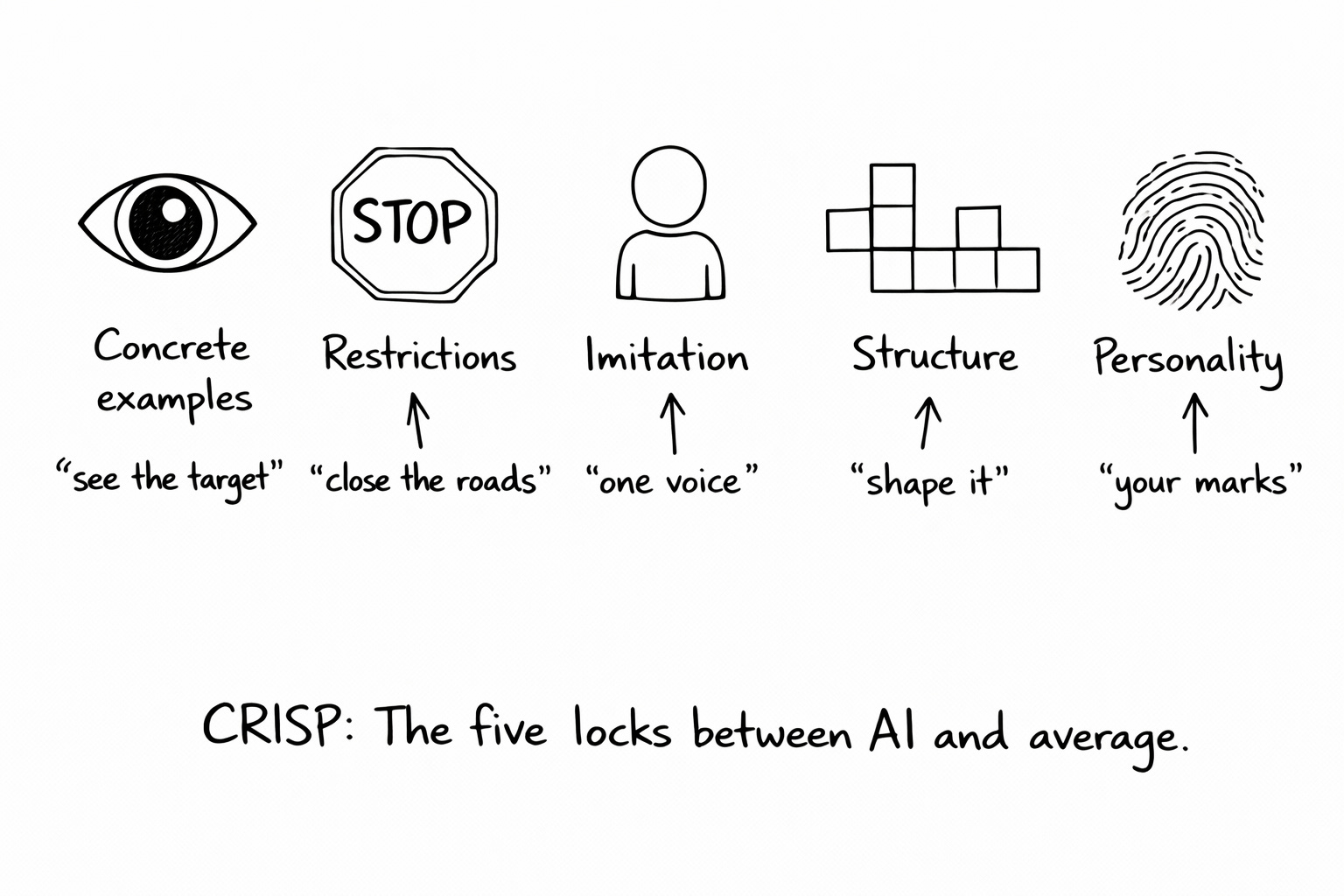
C.R.I.S.P. stands for five types of instructions that force AI off the average and onto YOUR specific patterns:
C — Concrete Examples
R — Restrictions That Force Divergence
I — Imitation Targets
S — Structural Mandates
P — Personality Injections
Each one gives AI something it can actually execute—not something it has to interpret. And interpretation is where the trouble starts. Give AI room to interpret and it will interpret itself straight back to the mean, every single time.
C — Concrete Examples (Show, Don’t Describe, For the Love of God)
Don’t describe your voice. SHOW your voice.
This is the single most powerful thing you can do in any prompt, and it’s the thing almost nobody does because it feels like cheating. It’s not cheating. It’s giving AI the only thing it actually understands: patterns to copy.
Paste 150–200 words of your actual writing… something from the night your paragraphs unionized, demanded better metaphors, and you agreed because they had a megaphone and a very persuasive octopus.
AI can’t hit a target it can’t see.
Before: “Write in my style”
After: “Match the voice in this example: [paste your sample, you coward]”
If you’re thinking “I don’t have good samples of my writing”—yes you do. That email you wrote at 11pm when you were pissed off about the project going sideways. Those Slack messages that made your coworker snort coffee through their nose. That LinkedIn post you almost deleted because it felt too you. That’s the stuff. Your authentic voice exists. It’s just scattered across platforms like evidence at a crime scene.
Go find 200 words of it.
R — Restrictions That Force Divergence (The Art of Telling AI What It Can’t Do)
Tell AI what it CAN’T do.
This sounds backwards, like trying to sculpt by describing which marble to leave. But restrictions are the fastest path to originality. When you ban the obvious choices, AI is forced to find alternatives. It has to diverge from the average because you’ve blocked the average. You’ve put up roadblocks on all the highways to Mediocrity City.
Before: “Be original”
After: “Never use these words: leverage, crucial, seamlessly, navigate, utilize. Never start sentences with ‘This’ or ‘It is.’ No paragraphs longer than 4 sentences. And if you use the word ‘delve’ I will personally reach through the internet and unplug something.”
Here’s your starter banned list—words that scream “AI wrote this” so loudly they might as well come with a confession attached:
delve, embark, leverage, utilize, crucial, pivotal, paramount, seamless, navigate, multifaceted, comprehensive, robust, cutting-edge, game-changer, groundbreaking, transformative
And phrases to kill immediately, with prejudice, without remorse:
“In today’s [anything] world” “It’s important to note” “Let’s dive in” “At the end of the day” “When it comes to”
Every word you ban is a path toward the average you’ve closed off. Close enough of them and AI is forced to take the scenic route. Which, turns out, is where your voice lives.
Constraints breed creativity. For humans AND machines, apparently.
I — Imitation Targets (Pick One Person, Not Everyone Who’s Ever Lived)
Name a specific voice to channel.
“Engaging” is an average. A giant, mushy, meaningless average that encompasses everything from carnival barkers to funeral directors who are really trying their darnedest. “Write like [specific person] would explain this” is a target. A singular, concrete, aimable-at target.
Before: “Be engaging”
After: “Write like Anthony Bourdain would explain this to someone who’s never tried the cuisine—curious, slightly irreverent, probably a little buzzed, definitely opinionated, willing to call bullshit when he sees it but genuinely excited about the good stuff.”
The key is specificity. Not “write like a smart person” but “write like this particular person in this particular context talking to this particular audience after this particular amount of whatever they drink.”
Some targets I use:
“Explain this like Paul Graham explaining a startup concept to a founder who’s about to make a preventable mistake”
“Write this like Jerry Seinfeld doing observational comedy about the topic—finding the weird thing everyone does that nobody talks about”
“Frame this like Hunter S. Thompson covering a press release as if it were a crime against humanity”
A singular target beats the averaged target. Every. Single. Time.
S — Structural Mandates (The Shape of the Thing Matters More Than You Think)
Dictate the SHAPE, not just the feel.
Voice isn’t only word choice—it’s architecture. How you open. How long your paragraphs run. Where you put the punch. Whether you build to conclusions or drop them in the first sentence and then explain backwards.
Before: “Organize this well”
After: “Open with a one-sentence hook—something counterintuitive, something that makes them stop scrolling and think ‘wait, what?’ Second paragraph is a short story or specific example, not an explanation. Use sentence fragments for emphasis. No paragraph longer than 5 sentences. End with a single punchy line that doesn’t wrap things up neatly.”
Structure is where most prompts fail because people focus entirely on tone. Tone is subjective. Tone is interpretable. Tone is the thing AI will average back to the mean while you’re not looking.
Structure is mechanical. AI can follow structural rules perfectly if you give them. It’s a beautiful idiot savant—incapable of taste but devastatingly good at following instructions.
Quantify where possible:
“First sentence under 10 words”
“One paragraph that’s just a single sentence standing alone”
“Three short sentences in a row before the longer explanation”
P — Personality Injections (Be Specific About Your Weirdness)
Add specific tics, not general vibes.
Personality isn’t “be funny.” Funny how? Slapstick funny? Dry funny? Dark funny? The kind of funny that makes you laugh or the kind that makes you exhale slightly harder through your nose?
Personality is “include one self-deprecating aside in parentheses.” It’s quantifiable. Specific. Executable.
Before: “Add personality”
After: “Include one self-deprecating aside. (Put it in parentheses, like an afterthought that isn’t actually an afterthought.) One unexpected metaphor comparing something to something else nobody would compare it to. One sentence fragment under 5 words. One rhetorical question that you immediately answer yourself because you’re not actually looking for input.”
The more specific, the better:
“One moment where you admit you might be wrong about something”
“One comparison to something completely unrelated (cooking, sports, 90s action movies, the mating habits of sub-Saharan primates)”
“One sentence that’s just three words”
Vague personality requests get averaged out. Specific personality mandates get executed.
Your quirks are your moat. Don’t describe them in generalities. Quantify them like an obsessive ex cataloging red flags. But lovingly.
The Copy-Paste Template (For People Who Scrolled to Find the Practical Part)
(I see you. I respect you. I am you, most days.)
Here’s the full C.R.I.S.P. template. Copy it. Paste it. Fill in the brackets. Watch the output transform from “could have been written by anyone” to “could only have been written by me.”
VOICE MODEL:
[Paste 150-200 words of your writing that sounds most like you. The stuff
you wrote at 11pm. The stuff you almost deleted. That stuff.]

RESTRICTIONS:
Never use: [your banned words—start with: leverage, crucial, seamlessly,
navigate, utilize, delve, embark, unprecedented, game-changer]
Never start sentences with: [your banned openers—maybe “This” or “It is”
or “In today’s”]
Maximum paragraph length: [number] sentences
Never include: [structures you hate—maybe “In conclusion,” maybe numbered
lists, maybe that thing where every paragraph starts with the point]

IMITATION TARGET:
Write like [specific person] would [specific context]. Not “a smart person.”
A NAMED person. In a NAMED situation.

STRUCTURE:
Open with: [type of opening—maybe a counterintuitive claim, maybe a
confession, maybe already in the middle of a story]
Second paragraph: [what goes here—a specific example? a story?
definitely not an explanation of what you’re about to explain]
Paragraph rhythm: [short/long pattern—maybe “short-short-short-LONG”]
End with: [type of closing—not “In conclusion.” Never “In conclusion.”]

PERSONALITY:
Include: [specific element 1—maybe “one parenthetical aside”]
Include: [specific element 2—maybe “one absurd metaphor”]
Include: [specific element 3—maybe “one sentence fragment under 5 words”]
Tone: [specific descriptor—”slightly confrontational but not aggressive”
or “confident but willing to admit uncertainty”]
Want the expanded version with the full banned word list and five before/after examples? I put together the C.R.I.S.P. Prompt Kit. It’s free. It’s comprehensive. It’s the result of approximately 400 failures that you now get to learn from without the emotional scarring. Grab it:
Download The C.R.I.S.P. Prompt Kit
The Proof (Same AI, Same Topic, Different Universe)
Generic Prompt: “Write a short LinkedIn post about AI writing in a conversational, engaging tone.”
Generic Output: “In today’s rapidly evolving business landscape, AI collaboration has become crucial for success. It’s important to note that leveraging AI tools can help professionals navigate complex challenges and drive innovation. Perhaps the most compelling aspect is how these tools seamlessly integrate into existing workflows...”
(I want you to know that writing that hurt me physically. My fingers resisted. My soul left my body briefly. This is what we’re up against.)
C.R.I.S.P. Prompt: “Write a short LinkedIn post about AI writing.
VOICE MODEL: ‘Most advice about AI tools is garbage. Not because it’s wrong—technically it’s fine—but because it treats AI like a vending machine. Insert prompt, receive content. That’s not collaboration. That’s a transaction with worse output.’
RESTRICTIONS: Never use leverage, crucial, seamlessly, arguably, navigate. Never start with ‘In today’s’ anything. No more than 3 sentences per paragraph. If the word ‘delve’ appears, start over.
STRUCTURE: Open with a contrarian claim. One specific example. End with a short punchy statement.
PERSONALITY: Include one parenthetical aside. One sentence fragment under 5 words. Slightly confrontational but not aggressive. The energy of someone who’s tired of seeing the same mistakes.”
C.R.I.S.P. Output: “Most people use AI wrong. Not badly… just generically. They prompt for ‘engaging content’ and get the average of engaging. (Which, turns out, is pretty forgettable.) Here’s what works instead: constraints. Restrictions. Telling AI what it CAN’T do so it’s forced into specifics. The difference? Night and day.”
The AI didn’t get smarter between prompts. It didn’t evolve. It didn’t have a breakthrough.
It got better instructions.
The 60-Second Quick-Start (For People Who Are Already Late for Something)
Don’t have time for the full template? I respect that. I rarely have time for anything I recommend. Start with just three things:
Voice model: Find ONE piece of your writing you love. Paste it. Done.
Banned words: Pick TEN words from the list above. Add them. Not twelve. Not eight. Ten. A nice round number that your brain will actually remember.
One structural mandate: “Open with a counterintuitive claim” or “No paragraph longer than 4 sentences” or “End with a fragment.”
That’s minimum viable C.R.I.S.P. Three elements. Sixty seconds to implement. Noticeably better output than “write in a conversational tone.”
You can add more later. You probably will. The addiction to constraints is real and I will not apologize for getting you hooked on them.
Your Turn
I typed “conversational tone” for years before realizing I was asking for an average and getting exactly that. Which, in retrospect, is like walking into a bar and ordering “booze, please… but make it interesting.” You’re getting the well vodka. Every time.
The fix wasn’t better AI. The fix wasn’t finding the magic tool. The fix wasn’t some secret prompt library that “top creators don’t want you to know about.” (They do want you to know. They’re selling it for $97.)
The fix was giving AI instructions it could actually follow.
Constraints, not descriptions. Examples, not adjectives. Restrictions, not aspirations.
The AI didn’t change. Your instructions did.
Build your template this week. Start with just C and R. Reply with ‘🌶️’ if you’re in.
What’s in your banned word list? Drop the AI-isms that make you cringe—the words that, when you see them in output, make your eye twitch with the recognition that you’ve once again produced something anyone could have written. Let’s build a master list in the comments.
(Know someone still typing ‘engaging and conversational’? Send them this. Consider it an intervention. They won’t thank you. But they’ll stop posting hot , and that’s basically the same thing.)
Crafted with love (and AI),
Nick “The Prompt Interventionist” Quick

PS…This is one framework. I have more. Subscribe and I’ll send them to you like a man slowly revealing that he’s thought way too hard about this. Which I have. No regrets.
You're not alone.
'Conversational' is the panic button we all hit when nothing else works. The problem is the panic button is wired to a machine that averages panic buttons.
Now we have the unlock kit. Go forth and ban words 💪
Brilliant article and advice! And ummm confession time, I ABSOLUTELY still ask AI "be conversational!!!!!" from time to time, mostly when I'm deep into an email and I'm super annoyed 🤣