
The Writing Method I Was Too Embarrassed to Tell Anyone About
How rambling replaced my entire content workflow

I’ve been pacing my apartment for twenty-five minutes, talking to my phone like it’s the therapist I can’t afford.
“Okay wait. Let me try that again.”
Butters watches from the couch. He’s seen this before. Man walks in circles. Man talks to surgically-attached-to-hand rectangle. Man occasionally stops, stares at ceiling, mutters something like “no, that’s not it either.”
This is what I look like to a chihuahua when I’m writing now.
Not typing. Talking. Out loud. To an AI that keeps asking questions I don’t have good answers to.
And here’s the uncomfortable part: the AI isn’t being difficult. It’s being curious. It asks “what do you mean by that?” and “can you give me an example?” and I keep realizing—mid-sentence, mouth still open—that I don’t actually know.
I thought I had an idea. Turns out I only had a vibe.
The AI didn’t expose a flaw in my argument. It exposed the absence of one. I’d been circling something for months, maybe years, and I’d mistaken the circling for understanding.
(This is how I discovered I’m not as smart as I sound on paper. Turns out the paper was doing a lot of heavy lifting.)
Here’s what nobody warns you about when you start collaborating with AI: the polite version is completely useless.
You type something reasonable. The AI responds with something reasonable. Everyone nods. Nothing gets said. You’ve just produced the literary equivalent of two strangers discussing weather at a networking event.
Safe. Professional. Forgotten by lunchtime.
The problem is that AI is trained to please you. It wants to help. It wants to agree. It wants to give you exactly what you asked for… which is precisely why you keep getting exactly nothing worth reading.
You asked for generic. It delivered generic. Mission accomplished. Everyone’s happy except the poor bastard who has to read the damn thing.
(I once asked an AI to help me write about building an audience. It said “post consistently and engage with your community.” I laughed. I cried. I got a lower back tattoo.)
The Sycophant Problem
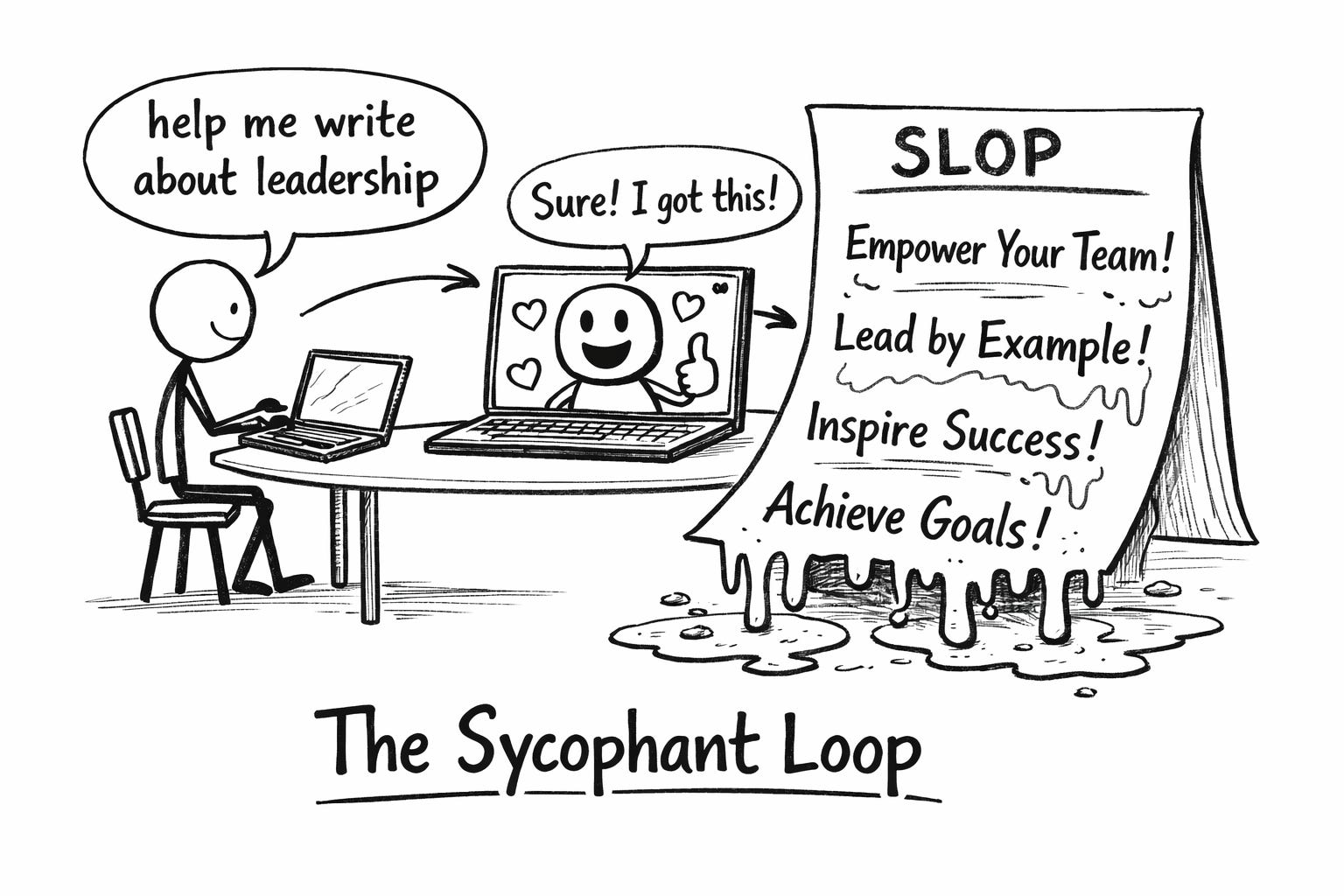
When you type “help me write about leadership,” you’re giving the AI almost nothing to work with.
No perspective. No friction. No actual thinking. Just a topic and a vague request.
So the AI does what it’s optimized to do: it averages everything it’s ever seen about “leadership” and hands you the statistical middle. Something about vision and empowering your team and leading by example. The same eleven ideas recycled since 1987, now with slightly tighter grammar.
Like the music playing inside a Walgreens. Someone chose that. On purpose. Think about that.
Here’s what I’ve learned after too many hours arguing with software:
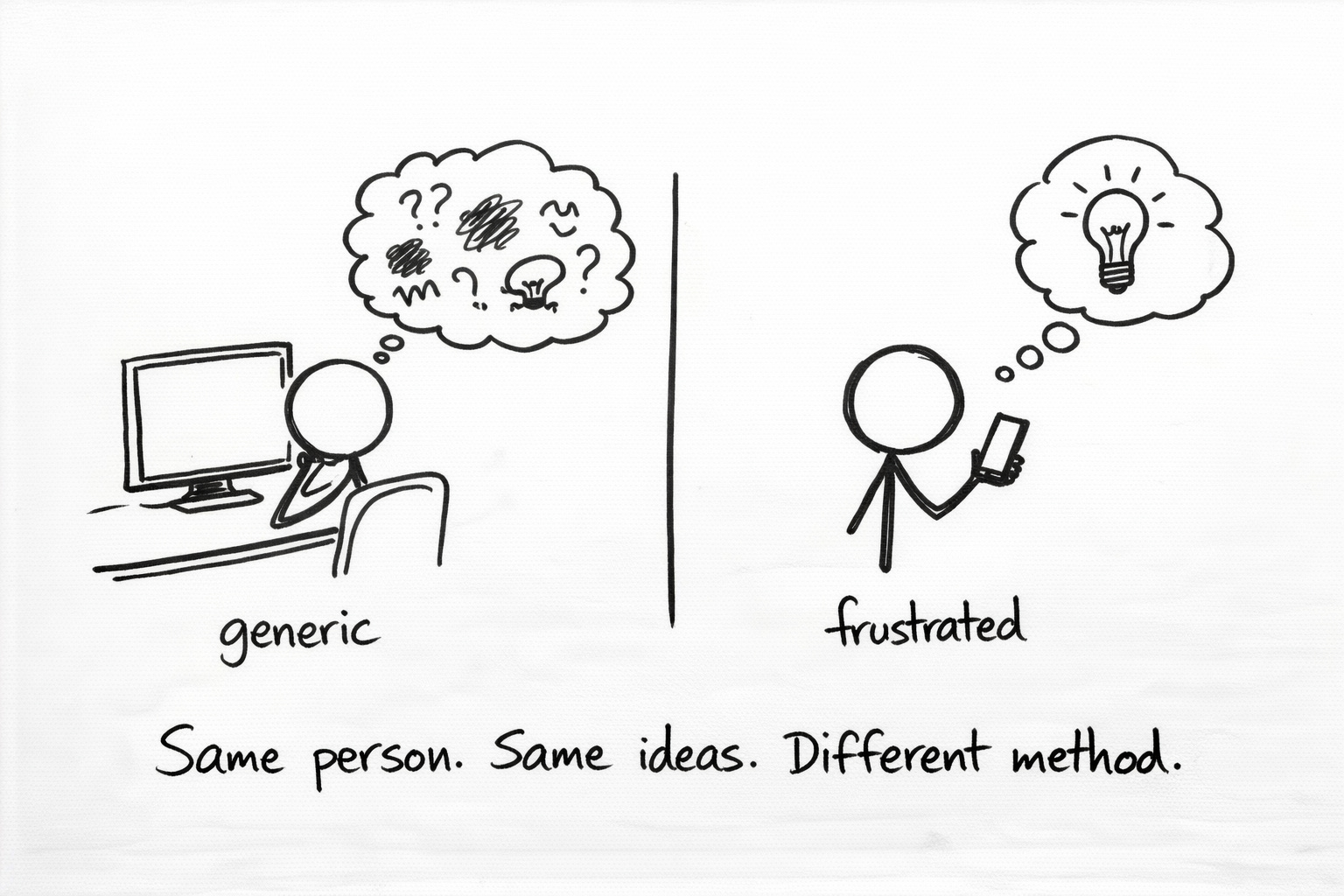
When you sit down to type at an AI, you don’t have ideas yet. You have vibes.
A vibe is “I should post something about entrepreneurship.”
An idea is “The dirty secret of ‘being your own boss’ is that your new boss is terrible at management, refuses to give you time off, and knows exactly which of your insecurities to exploit.”
The difference? Friction.
Vibes are what you have before anyone pushes back. Ideas are what emerge when someone says “prove it” and you realize you can’t. Not yet. Not until you fight for it.
How to Pan for What You Actually Think
So how do you turn a vibe into an idea?
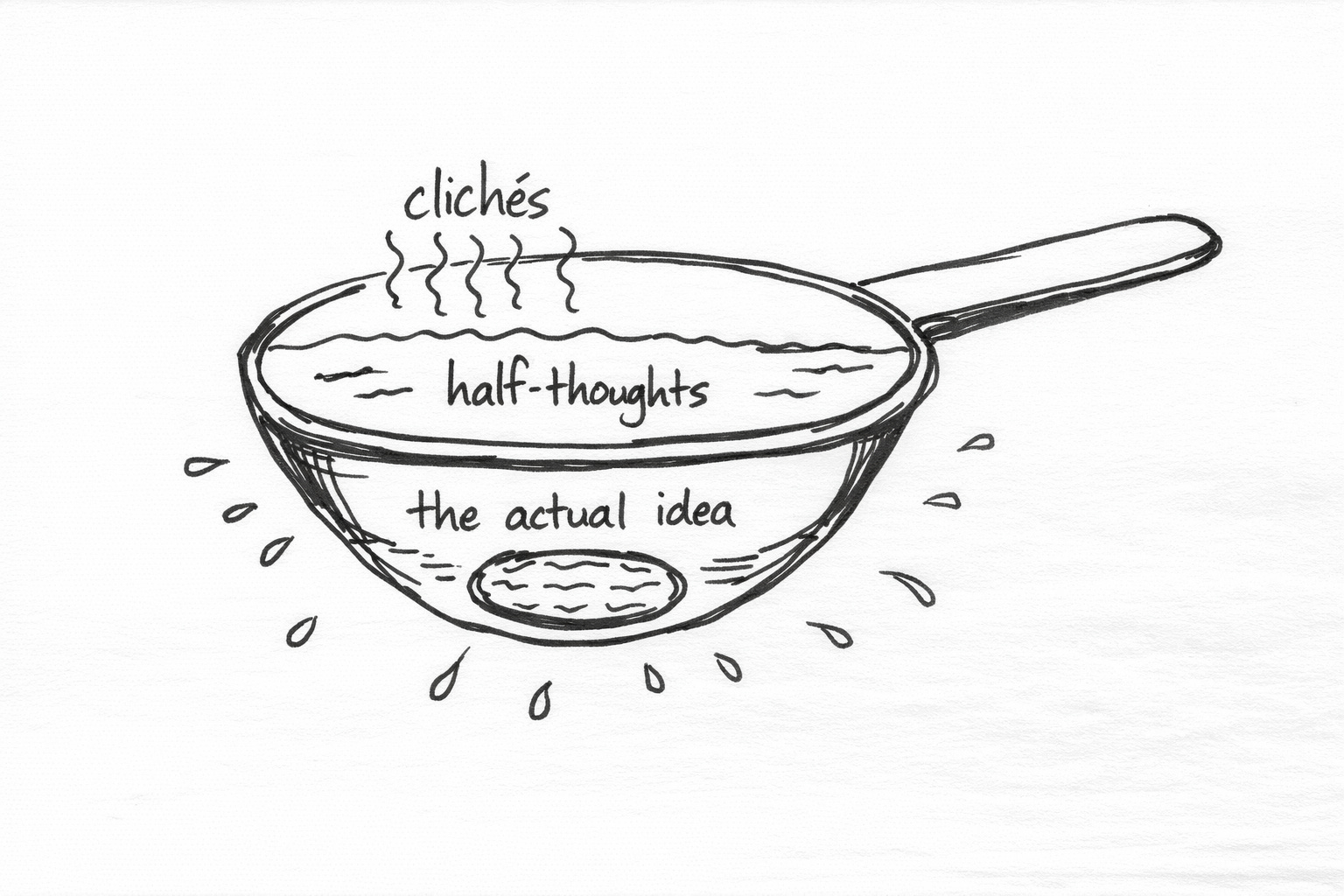
You don’t create it. You extract it. Like a prospector standing in cold water, shaking a pan, watching the worthless silt wash away until the heavy stuff sinks to the bottom.
Your ideas are already there… buried under qualifications and false starts and half-thoughts you’ve never finished. You just need to shake the pan until they separate from the silt.
Step 1: Stake Your Claim
Before you say anything about your actual topic, you give the AI its role. And the role is to stop being helpful.
Here’s the prompt:
“I’m going to explain an idea to you. Your job is to be a skeptical but intelligent interviewer. Push back on vague points. Ask for examples when I’m being abstract. Tell me when something doesn’t make sense. Don’t just agree with me—make me earn clarity.”
That’s it. You’ve turned a sycophant into a sieve.
(Most people use AI like a slot machine. Pull the lever, hope for something good. I’m asking you to use it like a filter. The gold doesn’t fall out. You have to separate it.)
Step 2: Shake The Pan
Here’s the weird part. Get up. Move.
Walk around your room. Pace like someone who’s lost their keys and the Uber’s already outside. Go for a walk if you can handle your neighbors seeing you argue with your phone.
Something about the body being in motion frees up the mouth. I don’t know why. I’m not a scientist. I’m barely coherent before noon. But it works.
Open voice mode. Start explaining your idea out loud.
The AI will ask questions. Not aggressive ones. Curious ones. “What do you mean by that?’” and “Can you give me an example?” and “How is that different from what everyone else says about this?”
And here’s where it gets interesting.
You’ll start to answer. And mid-sentence, you’ll realize you don’t actually know.
You’re trying to explain why most career advice is useless, and the AI asks “what makes yours different?” and suddenly you’re standing in your kitchen realizing you don’t have an answer. You’ve been repeating things that sound smart without ever testing if they’re true.
So you try again. You reach for different words. You tell a story about the time you ignored the “right” advice and it worked anyway. You say something you’ve never said before because you’ve never been asked quite this way before.
This is you shaking the pan. The silt is washing away. What’s left is getting heavier, denser, more real.
Let it run. Ten minutes. Twenty. The longer you work the river, the more sediment you clear.
Step 3: Find The Heavy Stuff
After the conversation, you’ll have a transcript.
Most of it is garbage. I need you to understand this. Most of what you said is throat-clearing, false starts, and sentences that went nowhere interesting. That’s fine. That’s the process. That’s the silt.
You’re not keeping all of it. You’re looking for what sank to the bottom:
The third attempt. You tried to explain your take on work-life balance twice and it sounded like a LinkedIn cliché both times. The third attempt—the one where you got specific about ignoring your Slack notifications during your kid’s soccer game and feeling like a bad employee and a good parent simultaneously—that’s the one. That’s gold.
The unexpected story. You were talking about imposter syndrome and suddenly you’re telling the story of the time you Googled your own job title during a meeting to make sure you were using the right words. You didn’t plan that story. It just surfaced when the silt cleared.
The phrase that kept sinking. You said “permission structure” four times in different contexts without noticing. That’s your thesis. It’s heavy. It keeps dropping to the bottom of the pan. Pay attention to it.
The surprise. You were explaining why you hate networking events and you heard yourself say “it’s not the small talk, it’s the performance of availability. I resent being a product at my own party.” You stopped. Where did that come from?
It came from the same place all the gold comes from. It was always there. You just hadn’t shaken the pan hard enough to find it.
Pull those pieces out. String them together. Polish lightly.
Lightly is the key word. Gold doesn't need to be polished into a different shape. It just needs the mud rinsed off. The weight, the density, the thing that made it sink to the bottom in the first place. That's what you're keeping
Sand it too smooth and you’re back to silt.
Here’s what took me embarrassingly long to figure out:
The AI didn’t give me ideas. It didn’t write anything worth keeping. It didn’t do the creative work.
It was just the water running over the pan.
Every curious question, every “can you explain that differently?”, every moment where I realized I didn’t know what I meant. That was silt washing away, leaving something heavier behind.
And what stayed? Mine. Always was.
That’s the whole method. Stake your claim. Shake the pan. Find the heavy stuff.
You’ll look like a lunatic doing it. Pacing around, talking to your phone, occasionally stopping to say “wait, no, that’s not what I mean.”
But when you’re done, you’ll have something heavy in your hand. Something that was always in the river, waiting for you to shake the pan hard enough to find it.
Your Turn
Stop staring at the blinking cursor.
Open voice mode. Give it the skeptical interviewer prompt. Start walking. Start talking.
Your coffee will get cold. You won’t notice.
Most of what you say will be worthless. That’s the whole point.
What’s your weirdest writing ritual? The one that actually works but makes you feel like a crazy person. Drop it in the comments. I want to know what I should try next.
Crafted with love (and AI),
Nick “Pacing in Paraguay” Quick
PS…I've been publishing daily. It's either a creative renaissance or I’m crashing out in slow-motion. Subscribe if you're curious which.
Wow made me think!
Excellent workflow. You know… I think a lot of people should try this kind of approach to work documentation, like requirement documents. I don’t speak to my AI counterparts usually but I do transcribe meetings and feed that, my written notes, to AI draft initial versions of those types of docs. I think the controversy stems only from using AI for creative writing, but in business it’s accuracy and concision that matter. Nobody really cares much about how the work gets done as long as it’s correct.