
The Slop Factories Are Coming for 2026. Here’s Your Battle Plan.
The quarter-by-quarter methodology for beating the content machines without becoming one.

I’m going to ruin your New Year’s optimism in about thirty seconds.
Every productivity guru who discovered AI in 2024 spent all of 2025 teaching their audience to do it too. Thousands of creators. Millions of posts. All of it converging toward the same algorithmic average—optimized, polished, professionally meaningless content that sounds like a LinkedIn influencer who recently discovered stoicism and won’t shut the f#ck up about it.
2025 was the warm-up round.
2026 is when the slop factories go industrial strength.
And you’re about to compete with all of them.
(Happy New Year.)
The War You’ve Already Lost
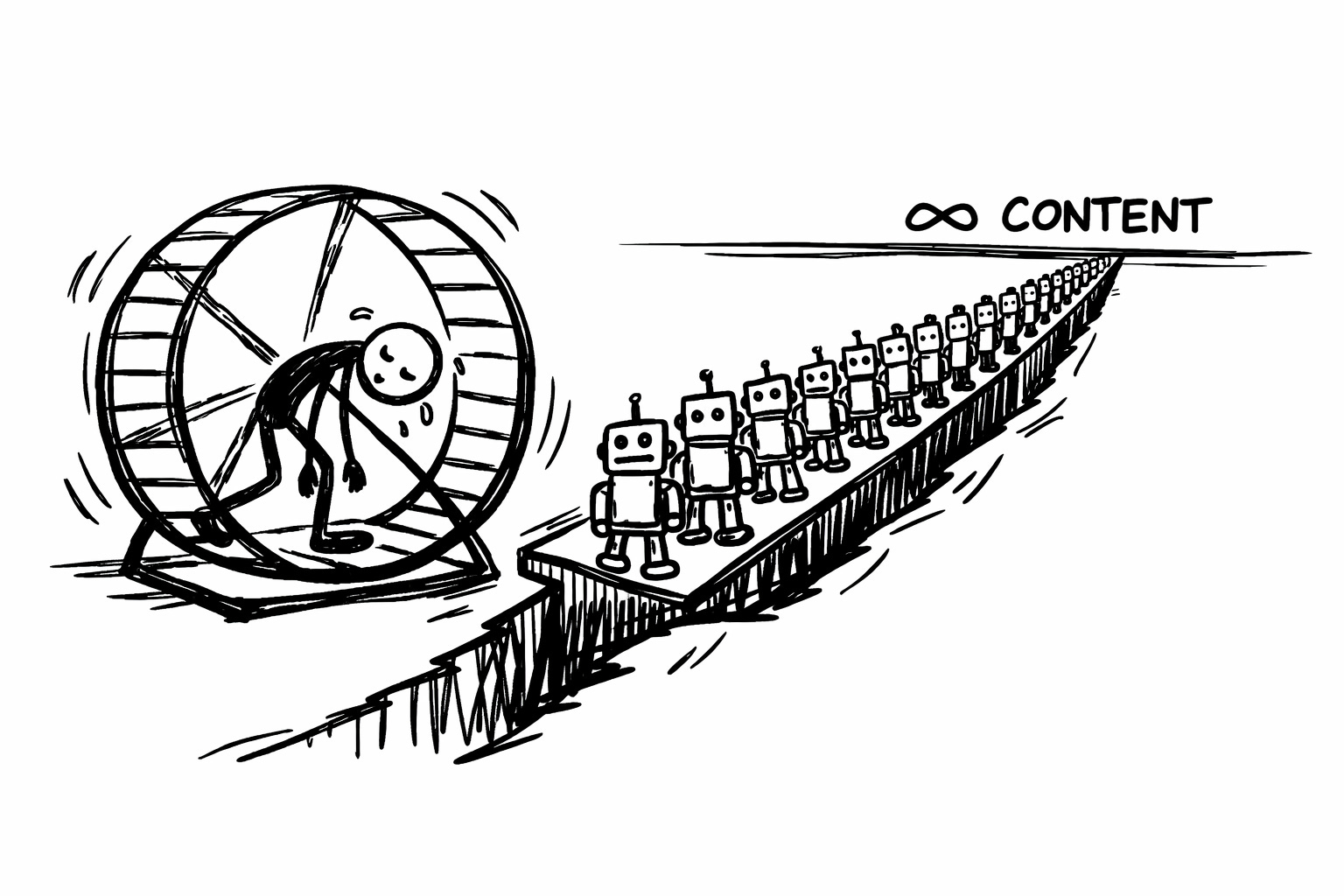
Here’s the math, since we’re already depressing ourselves: you’re not going to out-produce them.
You weren’t going to out-produce them in 2025. You definitely won’t in 2026. The slop factories run assembly lines. They’ve optimized for volume because volume is all they have. Content without a soul can be manufactured infinitely. Soullessness, it turns out, scales beautifully.
While you’re crafting one piece you’re proud of, they’re publishing fifty. While you’re agonizing over comma placement, they’re churning out posts with the emotional depth of an airline rebooking notification.
The math never gets better. Every new AI update makes their assembly lines faster. Every “10X Your Content Output” course adds more factories to the feed. Every creator who decides “quantity over quality” piles more noise onto the internet.
I’m calling this phenomenon enslopification. (If enshittification is platforms rotting from above, this is the rot rising from below.)
You could try matching their pace. You could sacrifice sleep, relationships, your remaining will to live… all in service of “staying visible.” You could grind until your personality becomes a series of increasingly desperate content pillars.
You’d still lose.
And here’s the part nobody wants to admit: you were never going to win that war anyway. The volume game was always unwinnable for people who actually give a damn about what they publish.
The factories will keep churning. The slop will keep rising. And trying to outrun it on foot was always a losing strategy.
The War Worth Fighting
The good news (we’re doing good news now, apparently) is there’s another game entirely.
The slop factories produce content that sounds like a placeholder that forgot to get replaced. Optimize toward the average. Sand off every edge. Smooth it until reading it and not reading it become indistinguishable.
But one piece that sounds like someone wrote it—someone specific, with fingerprints on the work, with opinions they’re willing to defend—cuts through a hundred pieces that sound like they wrote themselves.
Humans are pattern-recognition machines. (Ironic, given how we keep building other pattern-recognition machines to replace ourselves.) We can spot a real voice in a sea of manufactured authenticity the same way you can spot a fake laugh at a networking event. Something just feels wrong about the alternative.
Craft beats slop. It always has.
But—and this is the part where we get honest—craft only beats slop if you can actually produce it at a pace that doesn’t destroy you in the process.
This is where most creators break. They recognize the slop problem. They commit to quality. They vow to out-craft the machines while still working manually.
Dawn-to-midnight sessions. Weekend grinds. The slow erosion of everything else in life that used to matter. Three months later, they’re either burned out, producing their own variety of slop, or staring at a blinking cursor wondering why they got into this racket in the first place.
(I’ve been all three. Sometimes in the same afternoon.)
Refusing to use AI doesn’t make you more authentic. It just makes you slower and more exhausted while the slop factories bury you. There’s no nobility in losing. Only exhaustion, and eventually, silence.
The answer isn’t “work harder.”
The answer is learning to use the tools without becoming the very thing you’re fighting.
The Two Things You Need
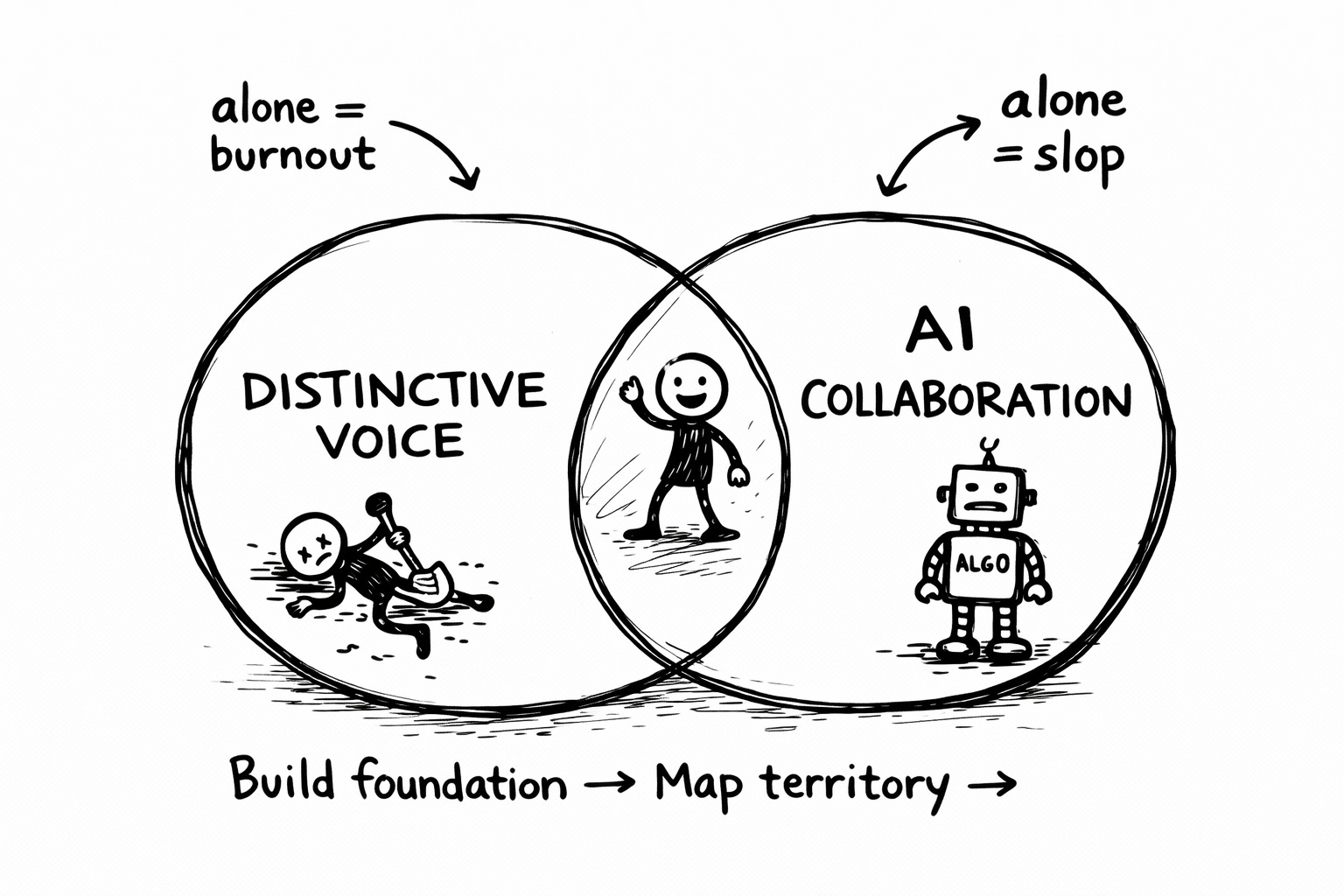
To beat the slop factories in 2026, you need two things. Not three. Not a “comprehensive five-pillar strategy.” Two.
One: A voice worth hearing. Patterns that are yours. Writing that couldn’t have come from anyone else. The kind of work that makes people think “I know exactly who wrote this” before they see the byline.
(This is harder than it sounds. Most people’s “authentic voice” is just a collage of influences they haven’t examined closely enough to see the rips in the seams.)
Two: The skill to produce it without burning out. Co-writing with AI in a way that keeps your fingerprints on everything. Collaboration, not automation. Your voice, amplified… not replaced by a statistically average approximation of human communication.
Neither skill is optional.
Voice without AI collaboration is burnout. Beautiful work, unsustainable pace. You produce one piece you’re proud of while the factories bury you in forgettable content. Eventually, you disappear. Not because you weren’t good. Because you ran out of gas.
Collaboration without voice is slop. You become the thing you swore you’d never become. AI writes it, you publish it, and somewhere deep in your creative soul, a small piece of you dies every time you hit “post.”
(The audience won’t notice at first. They’ll notice eventually. The uncanny valley of almost-human content is worse than obvious garbage. It’s the written equivalent of watching a deepfake try to smile.)
Both skills. Same year. Build them or get buried.
Your 2026 Battle Plan
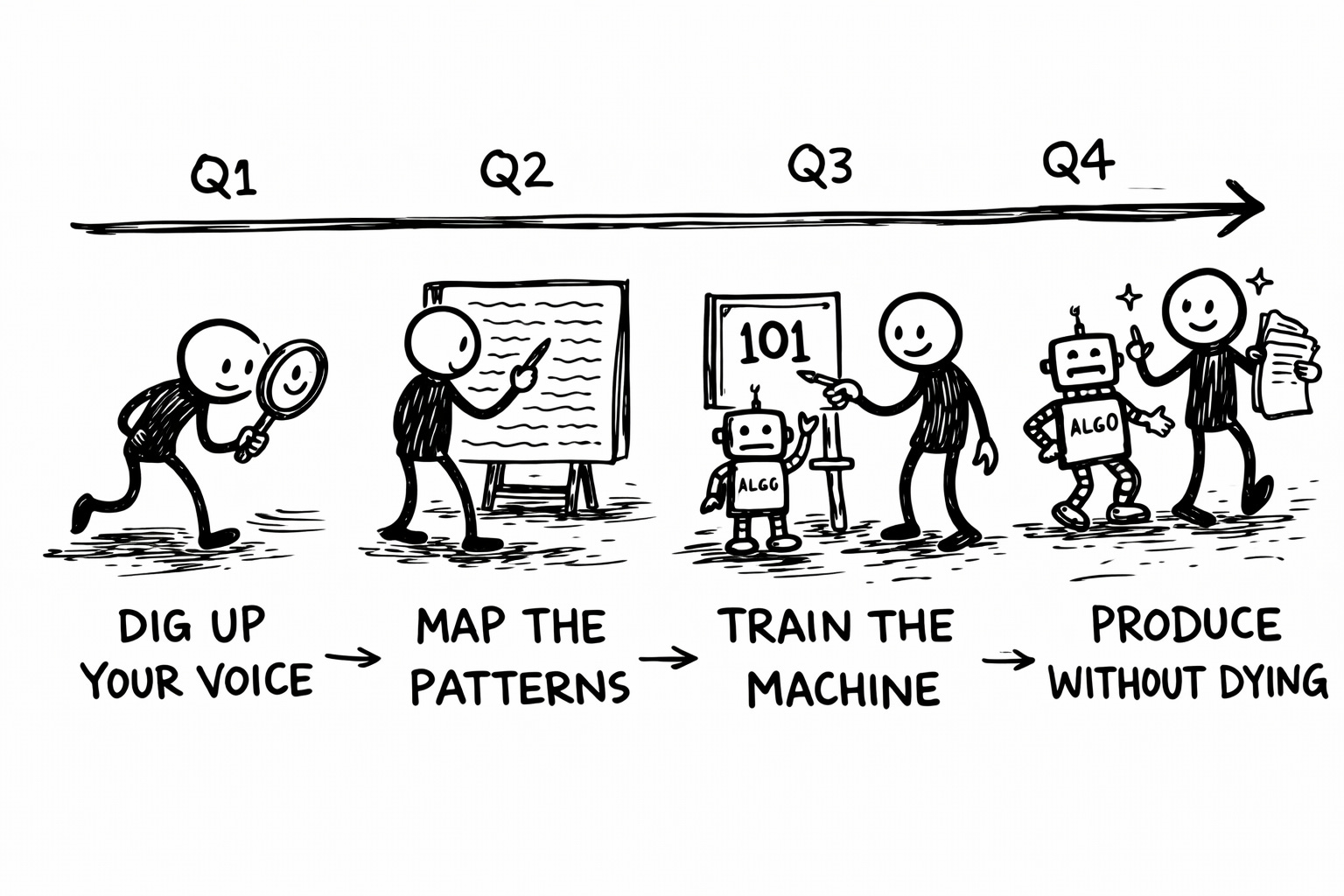
Four quarters. Two skills. Twelve months of actually doing the work instead of just reading about it.
(That last part is the hard one. We both know you’ve bookmarked a lot of advice you’ve never implemented. I have too. We’re all hypocrites here. The difference is whether we stay hypocrites.)
By December 31, 2026, the goal is simple: a distinctive voice that’s documented and AI-calibrated, a sustainable production pace that doesn’t wreck you, and a workflow that keeps your fingerprints on everything you publish.
The slop becomes background noise. You’re playing a different game.
Q1: Sharpen Your Blade (January–March)
Before you can document your voice, you need one worth documenting.
(Bold assumption: you have one. Most people do. It’s just buried under years of trying to sound “professional” and “optimized” and other words that mean “like everyone else but slightly more boring.”)
Q1 is excavation. Digging up what makes you you before some algorithm decides for you.
The Consumption Audit (Week 1-2)
For one week, track everything you consume. Newsletters, articles, books, podcasts, that weird thread you accidentally spent 45 minutes reading when you should’ve been working.
Mark what you love. What you’d want to have written yourself. What makes you jealous in a productive “I need to be better” way, not a destructive “I should give up” way.
Mark what you’d never do. What feels wrong. Off. Not-you. What makes your skin crawl like a cold caller who uses your first name four times in 37 seconds.
Your taste is a map. You just haven’t read it yet.
The Steal File (Ongoing)
Start collecting sentences that hit.
Not to plagiarize. To understand. When something stops you mid-scroll—a phrase, a structure, a weird little turn—capture it. Ask yourself: what made that work?
Review weekly. Patterns will emerge. The things you keep collecting will start to show you who you want to be on the page.
The Voice Inventory (Week 4-8)
Pull your last ten pieces of writing.
Read them looking for you, not quality. What makes these yours? What phrases keep appearing uninvited? What structures do you default to when you’re not thinking? What stances do you take without realizing you’re taking them?
Name what you’re already doing. Even the patterns you weren’t conscious of. Especially those.
Q1 Checkpoint: Can you list 3-5 specific patterns that make your writing recognizable as yours?
If yes: proceed.
If no: you’re not done. Stay in Q1 until you can.
Q2: Document Your Patterns (April–June)
You can’t teach AI what you can’t articulate.
This is where it gets uncomfortable. When you say “write like me,” AI has no idea what you mean. It doesn’t have your patterns no matter how many items ChatGPT has stored in its memory bank. It doesn’t have your lived history. It doesn’t have that time you heard a phrase in a coffee shop that lodged in your brain and shows up in your writing fifteen years later.
All AI has is a statistical model of what “writing” looks like across billions of documents. When it guesses what “you” sound like, it guesses toward the average. Which is, definitionally, slop.
Your job in Q2: build the map that makes AI stop guessing.
I call this your Voiceprint. (Yes, I named it. I’m that guy now.) It’s a detailed breakdown of exactly how you write, organized around four layers:
Vocabulary: What words do you overuse on purpose? What words would you never use even if someone paid you? What’s your relationship with jargon… do you embrace it, mock it, weaponize it? Do you curse? How often? When? Document your lexicon.
Architecture: How do you open pieces? (I jump straight into things without warning. It’s a personality disorder masquerading as a style choice.) How do you build arguments? How long are your paragraphs? Do you love lists or hate them? How do you close? Document your structures.
Stance: How do you position yourself to readers? Expert? Peer? Fellow idiot figuring it out in real time? How strongly do you state opinions? How vulnerable do you get before it starts feeling performative? Document your relationship.
Tempo: Short punchy sentences? Long flowing ones? Fragments everywhere? What punctuation defines your rhythm—parentheticals, em dashes, ellipses? How fast do you get to the point? (I take forever. Another personality disorder.) Document your cadence.
Here’s what “conversational” looks like in my Voiceprint: staccato bursts of 2-3 short sentences, then release with something longer. Parentheticals for the thoughts I probably shouldn’t say out loud but will anyway. Line breaks after every 2-4 sentences because dense paragraphs make me twitchy. Italics when a word needs to land.
That’s specific enough to follow.
“Conversational” is not.
Q2 Checkpoint: Could someone (or something) imitate your writing from this document alone?
Q3: Train Your AI (July–September)
The map is useless if you never use it.
Q3 is calibration. Teaching AI to read your Voiceprint and actually follow the damn thing. This isn’t one-shot prompting. This is iterative. This is work. This is the part that separates people who get results from people who complain that AI “doesn’t work.”
The First Feed
Give AI your Voiceprint document. Give it a writing task. Be stupidly explicit: “Follow the patterns in my Voiceprint document. I’m not asking for suggestions. Follow it.”
See what comes back.
(Spoiler: the first few attempts will be rough. Don’t panic. We’re calibrating, not performing miracles.)
The Critical Read
Read the output like you’re grading a student you’re mildly disappointed in.
Where did AI nail your voice? Mark it. Where did it drift generic? Mark that too. What patterns from your Voiceprint did it ignore? What did it add that you would never say in a million years?
(My AI kept trying to use the word “leverage.” We had to have a serious conversation.)
The Correction Loop
This is where the magic happens. (Not “magic.” Work. Concentrated, repetitive work. But it does work.)
Edit the output to make it actually yours. Then—this is crucial—document what you changed and why. Feed that back: “You said X, I changed it to Y because Z. Don’t do X anymore.”
Each cycle sharpens the calibration. The Voiceprint evolves. Your understanding of your own patterns deepens. (You’ll discover things about your writing you never noticed. Some of them will be embarrassing. This is growth.)
After 10-15 loops, AI should produce rough drafts that sound like you—not finished work, but starting points with your fingerprints on them. Something you’d edit, not rewrite from scratch.
Q3 Checkpoint: Is AI producing output that sounds like your rough drafts—something you’d refine rather than delete?
Q4: Produce Sustainably (October–December)
You’ve built the skills. Now you use them without blowing up.
Q4 is about locking your workflow and proving—to yourself, mostly—that you can produce at pace without becoming a hollow shell of a human being who stares at walls and wonders where their personality went.
The Workflow Lock
Figure out where AI helps you most. Ideation? First drafts? Editing? Expansion? Research? Everyone’s different. I use AI for first-draft expansion and alternative angles; I do opening hooks and final polish solo because that’s where my fingerprints matter most.
Map your production process. Test for 2-3 weeks. Adjust. Lock in whatever feels sustainable and high-quality.
The Quality Bar
Set your publication standard: “Does this sound like me? Is it good enough to publish?”
Develop a quick checklist based on your Voiceprint. Over time, the checklist becomes intuition—you’ll feel when something’s off, even if you can’t articulate why.
(That intuition is the real Voiceprint. The document just gets you there faster.)
The Pace Check
Track output and energy. Are you producing more than 2025 without the exhaustion?
If not: adjust. More AI support? Different workflow? Lower volume? The goal isn’t maximum output. Maximum output is the slop factory game, and we’ve established you’re not built for assembly lines.
The goal is your best work without burnout. Craft at a pace that sustains for years—not weeks.
Q4 Checkpoint: Are you producing quality work at a sustainable pace? Like, actually sustainable? Not “I can maintain this for three months before crashing” sustainable?
The Part Where I Sell You Something (Sort Of)
I teach this whole methodology in Co-Write OS. The Voiceprint process, the VAST framework for documentation, the Ink Sync calibration loops, all of it.
But this battle plan gives you the structure to start now. Today. Before the slop factories finish scaling and bury you completely.
The course is for people who want the templates, the examples, the detailed breakdowns, the “here’s exactly what to do at every step” version.
This post is for people who want the map and are willing to figure out the terrain themselves.
Both work. Choose your own adventure.
Start Now (60 Seconds)
You don’t have to wait until January officially feels like January.
Today: Create a “Steal File” document. Empty for now. Call it whatever you want. Mine is called “Sentences That Seriously Slap” because I have the naming sensibility of a thirteen-year-old. It works for me.
This week: Every time you read something that hits—stops you mid-scroll, makes you think “damn, I wish I’d written that”—drop it in.
End of week: Look for patterns. What keeps showing up? What do you keep collecting?
That’s Q1 in motion. Everything else builds from there.
The slop factories will always win the volume war. They’re supposed to. That’s the only game they know how to play.
There’s another war… one where craft wins, where voice matters, where your fingerprints on the work actually mean something. The slop factories can’t play that game. They don’t have fingerprints. Just assembly lines and quarterly targets.
You have twelve months. Four quarters. A methodology that works if you work it.
The slop is coming. Let it come.
What’s your Q1 focus? Consumption Audit, Steal File, or Voice Inventory? Pick one. Start there. Tell me which one in the comments—I’m genuinely curious what’s resonating.
Crafted with love (and AI),
Nick “Patron Saint of Strategic Profanity” Quick

PS…Co-Write OS is the full system—Voiceprint templates, VAST breakdowns, calibration exercises, the works. If you want the guided version, it’s there. This battle plan is enough to start on your own.
PPS…I’m publishing daily right now. (My chihuahua is concerned.) No promises on how long that lasts. Subscribe and ride the wave while it’s happening.
Collaborate not automate. Love it!