
The Second-Order Thinking Protocol: How to Find Ideas AI Can’t Generate
Most creators are competing on a level that's already been lost. There's another level.

Here’s what most creators don’t realize about AI.
It’s not coming for your job. It’s coming for your level.
The level where ideas are obvious. Where content is competent. Where you sound like you could be anyone. Which means you sound like no one.
AI dominates that level. Completely. Already.
But there’s a level above it. One AI literally cannot reach.
And most creators don’t know it exists… which means they’re not building there. They’re fortifying a position that’s already been overrun, stacking sandbags in a flood zone, wondering why the water keeps rising.
(This is not a drill. This is also not the depressing part. The depressing part is that it’s fixable and most people won’t bother.)
The Depth Problem Nobody Mentions
There are two kinds of thinking. Most people do the first kind and call it a day.
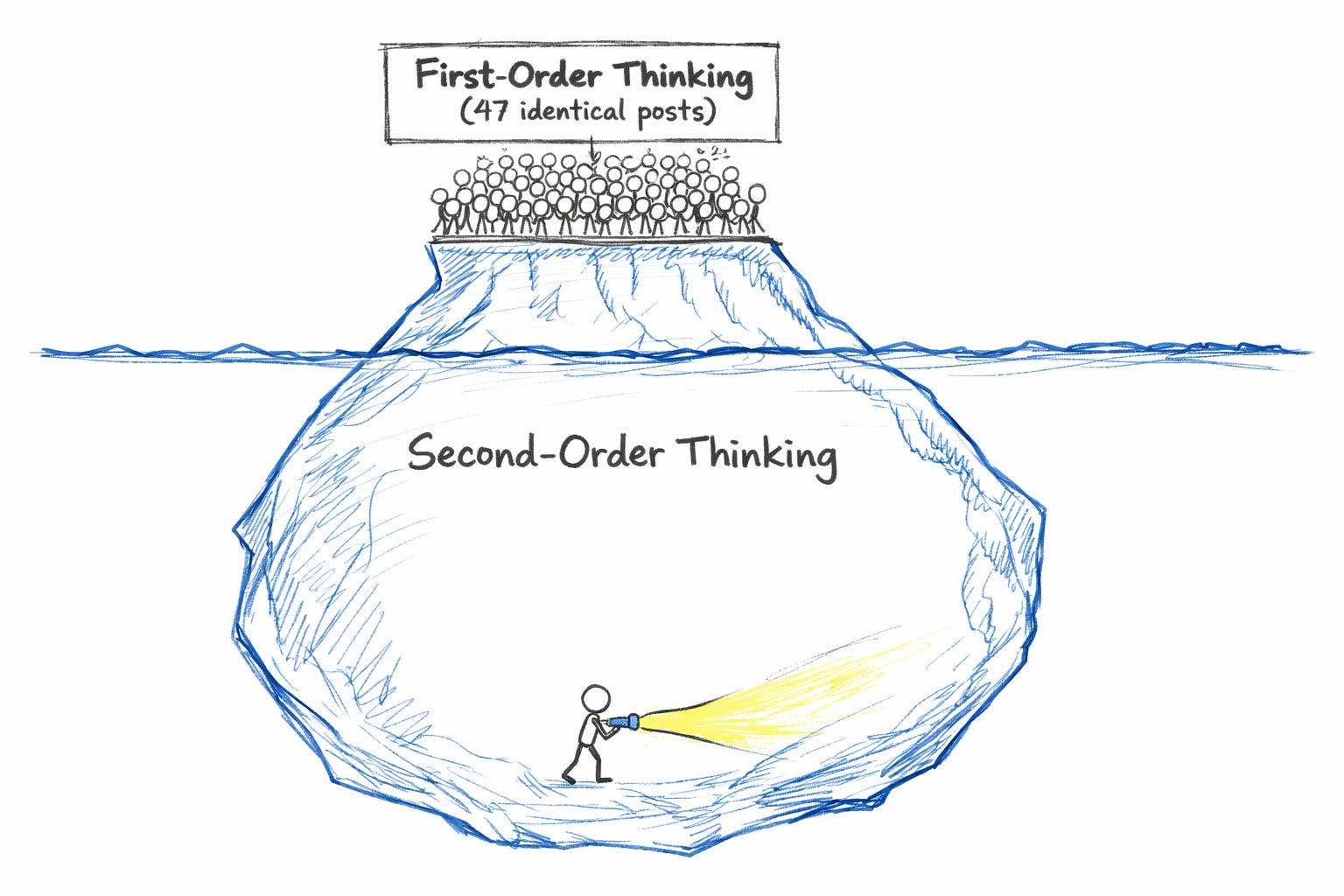
First-order thinking is whatever shows up when you consider a topic. The immediate answer. The take that would get polite nods at a networking event. It feels true because everyone believes it, and everyone believes it because it feels true.
Circular reasoning is very comfortable, which is why humans love it so much.
Second-order thinking is what happens when you refuse to stop at the first answer. When you follow the logic past the part where everyone agrees into the part where reality gets inconvenient.
I had a 'breakthrough' idea two weeks ago. Genuinely excited. Couldn't wait to write it. Then I made the mistake of checking what already existed on the topic. The exact thesis? No. But the same general direction, the same framing, the same conclusions dressed in slightly different language? All over the damn place. The shower had lied to me again.
That’s first-order thinking. That’s the level AI owns. And I was living there without realizing it, paying rent on a room that had already been repossessed.
Most creators never escape.
Not because they can’t. Because nobody told them there was a “there” to escape to. They thought the first answer was the answer. The networking event nods confirmed it. Why keep digging when everyone’s already applauding?
Because the first answer is where everyone crowds.
And AI is optimized specifically for crowds.
What Second-Order Actually Looks Like
Let me show you, because theory is useless without examples and examples are useless without honesty about how stupid I’ve been.
First-order take: “Remote work is flexible. Remote work is great.”
Nods all around. Pass the cheese plate. Somebody mention the algorithm.
Second-order:
Remote work is flexible, sure. But flexibility for everyone means your coworker in Singapore schedules a meeting at what she calls “morning” and you call “why is my phone buzzing at 3am.” Which kills your deep sleep. Which kills your deep work. Which means you’re technically “working from home” while actually doing shallow busywork between Zoom calls that could have been emails and emails that could have been silence.
Remote work flexibility might be worse than commuting. At least commutes had a clear end point. Now your office is nowhere, which means it's everywhere. Which means it's also your bedroom. Which means you're never really off.
(I wrote this from my bedroom. At 11pm. The irony is not lost on me, but I’m going to publish it anyway because that’s the kind of person I’ve become.)
See what happened? The first answer is where everyone agrees. The second answer is where the agreeing stops and the thinking starts.
Another one:
First-order: “Consistency is the key to building an audience.”
Every guru says it. Must be true. Post daily, show up, trust the process, manifest abundance, namaste.
Second-order:
If consistency is the key, then the most consistent creators should have the biggest audiences. They don’t. Scroll through any platform. Plenty of daily posters with eleven followers and a concerning amount of free time. Meanwhile, people like James Clear posted sporadically for years while building millions of subscribers.
What’s actually happening?
Consistency without taste just scales mediocrity.
(I should get that tattooed. Or at least put it on a mug. Mugs are the coward’s tattoo.)
The real variable isn’t frequency. It’s quality of thinking, deployed with enough regularity to compound. Consistency is the delivery truck. It’s not the package. And a lot of people are sending empty trucks on a very reliable schedule.
One more, because I’m making a point and three examples is the minimum for credibility:
First-order: “Use storytelling to engage your audience.”
Every writing course. Every content guide. Story, story, story. Joseph Campbell. Hero's journey. The audience will weep torrential floods. Tissues will be rationed. Marriages will be saved.
Second-order:
Stories are engaging, which means memorable. Memorable means they stick in the brain. Which means they can overpower whatever point you were trying to make. Readers remember your story about the time you failed at the thing. They forget the three lessons you extracted from it.
The most persuasive writing doesn’t lead with story. It leads with insight—here’s what I figured out—then uses story to illustrate. Story is the vehicle, not the destination. Most people have it backwards. They tell a great story and bolt on a lesson at the end like a bumper sticker on a hearse.
(That metaphor got away from me. I’m keeping it.)
The Protocol That Forces Depth
This isn’t mystical. It’s mechanical.
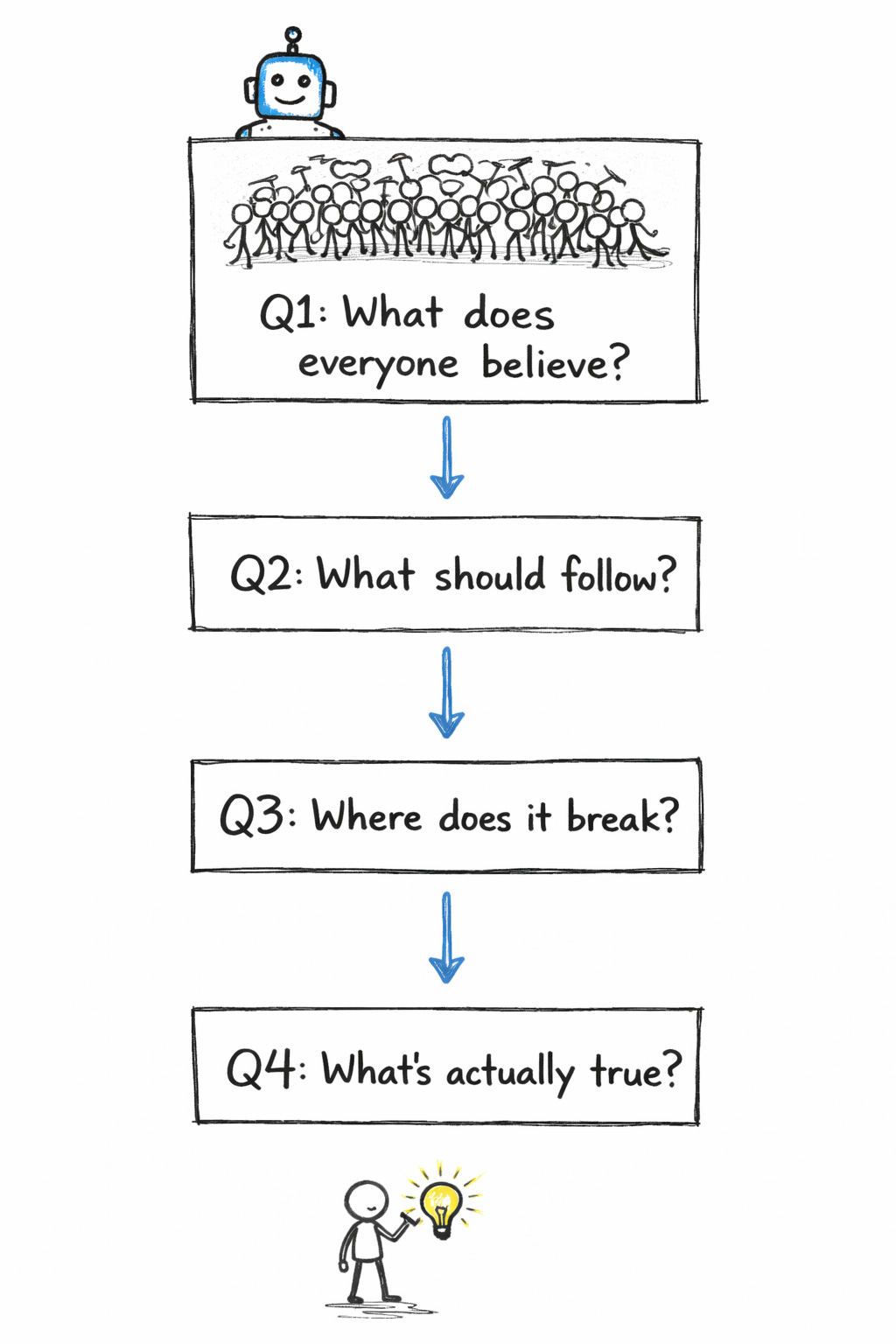
Four questions. Ask them in order. Ten minutes total. The fourth answer is the one worth writing about.
Question 1: “What does everyone believe about this?”
State the consensus. The obvious take. What would get you polite agreement at any gathering of people who pretend to have read the same books.
Time: 2 minutes. Maybe less if you’re honest about how basic the first answer usually is.
Question 2: “If that’s true, what should follow?”
Follow the logic. If the consensus is correct, what would we expect to see in reality? What’s the logical consequence of this belief actually being true?
Time: 2 minutes.
Question 3: “Where does that break down?”
Find the cracks. The counterexamples. The places where reality doesn’t match what the consensus predicts.
This is where most people quit, because it’s uncomfortable. The thing everyone believes starts looking less solid. That’s the point. Keep going.
Time: 3 minutes.
Question 4: “So what’s actually true?”
Synthesize. Given the breakdown, what’s the more accurate position? What explains both why the consensus feels right and why it fails in practice?
Time: 3 minutes.
That fourth answer is your moat.
AI can’t get there. AI is optimized for Question 1. Statistically probable means what most people would say, which means consensus, which means the exact thing you’re trying to escape.
The chain of consequences that leads from “obvious” to “actually true” isn’t in the training data. It can’t be. Original insight, by definition, hasn’t been written 47 times yet.
Why This Matters More Than It Should
AI can produce infinite first-order content. Infinite polished, professional, sounds-like-content content. Every platform is drowning in it. The sheer volume of obvious-takes-stated-confidently has become staggering.
The surface is overcrowded.
Depth is almost empty.
Readers can feel this, even if they can’t articulate it. They’re developing antibodies. The thing that made them scroll past your competitor’s post without slowing down? That thing is coming for your posts too. Unless you’re doing something different. Unless you’re going somewhere AI can’t follow.
Second-order thinking produces ideas that feel novel.
Novel gets attention. Gets shared. Gets remembered. Builds the kind of authority that doesn’t require you to post daily like a lab rat pressing the content lever for pellets.
(I’m not anti-consistency. I’m anti-empty-consistency. There’s a difference. One builds something. The other just makes noise on a schedule.)
While everyone races to produce more, you learn to think deeper.
While everyone automates the obvious, you develop what can’t be automated.
That’s the level AI can’t reach. The one I mentioned at the start. The one most creators don’t know exists.
Now you know it exists.
The 60-Second Version
For the impatient, the skeptical, and the people who scroll to the end of everything before deciding to read the middle (you know who you are):
Name the consensus. One sentence. What would everyone in your field say about your topic?
Trace the consequence. If that’s true, what should we observe?
Find one crack. Where does reality not match the prediction?
State what’s actually true. Given the crack, what’s the better model?
The fourth sentence is your idea. The one worth writing.
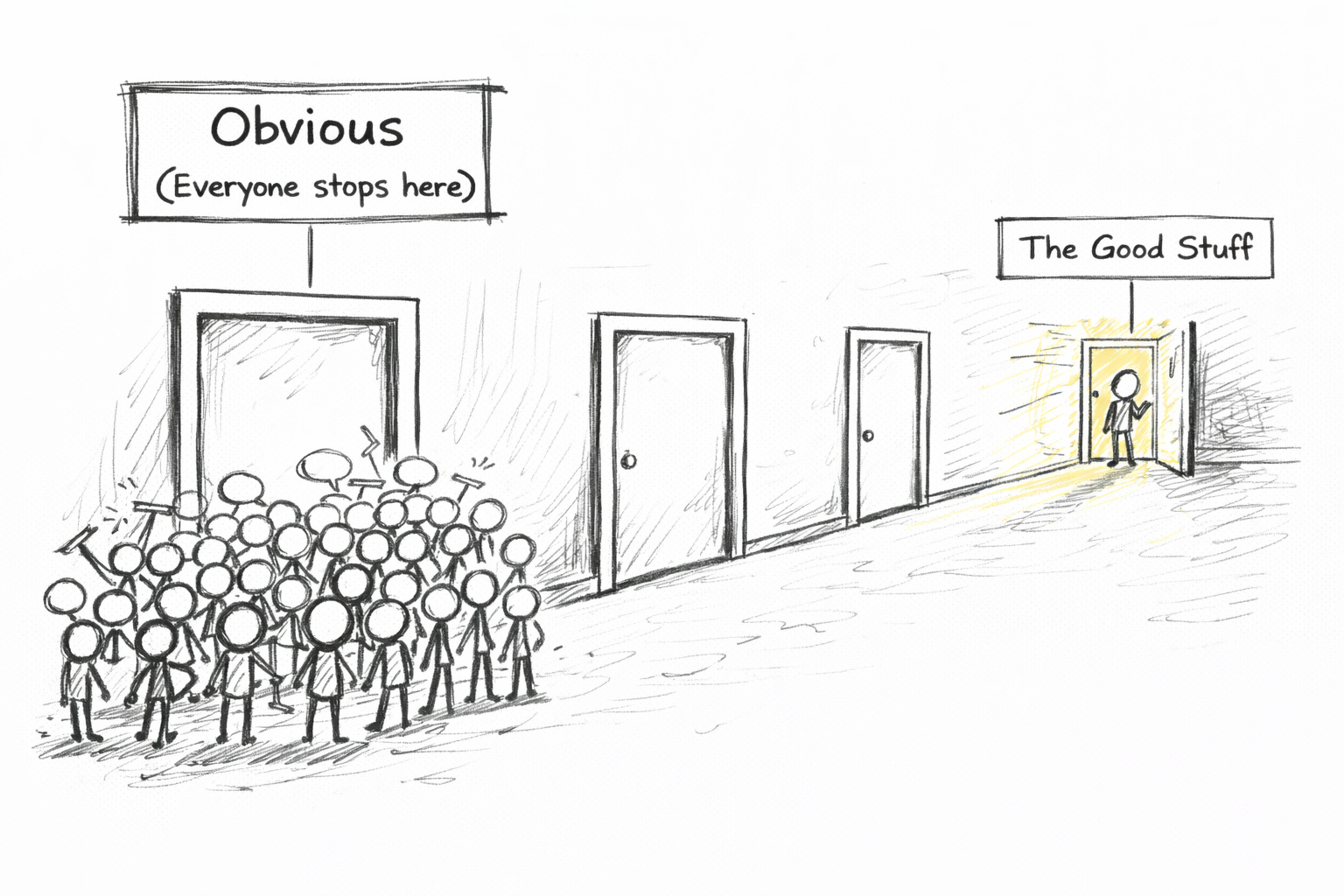
Do this before you write anything. Ten minutes. The difference between “another post” and “something people actually remember” often lives in those ten minutes.
My shower ideas still feel original sometimes. The hot water and the steam create a false sense of profundity, like a private sauna for your neurons.
But I don’t trust them anymore.
I run them through the four questions first. Most don’t survive. The ones that do? Those are mine. Genuinely. Not consensus with my fonts. Not the same 47 takes in a different order. Something that came from following the logic past the place where everyone else stopped.
That’s the moat. The thing AI can’t cross. The reason you’re still worth reading in a world where robots can string sentences together faster than you can blink.
But you have to do the work. Nobody’s coming to give you original ideas. They have to be extracted, and extraction requires a protocol, and protocols require discipline, and discipline requires believing it’s worth it.
It is.
Probably.
I've now run this idea through the protocol three times and it keeps surviving. That's as close to certainty as I get.)
The protocol takes ten minutes. The advantage lasts until you stop using it. Which, if you’re smart, is never.
Discussion Thread: What’s a “consensus take” in your field that you’ve always suspected was slightly bullshit? Run it through Question 3 in the comments. I want to see where things crack.
Crafted with love (and AI),
Nick “Second-Order Chaos Merchant” Quick

PS…Want more on thinking deeper while everyone else thinks faster? Subscribe. New posts show up in your inbox more often than I'd like to admit.