
The Nine-Headed Hydra of Ensloppification
You'll recognize yourself in at least three. (I recognized myself in five.)

The internet has a monster problem.
Not the trolls. Not the algorithms. Not even the bots. (Though the d-bag who invented “DM me GROWTH” deserves to be DM’d by bots until the heat death of the universe.)
The real monster has nine heads. And it grows back every time you cut one off.
In Greek mythology, the Lernaean Hydra was a serpentine water monster. Cut off one head, two more grew in its place. Hercules learned the hard way that you can’t defeat a Hydra by fighting each head individually.
The content world has its own Hydra. Nine distinct behaviors breeding in the algorithm like horny, illiterate rabbits. Stop one, two others emerge. Fight them individually and you lose.
Yesterday, I coined a term for the force feeding this beast: ensloppification—the ground-up collapse of distinctiveness. The stink rising from below while platforms rot from above.
Today, we meet the beast.
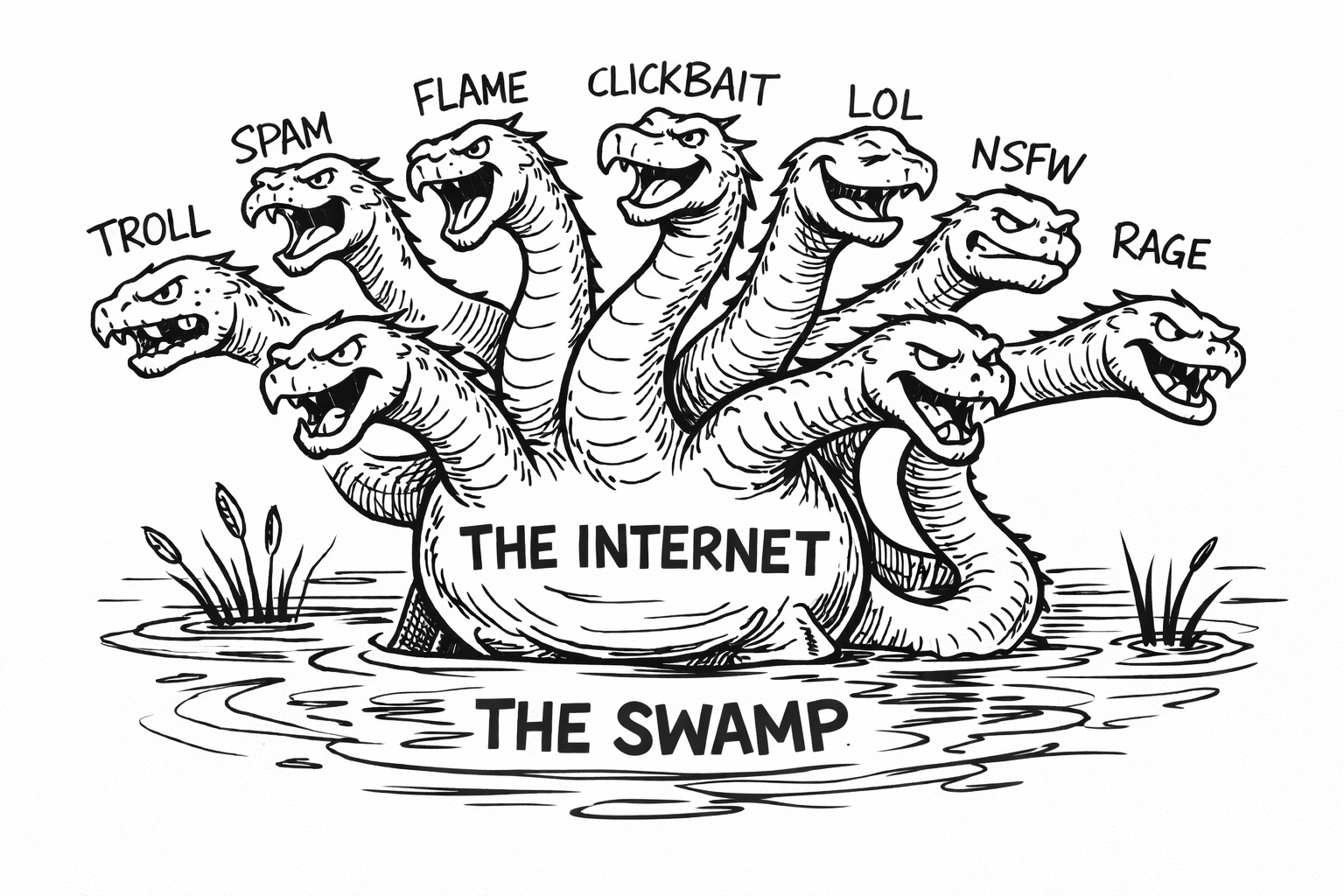
HEAD I: Algorithmic Courtship
Writing for machines instead of humans.
The original sin. The first betrayal. The moment you stopped asking “what do I actually want to say?” and started asking “what does the algorithm want me to say?”
The symptoms:
Keywords stuffed into sentences until they read like a ransom note from a malfunctioning robot
Character counts optimized for platform preference instead of saying the thing
Hook structures reverse-engineered from viral posts, deployed without understanding why they actually worked
Posting times chosen by algorithm rather than by having something worth saying
The tell is always the same: you write something and your first thought is “will this perform?” instead of “is this true?”
The algorithm rewards what it’s seen before. Algorithmic Courtship, by definition, pushes you toward producing content that resembles content that already exists.
You’re trying to seduce a machine by becoming exactly like everything it’s already been with.
This is not a winning romantic strategy. (But it does scale, which is apparently all that matters now.)
HEAD II: Template Infection
Copying what works until nothing works.
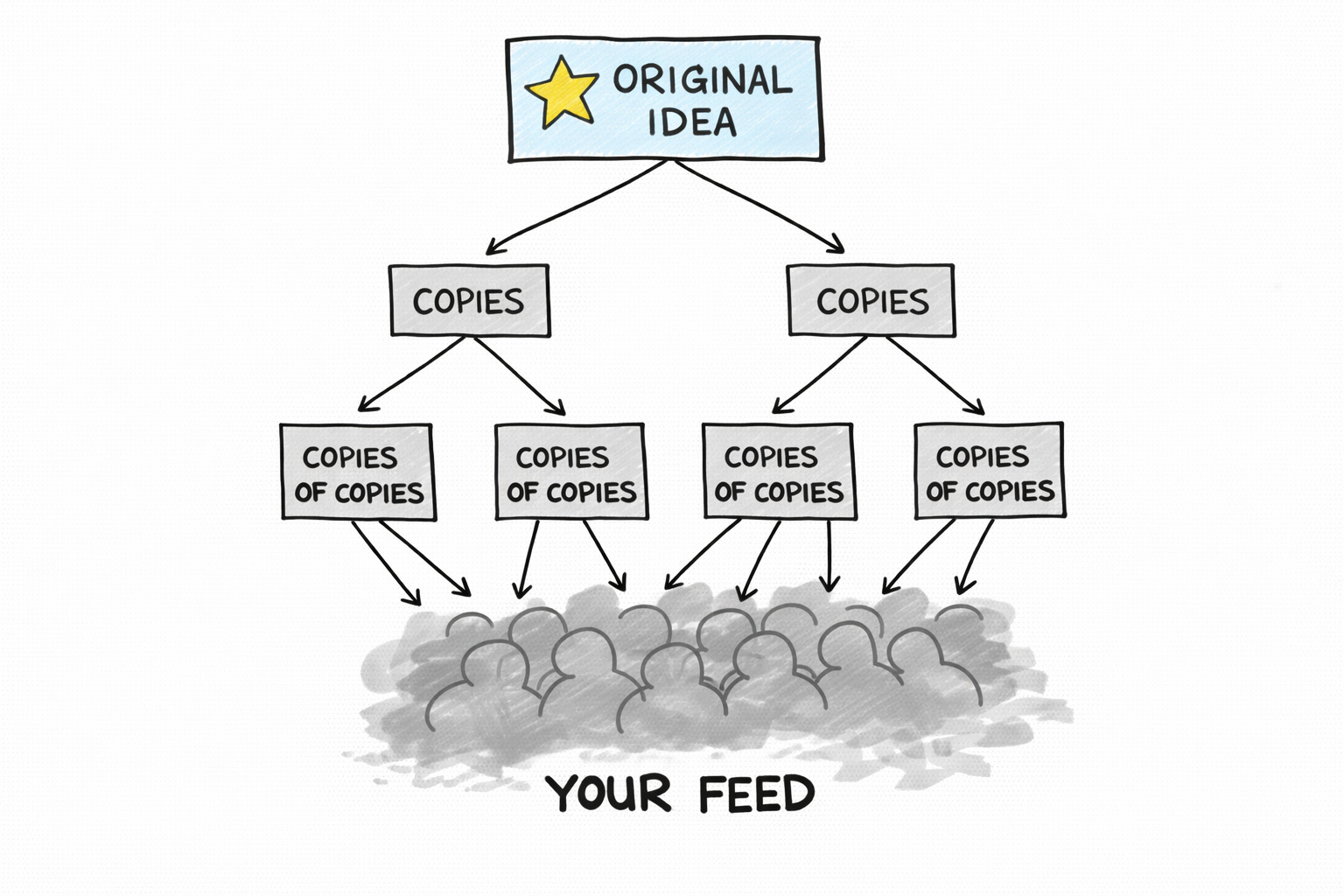
Someone succeeds with a format. The format gets noticed. It gets copied. The copies get copied. Six months later, your entire feed is variations of the same template, and the format that once stood out now disappears into the noise.
The carousel format that spread from one creator to ten thousand. The LinkedIn post structure everyone adopted. (”Controversial opinion: [extremely mainstream take that no reasonable person would disagree with]”.) The Twitter thread where one decent observation gets stretched across seventeen tweets like salt water taffy pulled by a sadist.
The irony is spectacular.
You copy a template because it worked for someone else. It worked for them because it was distinctive. By copying it, you dilute the distinction. Once enough people copy it, the template actively hurts you—it signals “I have nothing original to say.”
(I’ve been guilty of this. The carousel format specifically has claimed hours of my life I’ll never recover. Please kick me while I’m down!)
HEAD III: Trend Parasitism
Jumping on whatever’s trending regardless of fit.
The trending audio that has nothing to do with your message but you use it anyway because maybe the algorithm will be fooled. (The algorithm is a cold mathematical function. It doesn’t experience fooling.)
The hot take manufactured for engagement rather than conviction. You don’t actually believe this strongly. You’re not sure you believe it at all. But it’s trending, and you need content.
Newsjacking without genuine perspective. Something happened. Everyone’s talking about it. You need to talk about it too, even though your contribution is the equivalent of standing outside a house fire saying “Yep. That’s definitely fire.”
Trend Parasitism feels productive. You’re “staying relevant.” You’re “capitalizing on cultural moments.”
You’re also contributing to a feed where everyone’s talking about the same thing in the same way at the same time.
Congratulations on your supreme relevance.
HEAD IV: Manufactured Authenticity
Vulnerability as growth hack.
This head makes me want to take a shower.
The strategic confession calibrated for maximum sympathy and minimum actual risk. The “personal brand” that’s been focus-grouped into blandness, then wrapped in authenticity like a gas station burrito.
The “What do you think?” added to every post when you couldn’t care less what they think. The behind-the-scenes content that’s another performance… carefully curated to look uncurated, deliberately messy in a way that took three hours to achieve.
Real vulnerability creates connection. It’s rare. It takes courage. It costs something.
Manufactured vulnerability creates... the same thing everyone else is manufacturing. Strategic openness that all sounds identical. Confessions that follow the same dramatic arc. “Honesty” that’s been A/B tested for optimal engagement.
(I’ve done this. Crafted vulnerability for effect. It worked, which is the worst part. The algorithm rewards performed authenticity just as much as the real thing—it can’t tell the difference.
Only you can tell the difference. And you have to live with yourself afterward.)
HEAD V: Visual Sameness
The YouTube thumbnail face. The Canva template plague.
You know them:
Mouths agape, eyes wide, hand pointing at something off-screen
The same five color schemes on every carousel in your industry
“Diverse team high-fiving in modern office” appearing in forty-seven thousand presentations
Logo trends that make every startup look like a different flavor of the same minimalist tech company
Website templates so ubiquitous you can identify the platform before reading a word
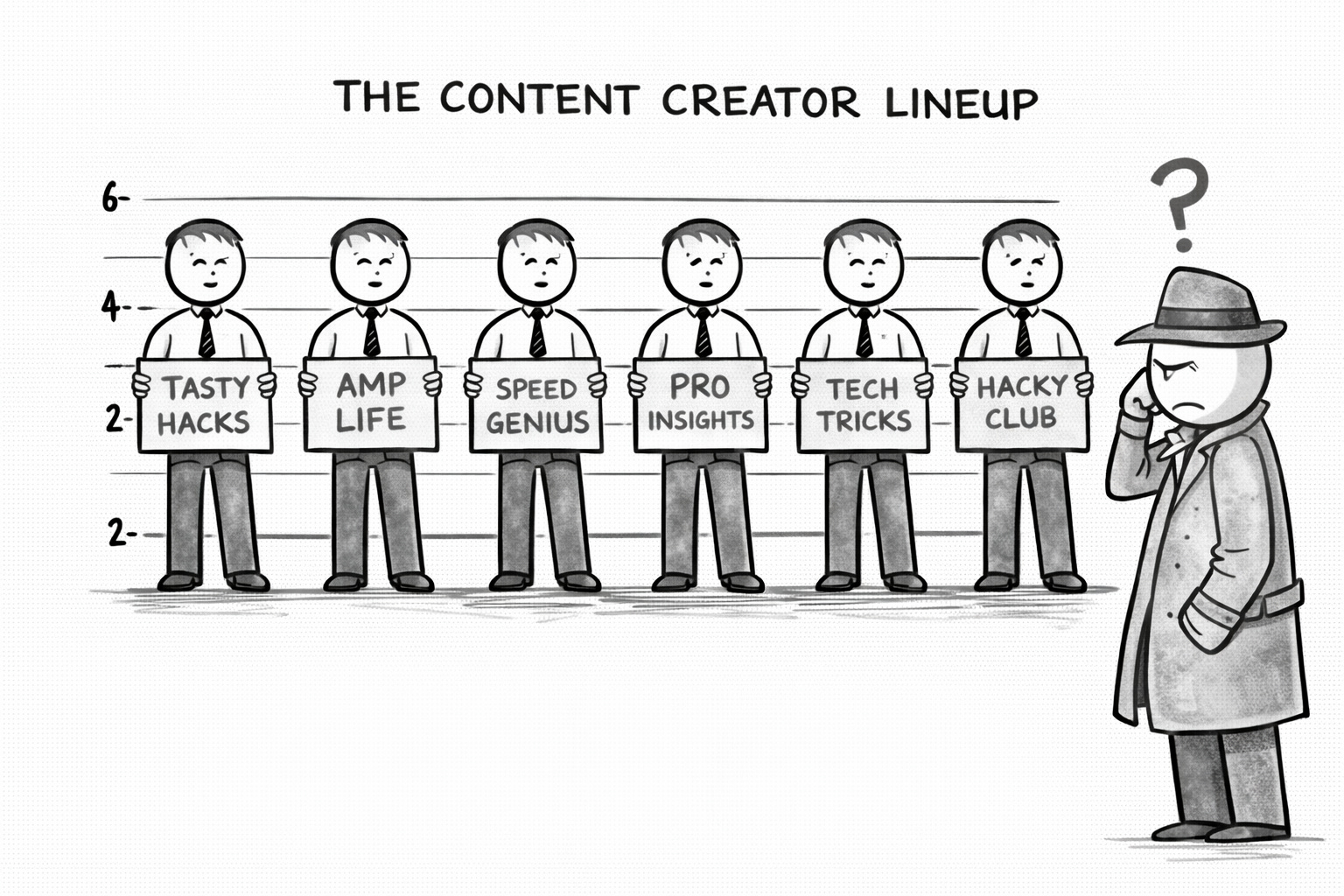
Visual Sameness is ensloppification you can spot from across the room without your glasses.
Design is hard. Templates are easy. “This is fine, it’s professional, nobody will judge me.”
Nobody judges you. They just don’t remember you. You’ve outsourced your first impression to someone else’s design system. You look exactly like everyone who made the same choice.
Which is everyone.
HEAD VI: Credibility Theater
Performing expertise instead of demonstrating it.
The “As seen in” logos from publications that literally sell placement. You paid to be “featured in Forbes”—not because their editorial team wanted to profile you, but because Forbes realized they could sell the badge.
The podcast guest circuit where the same twenty people interview each other in an endless circle of mutual credibility inflation. “As heard on 47 podcasts” sounds impressive until you realize it’s the same six listeners hearing you say the same thing on each one.
“Award-winning” followed by awards nobody’s heard of. “Best New Voice in Content Marketing 2023” from an organization that would’ve given the same award to three raccoons in a Burberry trenchcoat if the raccoons had filled out the form.
Author credentials from self-published books that sold seventeen copies (mostly to family members who asked polite questions at Thanksgiving and then never brought it up again).
Credibility Theater is borrowed trust. When everyone claims the same social proof, the social proof becomes worthless.
The alternative—demonstrated credibility, built over time, through actually helping people—is slower. Harder. Less immediately impressive on a landing page.
Also the only kind that works.
HEAD VII: The Funnel Industrial Complex
The machinery of manufactured demand.
Lead magnets that are just blog posts imprisoned in PDF format. (The PDF makes it feel more valuable. It doesn’t make it more valuable.)
The webinar formula. Fifteen minutes of value stretched thinner than church basement coffee, followed by forty-five minutes of "but wait, there's more." You saw it coming. You stayed anyway.
“DM me [KEYWORD]” automation. You’ve created a system where people trigger a bot by sending you a word, and you’ve convinced yourself this is relationship-building because technically they initiated contact. (By that logic, I have a deep personal relationship with every CAPTCHA I've ever solved. My polycule is enormous.)
Tripwire sequences. Order bumps. Downsells. Scarcity that isn’t scarce. Urgency that isn’t urgent. “Doors closing” when the doors have been “closing” for six months.
The Funnel Industrial Complex is what happens when an entire industry optimizes for the same conversion playbook. Everyone read the same books. Took the same courses. Implemented the same sequences.
Your audience knows when they’re in a funnel. They can feel the water temperature rising.
The playbook worked when it was novel. Now it's white noise with a payment plan.
HEAD VIII: Engagement Theater
Performing engagement instead of creating it.
When you’ve optimized everything else and the numbers won’t move, there’s one option left: fake them.
Engagement pods where creators agree to like, comment, and boost each other’s content regardless of quality. “I’ll stroke yours if you stroke mine.” Mutual appreciation built on mutual desperation.
“Tag someone who needs this” prompts that generate worthless notifications. Someone gets tagged. They feel obligated to look. They don’t care. They’ve been tagged in seventeen similar posts this week.
Polls designed for algorithm boost rather than actual feedback. “What’s your biggest challenge with [topic]?” You don’t care about the answer. You’re not going to do anything with the data. You just need the engagement metrics.
Engagement Theater degrades the signal. When engagement can be manufactured, engagement means less. When everyone’s gaming the same metrics, the metrics become unreliable.
We’ve built an economy where the currency is fake and everyone knows it’s fake and everyone keeps trading it anyway.
HEAD IX: The Recursive Collapse
AI training on AI, slop generating slop.
The ninth head. The one that didn’t exist five years ago. The one that’s growing faster than all the others combined.
Everything I’ve listed above predates ChatGPT. Humans created these diseases. Humans spread them. Humans were producing slop at industrial scale before AI showed up to help.
But AI added recursion to the equation.
Content farms running generation pipelines around the clock, producing articles that technically contain words arranged in sentences that technically convey meaning that technically addresses the search query.
AI training on AI output, creating feedback loops where convergent content trains models to produce more convergent content. The slop generates slop that generates more slop.
Convergence converging on convergence.
The mean collapsing toward a mean of means. The average of averages. An infinite regress of mediocrity, each generation smoother than the last.
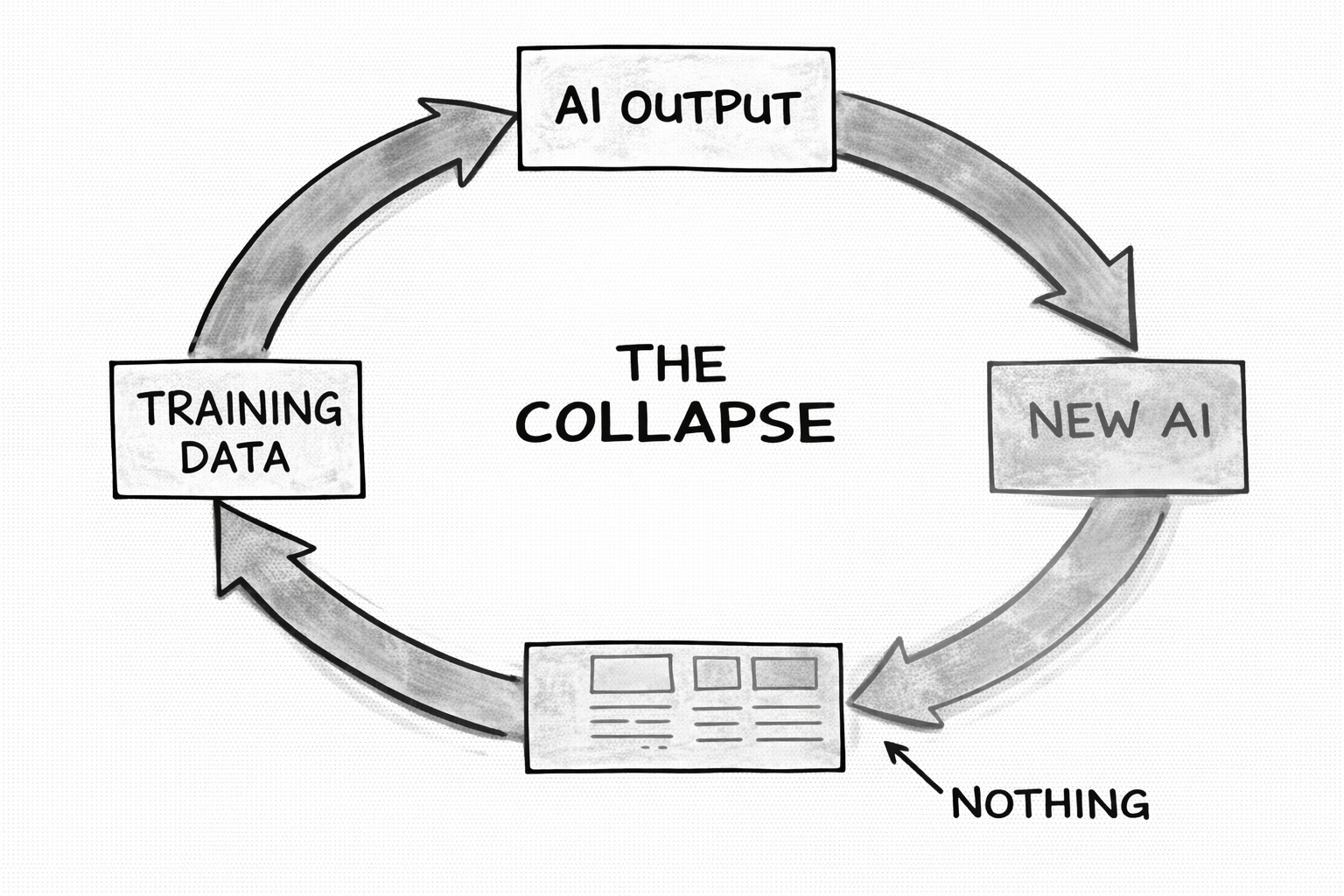
This is the immortal head.
In the myth, one of the Hydra’s heads was immortal—it couldn’t be killed, only contained. The Recursive Collapse is that head. You can fight the other eight behaviors in yourself. You can’t individually stop the machine-generated convergence that’s flooding every platform and training the next generation of models.
You can only make sure you’re not contributing to it.
My Confession
I promised I’d tell you which heads I’ve fed.
Template Infection: Template Infection: Absolutely. Somewhere in my drafts is a “I quit my job and here's what I learned” post. I didn't quit my job.
Manufactured Authenticity: More than once. Strategic vulnerability, calibrated for effect. Technically true. Optimized for impact.
Algorithmic Courtship: Early in my career especially. Keywords that made sentences awkward. Headlines designed for click-through rates rather than accuracy.
The Funnel Industrial Complex: I’ve deployed the playbook. Multiple times. You're probably in one of my sequences as we speak."
Credibility Theater: I’ve used “As seen in” badges. I’ve listed credentials that looked more impressive than they were.
That’s five heads. Maybe five and a half if we’re honest about engagement metrics I’ve quietly celebrated without asking where they came from.
Why Hercules Almost Lost
The Hydra seemed unbeatable. Cut off one head, two more grow.
Hercules tried fighting harder. Fighting smarter. Fighting faster. Nothing worked. The beast kept regenerating.
The solution wasn’t fighting better.
The solution was changing strategy entirely.
He stopped fighting heads. He cauterized the stumps. Fire prevented regrowth. The heads couldn’t regenerate if the wounds were sealed.
You can’t beat ensloppification by fixing individual behaviors.
Stop one, two more emerge. Fix your template dependence, you’ll drift into trend parasitism. Clean up your visual sameness, you’ll slide into algorithmic courtship. The heads keep regenerating because the body—the underlying convergent force—remains alive.
Tomorrow: The cauterization strategy. What Hercules figured out that most creators haven’t. The third path between resistance and automation.
(Finally. The part where I tell you something useful instead of just cataloging our collective sins.)
Which head of the Hydra have you been feeding most? I showed mine. Now show me yours. Reply with your confession… I read every response and I’m in no position to judge.
Crafted with love (and AI),
Nick "Head Count: Five" Quick

PS...Part 3 drops tomorrow. It’s the part where I stop diagnosing and start prescribing. Subscribe or stay stuck in the swamp with the rest of us hydra snacks.