
The Most Advanced AI Workflow Uses a $2 Pen
I sabotaged my AI workflow with 2000-year-old technology. It's the only thing that works.

Close the laptop. We need to cook.
I’ve spent the last three months deliberately sabotaging my workflow with ancient technology. Paper. A Bic pen I found in a junk drawer. A printer that sounds like it’s experiencing an existential crisis every time I press the button.
This isn’t some cottagecore productivity aesthetic. I’m not photographing my Moleskine next to a latte for the content. (My handwriting looks like a ransom note written during an earthquake. Nobody needs to see that.)
I’m doing this because it works.
Annoyingly well.
The creators who are genuinely good at AI collaboration have all figured out the same secret, and nobody wants to talk about it because it makes us sound like lunatics. The secret is that you have to not use the computer at the most important moment.
We’ve built a cult around artificial intelligence, and the high priests are all sneaking off to write in notebooks like we’re living in a Victorian novel.
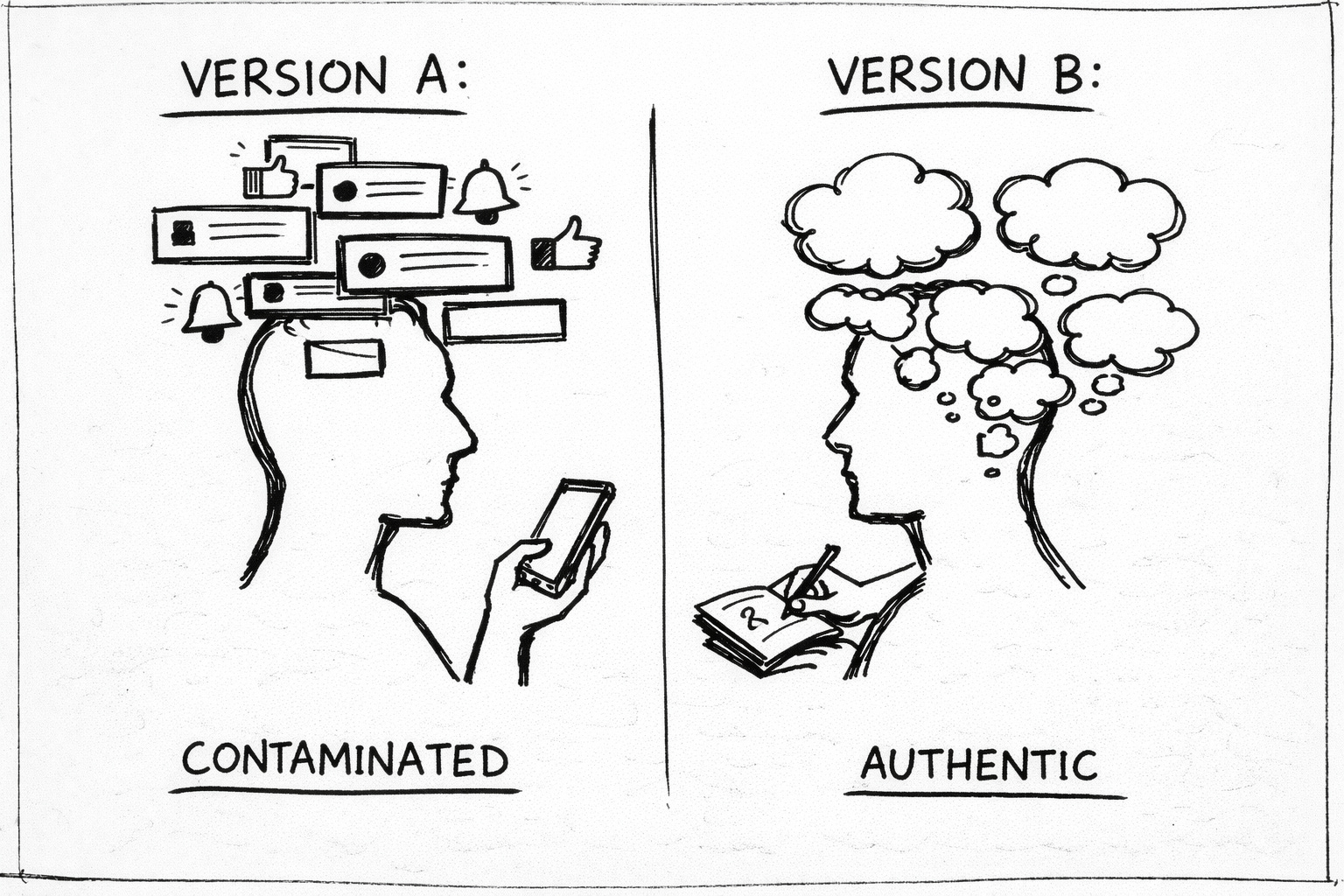
The Screen Is Not Your Friend
Your brain does something strange when it connects to the digital hive mind.
I don’t mean strange like “you check Twitter too much” (though you do, and I do, and we’re all marching toward the same cliff together). I mean strange like your actual cognitive patterns rewire themselves the moment you open a browser.
You start thinking in posts. In shareable snippets. In engagement metrics. Your thoughts begin pre-formatting themselves into little content pellets ready for algorithmic consumption.
(This is extremely normal and fine. We’re all doing great.)
The problem is that this mode of thinking produces a specific kind of output. Technically competent. Structurally sound. Completely indistinguishable from everything else sloshing around the internet like lukewarm soup from a hospital cafeteria.
You’re trying to see your true face in a funhouse mirror. The reflection moves, but it’s not you.
Screens have a way of making every word feel like the almost right word. Like you’re writing with mittens on. Everything gets muffled. Everything loses its edges. You end up sounding like a rough draft of a person who almost had something to say.
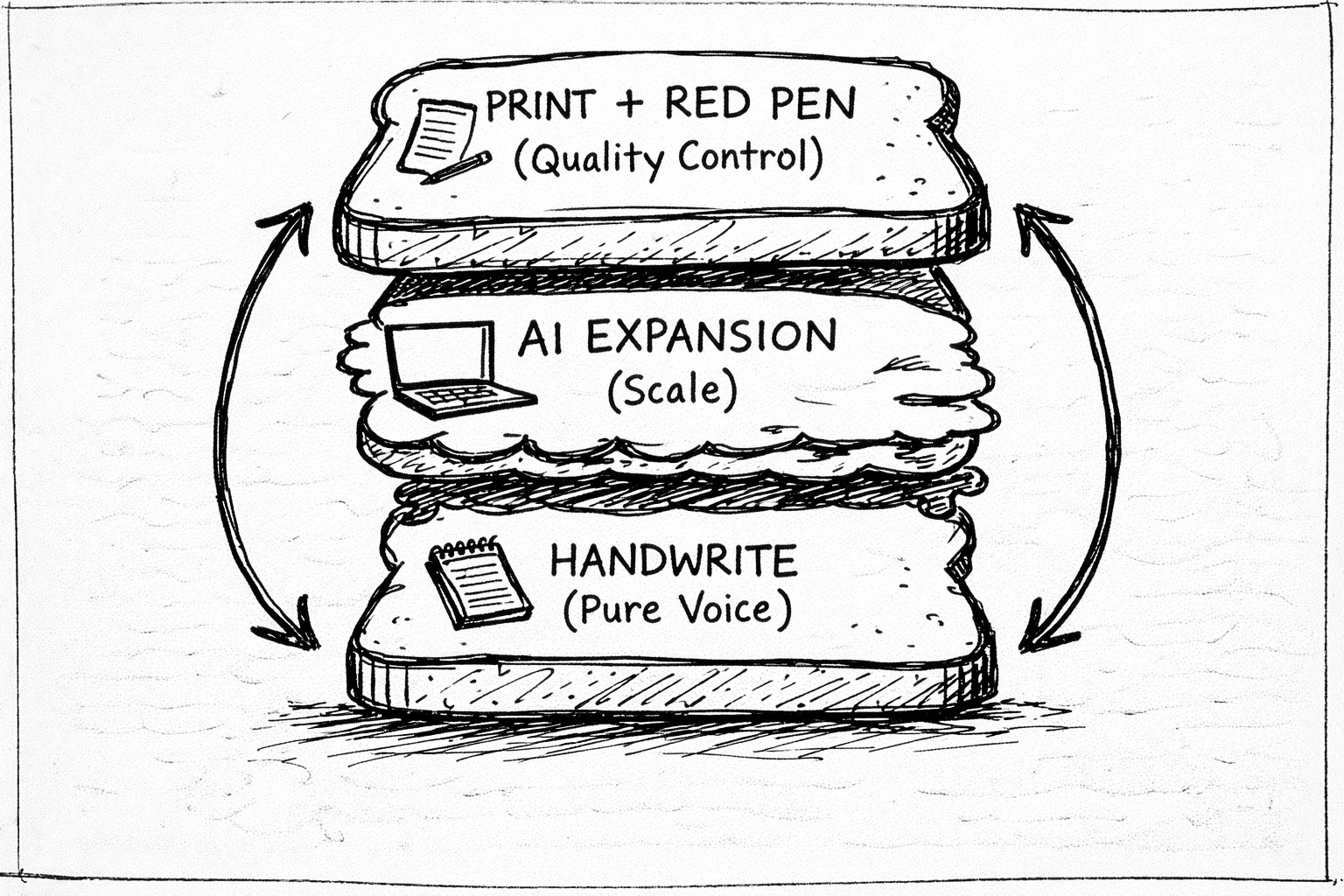
The Analog Sandwich (A Workflow That Sounds Stupid But Works)
Here’s the system. I call it the Analog Sandwich because I have a gift for naming things that makes people take me slightly less seriously. (This is strategic. If you take yourself too seriously, people notice when you’re wrong. If you’re already a little ridiculous, wrong just looks like more of the same.)
The structure is simple: digital work gets sandwiched between two layers of analog work. Bread-meat-bread. A workflow you could explain to your college roommate at 1am when he’s three bowls deep and convinced he’s about to solve capitalism. That’s the bar. Most productivity advice doesn’t clear it.
Layer 1: The Bottom Bread
Paper. Pen. No screens visible. Preferably not even in the same room, because you will reach for your phone, and you will check something, and then forty-five minutes will collapse into the black hole that used to be your attention span.
Write two things:
First, the outline. Just the skeleton. Five to seven bullets of where this thing is going.
Second, what I call the Core Rant. This is important. The Core Rant is you, uncensored, unfiltered, rambling about what you actually think about the topic at hand. Stream of consciousness. Fragments. Half-formed ideas. Profanity if that’s how your brain works. (Mine does. Extensively.)
The Core Rant will never be seen by another human. It doesn’t need to be good. It needs to be real. You’re not writing a draft. You’re capturing voice data.
The version of yourself that shows up on paper (before the performance starts, before the audience arrives) is a different creature entirely. Wilder. Less polished. More interesting. The self that exists before anyone’s watching is always more honest than the self that knows it’s being observed. Paper gives that self a place to exist.
Layer 2: The Meat
Now you open the laptop. (Finally. The dopamine addicts in the audience can unclench their butt-cheeks.)
Type or dictate your handwritten material into AI. Ask it to expand, structure, and develop what you’ve captured.
Here’s the crucial distinction: AI is now working with raw material that already has your fingerprints all over it. It’s not generating from a prompt. It’s not riffing on a topic. It’s expanding something you smuggled out before the algorithm could strip-search it.
AI is just coloring inside the lines you already drew.
Layer 3: The Top Bread
Print the draft. Yes, physically print it. I know your printer is broken. Everyone’s printer is broken. This is the human condition. Fix it or buy a new one for $50. This is worth $50.
Edit with a red pen. Not on screen. On paper.
Something happens when you edit on paper that doesn’t happen when you edit digitally. You catch things. You feel rhythms you couldn’t feel before. You see the structure with eyes that haven’t been glazed over by infinite scroll.
Then (and this is the part everyone skips) document what you changed and why. Feed it back to AI. This is how your co-writing gets tighter. Not the prompts. This.
Why This Actually Works (The Part Where I Pretend to Be Scientific)
The Analog Sandwich isn’t productivity theater. I’m not doing this to feel artisanal. (Okay, I’m doing it a little to feel artisanal. The heart wants what it wants.)
But the actual reason is voice protection.
Layer 1 protects you from Internet Brain. By starting with paper, you capture your authentic thought patterns before the screen can rewire them. Your vocabulary. Your sentence rhythms. Your genuine perspective. The stuff that makes your writing distinctly yours instead of distinctly bleh.
Layer 2 leverages AI on your terms. You’re not asking a robot to generate content from nothing. You’re asking it to expand raw material that already carries your voice signature. The patterns are already encoded. AI is just building around something real.
Layer 3 catches what screens hide. Digital editing creates a weird blind spot. We skim differently on screens. We trust the software too much. We miss rhythmic problems that become screamingly obvious when the words are printed on physical paper in front of our physical faces.
Writing by hand slows you down. It forces you to think about every word because your hand literally can’t keep up with your brain the way a keyboard can. This feels like a bug. It’s the whole point. The slowness is what keeps the machines out of your head until you’re ready to invite them in.
The sandwich structure ensures your fingerprints stay on the work at every stage. Beginning. Middle. End. There’s no point where AI is operating without your voice already embedded in the raw materials.
The Uncomfortable Truth (The Part Where I Insult Both of Us)
You’re addicted to the screen.
I’m addicted to the screen.
We’re all addicted to the screen.
This is a description of reality, like saying ICE is cold or that every software update makes things slightly worse. We reach for our phones before our eyes are fully open in the morning. We tab over to check something every three minutes. We’ve trained our nervous systems to need the little hits of novelty and connection that screens provide.
(I once picked up my phone to check the time and somehow ended up reading about the guy who invented Pringles and got buried in a Pringles can. His name was Fred. I don’t know why I know this. I will know it until I die. Fred has replaced something useful in my brain. Probably my mother’s birthday. This is what screens do to us.)
And this addiction is murdering your authentic voice.
Not because screens are evil. They’re neutral. Tools are always neutral. Hammers don’t care whether they’re building houses or smashing windows. But your brain operates differently when it’s plugged into the infinite scroll. You think in posts. In shareable fragments. In audience reactions you’re already anticipating before you’ve said anything.
That’s not your authentic voice. That’s your performer voice. Your optimized-for-engagement voice. Your “I wonder if this will go viral” voice.
Your actual voice lives in the quiet spaces. The slow thinking. The moments when nobody’s watching and you’re not anticipating how something will land.
The Analog Sandwich forces you into those spaces. Deliberately. Systematically. Because you won’t go there voluntarily. (I know because I tried. For years. I was always going to “unplug” and “write longhand” and “reconnect with my creative roots.” Then I'd open my laptop to check one thing and surface four hours later knowing Fred's entire biography.)
The Implementation Guide (For People Who Skipped to the Practical Part)
What you need:
A notebook. Literally any notebook. Don’t overthink this. Don’t go buy a special notebook. Use the one you already have or the back of an envelope or a stack of napkins you stole from a restaurant. The physical object is irrelevant. The act is everything.
A pen. Something you don’t hate. (I use cheap-ass Bic pens because I lose pens constantly and expensive pens make this a tragedy instead of a minor inconvenience.)
A printer. Or a tablet with a stylus as a backup if you’re one of those people whose relationship with printers is irretrievably broken. I understand. Some wounds don’t heal.
A red pen. For editing. The color matters psychologically. Red means business. Red means someone’s about to get hurt. (The someone is your first draft.)
The process:
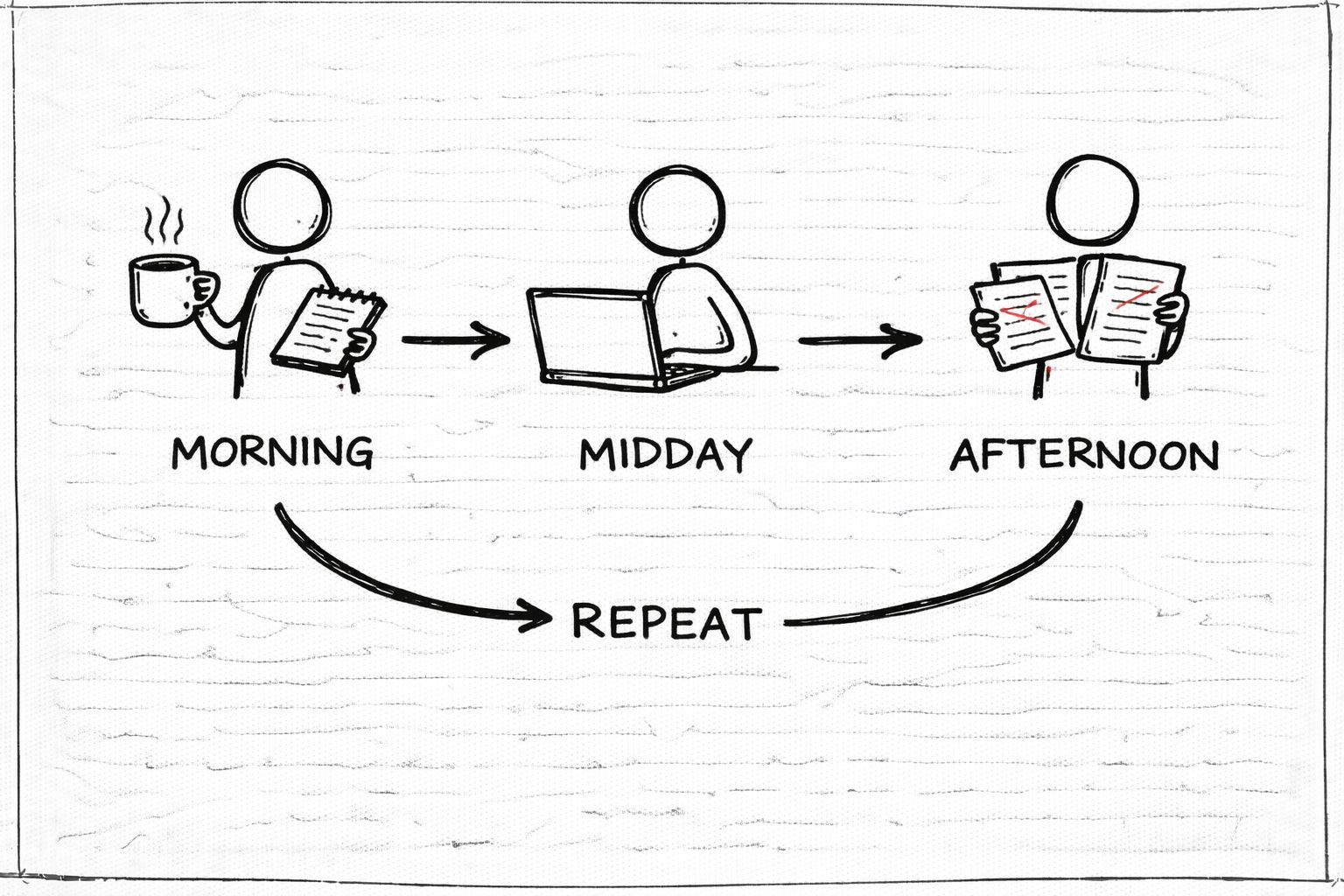
Step 1: Block time for analog work. Not “when you feel like it.” Actually schedule it. I do mornings before I open my laptop. The specific time matters less than the consistency.
Step 2: Write the Core Rant first. Before you outline. Before you structure. Just vomit your actual thoughts about the topic onto paper. Raw. Real. Embarrassing. Nobody will see this except you.
Step 3: Outline second. Still on paper. Just the map of where you’re going. Five to seven bullets. Don’t overthink.
Step 4: Transfer to AI. Type or dictate your handwritten material. Include your Voiceprint document for reference. Ask it to expand into a full draft while maintaining your voice patterns.
Step 5: Print immediately. Do not edit on screen. Do not tweak. Do not “just fix this one thing.” Print it.
Step 6: Red pen everything. Circle weak phrases. Draw arrows for restructuring. Write better versions in the margins. Cross out what doesn’t work. Be brutal. This is the edit that matters.
Step 7: Document your changes. What did you change? Why? Feed this back to AI for calibration. This step is what makes the system get better over time.
What I’ve Noticed After Three Months
My AI-assisted drafts need fewer revision passes. This sounds small. It’s enormous. I used to spend more time fighting AI’s tendency toward generic than I spent actually writing. Now the voice is embedded from the start because I’m feeding it material that’s already mine.
My understanding of my own voice has sharpened. The Core Rant process forces you to notice how you actually think. Which words you reach for naturally. Which sentence structures feel like home. This awareness makes everything else (Voiceprint documentation, AI calibration, quality control) more precise.
My editing is more surgical. Instead of a vague sense that “something’s off,” I can point to specific problems. The paper makes everything visible. It’s hard to ignore a circled phrase when it’s staring at you in red ink like an accusation.
My relationship with AI actually feels collaborative. Like working with a competent assistant who gets my style, instead of wrestling with a machine that keeps trying to turn me into a thought leader with zero original thoughts.
The slop factories pump content straight from prompt to publish. That’s how slop gets made at scale. That’s also why most AI content sounds like it was generated by the same exhausted robot stuck in a content mine somewhere, producing “value” for platforms that couldn’t define the word if you paid them.
Craft takes more care. It takes deliberate sequencing. It takes knowing when to engage the tools and when to keep them closed.
Your fingerprints have to get on the work before and after AI touches it. That’s the whole insight. That’s what the Analog Sandwich protects.
The Paradox
The most advanced AI writing workflow involves technology that hasn’t meaningfully changed since someone figured out you could make marks on flat things.
Paper. Ink. The physical act of making marks with your hand like some kind of medieval monk, except the monk probably had better posture and definitely had fewer notifications.
Call it nostalgia if you want. Call it productivity porn. I call it the only thing that’s actually moved the needle.
Because AI is only as good as what you feed it. And what you feed it when you’re in Internet Brain mode is already contaminated. Already smoothed. Already halfway to generic. Already sounding like every other person who sat down at a keyboard and asked a robot to help them sound smart.
Start with paper. Let your voice emerge before the machines get involved.
Then bring in the tools. Then let them help.
But the voice has to come first. Always first.
The slop factories will keep winning on volume. Let them. They can have the volume. You take the craft.
🧉 Here’s what I want to know: What’s your current analog-to-digital ratio when you’re creating? Have you noticed your thinking change depending on whether you start on screen or off? I’m genuinely curious. Drop a comment below. I read every single one.
(I also respond to most of them. Sometimes while drinking Malört. The quality varies.)
Crafted with love (and AI),
Nick “Pen Pusher General” Quick
PS… No prompt libraries. No magic buttons. Just craft-based AI collaboration, daily. Subscribe if that spikes your punch.
I like this!
I’m using the cheddar | meat | bread technique. Blurb out my thoughts (voice), my own writings & a little bit of AI, and redacting this with a red pen.
For the last part, I’m adding printing to the mix. (For now, this was digital). Thanks for the inspiration!
You're getting ripped off if you are paying $2 for a Bic pen