
The Hoarder’s Guide to Publishing Daily
Keep capturing everything. These five filters decide which of your notes earns the right to go out under your name, so your output goes up while your slop count stays at zero.

Somewhere in your notes is the best thing you’ll publish this year.
It’s been sitting there for eight months. You’ve reviewed it four times. You almost shipped it twice. The tag says #someday.
This post is about that note, and the advice nobody finished writing. Everyone taught you step one: capture everything. Every app, every guru, every productivity video with a desk tour in it. And they were right, for once. The half-second after a thought arrives is the worst moment to judge it (it hasn’t cooled, you can’t see its shape, you’re grading an egg on its ability to fly), so saving it all is correct. Then the advice just... ends. Step two was never delivered. You’ve been running half a system for years and calling the warehouse the win.
My step one is voice notes. A thought shows up and I record it in whatever it’s wearing: wrong words, half sentences, no pants. (That describes the thought and, most mornings, the operator.) Then I move on with my life. No typing. No tidying. Polish at capture time is just judgment sneaking back in through the wardrobe. Catch the genius ones, the half-formed ones, the embarrassing ones you’d never say in mixed company, the garbage. Cheap, fast, greedy.
The problem is never step one.
The problem is Whitney.
Whitney has 14,000 notes. Obsidian vault. Custom theme. Forty-one plugins, two of which conflict in a way she describes as “a known issue.” A graph view she screenshots for strangers on the internet like it’s an ultrasound. (It’s a hairball. It’s always a hairball. No one in recorded history has looked at a graph view and learned anything except that the owner needs a hobby, preferably with some sunlight involved.)
Whitney has published three things in two years.
Somewhere between her first highlight and her fourth app migration, the pile became the point.
The Pile Is Not The Product
Notes exist to produce output. That’s the whole job description.
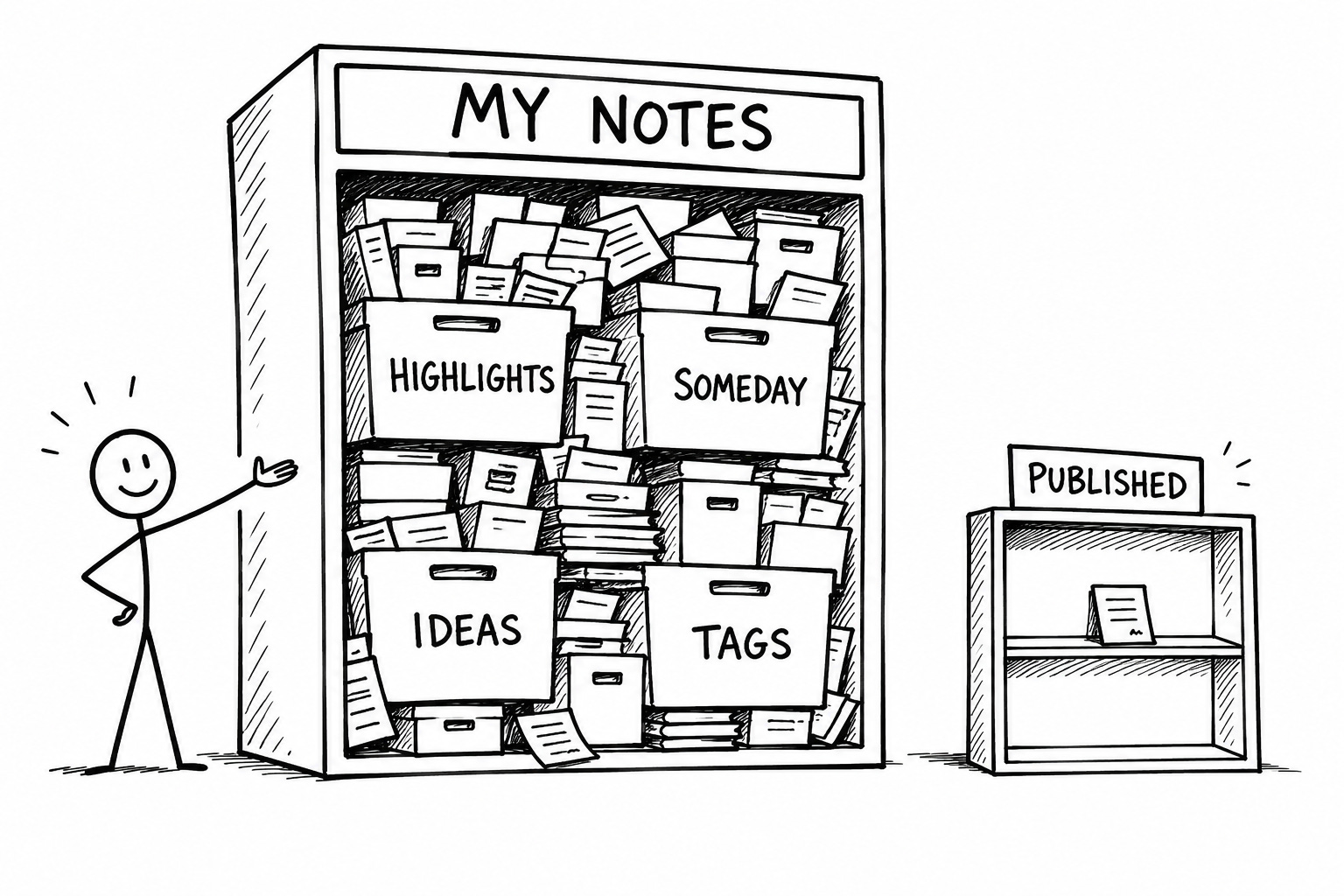
What most writers have built instead is a storage unit: climate-controlled, beautifully organized, visited mostly to admire the shelving. (Some of you pay monthly for it, which makes the metaphor uncomfortably literal.)
Creatives have a hoarding problem, and we fixed it by renaming it research. Capturing feels like thinking. It isn’t. It’s the stretching thinking does before it gets dressed. Highlighting a book feels like reading it twice. Linking two notes feels like having an idea. Reorganizing the vault feels like progress, in the same way reorganizing the garage feels like building something. (You moved boxes. The boxes are very impressed.)
Whitney knows this better than anyone. Whitney spent an entire quarter migrating from Notion to Obsidian, then briefly to Capacities because it felt “calmer.” Her most-linked note is a note about her linking system. She refers to this as infrastructure work.
Most note piles hold ten years of thinking and zero years of saying. And the internet keeps not noticing
Your Judgment Didn’t Disappear. It Moved.
Here’s where the capture-everything crowd and I part ways: they think the system ends when the note is filed. The note being filed is the system clearing its throat.
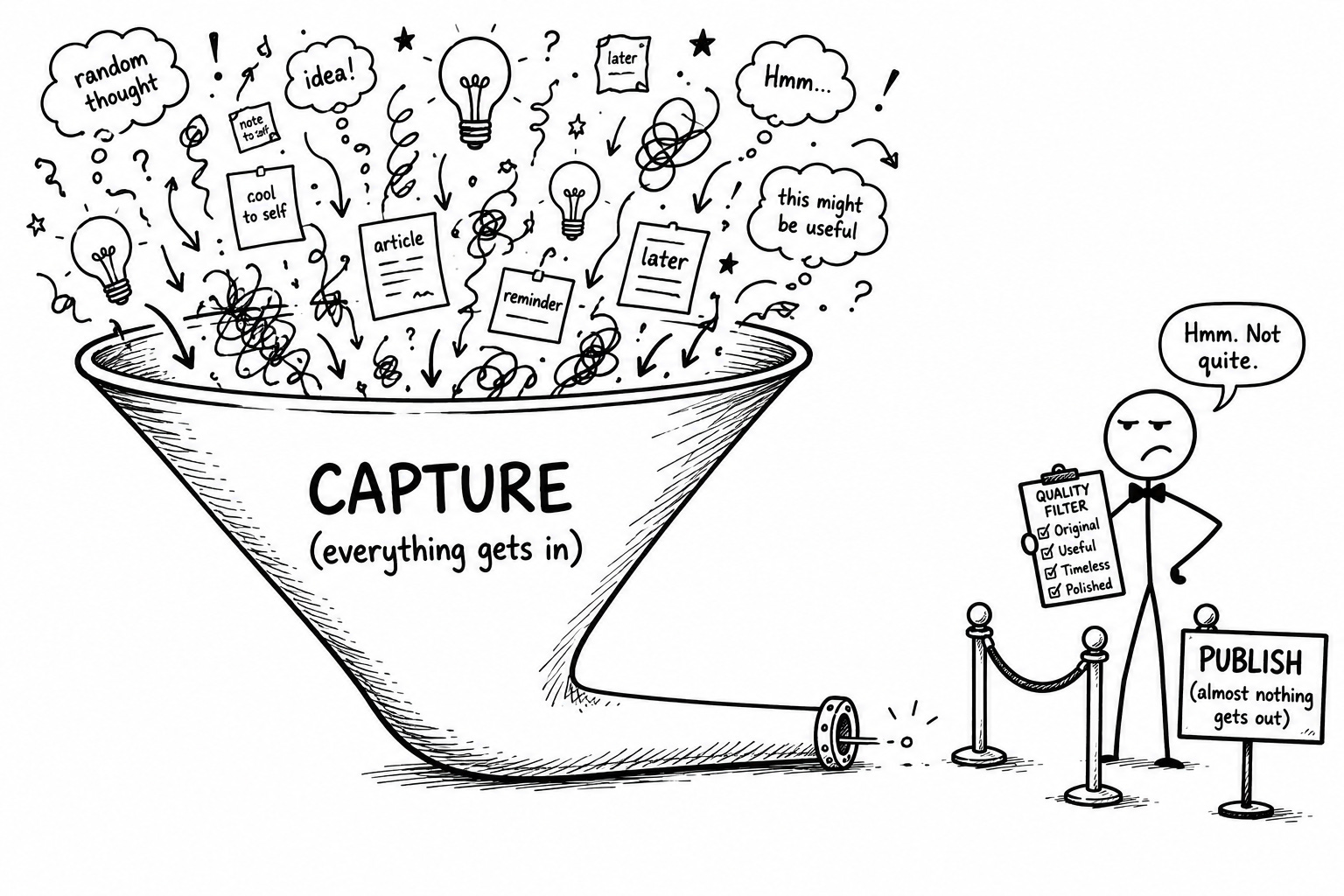
The judgment you suppressed at the mic (correctly, keep suppressing it) belongs at the other end of the pipe. Not at capture, where everything gets a yes, but at publish, where almost nothing should. That’s the gate that matters. That’s step two, the half nobody wrote down. And it’s where you finally get to be a snob.
And you should be an insufferable snob. Your notes are private. Your post is forever, with your name nail-gunned to it.
Skip the gate and there are only two places to land. Ship everything and you’ve built a slop factory with better intentions. Ship nothing and you’re Whitney, three posts deep into two damned years. The gate is the only reason “daily” and “good” can live in the same sentence. Five filters, in the order I run them…
1. It Has An Opponent
A thought worth publishing is arguing with someone.
There’s a “no, see, the part everyone gets wrong is...” humming underneath it. Open your pile, land on a note, and try to name who’d disagree with it. If you can’t, you’re holding an observation, and observations make the kind of post that earns three likes and a pity restack from your most loyal friend.
“AI is changing writing” has no opponent. Everyone nods, nobody argues, it evaporates on contact.
“Most writers are using AI to sound more correct, which is the exact thing making their work worse” has an opponent. Several. Some of them have newsletters. Publish that one.
2. You’ve Already Saved It Three Different Ways
Scroll your captures and watch for the repeats. The same thought, recorded Tuesday, then again Thursday in different words, then a third time as a voice memo you forgot you made.
That circling isn’t redundancy. It’s your subconscious filing the same complaint until somebody finally listens. (It’s a terrible communicator but a surprisingly good metal detector.)
The notes you caught once and never returned to were either complete or they were nothing. The ones you keep re-capturing have something still trapped inside. Those are your publish candidates, and the beautiful part is your pile already ran this analysis for you. It just never told you, because nobody asked it a question. They only ever fed it.
3. It Makes You A Little Nervous To Ship
Some captures come with a faint “am I allowed to say this” wobble the second you imagine them with your name attached.
Not the reckless kind. The kind where you’ve got a real position and you’re not totally sure you could defend it at a dinner party full of people who do this for a living.
That wobble is the sound of an actual opinion. Consensus is comfortable. Comfortable is forgettable. If a take costs you nothing to publish, it’ll earn you nothing once it’s out, and you’ll have spent a Tuesday confirming the consensus like a notary.
4. It Came With Heat
Watch for the captures that still have a temperature when you reread them a week later.
Irritation. Delight. That hot little flash of “oh, that is so wrong.” Secondhand embarrassment on behalf of an entire industry. (My best material runs about 40% spite, and I’ve made peace with that. My therapist calls it fuel-agnostic.)
A thought that went cold in the file and stays cold on reread is probably done. The ones that still have a pulse weeks later are the ones to grow. Emotion is skin in the game, and skin in the game is what separates a post from a press release.
5. It Shows Up With Its Own Example
This is the one the machines can’t fake, because the machine wasn’t in the room.
Reread the capture. Is there a real instance already attached, or do you have to go shopping for one? Load-bearing thoughts arrive pre-attached to the thing that set them off. The client who said the thing. The post that made you wince. The exact moment you spotted the pattern.
If the example’s already sitting in the note, the thought is real and ready. If you have to assemble evidence after the fact to justify shipping it, that’s the tell: you felt something once, and now you’re dressing it up as a thought. (Nothing against a vibe. A vibe just won’t survive contact with a reader.)
The specific is the moat. The generic is the trap. The machines own the generic now, all of it, in bulk, at wholesale prices. Your lived specifics are the one inventory they can’t stock.
The Stuff That Feels Publishable And Isn’t
Your pile is full of these, and that’s fine. The mistake was never catching them. It’s letting them out.
The recap. You’re restating someone else’s point with no friction added. Felt productive to capture. Adds nothing the second you publish it. The internet did not need a fourth summary of that podcast.
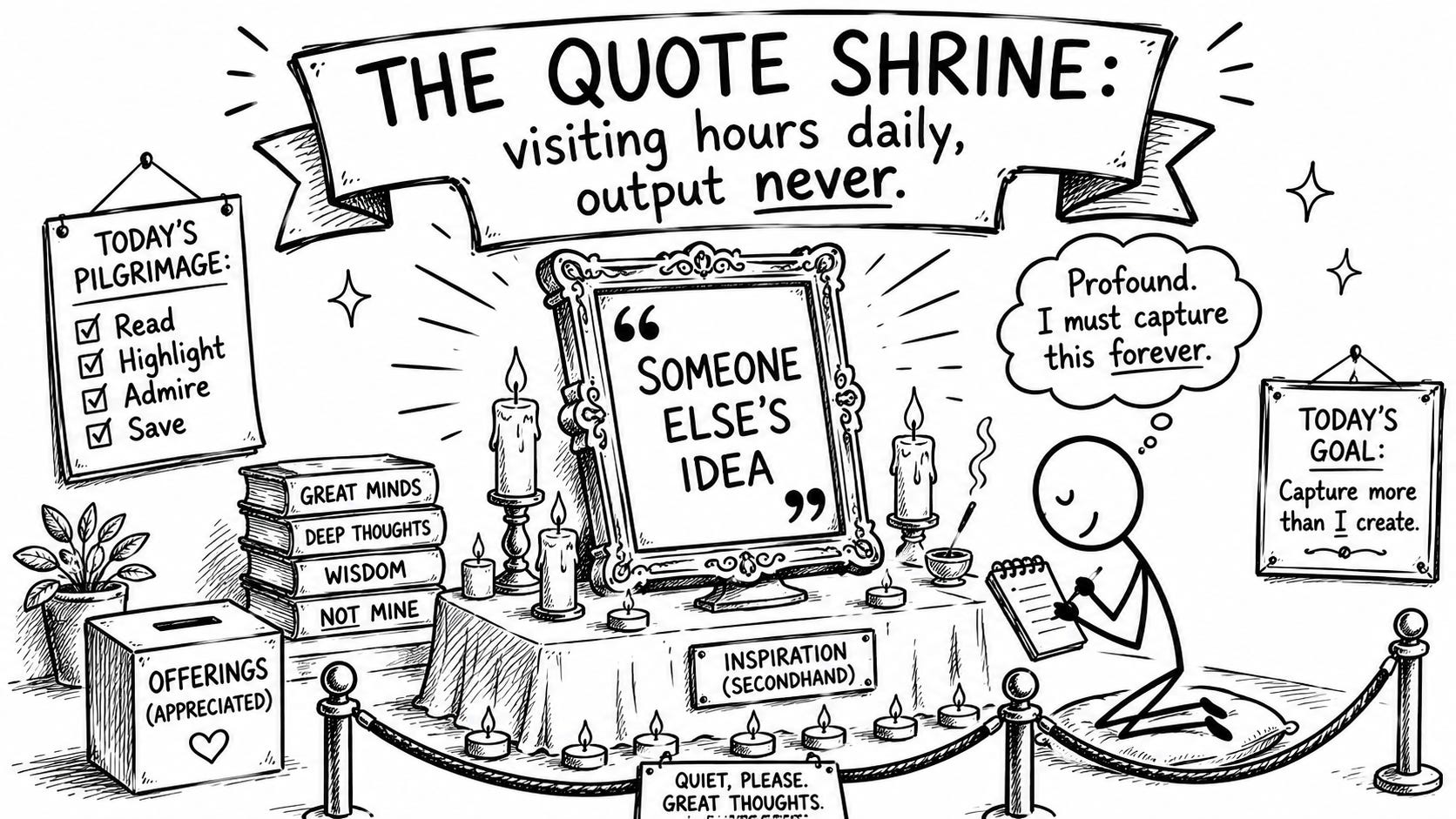
The quote shrine. A highlight from a book, lovingly preserved, tagged, and linked to six other highlights. This is the knowledge worker’s signature move: collecting other people’s thinking and filing it under “my ideas.” A quote in your notes is a guest. It doesn’t pay rent, it doesn’t go out under your name, and if your publication is mostly quote shrines, you’re running a museum gift shop for minds that actually shipped.
The vague gesture. “Things are really shifting right now.” In what direction. For whom. Says nothing, costs nothing, means nothing. Fine in a file. Filler on a page.
The to-do in a trench coat. “I should write about onboarding.” That’s a chore that wandered into the wrong room and put on a thinking face. Keep it as a task if you want. Just don’t mistake it for an idea, and for the love of hell, don’t publish it as one.
The Three-Second Test
Before you publish (not before you capture, never before you capture), ask one question:
Would I bother arguing this with a smart person who disagreed?
If yes, it’s got a spine. Grow it, shape it, ship it. If you’d shrug and change the subject, leave it in the pile. Maybe it ripens. Maybe it doesn’t. Either way it stays private until it earns its way out.
One question. Three seconds. It runs faster than the urge to overthink, which is the only speed that matters when you’ve got a few thousand captures and a finite number of weekends.
And this is the part Whitney never got to, because Whitney is currently evaluating Tana. The pile was never the product. It’s the supply chain. The snob at the publish gate is only ever as good as the greedy lunatic at the capture end feeding them options, and the gate is only worth anything if it actually opens. Often.
Because here’s the math the hoarders keep missing: blurt a hundred captures a week (cheap, remember, you’re already doing it) and even a gate that rejects 95 of them hands you a post for every weekday. That’s prolific. Not because you lowered the bar, but because you raised the intake. The slop factories publish everything they generate. You publish the survivors, and the survivors come out swinging.
Let the rejects rust in the yard. Some of them are next month’s best post; you just haven’t come back for the parts yet.
One more thing about the pipe, since I just spent two thousand words yelling about it. You already know my capture end is a phone and a blurt. The middle is the part nobody believes until they watch it IRL: one rambling voice memo going in, a week of published work coming out, fingerprints intact. So I’m gonna run it live in the Word of Mouth workshop, judgment calls out loud, mistakes included. If you’ve ever wondered whether your blurts could carry a publishing schedule, that’s where you find out.
Catch everything in your own unpolished words. Ship what has a pulse. The gate between them is your taste. The cadence is what makes you prolific.
Crafted with love (and AI),
Nick “Snob at the Gate” Quick

PS... Skimmed to the bottom? The whole post in one line: catch everything as voice notes, gate ruthlessly, ship daily. The one part prose can’t show (a single memo becoming the week’s content) is the part I run live in the Word of Mouth workshop.
PPS... If this one made you side-eye your notes app, a like or restack helps it find the other hoarders. And Whitney, if you’re reading this: I know you didn’t restack it. I know you clipped it into the vault instead. I even know the tag you used. It was #someday. It’s always #someday.
As a neurodivergent writer, I've learned that I don't have to wait until I have an idea to pursue to write. In fact, it's far easier for me to pull ideas from all the many things I've got going in my day and leave drafts about them as they occur in the moment for clean-up later. I use AuthoredUp Drafts for LinkedIn and simple Apple Notes for Substack.
Then when it's time to post, I'll look through my Drafts and see what 'has a pulse,' as you put it, writing when I have energy and ambition and interest. I write when I feel like it, not when I have to.