
The Dumbest Trade I Keep Making
A reader replied with just "🤖?" and I deserved it

Let me walk you through the mathematics of my Tuesday.
I skipped my pre-session setup because I was “in a hurry.” The quotation marks are doing a lot of heavy lifting there. What I actually was: lazy. What I told myself I was: efficient.
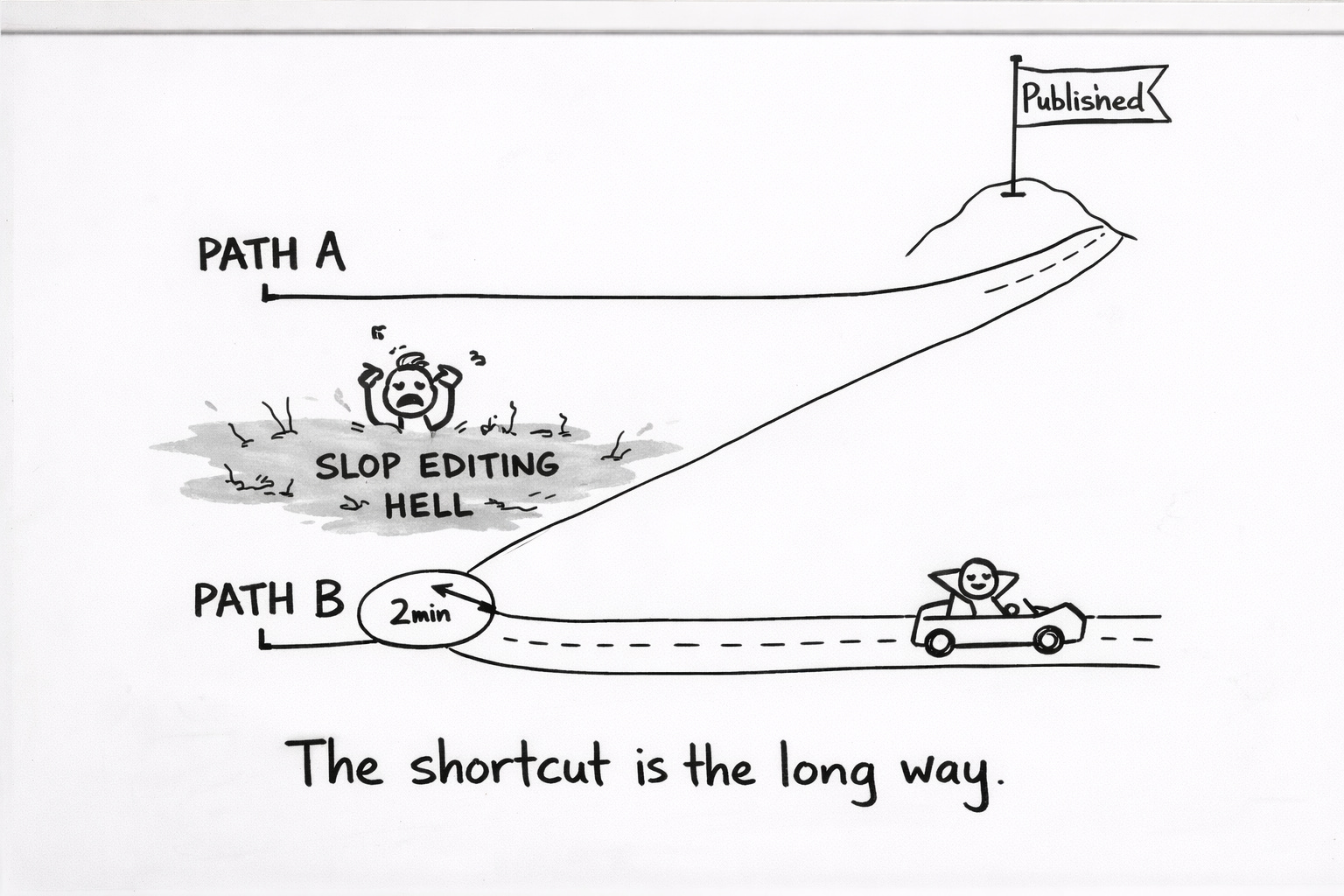
Time saved by skipping: 2 minutes.
Time spent editing slop out of the draft afterward: 45 minutes.
Time spent explaining to a reader why I published something with “strategic framework” in it twice (in the same paragraph, like a person who hates themselves): incalculable. Some things can’t be measured in minutes. Only in shame.
Net result: I lost 43 minutes and some credibility. To save 2 minutes.
The math doesn’t work. It has never worked. It will never work. And yet I keep doing it. And you keep doing it. And we all keep doing it, because human beings are a species that invented the alarm clock and the snooze button in the same century. We contain multitudes, most of them self-defeating.
Here’s the setup I skipped, why the math is so catastrophically lopsided, and how to stop making this trade.
(I say “how to stop” like I’ve stopped. I haven’t. I’m writing this partly as a reminder to myself. Consider this newsletter a form of public accountability for a man who cannot be trusted alone with a blank Gemini window.)
The Part Where I Insult Your Intelligence (And Mine)
Most people think about AI writing sessions like this:
Time to generate: 2 minutes. Time to edit: 30-45 minutes. Total: About an hour. Acceptable. What are you gonna do. The cost of doing business.
They treat the editing time as fixed. Immutable. A law of nature, like gravity or the fact that your backup plan has quietly become your actual life. “That’s just what working with AI takes.”
But editing time isn’t fixed.
It’s a function of how much slop got in. And how much slop gets in is almost entirely determined by what happens BEFORE you start generating.
Skip the setup, and you’re basically opening your door and inviting the generic in for coffee. Making it comfortable. Offering it a seat at your table. And then acting surprised when it starts speaking for you.
What’s Actually Happening (A Brief Tour of Self-Sabotage)
Here’s the mechanism of your own destruction, explained with love.
Without boundaries, AI defaults to the statistical middle.
It doesn’t know what you want. It has no context on your voice, your quirks, the specific way you’ve learned to hate certain phrases. So it does what any reasonable algorithm would do: it generates the average of everything it’s ever seen on your topic.
Error-free. Opinion-free. Point-free.
Prose with a pulse but no heartbeat.
Now you have to FIND the slop (which means reading carefully, which means paying attention, which was apparently too much to ask five minutes ago when you could have just answered five questions). Then you have to IDENTIFY what’s wrong (which requires pattern recognition under pressure, which your brain is great at when it’s not wondering if your friends actually like you or just tolerate you efficiently). Then you have to FIX it without introducing new problems (which requires creative energy you’ve already pissed away on steps one and two, leaving you to fix things with whatever fumes and “fuck it” energy remain).
That's 45 minutes. Minimum. Unless you hit publish anyway because you're tired and nobody will notice and actually everyone will notice but they're too polite to say anything except that one reader with the robot emoji.
With boundaries, AI starts closer to you.
You’ve named what’s banned. You’ve calibrated your ear by actually looking at your own good work. (When’s the last time you did that? Read something you wrote that you were proud of? We spend so much time consuming other people’s words and so little time remembering what our own good ones sounded like.)
You’ve defined your red flags. Set your handoff points. Built the guardrails before the car started moving.
AI is still AI. It’ll still drift toward the mean. That’s what it does. You can’t blame a hammer for being a hammer. But it’s drifting from a much better starting point. And you’re catching problems in the first paragraph instead of discovering them on your third desperate read-through at 11:47 PM.
That’s 12 minutes of editing. Sometimes less.
The 2 minutes you spend on setup prevents roughly 30 minutes of downstream work.
That’s a 15x return on your time investment.
(If someone offered you a 15x return on anything else, you’d take it immediately. But “spend 2 minutes thinking before you act” feels like too much to ask. We are, as a species, tremendously committed to learning things the hard way. It’s our most reliable characteristic.)
The 5-Question Protocol (2 Minutes That Buy Back Your Soul)
Here’s what I should have done on Tuesday.
What I do every other day.
What takes 2 minutes and saves at least 30.
What I apparently forgot the moment I decided I was “in a hurry” to produce content that would embarrass me in front of my own subscribers.
Five questions. Answer them BEFORE you open your AI tool. Not during. Not after. Before. Like a pilot does their checklist before takeoff, not while the plane is already screaming toward the mountain.
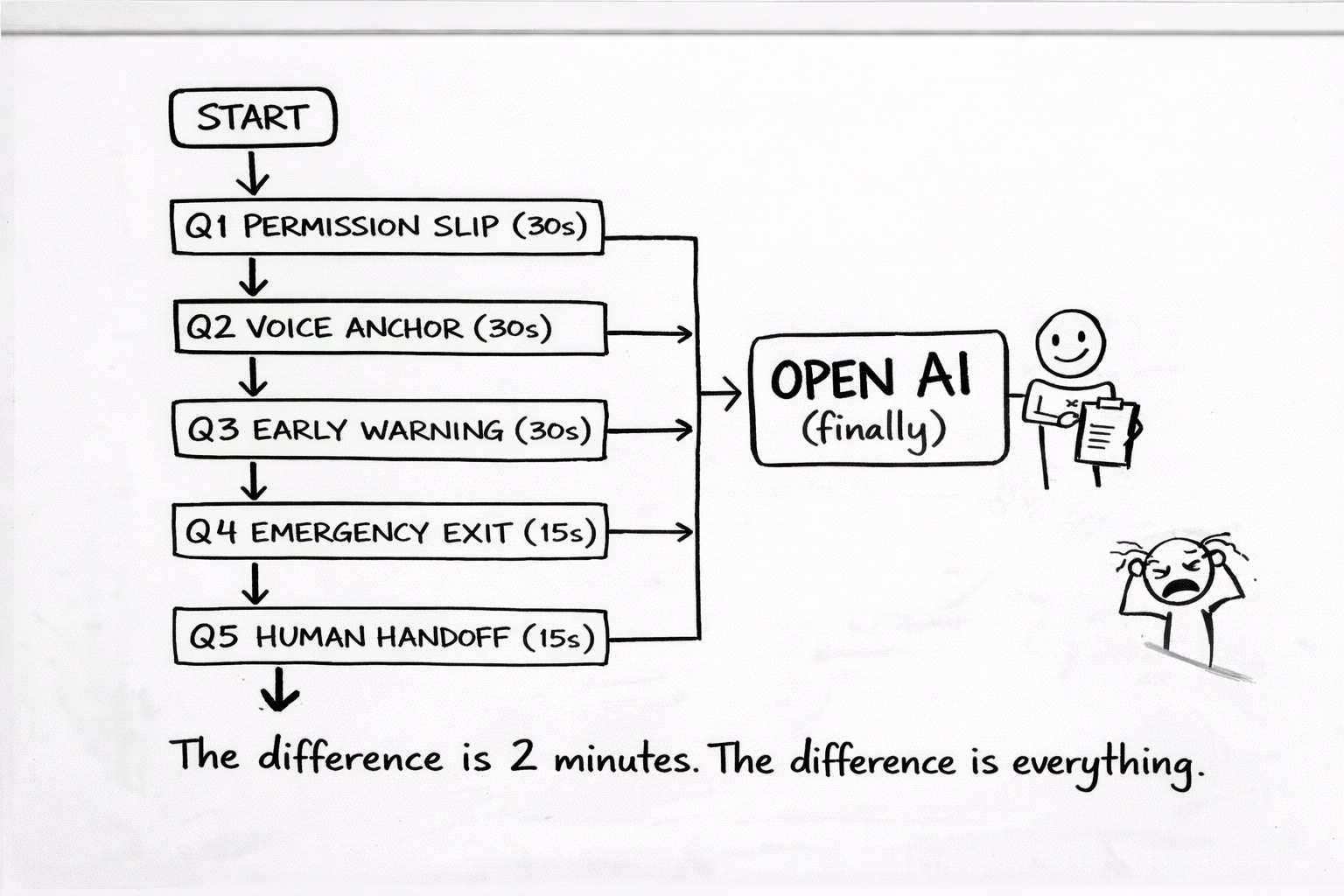
Question 1: The Permission Slip (30 seconds)
“What specific AI behaviors am I explicitly banning today?”
Not vague. Not “be less generic.” Not “try to sound more human.” Those are wishes, not instructions. They’re what you whisper into the void hoping the void whispers back something useful. (It won’t.)
Specific phrases you will not accept in today’s output. Write them down.
My Tuesday failure: I didn’t write anything down. I was “in a hurry,” remember? Too busy being efficient to be effective. So when “strategic framework” showed up twice, I didn’t catch it. A reader did. The reader emailed. The reader used only an emoji. 🤖
That emoji will haunt me forever. It contained an entire essay’s worth of disappointment in a single robotic face.
The math: 30 seconds to write your banned phrases. Versus 5+ minutes per occurrence to spot, fix, and verify the fix didn’t break something else. (It always breaks something else. Editing is whack-a-mole. The moles are infinite. You are mortal.)
Your 30 seconds: Think about your last few sessions. What phrases made you wince? What made you think “well, I guess that’s technically fine” in the tone of voice you use when you’ve given up? Write 3 of them down. Actually write them. Pen, paper, fingers on keys. Don’t just think them. Thinking is not doing. Thinking is rehearsal for doing. We’ve all rehearsed enough.
Question 2: The Voice Anchor (30 seconds)
“What’s one recent piece of my writing that actually sounds like me?”
Don’t describe your voice. Describing your voice is an exercise in futility, like trying to explain a joke or define pornography. (”I know it when I see it” works for Supreme Court justices and for recognizing your own best work.)
Point to it instead.
The math: 30 seconds to calibrate your ear. Versus reading the entire draft three times because something “feels off” but you can’t articulate what. You know the feeling. The unease. The sense that you’re reading someone else’s homework. The creeping suspicion that a very intelligent stranger has body-snatched your prose.
Your 30 seconds: Pull up a piece you’re proud of. One where you read it back and thought “yes, that’s the one.” Read the opening paragraph out loud. (Yes, out loud. Your mouth knows things your eyes have learned to ignore.) Your ear is now tuned. You have a reference frequency. You know what you sound like when you’re firing.
(Most people can’t do this quickly. They stare at their own archive like it belongs to someone else. That’s data. It means you haven’t identified your own best work yet. Start noticing. Start bookmarking. Build a file called “When I Was Good” and refer to it often.)
Question 3: The Slop Early Warning System (30 seconds)
“What specific red flags will tell me this session is going off the rails?”
Not “feeling generic.” Feelings are unreliable narrators. By the time you feel generic, you’ve already published three paragraphs of it.
Specific patterns. Named patterns. Patterns you can spot in a single sentence before they infect entire sections with that unmistakable scent of "written by probability."
My red flags:
When AI uses bullet points I didn’t ask for. (It loves bullet points. It dreams of bullet points. Its ideal output is an infinite list of slightly reworded variations on the same theme.)
When sentences all become the same length. (Monotonous rhythm is the first sign your prose has been replaced by an algorithmic approximation of prose.)
When “importantly” appears more than once. (No word has ever added less importance to anything than the word “importantly.”)
These are MY tells. Based on how MY voice gets violated.
Yours will be different. Your red flags are unique to you, like fingerprints or recurring nightmares or the specific phrases that remind you why you drink.
Write down 3 of them. You’re not waiting to feel generic. You’re naming the tells in advance so recognition becomes automatic. So you catch the first sign, not the fifth.
Question 4: The Emergency Exit Protocol (15 seconds)
“What's my kill switch when AI starts outputting content-shaped content?”
This is the uncomfortable one.
You need to decide, before you’re frustrated, before you’re 25 minutes deep and emotionally invested, before sunk cost fallacy has dug its claws into your judgment: what triggers an abort?
My kill switch: If I’ve corrected the same issue twice and it’s still happening, I close the chat and start fresh. No negotiating. No “maybe this time.” No bargaining with a statistical model that does not care about my feelings and cannot learn mid-conversation the way I keep hoping it will.
The math: 15 seconds to decide when to bail. Versus 45 minutes of chasing bad outputs because you’ve “already invested so much time.”
This is the sunk cost fallacy. It’s one of humanity’s most popular forms of self-torture. We know it’s irrational. We do it anyway. We are creatures of pattern and the pattern is suffering.
Without a predetermined abort trigger, you’ll convince yourself you can salvage it. You can’t. Some sessions go sideways. Some AI conversations produce nothing but increasingly confident nonsense. The only fix is walking away and starting fresh.
Decide when to bail before you’re in the water.
Question 5: The Human Handoff Point (15 seconds)
“Where exactly will I take over from AI in this piece?”
The handoff can’t be “when it feels done.” “When it feels done” is not a specification. “When it feels done” is “I haven’t actually thought about this and I’m hoping my future self will figure it out.” Your future self is just you, but more tired. Don’t do that to them.
My handoff: AI handles structure and first-pass prose. I write the opening, the closing, and every personal story.
Those are my fingerprints. The parts that make this mine. AI doesn’t touch them. Not because AI couldn’t write something serviceable for those sections. It could. That’s the terrifying part. It could write something perfectly acceptable, and it would sound like everyone else’s perfectly acceptable openings and closings and stories, and I would have traded my distinctive features for “good enough.”
I did not spend 25 years learning to write so I could publish “good enough.”
Draw the line before you start. Not after you’ve let AI drift into territory it shouldn’t own. By then, the colonization has already begun. The generic has already planted its flag.
The Compounding Problem (Or: Why This Gets Worse If You Ignore It)
Here’s the part that makes the math even worse.
(I know. You thought 43 lost minutes was bad. Settle in.)
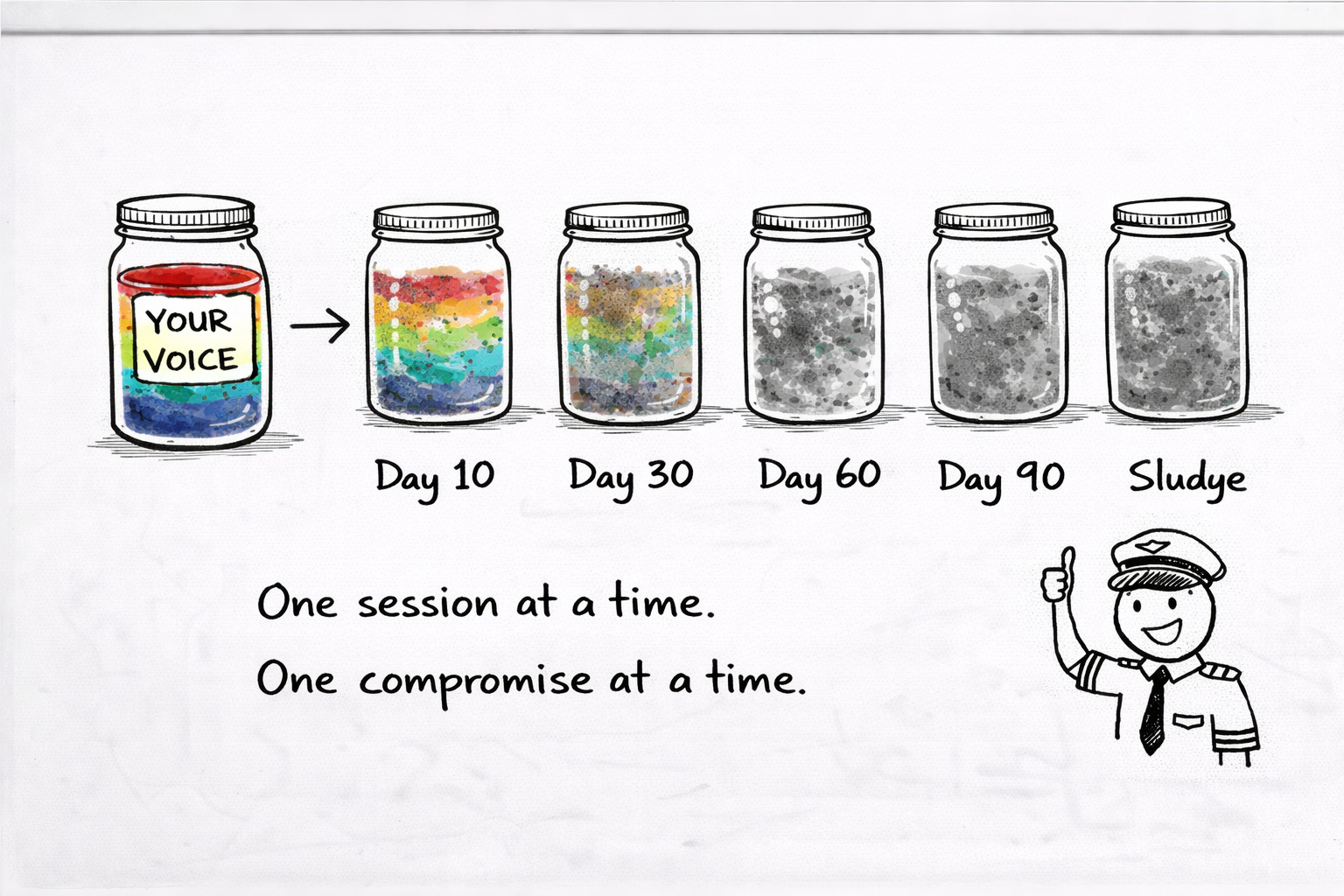
When you skip setup, you don’t just lose time TODAY. You lose calibration over time.
Each session without boundaries, a little more generic seeps into your default. Into your expectations. Into what you’ve learned to accept. You stop noticing the slop because you’ve gotten used to seeing it. Your standards drift downward like a raft with a slow leak. Your voice erodes.
And you don’t notice. That’s the really sinister part. You don’t wake up one day and think “my writing has become generic.” You wake up one day and realize you can’t remember the last time you published something that surprised you. Something that felt like YOURS. Something that could only have come from your specific brain with your specific experiences and your specific collection of strong opinions and petty grudges.
Three months of skipped setups doesn’t cost you 3 months × 30 minutes = 90 hours of editing.
It costs you your voice.
Gradual. Incremental. Plausibly deniable until it’s not.
Like ensloppification itself: it happens one “good enough” at a time, until your old posts feel like they were written by a roommate who moved out and immediately started dating someone who looks just like you.
Pick Your Pain
You’re going to spend time either way.
Writing takes time. Editing takes time. Staring at output and feeling vaguely disappointed takes time. Explaining to readers why you published “strategic framework” twice takes time (and dignity, which is harder to replenish).
The question is whether you spend that time BEFORE (2 minutes, preventive, high leverage, dignified) or AFTER (30-45 minutes, reactive, low leverage, slightly pathetic).
This isn’t a close call. It has never been a close call. Every time I’m honest with myself I’m freshly insulted by how obvious the right choice is and how often I make the wrong one.
I know this. I still skipped it on Tuesday.
Because “being in a hurry” felt more urgent than “behaving like an adult with object permanence.”
Because present me is always willing to screw over future me, and future me never gets to vote.
Because we are human, and humans are the species that invented the treadmill desk and then used it as a coat rack.
Don’t make my trade.
The 2 minutes are worth it.
I know they are, because I keep paying the price for skipping them, and the receipt is always worse than the investment would have been.
Slop doesn’t care if you’re busy. It’ll show up either way. The question is whether you made it easy.
🧉 What’s your biggest time sink when editing AI output? The specific thing that eats 15 minutes when it should take 2? Drop it below. Misery loves company and I want receipts.
Crafted with love (and AI),
Nick “🤖?” Quick

PS... I publish daily. Mostly about how to use AI without becoming the thing you hate. Subscribe if you want to watch me make mistakes in real time and occasionally learn something.
That observation about the alarm clock and snooze button is so spot on. It's like skipping Pilates stretches and then wondering why I'm stiff, isn't it?