
The Coming Class War Between “Artisanal Human” and “AI-Assisted” Writers
Why "I write everything myself" is the new "I summer in the Hamptons"

I watched a writer I respect do the face.
You know the face. Someone mentions they use AI in their process, and there’s this micro-expression. The slight recoil. The recalibration of respect happening in real-time behind the eyes.
It’s the literary equivalent of “I don’t own a television.”
“I don’t use AI.”
Both statements tell you more about the speaker’s tax bracket than their creative output. Both are performing a class position while pretending to perform a principle.
Writers are sorting themselves into castes right now. Not by talent. (Wouldn’t that be something.) Not by whether their work makes anyone feel anything. (Sorry, that’s not a measurable KPI.) Just by whether they’ll cop to letting a machine help with the scaffolding.
And if you think this is some principled stand about human creativity, well. Principles are easy when you can afford them.
The Holy War
Here’s the debate everyone’s having:
Camp A: The Purists. “I write everything myself.” Said with the quiet pride of someone who also makes their own sourdough and has opinions about pour-over coffee.
The implication: Anything touched by AI is contaminated. Lesser. Cheating, somehow.
Camp B: The Automators. “AI is just a tool, get over it.” Said with the eye-roll of someone who thinks anyone not optimizing their workflow is a Luddite.
The implication: Resistance is nostalgia. Adapt or die.
Both camps have podcasts. Both have manifestos. Both are absolutely certain the other side is either elitist or soulless.
This is the noise. The discourse. The takes and counter-takes that fill your feed while the actual future gets decided somewhere else entirely.
But underneath the yelling, something else is happening.
The Scarcity Grift
Premium has always been about scarcity.
The Medicis didn’t commission Michelangelo because he was the only painter in Italy. They commissioned him because they could afford to wait four years for the flex. Same energy. Different ceiling. (Literally, in that case.)
“Artisanal human” is becoming a luxury positioning. I mean that in the most Louis Vuitton sense possible. The people loudest about AI purity are frequently the ones whose bank accounts let them be loud about it.
Here’s the math nobody wants to do out loud:
Writing everything yourself takes time. Time costs money. Money is... well. You know what money is. You’re either swimming in it or treading water hoping your head stays above the surface.
The writer who can spend forty hours crafting a single piece without checking her balance exists in a different economic universe than the writer juggling three clients, a Substack, and the gnawing suspicion that they’re rent’s about to go up again.
“I write everything myself” is becoming the new “I summer in the Hamptons.”
Sounds like a quality claim. Functions as a class marker.
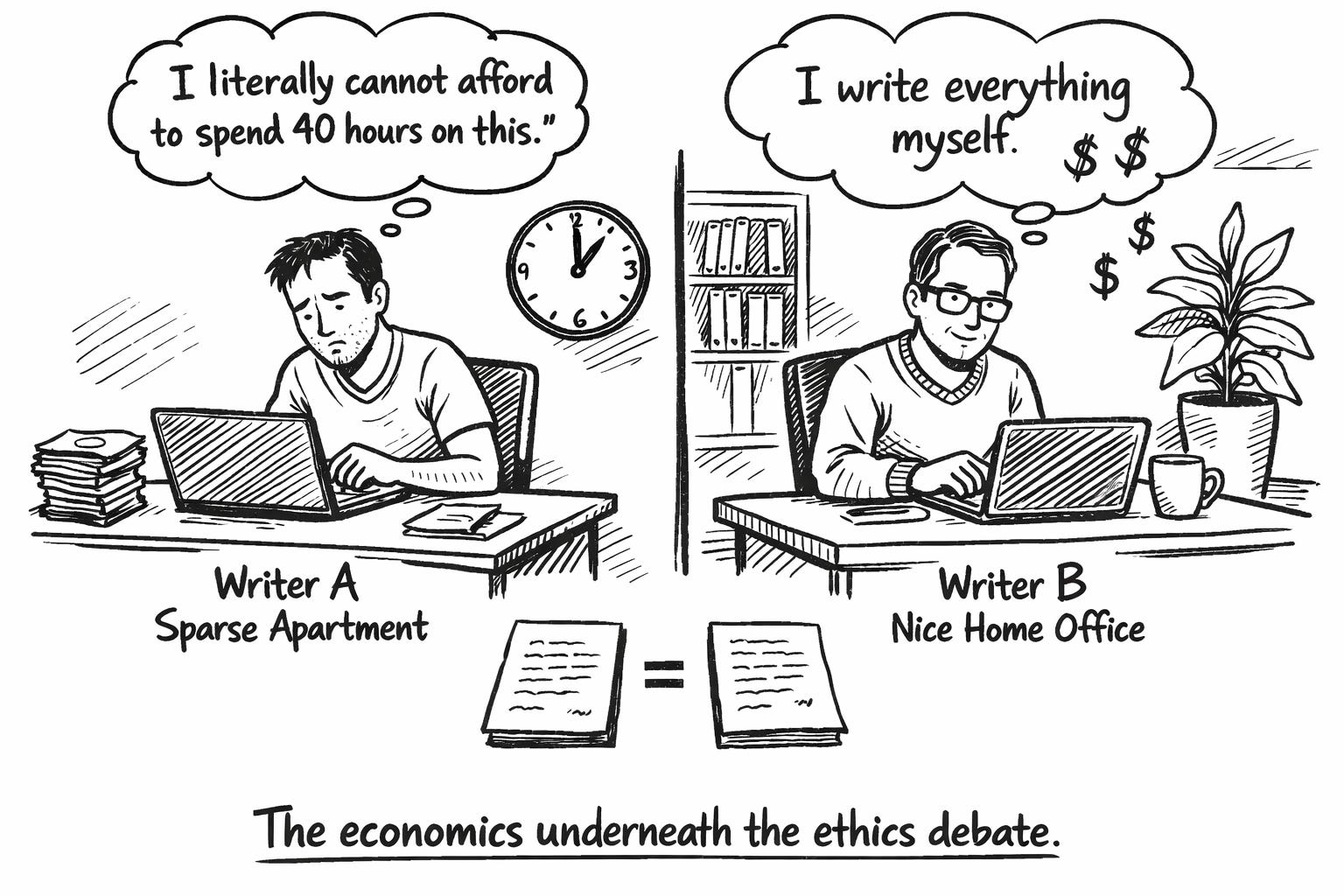
The economics aren’t complicated. “Artisanal human” commands premium rates precisely because most people can’t afford the time investment. The scarcity is real. So is the class gatekeeping hiding behind it.
Writers with financial cushion can sell scarcity. Writers without it can’t.
This creates a two-tier system that has nothing to do with whether anyone can actually write worth a damn. (Spoiler: some of the best writers I know use AI. Some of the worst wouldn’t touch it. Correlation with quality? Basically zero.)
But here’s where it gets uncomfortable for everyone.
Including the shiny happy AI-assisted crowd who think they’re the scrappy underdogs democratizing creativity.
They’re not.
The Other Side’s Blind Spot
The AI-assisted crowd has its own class problem. They just can’t see it because they’re too busy feeling like protagonists in a disruption narrative.
(Nothing says “underdog” like having leisure time to learn prompt engineering.)
Early AI adopters aren’t random. They skew younger, more tech-savvy, more likely to have the cognitive surplus to spend three weeks figuring out why ChatGPT keeps making their protagonist “chuckle warmly” in every scene. (Why does AI love chuckling? Who chuckles warmly? Serial killers. Serial killers chuckle warmly.)
They’re not “the masses democratizing creativity.” They’re a different flavor of privilege wearing a different costume.
The tools require learning curves. Learning curves require time. Time is a luxury. We’ve established this. The pattern holds.
So we’ve got two camps, both claiming moral high ground, both standing on economic advantages they’d rather not examine too closely.
And while they’re busy arguing about purity and progress?
Both camps are fighting over scraps while the real winners watch from the sidelines.
Platforms pocket ad revenue from the debate itself. LinkedIn doesn’t care if your post was hand-carved from reclaimed barn wood or generated by a robot having an existential crisis. It cares that you posted. Engaged. Generated data. Eyeballs. Ad impressions.
The debate itself is the product.
We’re performing outrage for companies that would replace us all with chatbots tomorrow if some analyst in a fleece vest suggested it might help margins.
The Market Reality (Four Tiers Forming)
While Camp A and Camp B yell at each other on social media, the market is quietly sorting writers into something else entirely.
Not by which camp they tweet from. Not by their stated principles. By how they’re actually positioned and priced.
Four tiers. Forming right now. Whether we voted for it or not.
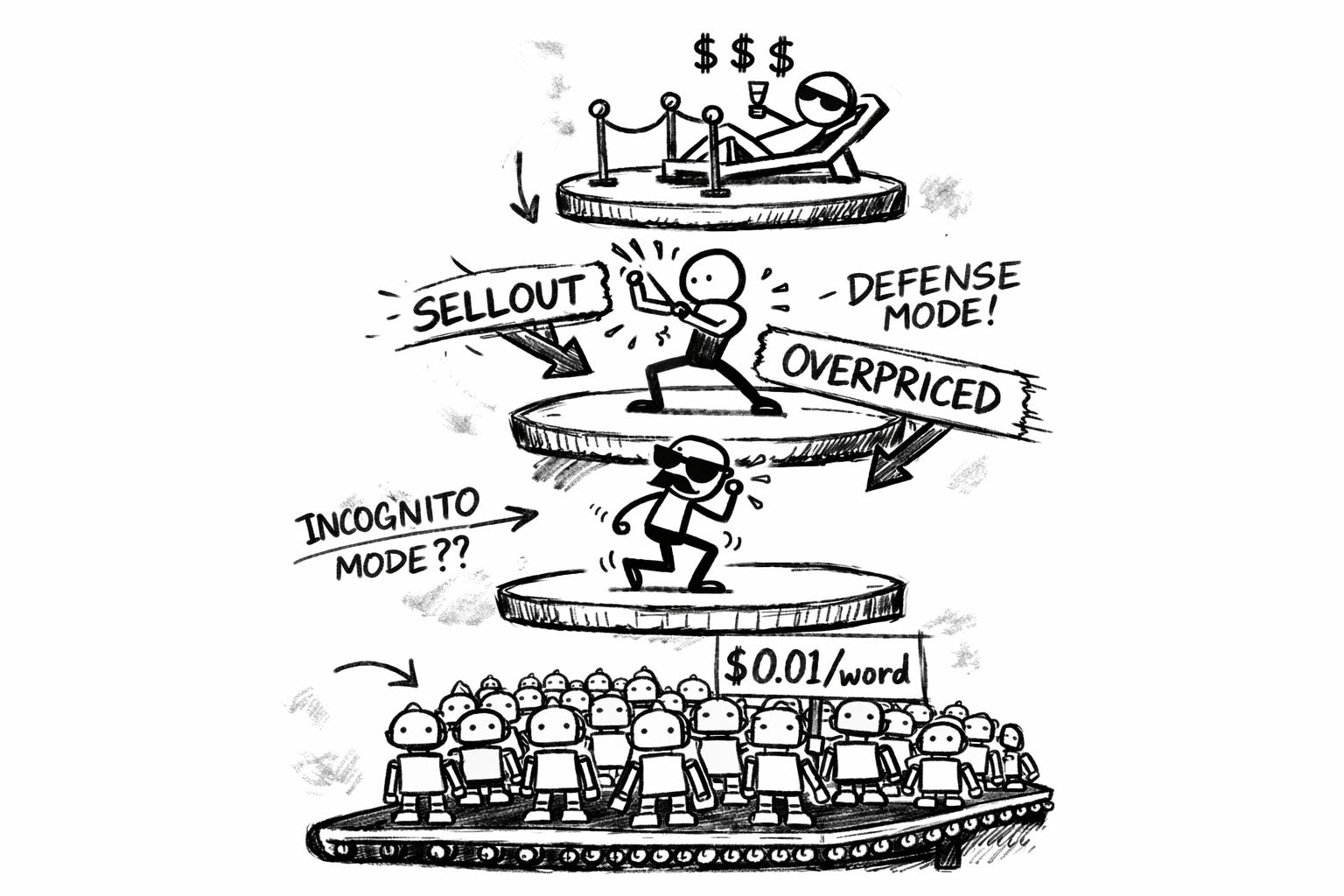
Tier 1: “Pure Human” Premium
High rates. Low volume. Status signaling so thick you could spread it on toast. Think artisanal cheese. The audience pays for the story as much as the product. “This was made by HUMAN HANDS” printed on the label. Probably in gold leaf.
Viable if you’ve got runway. A fantasy if you don’t.
Tier 2: “Disclosed AI-Assisted”
The honest middle. Writers using tools transparently, trying to do good work without pretending they’re doing it all by hand.
Also the tier currently getting crushed from both directions.
Too “impure” for Tier 1’s velvet rope. Too “expensive” compared to the shadows below. The reasonable position with the worst market economics. (Markets don’t reward reasonable. Markets reward extremes.)
Tier 3: “Undisclosed AI”
The shadow economy. Growing faster than anyone wants to admit. Writers claiming artisanal credentials while operating with factory efficiency.
If you think this isn’t happening, I’d like to introduce you to roughly 40% of Medium posts from the last eighteen months. Some of them are probably reading this right now. (Hi. I see you. I’m not here to judge. I’m here to describe the map.)
Not sustainable. But profitable until the music stops.
Tier 4: “Full Automation”
Content mills. No pretense of human involvement. Racing to zero margin and hoping to make it up on volume.
The Walmart of words. Everything must go.
The Cosmic Joke
Here’s what nobody in either camp wants to hear:
The four tiers describe where the market puts you. They don’t describe whether you’re doing good work.
Tier 1 writers can produce brilliant work or pretentious garbage. Tier 2 writers can produce brilliant work or lazy garbage. Tier 3 writers can produce... well, usually garbage, but occasionally something decent. Tier 4 is just garbage. (Sorry. It is.)
The tier is a market position. A pricing strategy. A disclosure status.
It says nothing about whether you’re actually any good.
And here’s the cosmic joke: Tier 2 might be where the best work actually happens. Human judgment steering AI capability. Craft informed by efficiency. The synthesis that neither extreme can produce alone.
But it’s the tier with no lobby. The people doing nuanced, thoughtful work are getting attacked from above (”sellout!”) and undercut from below (”overpriced!”).
“Artisanal human” is a pricing strategy cosplaying as an ethics position.
“Full automation” is a race to the bottom that salts the earth for everyone.
And the honest middle watches both extremes profit while explaining, for the nine hundredth time, that using AI for drafts doesn’t mean a robot wrote their novel.
The Question Nobody’s Asking
Both camps are arguing about the wrong thing.
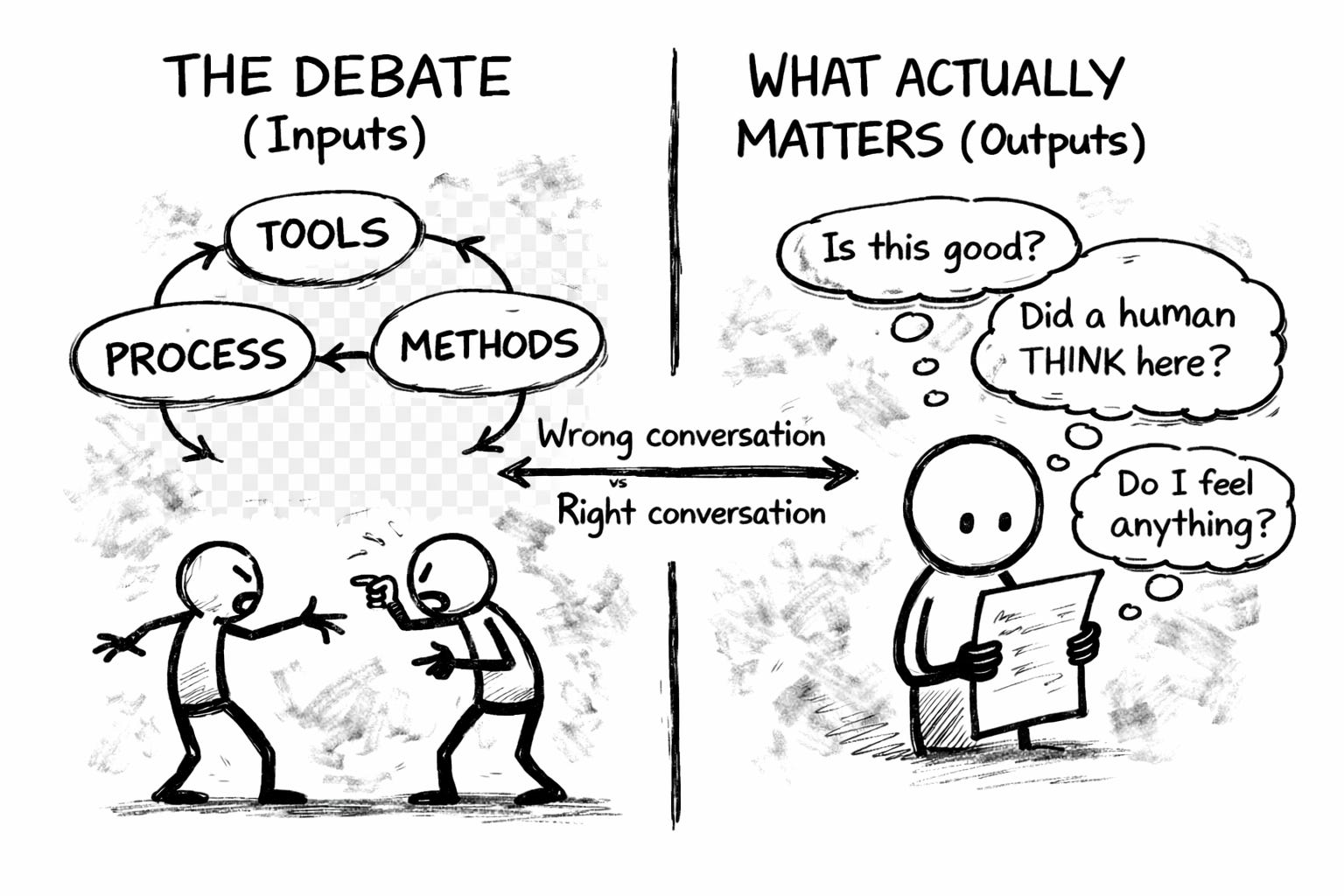
The purists obsess over inputs. “Did you use AI? How much? Which parts?” As if the creative process were a recipe that could be audited.
The automators obsess over efficiency. “How fast? How much? How scalable?” As if the goal were volume rather than value.
Neither question matters to the person reading your work.
The reader doesn’t care about your tools. The reader cares about the output. Is this good? Did a human actually think here? Do I feel anything?
The purity debate is about inputs.
What actually matters is outputs.
The Case for Co-Writing
“I use AI sometimes” is a confession.
“I produce work neither of us could make alone” is a craft standard.
One puts you on defense. The other gives you something to stand on.
The purists are right that craft matters. That human perspective is irreplaceable. That something genuine gets lost when you fully automate the process.
The automation crowd is right that tools are tools. That gatekeeping is usually elitism that wrote itself a permission slip. That refusing all assistance is frequently theater.
The synthesis isn’t about disclosure policies or ethics committees.
The real question: Are you using AI to produce more of the same? Or to do better work than you could alone?
Is your thinking in the work? Your judgment? Your weird specific perspective that comes from being the particular human you are?
Or did you just press a button and sign your name?
Your patterns. Your perspective. Your judgment about what’s worth saying. With tools that handle the scaffolding so you can focus on the architecture.
The uncomfortable part? This approach doesn’t have a lobby. No trade association. No LinkedIn influencer pushing it because “nuance” doesn’t fit on a carousel.
The purists will call you a sellout. The automation crowd will call you inefficient.
You have to be okay with nobody throwing you a parade.
Your Sixty-Second Positioning Check
The tiers are forming whether you participate in the debate or not. You don’t have to accept the position you’ve been assigned.
Step 1: Name your actual tier. Not your preferred tier. Not the one you perform on social media. Where do you actually operate? Be honest. The only person you’re lying to is yourself.
Step 2: Write one sentence describing what you add that no tool can replicate. Not “creativity.” (Too vague.) Not “the human touch.” (Meaningless.) What specifically? Your pattern recognition? Your hard-won expertise? Your ability to explain complex things to specific people?
Step 3: Ask yourself: Am I using AI to produce more of the same? Or to produce better work than I could alone?
One of those answers has a future. The other is a countdown.
Self-audit share: “Did you do the 60-second check? What did you actually write for Step 2?”
Crafted with love (and AI),
Nick “Class War Correspondent” Quick

PS…I’ve been writing like something’s chasing me. Subscribe if you want a front-row seat to whatever this is.
I think the "Artisanal Human" market will become more popular as the full-automation crowd continues to scale up their output. Part of enjoying a service or product is understanding that someone invested time and effort to ensure you have a good experience with what they offer. Ironically, the more low-effort AI that is generated, the more valuable the virtue signaling from the artisanal human crowd becomes. I think the most successful group will probably be someone who can demonstrate that their content is original, but who also augments their production process with technology to produce banger after banger.
I use ChatGPT to help with writing and I once asked it how to cite ChatGPT and how I should include ChatGPT as a co-author. It practically scolded me for even suggesting that! Wow. That's a problem in itself (for another time) but I always mention when I use AI. I do this because it is honest and if I didn't have ChatGPT I know I would not be writing. I don't like to write. There are too many boring aspects of writing like doing the literature search, following the citation path to find new articles related to a given article, synthesizing & organizing the literature (NotebookLM is great for this task), generating an outline, creating APA-style citations (major drag), rewriting, rewriting, rewriting, etc. I am okay with having to check everything ChatGPT produces; it makes a lot of errors but it is mostly correct (human in the loop). AI gets you up and running quickly. There are just too many topics that bother me. I have to write something.