
The Boulder Always Rolls Back Down
A dead French philosopher's guide to AI writing that actually works

The ancient Greeks cursed a man to roll a boulder up a hill forever. Every time he reached the top, it rolled back down. He walked back down. Started again. For eternity.
I think about Sisyphus every time I open ChatGPT.
(This is not the flex it sounds like. This is a cry for help dressed as a newsletter.)
A French philosopher named Albert Camus wrote an entire book about this myth in 1942. His conclusion, after all that philosophizing, after all those cigarettes and presumably a lot of staring moodily out of windows: we must imagine Sisyphus happy.
Happy.
Not because the boulder stops rolling. It never stops. Not because the gods relent. They don’t. Not because he finds a productivity hack that makes the boulder 10% lighter or rolls it up a slightly shorter hill. The boulder weighs what it weighs. The hill is the hill. The situation never improves.
Happy anyway. Because he chose to engage with the task. Because the act of pushing became its own meaning. Because the alternative is despair, and despair is boring.
I didn’t expect a dead existentialist to have the best AI writing advice I’ve ever encountered. But here we are. Him with his Nobel Prize and his artfully dangled Gauloises. Me with my ChatGPT subscription and my slowly deteriorating sense of what “productivity” even means anymore.
The Prompt That Doesn't Exist
Here’s what most AI writing advice gets catastrophically, embarrassingly, almost impressively wrong:
They act like there’s a prompt out there. The right prompt. The golden combination of words that makes AI suddenly understand you, capture your essence, reproduce your soul in convenient paragraph form.
There isn’t. Not the way they’re selling it.
I’ve looked. For months. Burned through every framework, every “ultimate prompt template,” every $47 guide that promised secrets and delivered clipart. My Downloads folder knows what I’ve done. We don’t talk about it.
The result was always the same:
Prompt AI. Get generic output. Refine prompt. Get slightly different generic output. Wonder if I’m uniquely broken. Try again anyway because what else am I going to do, develop a healthy relationship with my limitations?
The boulder rolling back down the hill.
Over and over. Forever.
The gods didn’t even have the decency to make it dramatic. No thunderbolts. No pronouncements from on high. Just... another generic LinkedIn post about “leveraging synergies” when I asked for my voice.
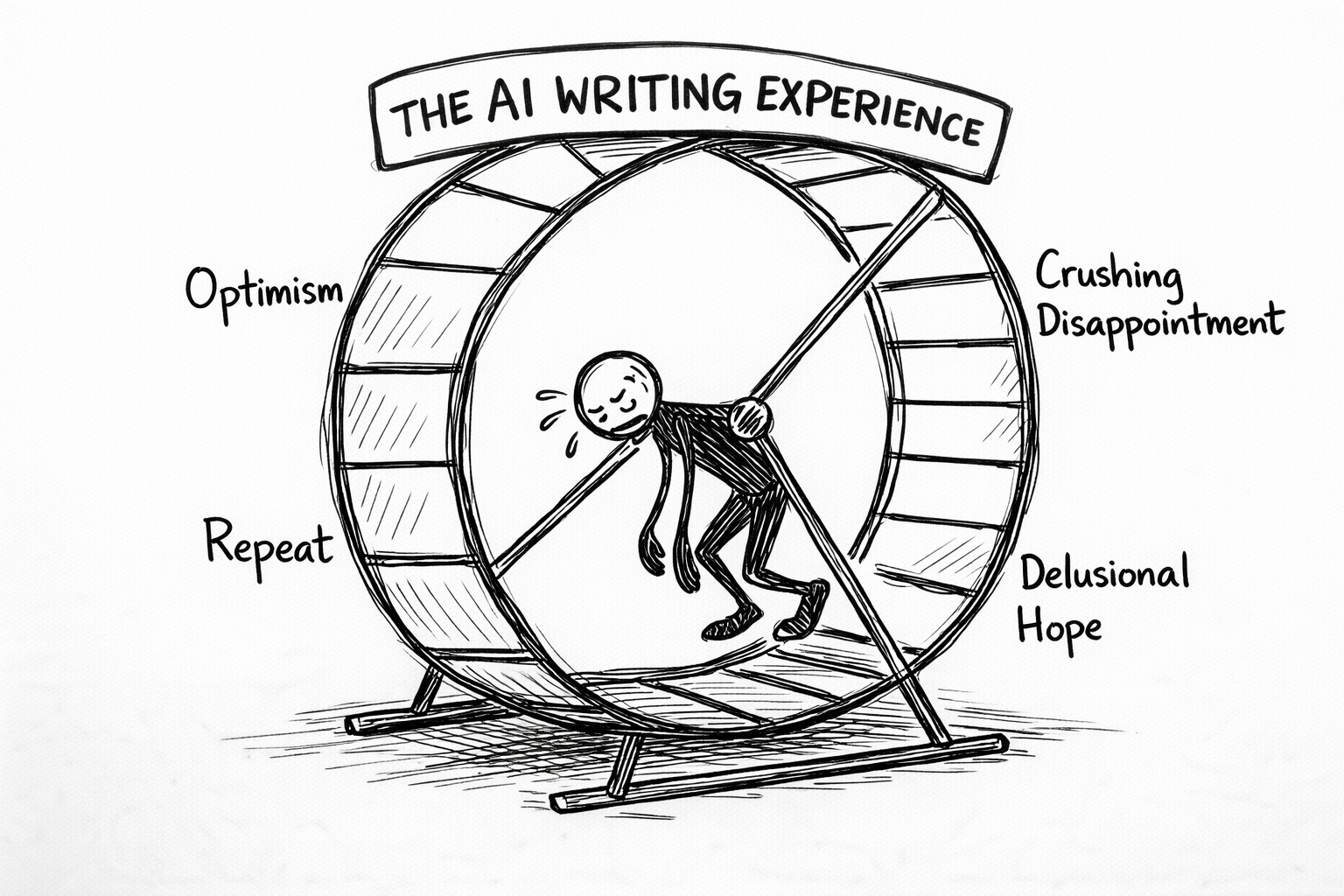
For a while I thought I was uniquely bad at this.
Maybe everyone else had figured it out. Maybe there was a meeting I missed where they distributed the secret prompts and I was in the bathroom. Maybe I was constitutionally incapable of this particular skill, like how some people can’t roll their tongues or enjoy jazz or stop buying courses from people who say “passive income” without flinching.
Then I went back to Camus.
Not because I’m particularly intellectual. (I majored in philosophy, which has prepared me for exactly two things: this moment and unemployment.) But the parallel kept nagging at me. The loop. The repetition. The sense that I was doing the same thing expecting different results, which is either the definition of insanity or the definition of Tuesdays, depending on who you ask.
Turns out the dead French guy had something useful to say.
You’re Not Failing. The Situation Is Absurd. There’s A Difference.
Here’s the reframe that changed everything for me:
You’re not failing at AI collaboration. AI collaboration is absurd. You’ve just been expecting it not to be.
Let me explain what you’re actually asking AI to do.
You’re asking a statistical prediction engine (a tool that literally guesses the next probable word based on patterns, that has no consciousness, no understanding, no preferences, no soul, nothing resembling an inner life) to understand your voice. Capture your perspective. Sound like you.
It doesn’t know you exist.
It has no context for who you are beyond whatever you’ve typed into that little box. And what have you typed? “Write this in my voice.” “Be more conversational.” “Sound like me.”
Instructions it literally cannot follow. Based on what data? Sourced from where?
So it guesses. And it guesses toward the statistical average of everything it’s ever seen on your topic. The mathematical mean of all writing ever written. Which is, by definition, average. Generic. Slop.
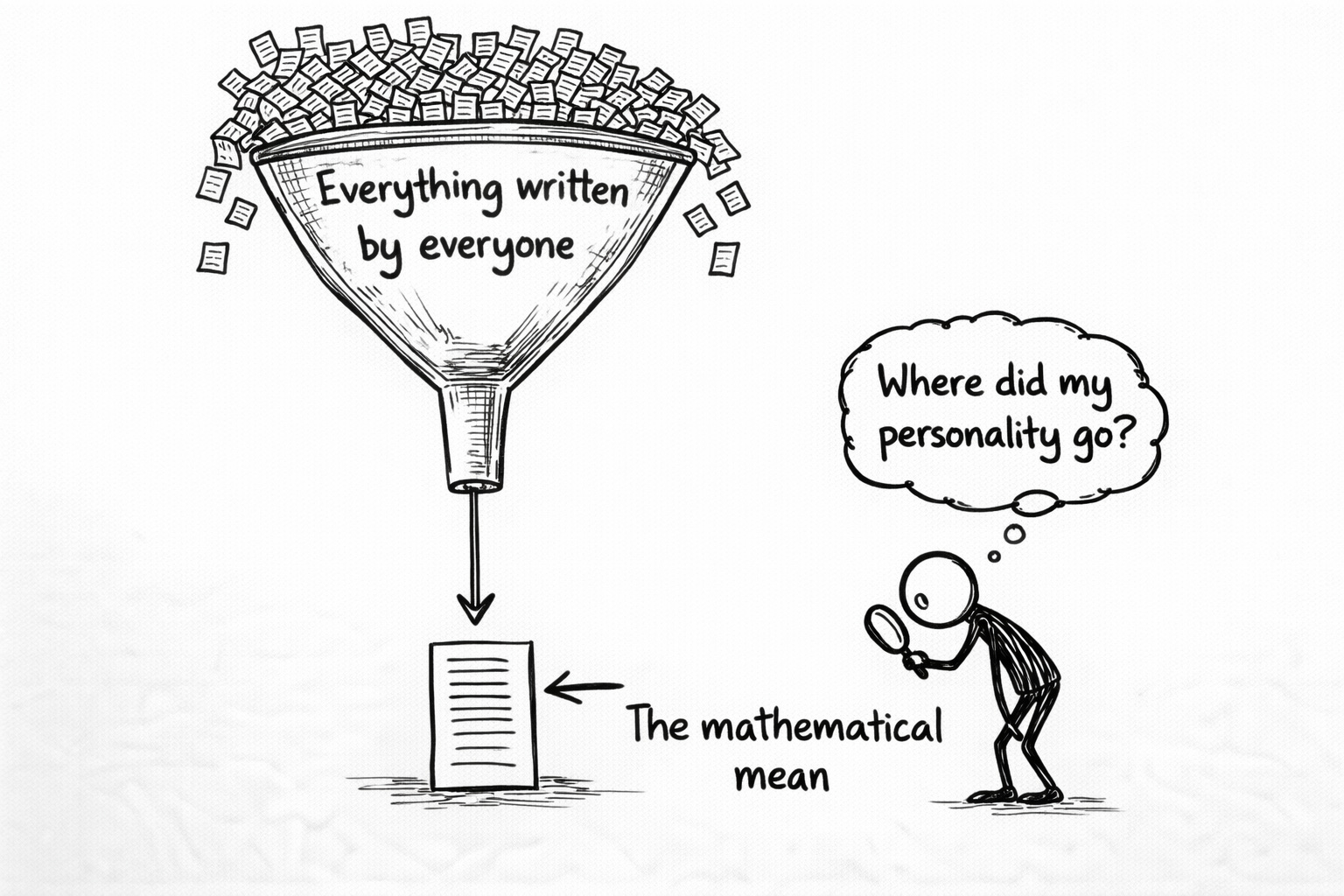
This is the absurdity Camus was writing about. Not the boulder itself. The expectation that the boulder should behave differently.
You’re asking a machine to produce exceptional output when its entire architecture is designed to produce probable output. You’re asking for uniqueness from a system built to find commonality. You’re asking a stranger to forge your signature without ever showing them your handwriting.
And then you’re frustrated when it doesn’t work.
The frustration isn’t a sign you’re bad at this. The frustration is a sign your expectations are misaligned with reality. You’re not failing. You’re fighting a situation that was never going to cooperate in the way you wanted.
The absurdity isn’t a problem to solve.
It’s a reality to work with.
The Absurdist Approach (Three Shifts That Actually Help)
Absurdism isn’t nihilism.
(People confuse these constantly. Nihilism is “nothing matters, why bother.” Absurdism is “nothing matters inherently, which means I get to decide what matters, and I’ve decided this boulder is going up the hill whether it likes it or not.”)
Absurdism doesn’t say give up. It says: the situation is absurd, your search for inherent meaning is absurd, and your response is to create meaning anyway. Not find it. Make it.
Applied to AI collaboration, that looks like three shifts:
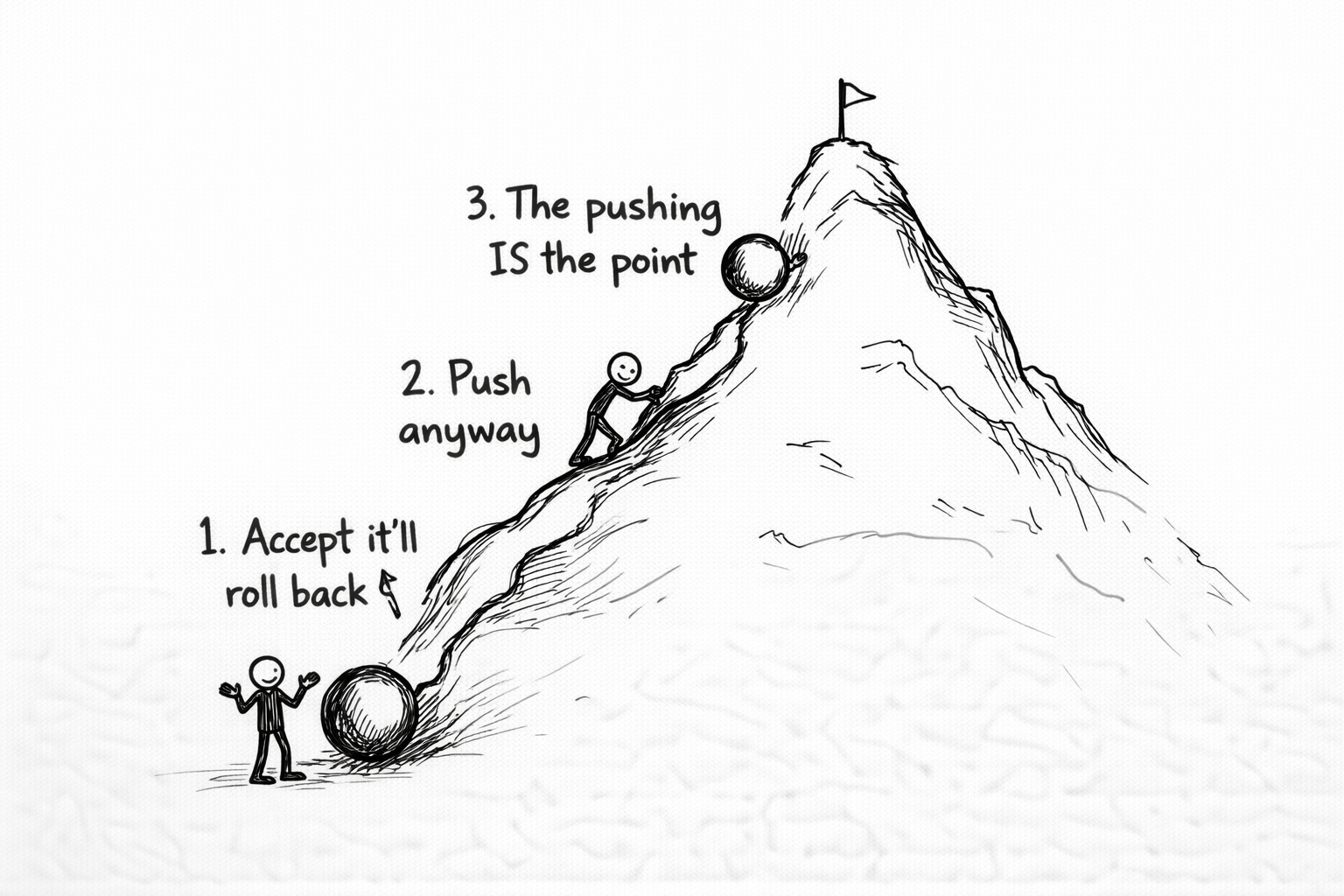
Shift 1: Accept the Absurd
Old expectation: AI should produce good writing from my prompts.
What actually happens: AI produces probable text. It has no idea who I am. It never will. It’s not playing hard to get. It genuinely cannot care.
The move: Before your next AI session, say “This is round one” out loud.
Mean it.
Round one is supposed to look rough. That’s not failure. That’s the starting point you’ll shape. The clay before sculpting. The ingredients before cooking. The silence before the song.
(I’ve started saying this out loud before every AI session. Like a prayer, but for people who’ve given up on magic prompts.)
Shift 2: Revolt Through Engagement
Old pattern: Prompt → Output → “This doesn’t sound like me” → Despair → New prompt from scratch → More despair → Eventually give up and write it myself while resenting the time I wasted
New pattern: Prompt → Output → “This is raw material” → Correct it (”too formal, more punchy, cut the corporate garbage”) → Better output → Correct again → Something I can actually use → Move on with my life
Plan for three passes minimum.
First pass: raw material. Accept its ugliness.
Second pass: shaping. Start to see the form.
Third pass: refining. Get it close enough.
Iteration isn’t failure. Iteration is the method. Iteration is Sisyphus walking back down the hill. He doesn’t walk back down because he failed to keep the boulder at the top. He walks back down because walking back down is part of the task.
(The people who expect one-shot perfection quit. The people who plan for iteration produce. The people who write newsletters about it are coping in public. Hi.)
Shift 3: Create Meaning in the Process
Old evaluation: Did I get good output?
New evaluation: What did I learn about my voice, my preferences, my patterns?
Every correction you give AI is a decision about your voice.
“Too formal” means you know what formal is. For you. That’s knowledge. That’s self-awareness. That’s data.
“More punchy” means you have a sense of your rhythm. You can feel when it’s off.
“Cut the corporate speak” means you know what doesn’t belong. You have taste. You have boundaries.
The process of correction is the process of self-knowledge.
Over time, you start to notice patterns in what you fix. The same corrections appearing across sessions. That’s your voice trying to tell you something. (I’ve turned mine into a system I now teach. Because of course I did. But that’s a different newsletter.)
The point isn’t optimization. The point is that the pushing itself becomes meaningful. Not because the boulder stays at the top. It never stays. But because you chose to engage. Because you decided this task matters to you. Because you made the absurd situation yours.
What Actually Changes
When I stopped expecting AI to get it right and started expecting to do work, something shifted.
Output quality paradoxically improved. Not because I found the magic prompt. Because I was engaged instead of disappointed. Because I was shaping instead of rejecting. Because I showed up as a collaborator instead of a customer waiting to be served.
The sessions started producing something. Not magic. Not one-shot perfection. But something I could shape instead of something I had to scrap.
And here’s the insight that keeps surprising me:
The slop factories are optimizing for frictionless.
They want to remove all human involvement. They want one-click content. They want input → output with nothing in between. They want the boulder to stay at the top so Sisyphus can take a goddamned nap.
But the friction (the shaping, the correcting, the iterating, the walking back down the hill) is the work. Not a barrier to it. The friction is where your voice enters the equation. Sisyphus didn’t get rock-hard abs from standing at the top. He got them from the climb.
Their output is probable text.
Yours has you in it.
That’s not a productivity hack. That’s a stance toward creative work. That’s a philosophy. That’s Sisyphus deciding to engage with the boulder because the alternative is letting the boulder win, and he’s been doing this too long to quit now.
The 60-Second Version (For People Who Scrolled To The End)
Before your next AI session: Say “This is round one” out loud. Mean it. Expect raw material, not finished work. The bar for round one should be on the floor.
When the first output disappoints: Don’t start over. Don’t rewrite your prompt from scratch. Correct what’s in front of you. “Too formal. Shorter sentences. More edge.” Shape the clay. Don’t throw it away and demand new clay.
After the session: Notice what you fixed. Write one sentence about what you learned about your own preferences. Even “failed” outputs teach you something. Especially failed outputs, actually.
The minimum viable version? Just #1.
Accept that AI collaboration is inherently iterative. Notice how that single reframe changes your energy. Notice how you feel different when you’re not expecting magic.
Quick Troubleshooting
“Doesn’t ‘accept the absurd’ mean accepting bad output?”
No. You still correct. You still refine. You still shape. You still reject garbage and demand better. You just do it without the emotional overhead of being surprised and disappointed every single time. The work is the same. The suffering is optional.
“What if I don’t have time for three iterations?”
Do two. Do one pass with aggressive correction. The principle isn’t “always iterate exactly three times.” The principle is “expect to do work.” Scale the work to your time. The absurdist approach scales.
“Isn’t this just cope for AI being bad?”
AI is what it is. Pretending it should be something different is what creates the frustration. I’m not telling you AI is good. I’m telling you the situation is absurd, your expectations are making you miserable, and there’s a way to engage that doesn’t require suffering.
Call it cope if you want. I call it sanity. Camus would call it rebellion. Sisyphus would call it Tuesday.
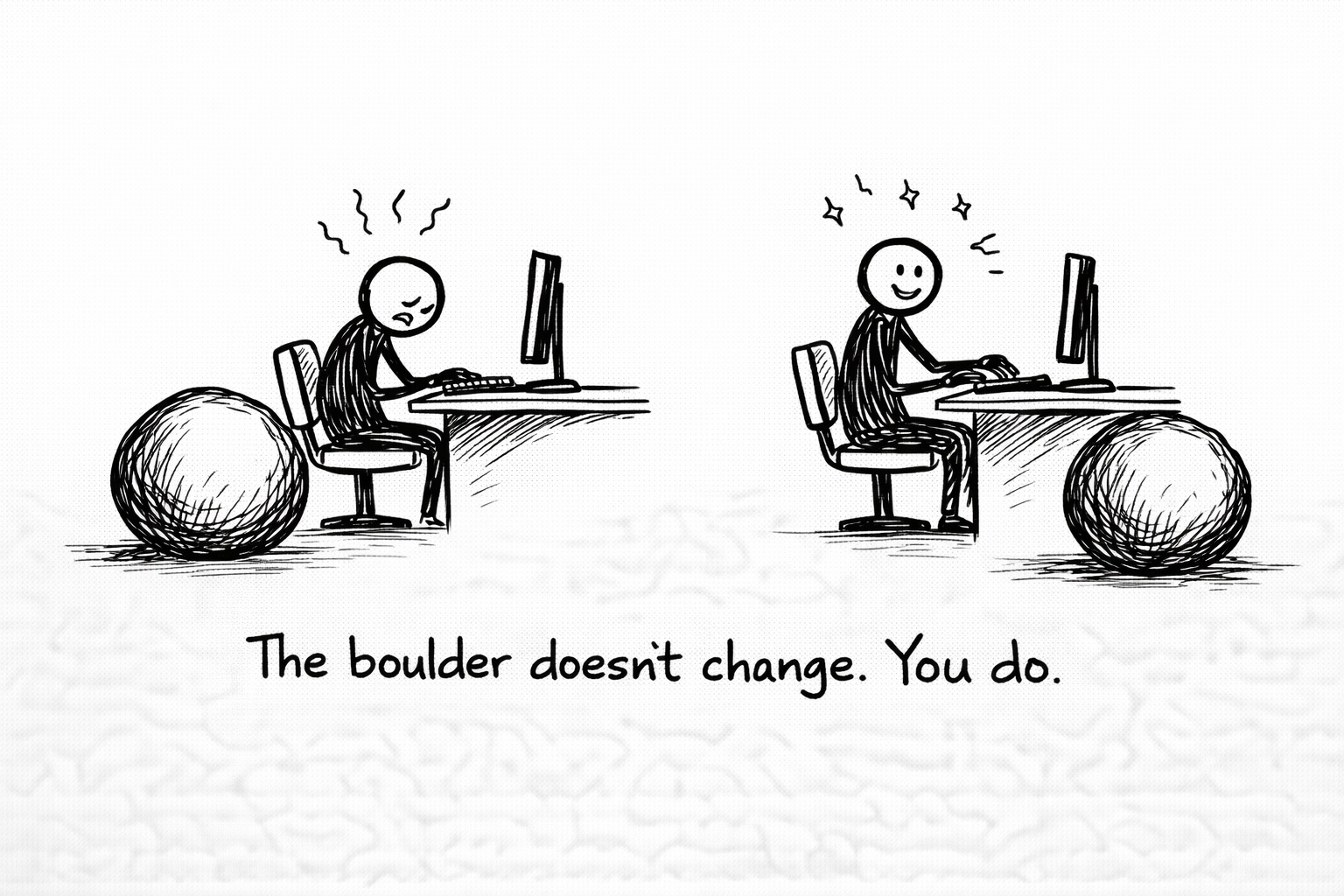
The loop is still there.
Prompt → output → correction → better output → repeat.
The boulder still rolls back down. It always rolls back down. The Greeks were clear about this. The gods set it up that way and they’re not taking feedback.
But the experience changes.
The suffering is optional.
Camus said the struggle itself toward the heights is enough to fill a person’s heart.
He wasn’t talking about AI collaboration. Obviously. He died before any of this existed. Probably would have hated it. Probably would have written something beautiful about hating it while chain-smoking on a beach somewhere.
But the principle holds.
The boulder’s still there. The hill’s still there. You’re going to push it anyway.
Might as well figure out how to enjoy the climb.
🧉 Sisyphus didn’t have a comments section. You do. What’s the AI writing myth you’re finally ready to let go of?
Crafted with love (and AI),
Nick “Happy Anyway” Quick

PS… Daily dispatches from the hill. Subscribe if you want to push boulders together. Or just watch. I’m not your dad.