
The Algorithm Isn’t Broken. It Just Hates You.
And the Drawbridge Is Going Up

Let me tell you about the worst five years of my professional life.
I’ve been posting on X since 2020. Threads, tweets, hot takes, thoughtful analysis—the whole performative dance. Five years of showing up. Being consistent. Playing the game exactly how every guru said to play it.
Under 100 followers.
Five. Frickin’. Years.
(I write about making AI sound human for a living. This is my villain origin story.)
I tried different formats. Different posting times. I read the threads about threads. Consumed so much advice about “what the algorithm wants” that I started dreaming in engagement metrics.
But here’s what finally broke through my thick skull.
The algorithm isn’t failing to surface my content. It’s working exactly as designed. The problem is it was never designed to help creators build anything sustainable.
It was designed to extract attention.
And for that purpose? It works beautifully.
The Distinction That Changes Everything
Here’s where I got confused for five years.
The algorithm is still excellent at passive consumption.
TikTok serves videos calibrated to your dopamine receptors. YouTube recommends rabbit holes you didn’t know you wanted. Instagram surfaces reels that make time disappear. For consumers, the algorithm works better than ever. A perfectly optimized attention-extraction machine.
But here’s what the algorithm has become terrible at: converting attention into anything meaningful for creators.
Views don’t become subscribers. Impressions don’t become trust. Viral moments don’t become sustainable audiences. The machine keeps people scrolling, not remembering who made the thing they scrolled past.
The ROI of algorithm-chasing has collapsed. Not for consuming content. For building on it.
The creators who figured this out first? They’ve already left the building. They’re not playing the viral lottery anymore.
I’m late to the party. But I finally understand what party I’m supposed to be at. (And I brought snacks.)
The Trust Collapse (With Receipts)
This isn’t vibes. This is data.
The Institution Is Broken
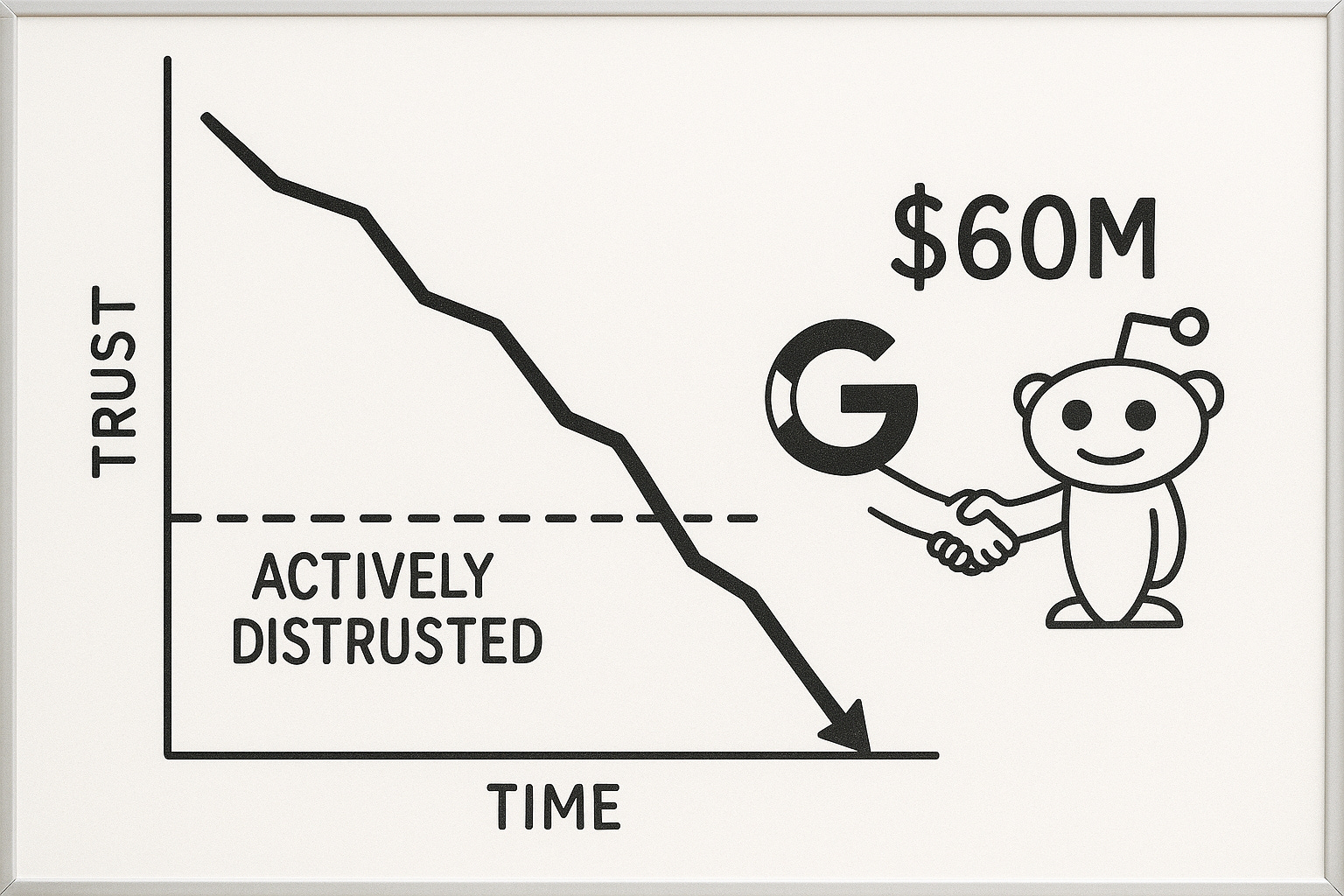
The Edelman Trust Barometer dropped a bomb in 2024: Global trust in “Media” has fallen below 50%. That’s the technical classification for an “actively distrusted institution.”
More than half the world looks at media and thinks: I don’t believe you.
When trust in the entire category collapses, people don’t just become discerning. They retreat to smaller circles where trust can actually be verified.
Google Waved a White Flag
Between July 2023 and April 2024, Reddit’s SEO visibility on Google increased by 1,328%. Not a typo. Google signed a $60 million per year deal to license Reddit data.
Why would the largest search engine on the planet pay $60 million annually for access to anonymous strangers arguing about video games?
Because their algorithm couldn’t tell garbage from gold anymore. They needed karma scores. Community verification. The messy, inefficient process of humans upvoting and downvoting each other.
Google looked at its own results and said: “We need backup from randos.”
People Have Stopped Clicking
58.5% of Google searches in the US result in zero clicks. More than half of all searches end with people staring at results and going... nah.
The search results page has become a wall, not a door.
The Broadcast Model Is Dying
Email click-through rates have flatlined at 1.4-3%. People “subscribe” but don’t act. The broadcast model (one person shouting at silent recipients) is losing to the interaction model (actual conversations in actual communities).
Your email list isn’t an asset if nobody’s clicking. It’s just a database of people who once thought about caring.
The Migration Is Already Happening
So where is everyone going?
Discord: 196.2 million monthly active users. 78% using it for non-gaming. The dark web of professional networking—massive, active, completely invisible to SEO.
You can’t Google your way into a Discord server. You have to be invited. You have to be trusted.
That’s not a bug. That’s the point.
Substack: Over 4 million paid subscriptions. People voluntarily paying money to escape the noise. When audiences start handing over cash for curation, you know the noise has become unbearable.
Community Platforms: Skool. Circle. Mighty Networks. Every one growing because they offer what the public internet can’t: verification that the people in the room are real and the content is curated.
The retreat to private spaces isn’t antisocial. It’s rational.
The Trust Binary
Here’s what’s happening in your audience’s brain right now.
We’ve all been burned too many times. By clickbait that promised insight and delivered a PDF. By AI-generated articles that said nothing with tremendous confidence. By threads that turned out to be rage-farming from accounts that didn’t exist two weeks ago.
So we installed a filter. The cognitive equivalent of a bouncer at the door of our attention.
Every piece of content gets sorted into two buckets:
Bucket 1: Verified Human. Someone whose judgment I trust. Their content gets opened, read, acted upon.
Bucket 2: Spam. Everyone else. Ignored by default. Deleted with prejudice.
No middle ground. No “I’ll give this stranger a chance.” No benefit of the doubt.
You’re either in someone’s trust network or you’re noise.
The space between those categories has collapsed.
The Reformation: A Four-Phase Breakdown
The Protestant Reformation happened because a technology (printing press) combined with institutional distrust (Church corruption) to fragment a centralized system.
Same pattern. Different century.
The “church” is mainstream media, algorithmic platforms, search engines—the institutions that controlled what got seen and trusted.
The “printing press” is AI-powered content creation. Anyone can produce anything. Volume is infinite.
The “corruption” is the flood of garbage. SEO-optimized nothing. AI slop. Engagement bait.
The “reformation” is the fragmentation into countless smaller trust networks.
This isn’t metaphor. It’s structural shift. And it’s happening in predictable phases.
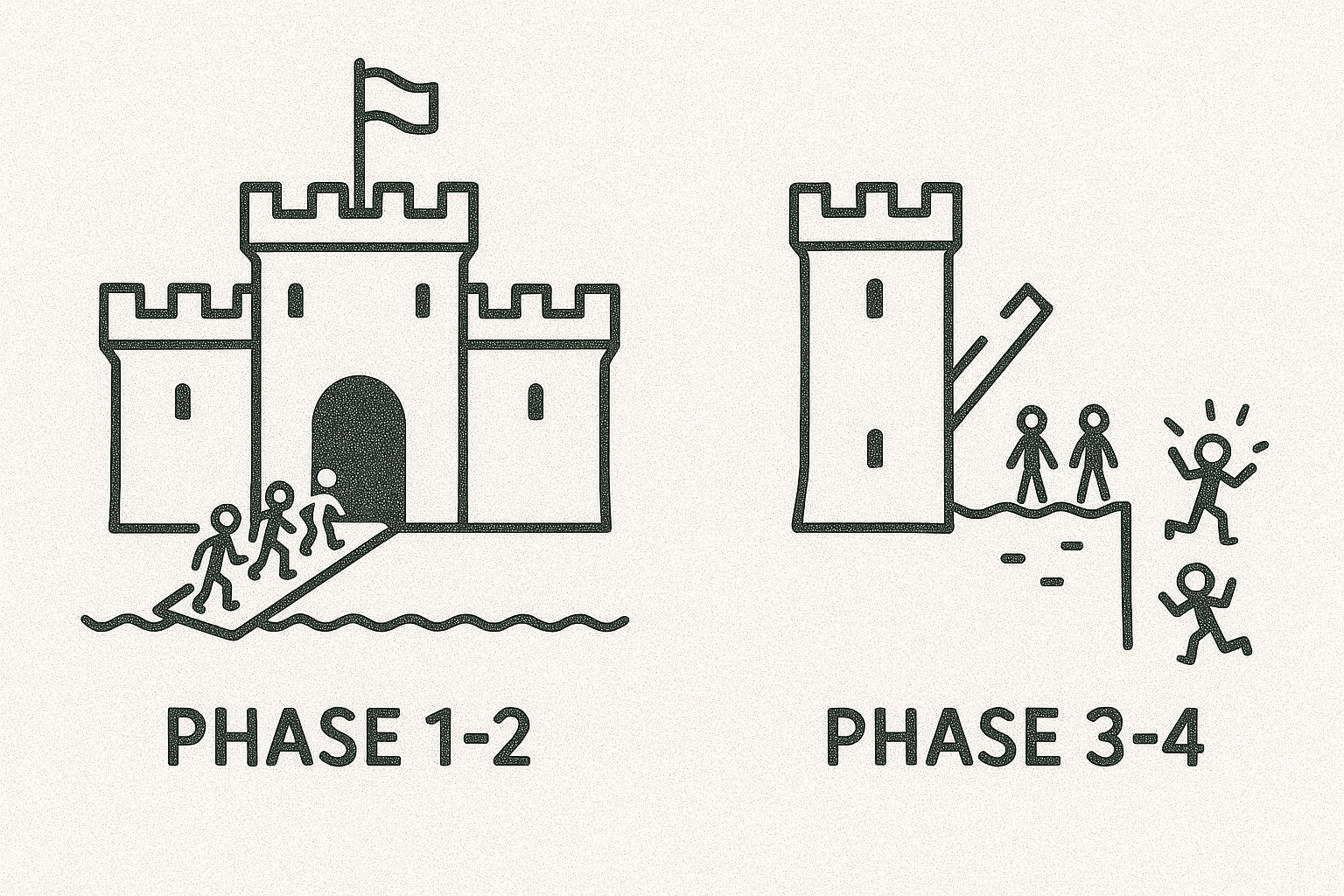
Phase 1: The Flooding (2020-2023)
COVID created a creator boom. AI tools democratized production. Platforms rewarded vver quality.
The commons filled with content faster than anyone could consume it. The noise floor rose exponentially.
Most people didn’t notice. The flood was building, but it hadn’t crested.
Phase 2: The Skepticism Phase (2024-2025)
We are here.
The Reddit appendage (1,328% SEO growth) proves audiences are hacking their own search behavior. Adding “reddit” to Google searches because they trust anonymous strangers more than Google’s results.
The zero-click epidemic (58.5%) proves the commons are viewed as a wall.
The platform exodus (33 million leaving X in one year) proves the “town square” is emptying.
Creators are publicly discussing the problem. Early adopters migrating to Skool, Circle, paid Substacks. The conversation shifted from “how do I go viral” to “how do I build something that doesn’t depend on virality.”
The retreat has begun.
Phase 3: The Retreat Accelerates (2026-2027)
Prediction 1: Critical mass of creators move primary value to gated spaces. Free content becomes audition material only.
Prediction 2: The newsletter bubble pops for generic content. Only newsletters with genuine community (not broadcast lists, but engaged audiences who talk back) survive.
Prediction 3: Referral chains become the primary discovery mechanism. “How did you find this?” “A friend sent it to me.” Word of mouth returns with a vengeance.
Phase 4: The New Equilibrium (2028+)
Two internets.
The Public Slop Layer: Search, AI feeds, algorithm wastelands. Content goes there to die (or be scraped by AI and regurgitated forever). Passive consumption continues. Conversion rates approach zero.
The Private Trust Layer: Communities. Paid subscriptions. Curated spaces. Where attention converts to action. Where money changes hands. Where careers are built.
The divide becomes permanent. The drawbridge goes up. And it doesn’t come back down.
The Window
The window to establish yourself inside trust networks is right now. Phase 2.
The drawbridge is still down. The gates still open. You can still build relationships, earn trust, demonstrate value before the retreat accelerates.
By Phase 3, the people who built trust in Phase 2 become the gatekeepers. They decide who else gets in.
If you’re not building now, you’ll be begging for invitations later.
What I’m Doing About It
I wasted five years playing the wrong game. Here’s my playbook now:
Publishing my best thinking publicly. Constantly.
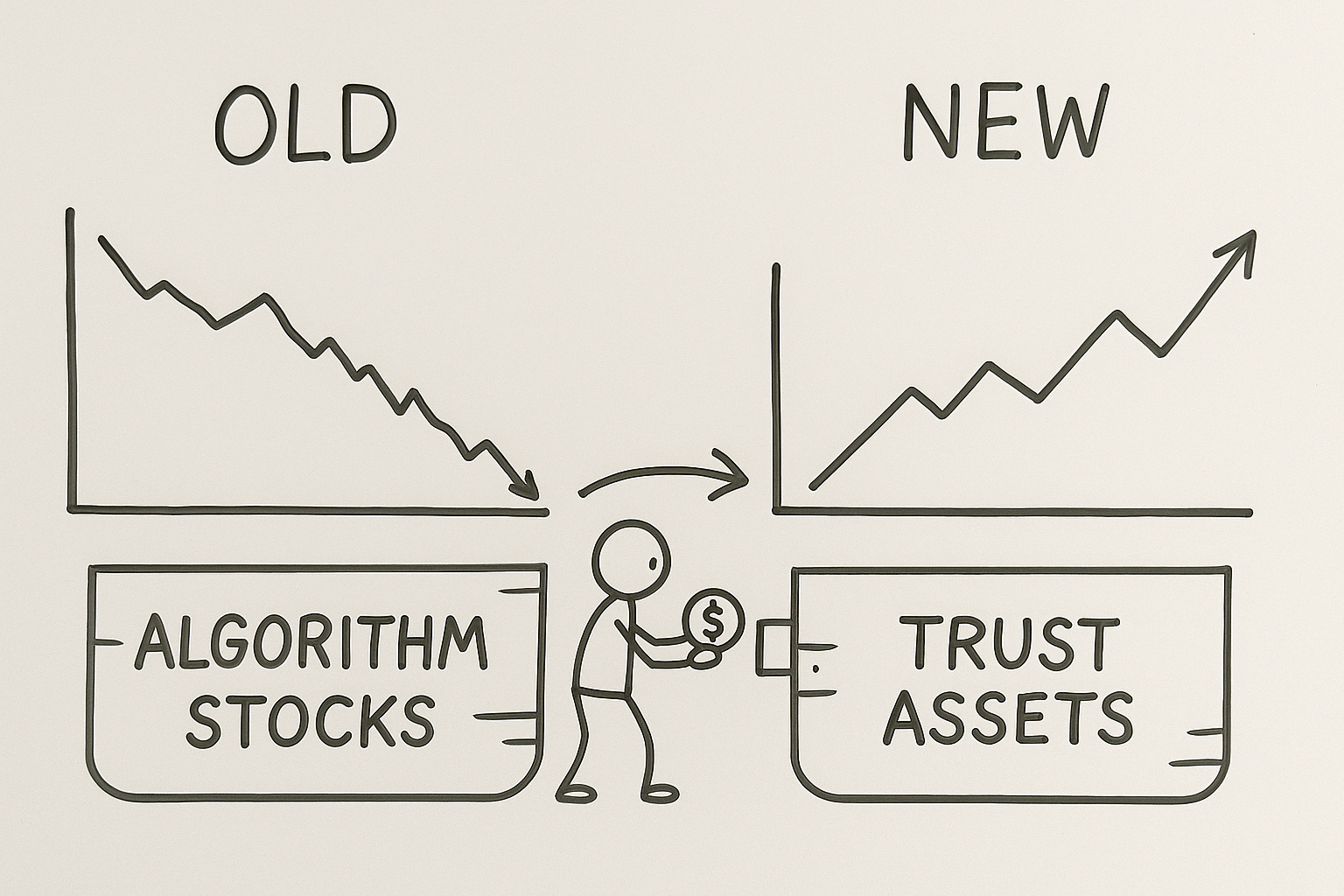
Every valuable piece is a trust deposit. Four million people pay for Substack content now—free content has to be better than 2021’s paid content to earn attention.
The hoarding instinct is the enemy. Build the trust account while the window is open.
Treating engagement as the metric that matters.
Reply rates over open rates. Click rates over impression counts. A hundred people who trust me completely are worth more than ten thousand who don’t know I exist.
Joining trust networks before I need them.
Being a verified human in three high-signal communities beats being anonymous on a platform with millions of bots.
This is why I built the Co-Write with AI community on Skool. Free to join. You also get my entire Co-Write OS course—everything I wish someone had told me before I wasted three years prompting like a damned fool. No paywall. No catch. Just a bet that if I help you now, you’ll remember me when the drawbridge goes up.
Becoming a curator, not just a creator.
“I found this so you don’t have to” is the highest-value proposition when algorithms fail. Curators are the new search engines.
Documenting everything.
Google’s March 2024 update de-indexed hundreds of small sites overnight. The algorithm doesn’t care about your history. Archive your receipts manually.
The Uncomfortable Truth
I wasted years trying to win a game rigged against me.
The algorithm was never designed to help me build anything. It was designed to extract my content, extract my attention, and give me just enough dopamine to keep producing.
(It’s embarrassing. But if my embarrassment saves you a few years of the same mistake, I’ll take that trade.)
The good news? The new game is more human. Slower. More relationship-based. More about trust than tricks.
The bad news? The window to establish yourself is shorter than you think.
The reformation is underway. The people who thrive in 2026 are building their lifeboats in 2025.
The drawbridge is still down.
But it’s going up.
Where are you in this migration? Still playing the algorithm game, or already building in trust networks? Drop it in the comments—I’ll actually reply. (Novel concept, I know.)
Crafted with love (and AI),
Nick “Five Years, Under 100 Followers” Quick
PS…If a friend sent you this, tell them thanks. Word of mouth is the whole thesis. They’re already living it.