
The AI Content Industry Isn't a Pyramid Scheme (But the Structure Is Suspiciously Similar)
A confession from a guy three levels deep

🎉 EXCITING OPPORTUNITY IN AI CONTENT 🎉
✅ Be your own boss
✅ Work from anywhere
✅ Help others while helping yourself
✅ Unlimited earning potential
✅ Build your downli—
Wait.
Let me start over.
I’ve been staring at this opening for an hour because every time I try to explain the AI content industry’s business model, it sounds like I’m recruiting for something I’d immediately block on LinkedIn.
That’s... not great.
Here’s what I’m trying to say: the AI content space has developed a structure. It’s not illegal. It’s not even intentional. But it creates a loop where the people teaching AI writing benefit from the average quality of AI writing staying low.
I benefit from it too.
That’s the part I need to talk about.
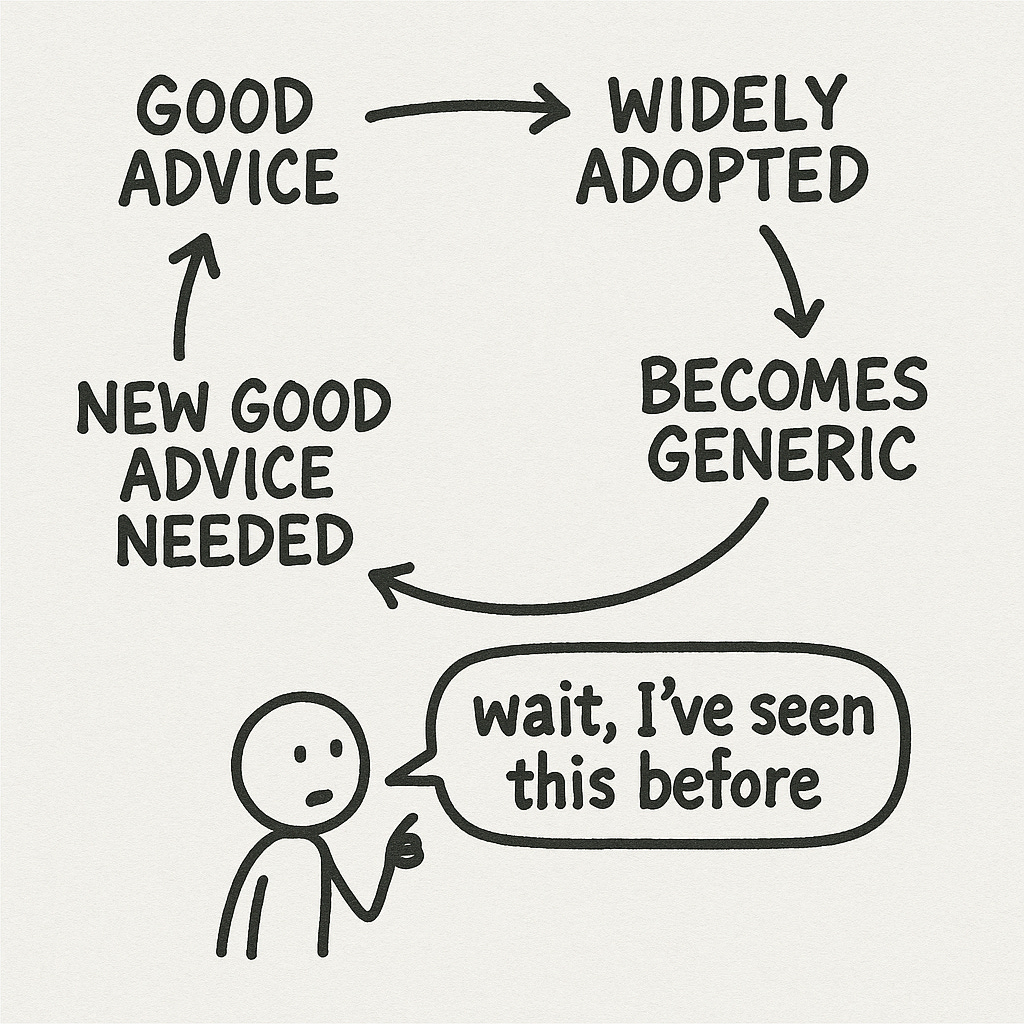
The Loop, Visualized
I’ve been watching this pattern for eighteen months now. (Watching it. Participating in it. Same difference, apparently.)
It starts innocently enough. Someone figures out a way to get better results from ChatGPT. They share it. It works. People are grateful. The creator thinks: I should teach more of this.
So they do.
They create a prompt pack. A tutorial series. A thread that goes viral. Thousands of people learn the technique.
And then something predictable happens.
The technique stops working. Not because it was bad advice. Because it was good advice that too many people followed. The output becomes recognizable. The “trick” becomes a tell. What used to sound fresh now sounds like everyone else who read the same thread.
Now the creator has a choice. They could say “that technique is played out, good luck.” But they have an audience now. An audience that followed them because they solved a problem. An audience that’s experiencing a new problem.
Their content sounds like everyone else’s.
So the creator pivots. “I’ll be honest,” they write, “I used to teach that approach. But I’ve learned some things. Here’s what actually works now.”
New course. New launch. Same audience.
The loop completes.
(This is where I’d normally feel superior about noticing the pattern. Except I’m in the pattern. More on that later.)
The Four Horsemen of the AI Content Apocalypse
I’ve identified four patterns that keep this loop spinning. (Yes, I named them. I’m THAT guy now.) I’m not naming specific people because that’s not the point. Also because I’ve done at least three of these myself.
Pattern 1: The Confession-to-Course Arc
This one’s my favorite because of how elegant it is.
Step one: Creator builds audience teaching tactics.
Step two: Tactics get commoditized. (Because thousands of people learned them. From the creator. Who is now concerned about commoditization.)
Step three: Creator publishes confession. “I’ll be honest. I used to produce AI slop too. Here’s what I learned the hard way.”
Step four: Confession builds massive trust. Vulnerability! Authenticity! Growth!
Step five: Course launch. “Now I help others avoid my mistakes.”
The confession IS the marketing. The “mistake” was often the thing they were teaching six months ago. The audience that made the mistake? Same people who followed the original advice.
I noticed this pattern in March when I saw a creator I follow (who shall go nameless here) post something vulnerable about their “AI content journey.” The post got huge engagement. Beautiful comments. Real connection.
The course launched eleven days later.
(I saved that post. I keep it in a folder called “things that made me uncomfortable about my own trajectory.” The folder is getting full.)
Pattern 2: The Tool Tutorial Escalation
This one follows a cleaner ladder:
Free content: “How to use [AI tool]”
Problem content: “The mistakes everyone makes with [AI tool]”
Solution content: “The [Name] Method for [AI tool]” (paid)
Retention content: Community/coaching for course buyers
Each rung creates the audience for the next rung. The free content establishes expertise. The mistake content creates anxiety. The paid content promises resolution. The community creates recurring revenue.
It’s a flywheel. A beautiful, self-sustaining flywheel. (Also known as a hamster wheel if you just so happen to be a hamster.)
I’ve watched this play out at least a dozen times. The creator who taught me my first ChatGPT workflow is now three rungs up the ladder, selling a coaching program. Their current students are learning how to do what they did two years ago and that no longer work with the latest LLM models.
Pattern 3: The Prompt-to-Authenticity Pipeline
This is the purest form of the loop:
Month 1: “Here are my 10 best ChatGPT prompts for [X]”
Month 3: “Why does everyone’s AI content sound the same?”
Month 5: “My framework for authentic AI writing” (course)
The same person who distributed the generic prompts now sells the cure for generic output. And here’s the beautiful part: they’re not wrong. The prompts DID create generic output. They would know.
They made the prompts.
Pattern 4: The Engagement Bait Cycle
This one’s more tactical:
Post 1: “Unpopular opinion: [spicy AI take]”
Post 2: Responds to the controversy from Post 1
Post 3: “What I really meant was...” (clarification that’s actually a pitch)
Post 4: “If this resonated, here’s my [lead magnet/course]”
The controversy is manufactured. The clarification is the real content. The whole arc is a funnel disguised as a conversation.
I fell for this one hard in January. A creator posted something deliberately provocative about AI replacing writers. Spicy take. Good engagement. I wrote a whole-ass response. Thoughtful. Nuanced. (A little self-righteous with hints of thought leader cosplay, if I’m being real.)
Then I watched them “clarify” their position in a way that perfectly set up their course on human-AI collaboration.
I felt like a prop in someone else’s content strategy.
(I might have also taken notes. For research purposes. Obviously.)
Here’s where I have to get uncomfortable.
I teach anti-slop methodology. I help people not sound like generic ChatGPT output. My whole positioning is “collaboration over automation, voice preservation over content factories.”
And my newsletter will grow faster as the slop epidemic continually worsens.
Every piece of garbage AI content creates more demand for what I’m selling. Every “10 prompts to 10x your output” thread that floods LinkedIn makes my “here’s why that approach fails” content more valuable.
I didn’t design this. But I benefit from it.
Hell, I’m benefiting right now. This very post. Industry critique from the inside? That’s catnip. I’m leveraging the loop to critique the loop.
(This is my villain origin story. Except I’m not even the actual villain. I’m like... villain middle management. Assistant to the regional villain.)
I’m not outside the loop. I’m not even at the edge. I’m somewhere in the middle, building an audience by articulating what’s wrong with how audiences get built.
The call is coming from inside the house.
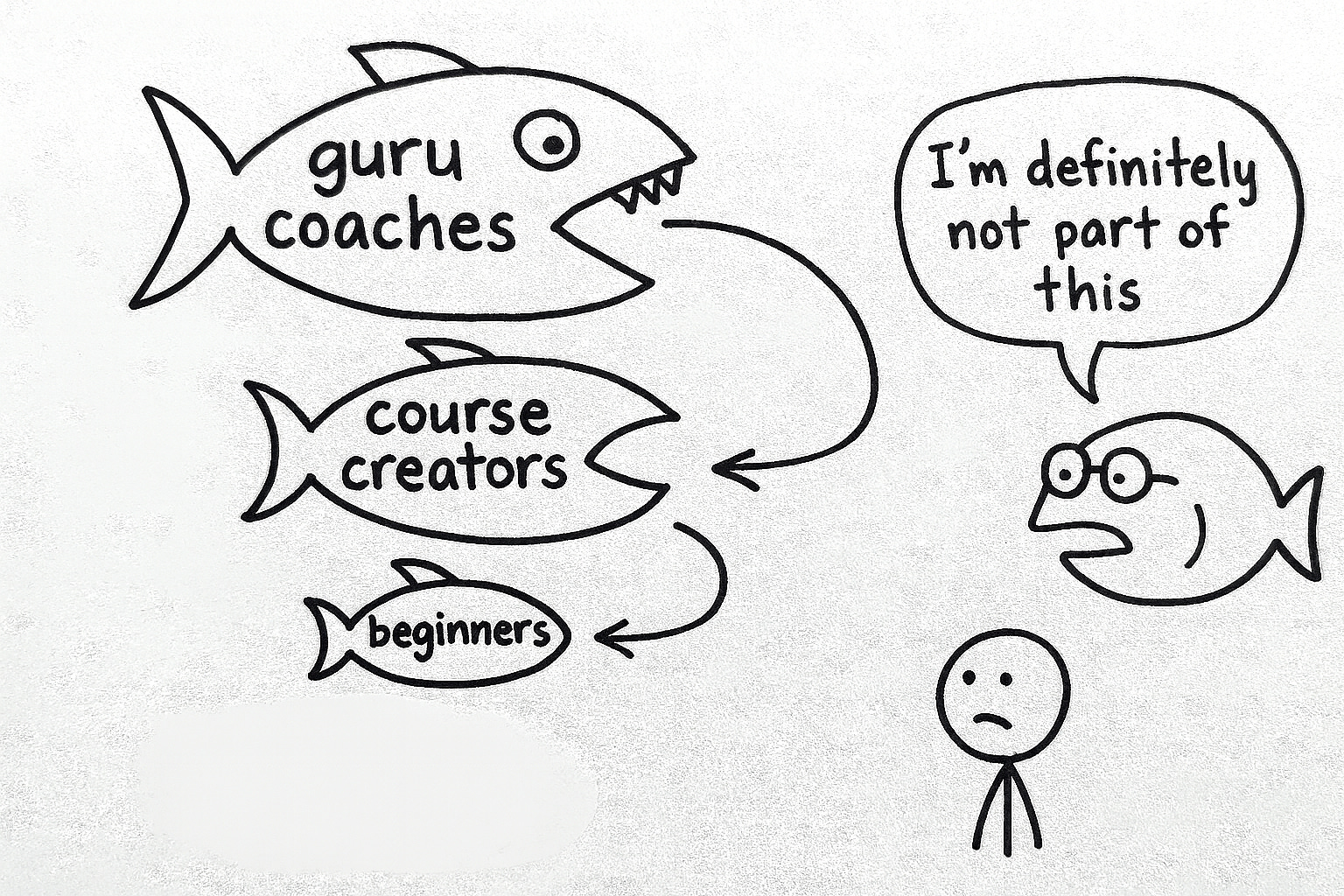
Is My Voiceprint Framework Actually Different?
I’ve asked myself this question at 2:30 am more times than I should probably admit. (Not a flex. More of a cry for help. Someone get me a hobby that doesn’t involve existential spirals about content economics.)
My methodology (Voiceprint) is supposed to be different. It’s not a prompt pack. It’s not “10 tricks to sound more human.” It’s a systematic process for understanding your voice so deeply that no tactic can commoditize it.
The idea is: if you build a foundation, you don’t need to keep chasing tactics. You don’t need the next course. You don’t need me to keep feeding you new frameworks. You develop the skill once and it compounds.
That’s the theory.
Here’s what I actually believe: Voiceprint IS different. But not because I’m smarter or more ethical than other creators. (I’m definitely not smarter. The ethical thing is still under review.) It’s different because of what it optimizes for.
Most AI content advice optimizes for immediate output. “Use this prompt, get this result.” The value proposition is speed and efficiency.
Voiceprint optimizes for long-term independence. The goal is to make yourself unnecessary. To give people a foundation they can build on without coming back for more instruction.
And look, I’m about to do something deeply awkward for a post that’s been roasting course peddlers for the last ten minutes: I’m going to tell you where to find my course.
(I know. I KNOW.) 🤮
It’s called Co-Write OS. It lives in the classroom section of my Skool community. And right now, while I’m still building this thing and the community is small enough that I recognize names? It’s free. I just have to manually approve your membership, which I do, because I’m not a bot and this isn’t automated. (See? Different.)
Will I eventually charge for it? Almost certainly. I have rent. But at the time of this writing, you can walk in, take the whole course, and leave without spending a dollar. If that feels like the loop, I get it. If it feels like someone trying to prove the methodology works before putting a price on it, that’s closer to the truth.
Anyway. Back to the existential uncertainty.
That’s either genuinely different or a more sophisticated form of the same loop. I don’t know which one yet.
What I do know is this: if I start teaching Voiceprint as a set of tactics rather than a foundation, it becomes the thing I’m critiquing. The moment “voice methodology” becomes a buzzword with its own prompt packs, I’ve lost.
So I’m trying to stay aware. I’m trying to keep asking whether I’m adding value or just spinning the wheel.
But I’m asking that question from inside the wheel. And I don’t have a clean exit.
The Demand Manufacturing Detector
I can’t tell you how to escape the loop entirely. (If I could, I’d be charging a lot more than I’m planning to. And I’d feel worse about it.)
But I can share the framework I use to evaluate whether content (mine or anyone else’s) is creating value or manufacturing demand.
🚩 Signs content is manufacturing demand:
It teaches tactics that only work until widely adopted. If the advice stops being useful when 10,000 people follow it, it’s not wisdom. It’s a temporary advantage being sold as a principle. Expiration date: whenever the thread goes viral.
It creates anxiety about a problem, then sells the solution. The content makes you feel behind, inadequate, or at risk. Then (conveniently) offers the fix. The emotional sequence is the tell. Anxiety → hope → credit card.
The “problem” didn’t exist before the content ecosystem created it. “AI content sounds generic” is a real problem. But it’s a problem that prompt libraries helped create. The ecosystem manufactures its own diseases.
Success stories focus on content performance, not real-world outcomes. “This post got 50K views” is not the same as “this approach helped me write a better book.” Vanity metrics are easier to manufacture than actual results. (And way easier to screenshot. Real or otherwise.)
The advice leads you to more advice from the same source, indefinitely. There’s a difference between a curriculum with a finish line and a content drip designed to keep you hooked. One builds toward independence. The other optimizes for your return.
✅ Signs content is creating genuine value:
It teaches principles that work regardless of how many people know them. Understanding your own voice patterns doesn’t get less effective when others understand theirs. The value isn’t scarce.
It would still be useful if AI tools disappeared tomorrow. Good writing advice is good writing advice. If the content only matters because of a specific tool, it has a short shelf life.
It improves your thinking, not just your prompts. You walk away understanding something you didn’t before. Not just knowing which buttons to push.
Success is measured by what YOU create, not engagement metrics. The content points outward toward your work, not inward toward more content consumption.
The advice leads you to your own work, not back to the creator. The best content makes itself unnecessary. It equips you and sends you off. It doesn’t try to keep you in the ecosystem.
The test: Ask “Would this advice still work if 10,000 people followed it?”
If yes, probably value.
If no, probably demand manufacturing.
Run it on everything you consume. Run it on everything you create.
(I run it on my own stuff. I don’t always like the answers.)
The Pledge (And Your Charge)
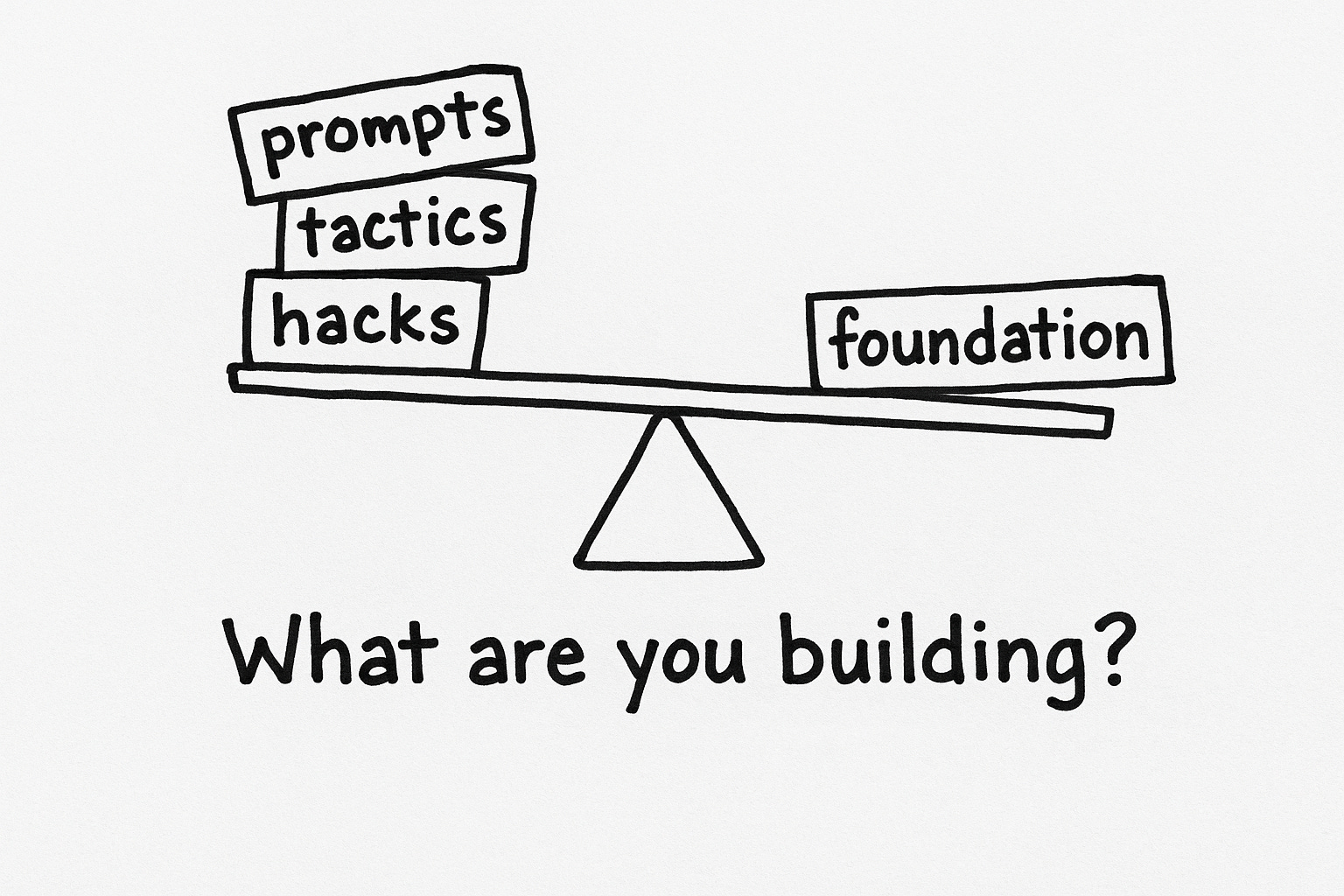
I don’t have a clean way out of the loop. I’m not going to pretend I’ve discovered something that everyone else missed.
But I can tell you what I’m committing to. Publicly. In front of you. So you can hold me to it.
I will not teach tactics that only work until widely adopted.
If my advice stops being useful when lots of people follow it, I’ve failed. The goal is principles that compound, not tricks that expire.
I will measure success by what my readers create, not by my own growth.
If this newsletter gets bigger but you aren’t producing better work, I’ve failed. Your outcomes are the metric. Not my subscriber count. Not my open rate. Not my “engagement.”
I will keep asking whether I’m adding value or just spinning the wheel.
Publicly. In posts like this one. Because the moment I stop questioning my own participation in the loop is the moment I become exactly what I’m critiquing.
I will build methodology, not content factories.
Voiceprint is supposed to create independence, not dependence. If I ever catch myself optimizing for “keep them coming back” over “equip them to leave,” call me out. I mean it.
That’s my line in the sand.
Your Turn
Here’s the part where I’m supposed to pitch something. That’s how this works, right? Critique the industry, establish credibility, soft-launch the solution.
Not today.
Instead, I want to leave you with a charge:
Run the detector on everything you consume.
That prompt pack you’re thinking about buying? Ask if it’ll still work when thousands of other people use the same prompts. That “authentic AI writing” course in your cart? Check if the creator was teaching the tactics they now call “inauthentic” six months ago.
The gurus aren’t evil. Most of them genuinely want to help. But the incentive structure creates loops that benefit everyone except the person at the bottom buying the fifteenth course.
You don’t have to exit the AI content space. I’m not exiting. But you can participate with your eyes open.
Build foundations, not tactic collections.
The only sustainable advantage in a space designed to commoditize every advantage is the thing that can’t be commoditized: your voice. Your perspective. The weird specific way you see the world.
No prompt pack gives you that. No course installs it. It comes from understanding yourself deeply enough that authentic is the only thing you CAN sound like.
That takes longer than learning a framework. It’s less satisfying than a quick win. But it’s the only thing that lasts.
Watch for your own loops.
If you’re creating content about AI (or about anything), notice when you’re manufacturing demand versus creating value. Notice when the confession-to-course arc starts feeling tempting. Notice when the engagement bait cycle seems like “just good strategy.”
We’re all capable of becoming what we critique. The awareness doesn’t prevent it. But it helps.
I’m going to keep writing about AI collaboration. I’m going to keep benefiting from the slop epidemic to some degree. That tension isn’t going away.
But I’d rather build something that makes itself unnecessary than spin content that keeps people dependent.
If that resonates, stick around. I’m figuring this out in public, and I could use the company.
And if you catch me falling into the loop? Call it out.
I’m asking you to.
The only thing more embarrassing than being part of the problem is being part of the problem while pretending you’re not.
At least I’m trying to keep my eyes open.
Crafted with love (and AI),
Nick “Professionally Compromised” Quick

PS…You just read me claim that a solid Voiceprint optimizes for independence, not dependence. That it builds foundations, not loops.
Bold words. Potentially bullshit.
Only one way to find out: Co-Write OS is free in my Skool community. Take the course. See if you need me afterward. If you do, I’ve failed. If you don’t, I’ve proven something.