
The 5 Lies Behind Every AI Writing Course (I Peddled #3)
Prompt packs won't save you. Here's what will.

I committed a crime against my own readers last year.
Nothing indictable. (Probably. I haven’t consulted a lawyer and frankly I can’t afford one who’d tell me what I want to hear.) But a crime nonetheless. The kind where nobody goes to prison but everyone gets a little dumber.
I sold a version of Lie #3.
We’ll get there. The anticipation is part of my penance. Also I need a few paragraphs to figure out how much to confess without completely immolating my credibility. (This is called “strategic vulnerability.” It’s a real thing. Marketing people have written books about it. The books are about manipulating people through calculated honesty, which is a sentence that should make us all uncomfortable.)
Five lies fund the AI writing education space. I’ve believed all of them…simultaneously, at various points, while teaching one, falling for another, and actively profiting from a third.
Here’s what 2 years inside the machine taught me: The lies work beautifully. Right up until your credibility becomes collateral damage in your own product launch.
The lies are comfortable. The truth is rude. The lies sell courses. The truth sells... eventually... something... probably... if you’re patient and lucky and willing to watch people with worse ideas but better lies eat your lunch for a few years.
Let’s burn some bridges.
The Economics of Bullshit
Every AI writing lie follows the same architecture.
This isn’t conspiracy. Conspiracy requires coordination. This is just economics—the boring, predictable kind where the most profitable claims happen to be the least true ones and the market doesn’t particularly care about the distinction.
A claim triggers an emotion. The emotion bypasses critical thinking. (Critical thinking is terrible for conversion rates. This is why sales pages read like they were written by someone who’s never experienced doubt.) The bypassed thinking leads to a purchase. The purchase funds a business model that needs the lie to stay true.
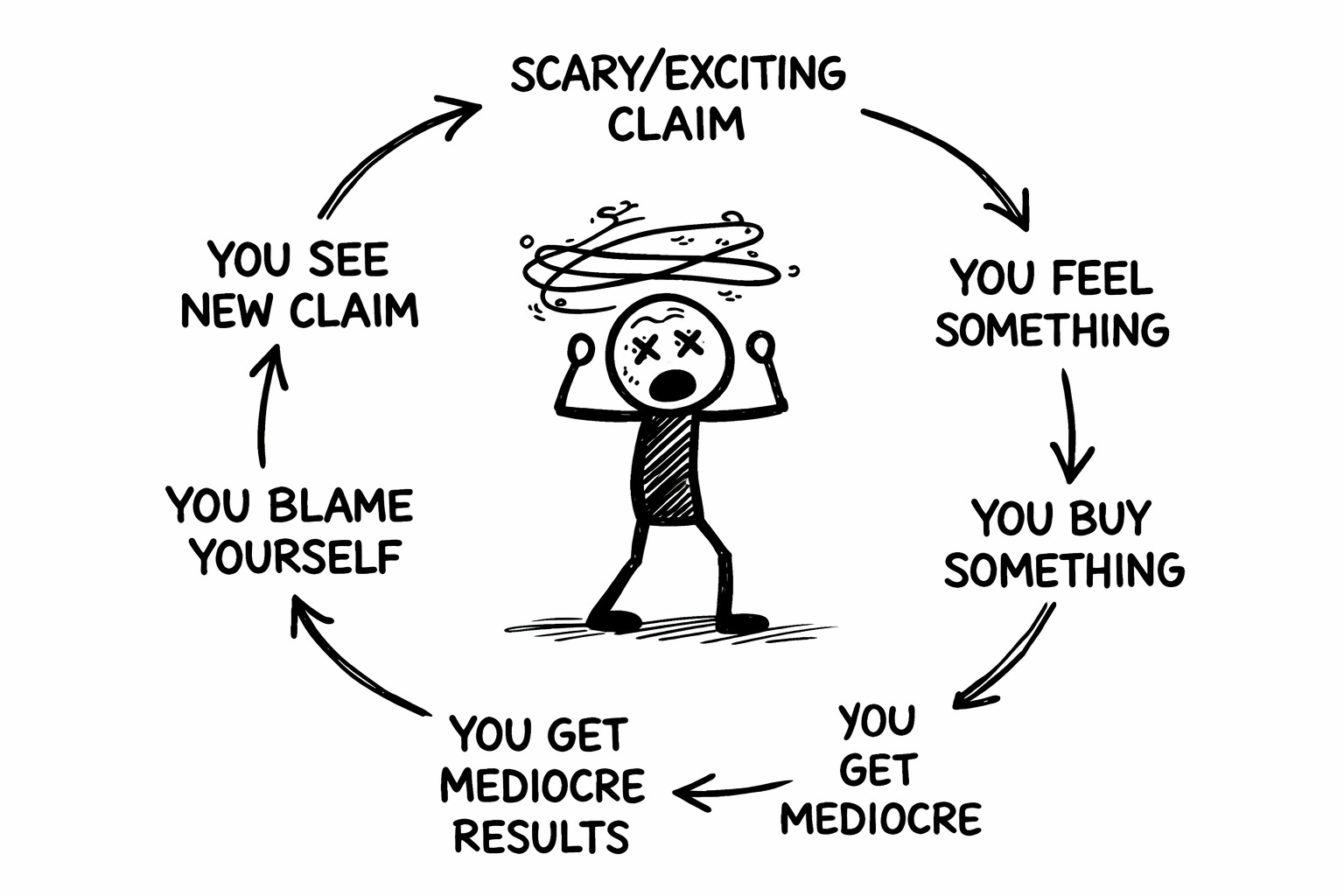
Five lies. I’m starting with the ones you’ll feel clever for spotting, ending with the one that’ll make you want to close this tab.
The discomfort is the point.
Lie #1: “Start with AI, Develop Voice Later”
This is the gateway lie. The one that sounds almost reasonable if you don’t think about it for more than four seconds.
The pitch: Just start using AI now. Get comfortable with the tools. You can always develop your voice later, once you understand how everything works. Don’t let perfectionism slow you down. Ship now, refine later. Move fast and break things. (Nobody tells you the ‘things’ include your own reputation.)
Here’s the problem with “later”:
Later never comes.
You start using AI before you’ve developed voice. The AI produces something. It’s... fine. Serviceable. You publish it because you’re on a schedule and “fine” beats “nothing.” You do this again. And again. Your audience gets used to a certain version of you. Except it’s not you. It's a statistical average doing a passable impression of someone who might be your cousin.
Six months in, you try to “develop voice.” But develop it from what? Your body of work is AI-assisted all the way down. You have no baseline. No control group. No idea what you actually sound like because you never gave yourself the chance to find out.
The voice you’re trying to develop is buried under six months of “fine.”
(Somewhere in my Notion is a folder called “Q2 Content” that I can't open without violently vomiting all over my keyboard.)
Why this lie sells:
AI tool companies need users NOW. Not in six months after you’ve done boring foundational work. Now. Today. Credit card out. Free trial started.
Every day you spend developing voice without their tool is a day you might realize you don’t need their tool as much as they need you to think you do. (I’m looking at you, Jasper.)
The sequencing serves them. Not you.
The truth:
Voice first. AI second. Always.
Not because AI is bad. Because AI is a session musician.
Technically brilliant. Can play anything you put in front of them. But they need sheet music. They need YOUR composition.
Hand a session musician a blank page and ask them to “just play something in your style”? They’ll play something. It’ll be competent. It’ll be... fine. It’ll sound like a thousand other sessions they’ve played before.
You can’t develop your compositional voice by outsourcing to session players from day one. You develop it by writing… badly, then less badly, then distinctively. THEN you bring in the session musicians.
The foundation isn’t optional. It’s not a nice-to-have you can circle back to. It’s the thing that makes everything else work.
Lie #2: “Prompt Engineering Is the Key Skill”
Why this lie prints money:
Prompts are infinitely productizable.
Package a prompt library on a Tuesday afternoon. Sell it forever with zero marginal cost. Volume 2, Volume 3, the Ultimate Bundle, the Black Friday Extension Pack, the thing you dust off every quarter with a new adjective. Ultimate. Essential. Definitive. (Next up: “Final.” Then “Actually Final.”)
One-time effort. Permanent revenue stream. The unit economics are genuinely beautiful if you don’t think too hard about whether any of it helps anyone.
The lie this funds:
Prompt engineering is the mullet of AI skills.
Business in the front. “Please work please work please work🤞” in the back.
(I’ve been waiting to use that line. Some people save good wine for special occasions. I save lousy jokes about regrettable haircuts from the 1980s. We all have our rituals.)
Master prompts, master AI. Learn the secret incantations and unlock unlimited power. The right arrangement of words is basically a cheat code. Copy these templates. Memorize these frameworks. Subscribe for 50 new prompts every month.
And look… prompts matter. I’m not saying they don’t. The difference between a garbage prompt and a decent one is real and measurable. Prompts are the steering wheel.
But here’s what nobody mentions about steering wheels:
They don’t make you a good driver.
A great prompt can’t create voice. It can only request it from raw material that doesn’t have any. A great prompt can’t generate original thinking. It can only structure the thinking you bring. (You do have to bring some. “Surprise me” is not a strategy.) A great prompt can’t develop your taste. At best, it can produce output. Knowing whether that output is garbage is still on you.
The prompt is the interface. Not the substance.
Confusing the access mechanism for the actual thing is like thinking the ATM is your money. The ATM is how you access your money. If there’s no money in the account, the ATM’s sophistication is irrelevant. You’re still broke. Just with a fancy card in your hand.
The truth:
Prompts are necessary. They’re not sufficient.
The person using the prompt determines the outcome. Their taste. Their voice. Their thinking. Their ability to evaluate whether the output is good or bullshit with a firm handshake.
If prompts were the key skill, everyone with a prompt library would be writing brilliantly. Look around. They’re not.
Lie #3: “Just Edit It to Make It Yours”
I sold this lie.
Not in those exact words. But close enough that I can’t pretend otherwise. Something about “efficient workflows.” Something about “letting AI handle the first draft so you can focus on refinement.” Something that made people feel like they weren’t cheating—they were optimizing.
(This is the part of the movie where the protagonist admits they were the problem all along. Very second-act. Slightly humiliating. Definitely cheaper than therapy.)
Here’s what “just edit it” actually looks like:
AI produces a draft. The draft is... coherent. Structured. Grammatically sound. It’s not YOU, but it’s not obviously NOT you. It’s in the uncanny valley of your voice—close enough to publish, far enough to feel weird about.
You’re tired. You’re behind. You have eleven other things due.
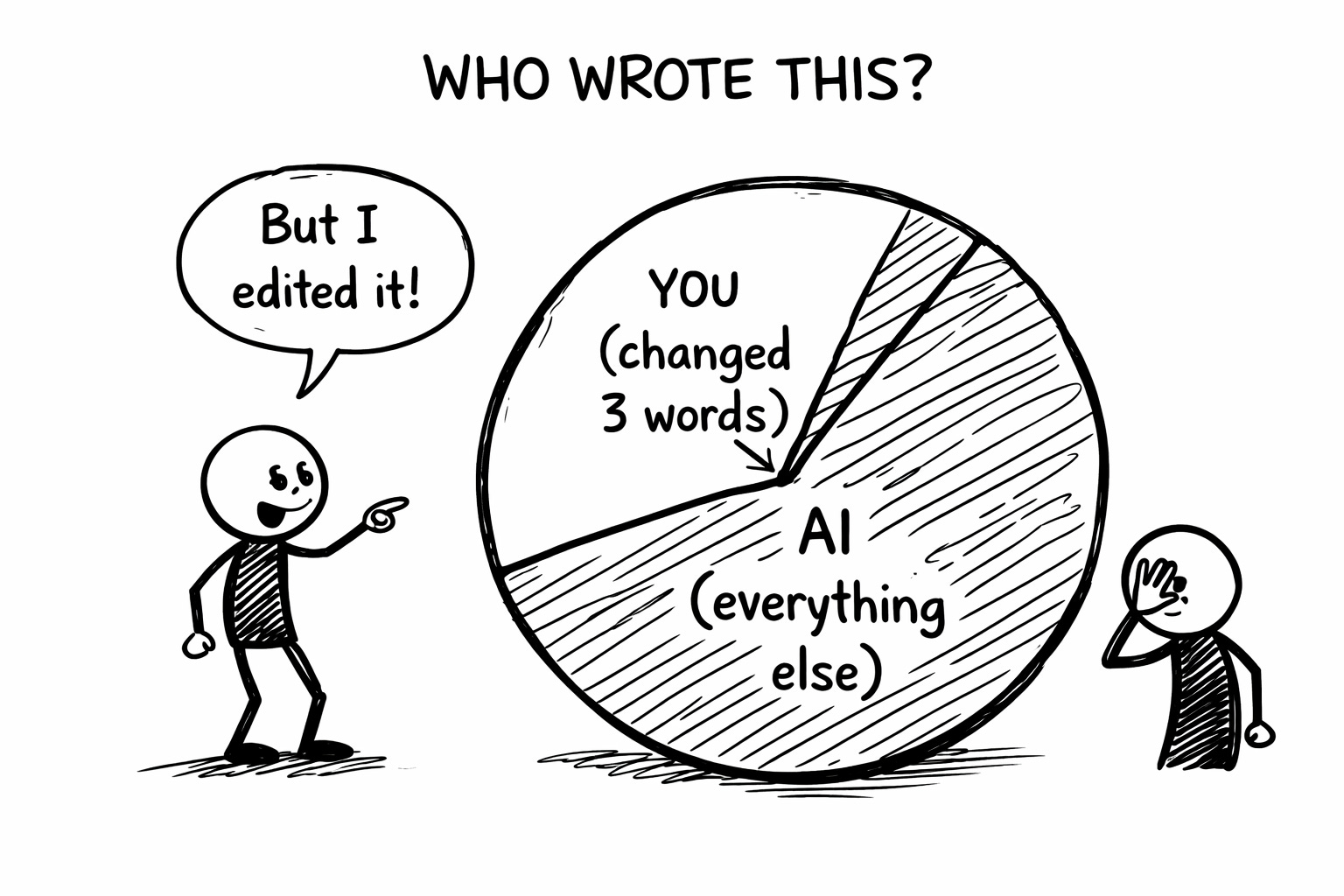
You change a few words. Add a sentence. Fix a transition that felt clunky. Tell yourself this counts as “making it yours.”
(It doesn’t.)
You’ve polished someone else’s thinking. You’ve decorated a house you didn’t build. You’ve put your name on a paint-by-numbers and hung it in the gallery.
And the worst part? You know.
That slight cringe when you hit publish. That hope that nobody reads it too carefully. That relief when engagement is low because at least you don’t have to defend something you’re not sure you believe.
That’s the tax. You pay it every time.
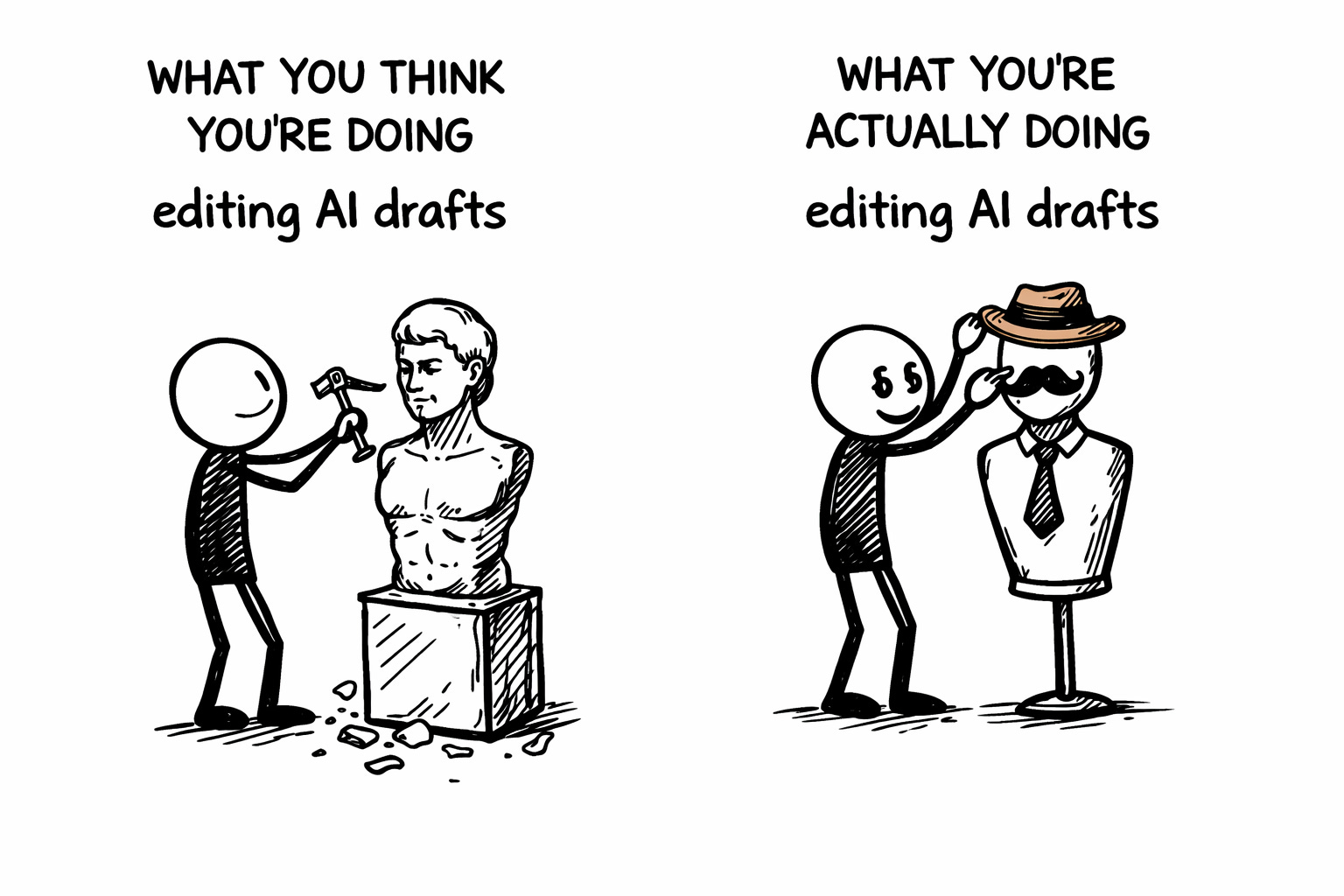
The lie I was selling:
AI gives you a draft. You edit it. Add your voice. Clean it up. Make it yours. Light touch. Twenty minutes tops. You’re not outsourcing your writing—you’re collaborating. The AI did the heavy lifting. You’re just... polishing.
The truth:
“Editing” AI output and “making it yours” are not the same thing.
Editing is a single pass. You polish what the AI gave you and call it done.
Making it yours is a calibration loop. Feed it your thinking. Reflect on the gap between what came back and what you actually sound like. Correct. Feed again. The AI learns. The output tightens. Eventually, you’re collaborating—not laundering.
Most people never get past the single pass. They call it “editing.” It’s not.
Lie #4: “Readers Can’t Tell the Difference”
They don’t send you angry emails. They don’t leave critical comments.
They slowly disappear.
And you never see the data on “people who used to care about what I wrote and now don’t.” That metric doesn’t exist. You just notice, months later, that the energy is different. That engagement is down. You've become the content between the content they actually came for.
They feel it in the sameness. The creeping suspicion that they've read this post before… from you, from someone else, does it even matter anymore?
They feel it in the absence. The missing weirdness. The quirks that got optimized away. The voice-shaped hole where personality used to live.
They feel it in their behavior. They stop reading to the end. They don’t share. They don’t reply. They don’t remember you said it. They just... scroll past. Another post. Another piece of content. Another brick in the infinite wall of “meh.”
The lie that lets you ignore this:
AI has gotten so good. It’s become a shell game—and we’ve all convinced ourselves we can spot the pea. Readers can’t tell. Studies show. Experts agree. Vibes confirm. Your audience won’t notice. Just ship it.
Here’s what this lie conveniently ignores:
Readers can’t always NAME what’s wrong. They can absolutely FEEL it.
Why this lie sells:
Because the alternative is terrifying.
If readers CAN tell, then every piece of AI-assisted content is a risk. Every “quick draft” is potentially eroding trust. Every shortcut is visible.
The lie is a permission slip. The lie lets you keep doing what you’re doing without examining whether what you’re doing is working.
The truth:
Readers are pattern-recognition machines.
They’ve read your work. They have a model of you in their heads… how you think, how you phrase things, where you zig when others zag. When the new thing doesn’t match the model, something feels off.
They might not say “this was clearly AI-assisted.” They might just say “I don’t know, I’m not as into their stuff lately.”
Same result. Less useful feedback.
The slop isn’t invisible. It’s just polite. It kills you quietly.
Lie #5: “The Output Is the Product”
Here’s why you fell for all of it.
Every lie so far shares a common assumption. An invisible premise that makes all the others possible.
The assumption: What matters is what comes OUT of the AI.
Better prompts → better output. Light editing → good enough output. Readers can’t tell → output passes. Start now, voice later → get output flowing.
Output. Output. Output.
Everyone’s staring at the wrong end of the equation.
The output was never the product.
The INPUT is the product.
Your voice. Your thinking. Your documented patterns. Your perspective that took years to develop. Your weird specific way of seeing your subject. The thing you bring to the collaboration.
AI is an amplifier. That’s it. That’s the whole thing.
Amplifiers don’t create signal. They amplify what’s already there.
Feed an amplifier nothing and you get nothing back. Feed it noise and you get louder noise. Feed it YOUR signal—clear, developed, documented—and you get more of you, faster, at scale.
This is why prompt engineering isn’t the key skill. (Prompts are how you access the amplifier. They’re not the signal.)
This is why “just edit it” doesn’t work. (You can’t edit in a voice that was never there.)
This is why readers can tell. (They’re hearing the absence of signal. The deafening loudness of nothing.)
This is why the sequence matters. (Voice first. Signal first. Then amplify.)
Why this lie sells:
Because input development is hard to package.
You can’t sell “spend six months developing your voice” as a weekend course. You can’t productize “do the internal work.” There’s no PDF for “figure out who you are as a writer.”
Output optimization is easy to sell: prompt packs, templates, '10x your content' promises. Clear. Measurable. Packageable.
Input development requires patience. Practice. Time.
Patience is not a product category.
So the gurus sell you output solutions for input problems. And you keep buying because the output keeps disappointing and surely the NEXT prompt pack will fix it.
It won’t.
The truth:
The input is everything.
Your voice. Your documented patterns. The signal you’ve developed before AI ever gets involved. That’s what determines whether collaboration works or produces high-ticket garbage.
I learned this the expensive way—optimizing outputs while ignoring inputs is like obsessing over your mic settings when you have nothing to say.
Develop the voice first. Document it second. THEN bring in the AI.
Not because AI is bad. Because AI is powerful. And powerful tools deserve inputs worthy of their power.
The Truth That Doesn’t Fit on a Sales Page
There’s no hack here. No framework I can sell you. No PDF that makes this faster.
You’re going to watch people with worse ideas ship more content. You’re going to see their follower counts climb while you’re still figuring out what you actually sound like. You’re going to wonder if you’re the sucker for doing it the slow way.
Some days, you will be.
But the people building on input—real voice, real thinking, real signal—are building something the slop factories can’t copy. Because there’s nothing to copy. It’s just them.
That's what the slop factories will never figure out. And it doesn't fit on a sales page.
Where This Leaves Us
The lies will keep selling. The incentives are too elegant. The market rewards promises over results and always has and probably always will.
But you don’t have to keep buying tickets.
You can build actual input. Develop real voice. Document your patterns before the AI gets involved. Use AI as amplification for something that’s actually worth amplifying.
It’s slower. Less exciting. Doesn’t make for great launch copy.
It’s also the only path that leads somewhere you’d want to be.
The lies are easier to sell. The truth is harder to live. But the truth is the only thing that produces writing worth reading.
Which lie did you spend actual money on?
I want numbers. Dollar amounts. Course names. The receipts of our collective delusion.
I’ll start: Lie #3 cost me eighteen months and at least one client who stopped replying. Your turn.
Crafted with love (and AI),
Nick “Prompt Pack Dropout” Quick

PS: If this made you uncomfortable, good. I’m in here most days, making myself uncomfortable too. Subscribe if you want to watch.
Most people are optimizing the amplifier while starving the signal, then wondering why everything sounds the same. Thanks for burning the bridges publicly. A lot of people need to read this and won’t admit it yet.
Yet another amazing curation of thoughts. All very true. Well done, Nick! I appreciate the humor and the unexpected hooks in your writing. You appearently developed your voice BEFORE AI, or at least at one point on the road, you certainly did. 😉🩷🦩