
The 3-Question Test That Kills Bad Content Ideas in 2 Minutes
Your random obsessions aren't procrastination. They're inventory.

One of the best content advice I ever received came from a documentary about line cooks.
Not a marketing course. Not some guru’s $497 video series designed to be bought, but never finished. A documentary about how restaurant kitchens avoid total collapse during dinner rush.
The core principle was something called mise en place. French for “everything in its place.” Before service begins, every ingredient is prepped. Every tool is positioned. Every station is clean. When tickets start flying, nobody’s asking “has anyone seen the melon baller?”
I watched this at 11pm on a Tuesday. For fun. Because apparently that’s what passes for entertainment when you’re in your 40s and have stopped pretending you’ll ever be cool again. (My twenties promised me cocaine at gallery openings and getting banned from at least one European country. Instead I’m watching documentaries about efficient vegetable storage and audibly gasping when they reveal the backup bain-marie. Life is a series of compromises, most of them with your former self.)
Three days later, it was still rattling around my head. That’s when I realized: this wasn’t about kitchens. This was about content.
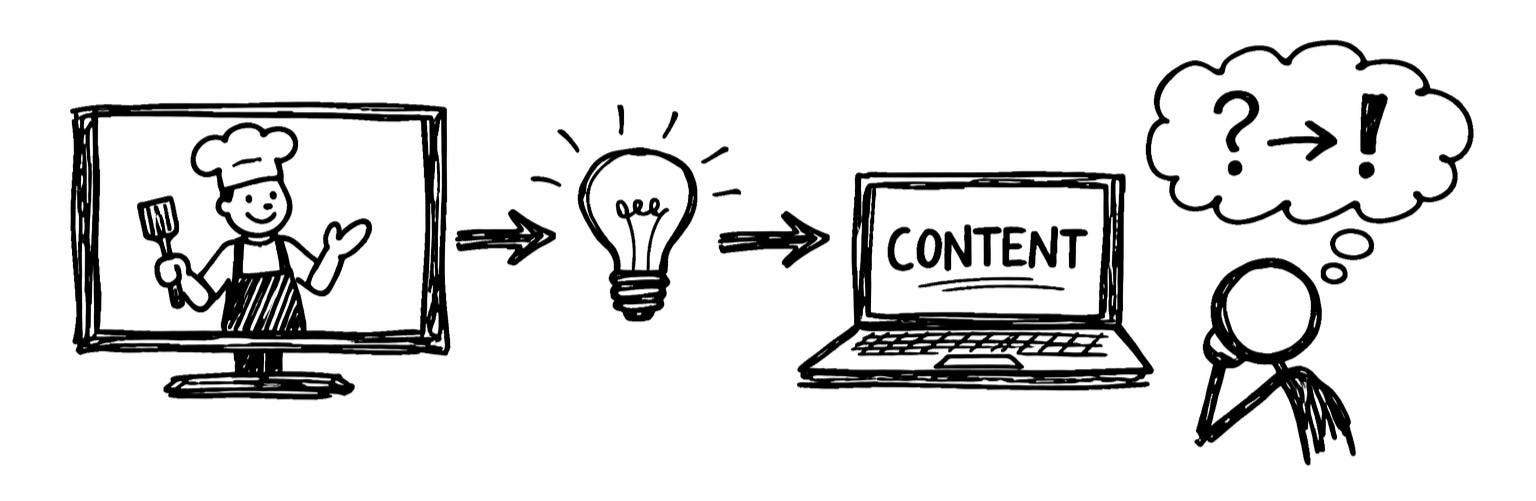
The Collision
What if writers did mise en place?
Instead of staring at blank pages on deadline day (that special hell where you start composing your “I’m pivoting to consulting” LinkedIn post), you’d prep your ingredients in calm moments. Collect ideas when they strike. Draft hooks while you’re sharp. Organize research before you need it.
Then writing days become assembly days. You’re not writing “FUCKMYLIFE” in a Google Doc seventeen times then deleting it before anyone sees. You’re combining ingredients that are already prepped.
So I did what any normal person would do: wrote a newsletter about vegetable prep, sent it to strangers, and hit publish.
People replied like I’d found a secret exit from a burning building they were also trapped in. Not metrics. Just strangers saying “how did you know.”
I didn’t know. I’d just stumbled into a connection that happened to be mine. Not original in the “nobody’s ever thought this” sense. Original in the “I got here my own weird way” sense.
AI wasn’t on that trip.
Why AI Can’t Do This
AI has read everything ever published about your topic. Every blog post. Every framework. Every “ultimate guide” written by someone who’s been in the industry for eighteen months and already has a course.
It’s all compressed into statistical patterns, ready to be averaged together and spit back out.
This is why AI content sounds the same. It’s inbreeding. The same ideas banging each other until the offspring can’t survive outside the algorithm.
You’ve read this content. Looks fine at first glance. Then you notice it has an introduction, a conclusion, and nothing worth remembering in between.
But that documentary I watched at 11pm? That wasn’t in the gene pool. AI didn’t watch it with me. AI can’t connect dots it doesn’t have.
Your 2am rabbit holes aren’t procrastination. They’re inventory.
How to Steal Your Way to Original Ideas
You’re not going to create original ideas. You’re going to steal them from sources who weren’t using them anyway.
This is a robbery. Here’s the plan.
Step 1: Build Your Stash
One note on your phone. A tag in your read-later app. Whatever friction-free container you’ll actually use. (If you spend more than three minutes setting this up, you’ve already lost. You’re not building a library, you’re procrastinating with productivity aesthetics.)
Personally, I use voice memos. Tap, ramble, let AI turn my 2am nonsense into something usable. Never have to listen to myself talk. That’s the dream.
When you notice something from a any field that resonates, steal it:
The capture format:
“[Concept] from [Source] — reminds me of [connection to your field]?”
Examples from mine:
“Mise en place (restaurant documentary) — what if content creators prepped ingredients before ‘service’?”
“Spaced repetition (learning science article) — redistribute old content at increasing intervals instead of posting once and praying?”
“Desire paths (urban planning book) — what are readers trying to do that I’m not making easy?”
“Load-bearing walls (home renovation YouTube) — which content pieces hold up everything else?”
You’re not capturing finished ideas. You’re stashing loot.
You’ll know Step 1 is working when: You have 5+ entries and adding new ones feels automatic.
Step 2: Run the Three-Question Test
Not every theft is worth fencing. Some ideas feel like “this is the one” at 2am and look... different... by morning. (Kind of like most of my Hinge matches. Moving on.)
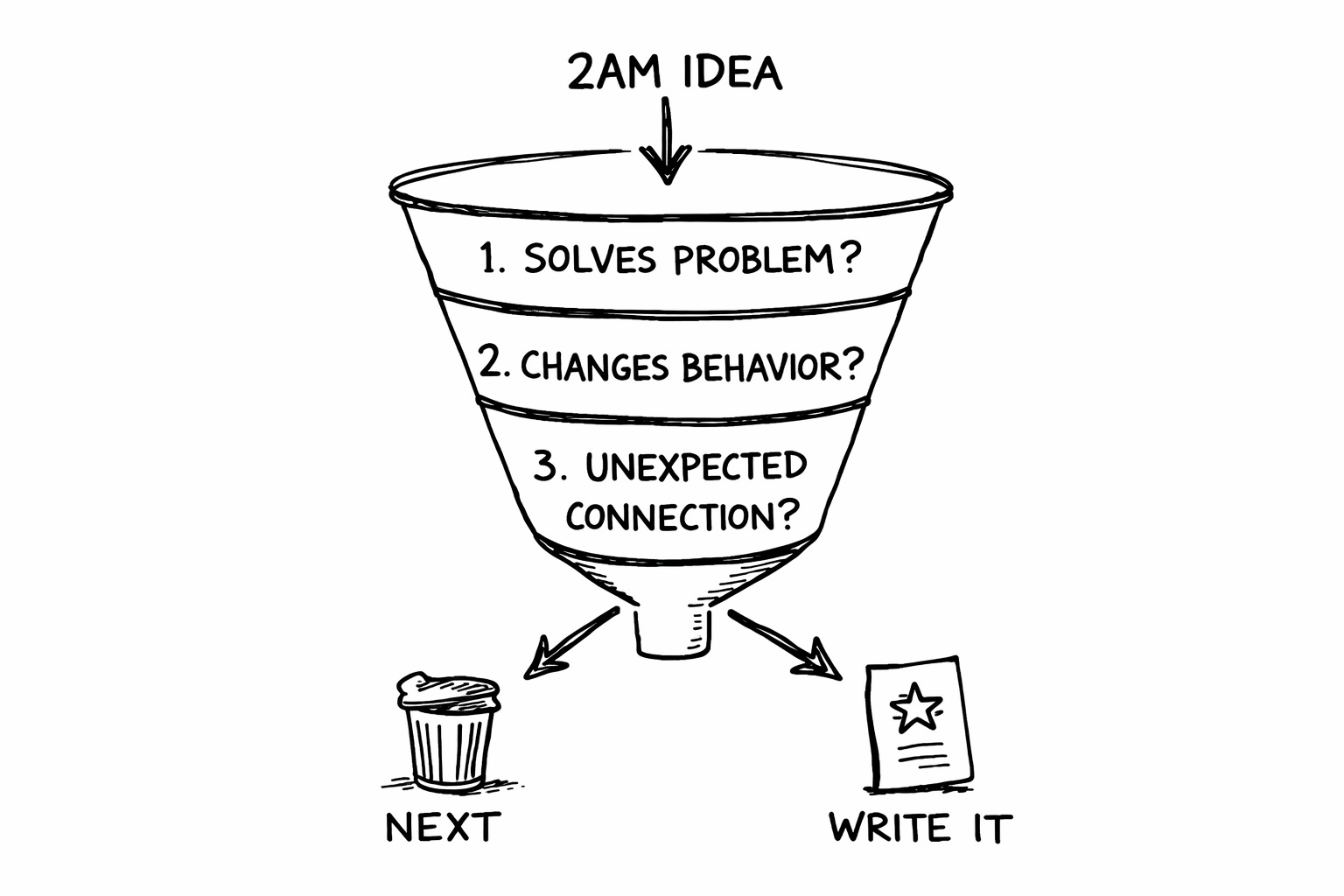
Question 1: What problem in my field does this concept solve differently?
Good answer: “Mise en place solves the ‘blank page on deadline day’ problem by separating prep from execution.”
Bad answer: “It’s an interesting comparison.” (Shower thoughts don’t always ship.)
Question 2: What would change if my audience adopted this approach?
Good answer: “Writers would stop trying to create from scratch under pressure. Writing days become assembly days.”
Bad answer: “They’d have a new metaphor for what they already do.” (A new metaphor is not a transformation. It’s decoration.)
Question 3: What’s the unexpected connection that makes this interesting?
Good answer: “Line cooks and writers fight the same enemy: too much to do, too little time, and the constant threat of falling catastrophically behind.”
Bad answer: “Being prepared is good.” (No shit. That’s a refrigerator magnet.)
The filter:
Three good answers = write it
One or two = refine or shelve
Zero = move on
You’ll know Step 2 is working when: You can kill a weak heist in under two minutes instead of wasting an hour drafting something that was never going to land.
A Heist That Flopped
I had an entry in my stash: “Sunk cost fallacy (behavioral economics) — applies to content that isn’t performing?”
Felt promising. Let’s run the test.
Q1: What problem does this solve differently? The problem of holding onto old content too long? “Let go of stuff that isn’t working” is so generic it could apply to relationships, closets, and stock portfolios.
Q2: What would change? They’d... delete old posts? Stop promoting things that don’t resonate? The “transformation” is basically “do less of the thing that isn’t working.” Revolutionary.
Q3: What’s the unexpected connection? Behavioral economics and content strategy both involve... decisions? That’s like saying cooking and architecture connect because they both involve “doing things.”
Verdict: Failed. All three answers weak. Back in the stash it goes. Maybe it connects to something else later. Probably it just sits there forever. Either way, I found out in two minutes instead of wasting an hour writing something that was never going to land.
Step 3: Launder It
You have something worth stealing. Now you need to make it look like it was always yours. There’s a structure:
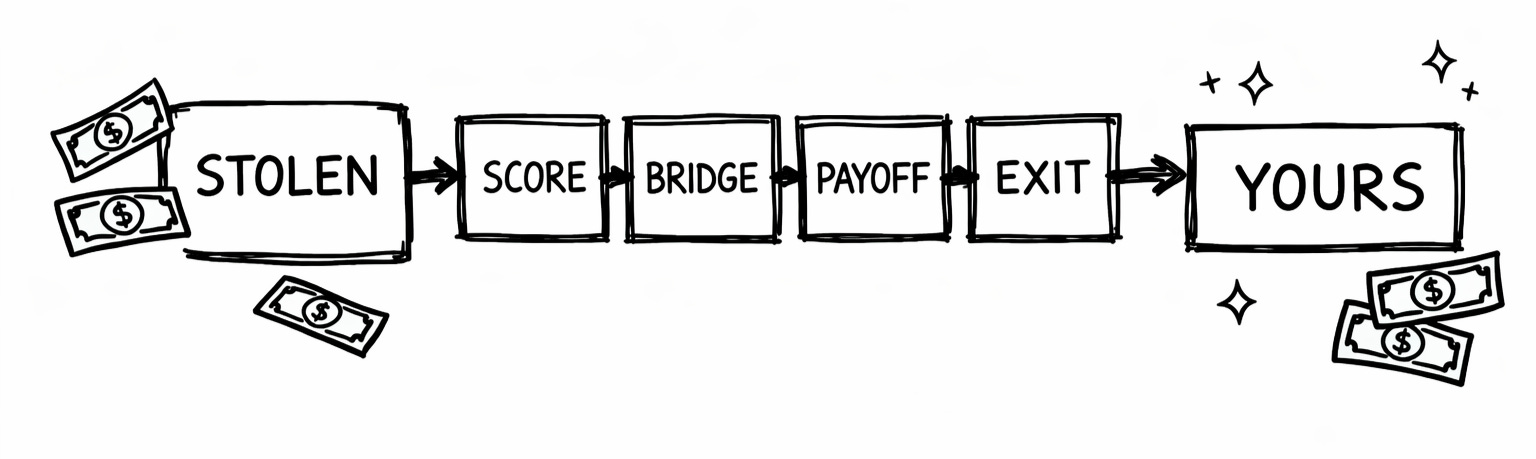
Part 1: The Score (2-3 sentences)
Quick context on what you stole. Don’t over-explain.
“Mise en place is French for ‘everything in its place.’ It’s how restaurant kitchens survive dinner rush. Before service starts, every ingredient is prepped, every tool is positioned.”
Part 2: The Bridge (1-2 sentences)
Connect the stolen goods to your world. Why does this belong here?
“Content creators face the same problem: deadline hits, and suddenly you’re creating from scratch while pressure mounts. What if you prepped your ingredients in advance?”
Part 3: The Payoff (Bulk of the piece)
Translate the stolen concept into their world. Show the problem this solves, paint the before and after, keep surfacing the unexpected connection.
The Problem: Most writers treat writing days like cooking days. Sit down, stare at a blank page, go from zero to finished. This is like a restaurant that starts prepping when customers walk in.
The Concept Applied: Mise en place for content means separating prep from service. In calm moments, do the cognitive heavy lifting. Then writing days become assembly days.
What Changes: You’re not staring at a blank page because it isn’t blank. The existential dread gets replaced by the manageable task of putting pieces together.
Part 4: The Exit (1-2 sentences)
Zoom out. Shift perspective, not just process. Leave clean.
“The kitchen doesn’t treat prep as procrastination. Prep IS the work. Maybe the same is true for content.”
You’ll know Step 3 is working when: You can go from “passed the test” to “first draft done” in under 45 minutes.
When Heists Fail (Troubleshooting)
“I can’t think of anything for my stash.”
You’re consuming outside content. You’re just not noticing connections yet.
Fix: For one week, end every book chapter or podcast with: “Does anything here remind me of my work?” The habit of noticing needs to be built.
“Everything I test fails the filter.”
Two possibilities. One: You’re being too harsh. If two questions have decent answers, the idea might still work for a shorter piece. Two: Your stash needs more entries. Cast a wider net on inputs.
“I wrote the piece and it feels flat.”
Probably a Q3 problem. The connection isn’t surprising enough.
Fix: Ask yourself: “If I pitched this at a dinner party, would people lean in or glaze over?” Sometimes you need to dig deeper into why the connection is weird. “Restaurant kitchens and content” isn’t interesting. “Line cooks and writers fight the same enemy” is.
The 60-Second Start
If you want to begin right now (and you should, because motivation is a depreciating asset):
Open your notes app. Create a note called “The Stash.”
Think about the last documentary, book, or podcast you consumed that had nothing to do with your work. What was one interesting concept?
Steal it: “[Concept] from [Source] — reminds me of [connection]?”
You now have a stash with one entry. Run the three-question test when you have ten minutes. Launder it when you have thirty.
The Getaway
The slop factories are running the same heists from the same playbook. Stealing from the same sources. Fencing the same goods.
You have access to a vault they don’t even know exists. It’s called “that weird documentary you watched at 11pm when you should’ve been sleeping.”
All that random input you thought was procrastination?
It’s your stash.
They can’t copy what they can’t find.
🧉 What’s the weirdest thing you’ve ever stolen for content? Drop it below. Bonus points if you’re slightly embarrassed by the source.
Crafted with love (and AI),
Nick “Clean Money, Dirty Sources” Quick

PS… Yes, I publish stuff like this daily. Stealing ideas, laundering them through AI, making content that sounds like a human wrote it. Subscribe if you want to keep up.
This is likely better advice than most of those $495 gurus are spouting out. The blank page is a formidable opponent, especially if you're writing content about different subjects such as blog posts. I have a bit of an advantage in that most of what I publish is fiction and the current story is written out for a considerable number of chapters. However, I still have to decide how I'm going to release the next parts and whether or not I want to do vignettes or short stories tied into the main story. Often times I'll write a little snippet and think, "wow, that's a really cool idea, now how do I tie this into one of the main characters?" That process has come up with a number of really good ideas that I think are going to improve the story. Same line Cook, different recipe. Having a plan to do that ahead of time makes it far easier to schedule post. Excellent work, Nick, thanks for sharing.
Nick, I've actually started a Word doc that I add lil "Nick Nowledge Nuggets" to (are we okay with the dropped K or does it need to go back in?). You serve up so much gold in every post!!