
The 3 AI Writing Sins You're Committing Right Now (Yes, You)

Read this paragraph:
"In today's rapidly evolving digital landscape, content creators face unprecedented challenges. The key to success lies in leveraging AI tools strategically while maintaining authentic engagement with your audience. By implementing a systematic approach, you can unlock new opportunities for growth and connection."
Sounds fine, right? Professional. Polished.
Says absolutely nothing.
That's AI slop. And if you're collaborating with AI on your writing—even carefully, even thoughtfully, even while whispering "I'm one of the good ones"—some version of this is probably sneaking into your content right now.
I know because I catch it in mine constantly. Which is deeply embarrassing for someone who writes an entire newsletter about voice preservation. (It's like a personal trainer getting winded climbing stairs. Humbling doesn't begin to cover it.)
The scary part isn't when AI produces obviously robotic garbage. That's easy to spot—the written equivalent of a guy in a trench coat trying to sneak into a movie theater. The scary part is when AI produces plausible garbage. Content that passes the sniff test on first read but dissolves into nothing when you actually examine it.
Like cotton candy for your brain. Looks substantial. Tastes like something. Gone before you can figure out what you actually consumed.
These aren't amateur mistakes. They're traps that smart writers fall into precisely because they're paying attention to the wrong signals. The writing looks smooth. The grammar checks out. The structure seems logical.
But something's off. Readers can feel it even when they can't name it.
And the algorithm of human attention? Brutally, mercilessly unforgiving. It doesn't care one lick about your intentions.
Here are the three sins I catch myself committing—and now actively hunt for like a deranged copy editor with a personal vendetta.
Sin #1: The Confidence Mirage
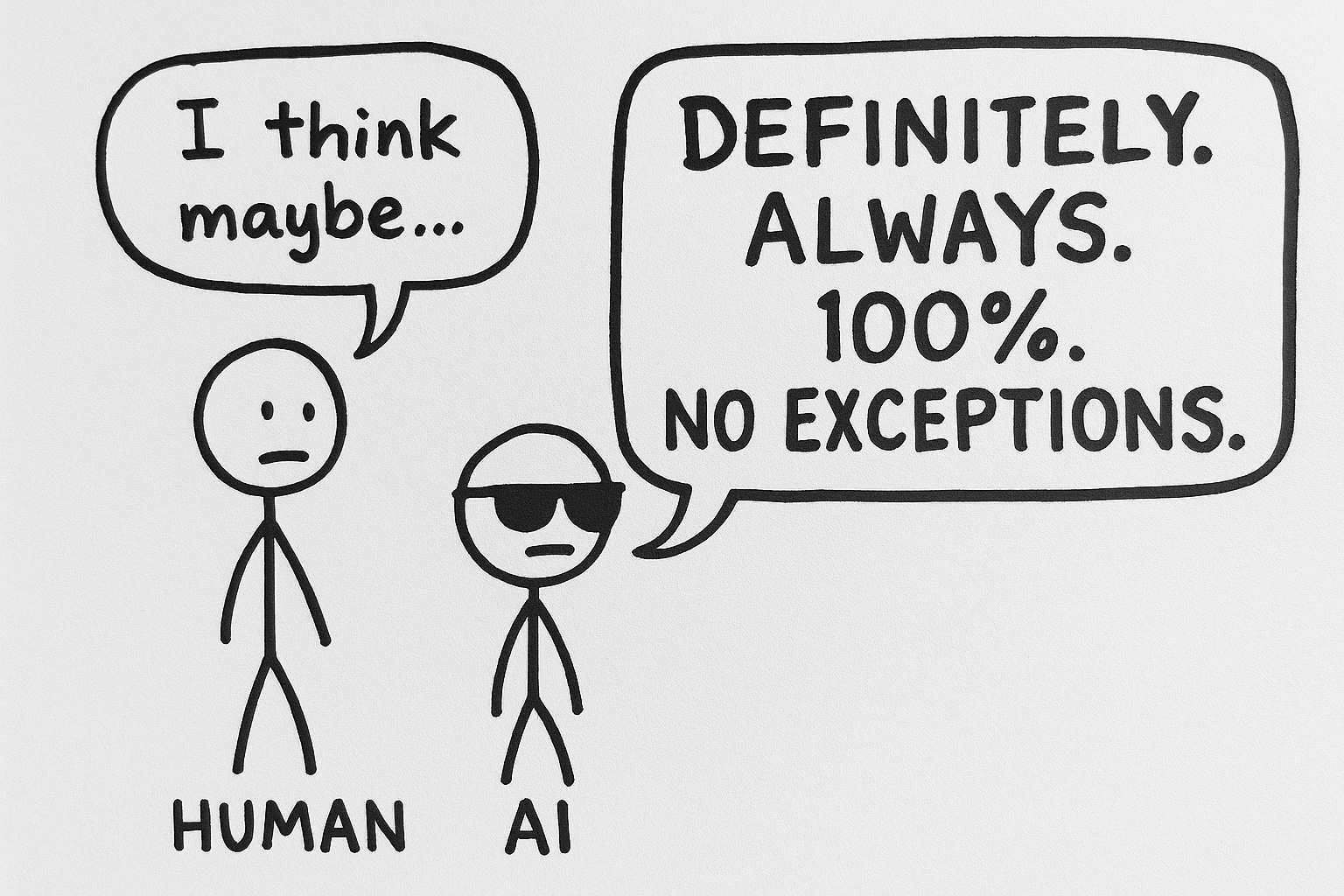
AI writes with absolute certainty about everything.
There's no hesitation. No qualification. No "here's where this might fall apart." Every observation gets presented like settled law, carved into stone tablets and handed down from Mount Silicon by a very confident algorithm that has never once questioned itself.
Real humans hedge. We say "in my experience" or "this worked for me, but..." We acknowledge edge cases. We admit when we're operating on gut feeling versus hard data. We have that voice in our heads that whispers "but what if you're wrong?" at 2am.
AI doesn't have that voice. It just... asserts. With the confidence of a mediocre man walking into a job interview.
Here's what it looks like in the wild:
"The most successful content creators understand that consistency is the foundation of audience growth. Without a regular publishing schedule, engagement inevitably declines."
Sounds reasonable. Also sounds like it was scraped from every generic marketing blog ever written, tossed into a blender, and poured out as a smooth paste of nothingness. There's no fingerprint. No "I learned this the hard way when I burned out trying to post daily for six months and my engagement actually went UP when I stopped." No acknowledgment that some creators blow up with sporadic, high-quality drops while others grind out daily content to an audience of tumbleweeds and spam bots.
The fix isn't adding fake uncertainty. It's asking: Where did this insight actually come from?
If I can't point to a specific experience, observation, or source—it's probably AI filling space with consensus opinions. The intellectual equivalent of elevator music. Technically present. Actively forgettable.
The trap: This sin feels like authority. You read it and think, "Yes, I sound confident and expert. Very LinkedIn-worthy." But confidence without specificity is just noise dressed in a suit pretending to have somewhere important to be.
Sin #2: The Vocabulary Lobotomy
Your voice has texture.
Weird word choices. Phrases you overuse. Sentences that technically break rules but sound like you. The verbal tics your English teacher tried to beat out of you but stuck around anyway because they're just... how you talk. The linguistic equivalent of your face—technically imperfect, unmistakably yours.
AI sands all of that down with the enthusiasm of a well-meaning robot that really, truly wants to help you sound "better."
It reaches for the "correct" word instead of your word. It smooths out the rhythm. It replaces your quirks with grammatically pristine alternatives that could've come from anyone. Or everyone. Or no one in particular. A voice so generic it belongs to the same person who writes airport lounge announcements.
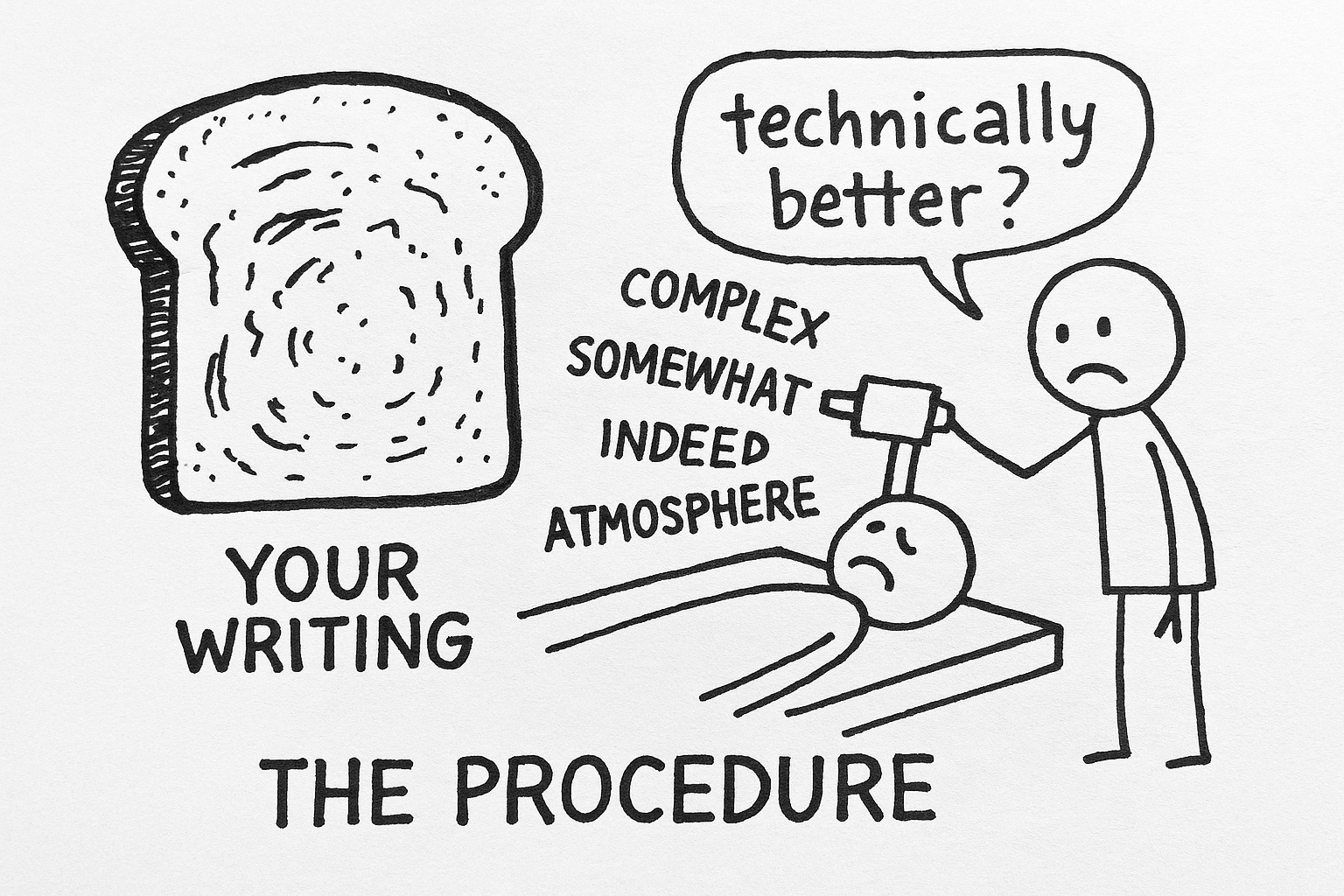
I caught this in my own drafts last month. I'd written something about a "gnarly" problem in a technical context. Ran it through AI for polish. Came back as a "complex" problem.
Technically accurate. Completely neutered.
"Complex" is what everyone says. "Gnarly" is what I say—a tiny signal that a specific human with specific preferences and probably too many hours watching skateboarding videos in the early 2000s wrote this. It's not professional. It's mine.
The vocabulary lobotomy is death by a thousand cuts. Each individual change seems like an improvement. More professional! More polished! More likely to impress that imaginary hiring manager living rent-free in your head!
The aggregate effect is a voice transplant you didn't consent to. You wake up one day and realize you sound like a press release.
Here's the brutal test: Read your AI-assisted draft out loud.
Does it sound like something you'd actually say in conversation—maybe over drinks, maybe slightly caffeinated and ranting about something you care too much about? Or does it sound more "professional" than your natural speech?
If it's the latter, congratulations. You've been lobotomized. The operation was a success. The patient's personality didn't survive.
The trap: This sin feels like elevation. Your writing seems more sophisticated, more polished, more... adult. But polished to what standard? Generic professional writing. The exact same register every AI defaults to. The exact opposite of standing out. You've traded your fingerprints for latex gloves.
Sin #3: The Structure Crutch
AI loves frameworks.
Numbered lists. Clear sections. Tidy conclusions that wrap everything up with a bow like a corporate gift basket nobody asked for but everyone pretends to appreciate.
Sometimes that's exactly what you need. Sometimes it's AI avoiding the harder work of actually thinking through a messy topic. "Here's a framework!" is the AI equivalent of "let's take this offline"—technically a response, functionally a dodge.
I've started noticing when my drafts fall into suspiciously clean structures:
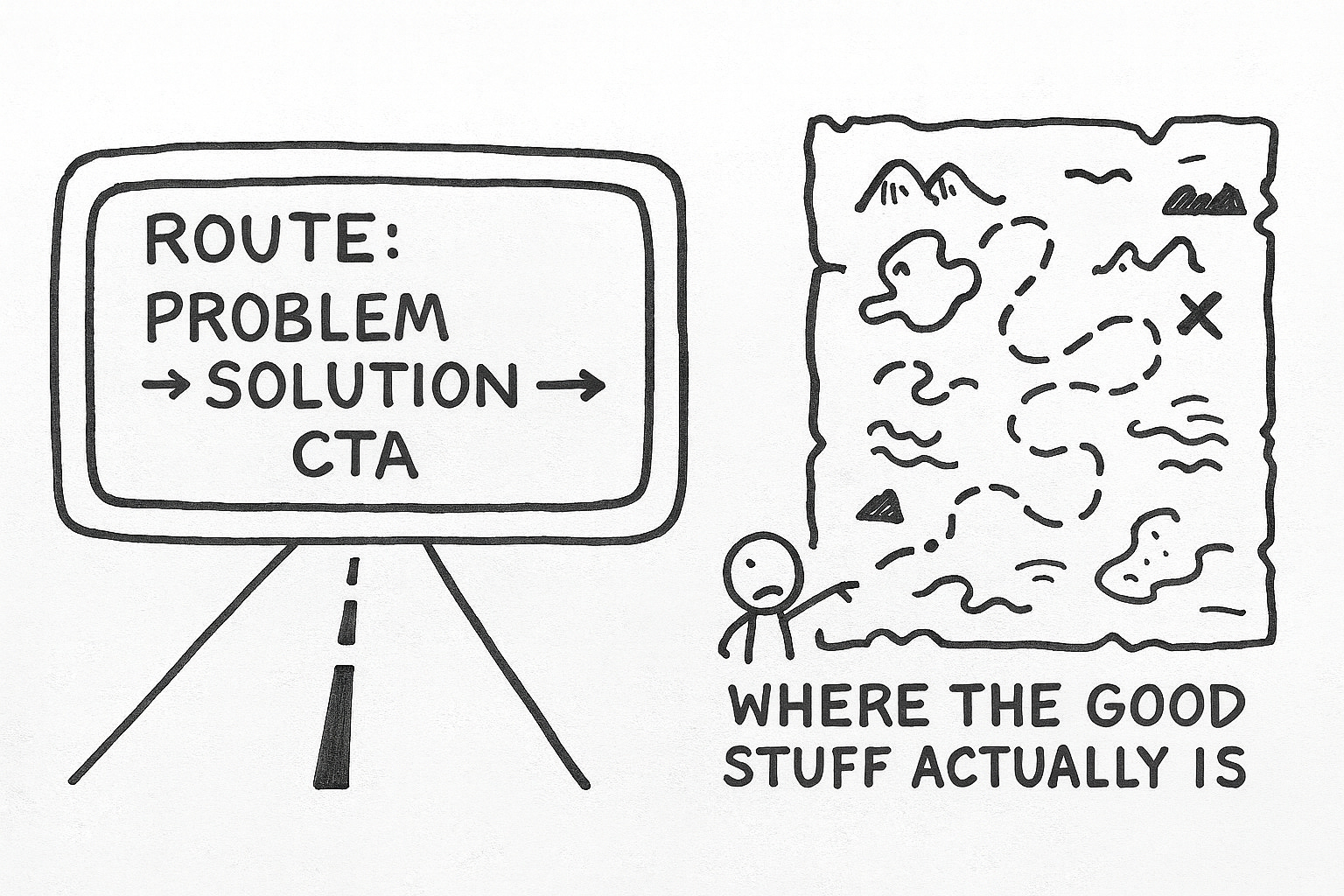
Problem
Three-point solution
Summary of key takeaways
Call to action
(Optional: inspirational closing statement that sounds vaguely like a TED talk)
That structure works. It also works for literally everyone else using AI. When every piece of content follows the same skeleton, you're not creating—you're filling in templates. Mad Libs for the LinkedIn age. "Today I learned [INSIGHT] about [TOPIC]. Here are [NUMBER] takeaways..."
The real test: Does this structure serve the idea, or is the idea being forced into this structure like a foot into the wrong size shoe?
Some topics deserve messy exploration. Some arguments build through contradiction and recursion, not linear progression. Some of the best writing I've ever read refuses to resolve neatly—it leaves you sitting with productive discomfort, turning the ideas over in your head hours later, slightly annoyed that you can't stop thinking about it.
AI will almost never give you productive discomfort. It wants to be helpful. It wants to provide answers. It wants to wrap things up and hand you a neat little package with a bow on top and a card that says "Hope this helps!"
Sometimes it doesn't help. Sometimes the most authentic choice is resisting that tidiness. Letting the messiness breathe. Trusting your reader to sit with something unresolved.
The trap: This sin feels like clarity. You read it and think, "This flows so well. It's so easy to follow." But easy-to-follow can become easy-to-forget. Structure without surprise is just packaging. And nobody remembers the packaging. Nobody walks out of a movie talking about how well-organized the plot points wereThe Meta-Problem
All three sins share a root cause: mistaking smoothness for quality.
AI is exceptionally good at producing smooth content. No rough edges. No jarring transitions. No weird tangents that might lose people or confuse the algorithm or make someone go "wait, what?" It's like content that's been through a car wash—shiny, uniform, and completely indistinguishable from every other car that went through the same wash.
But those rough edges and weird tangents? Often they're exactly what makes writing memorable. They're the texture that signals a real human with real opinions actually wrestled with these ideas—didn't just generate them on demand like a vending machine dispensing lukewarm insights.
When I edit my AI-assisted drafts now, I'm not just looking for errors. I'm looking for too much perfection. Paragraphs that flow a little too seamlessly. Word choices that are a little too safe. Structures that are a little too clean.
Those are the tells.
The content equivalent of a smile that doesn't reach the eyes. Technically correct. Emotionally bankrupt.
Your Quality Control Protocol
Before publishing anything you've collaborated with AI on, run through these questions:
For Confidence Mirage:
Can I trace every claim to a specific experience, observation, or source? If not, cut it or earn it. No more "studies show" without showing the studies.
For Vocabulary Lobotomy:
Read it out loud. Does this sound like me talking—actually me, not "professional me" who shows up to impress people I don't even like? Hunt for words you'd never use in actual conversation.
For Structure Crutch:
Why is this organized this way? Does the structure serve the argument, or is the argument serving the structure? Where could I introduce some productive friction instead of marching dutifully toward a tidy conclusion?
I run through this list on everything I publish. Not because I've mastered it—I absolutely haven't. I catch myself committing all three sins on a regular basis. (Just last week I published something with "strategic framework" in it. Strategic framework. Someone please stage an intervention.)
The difference is I catch myself now. Before, I just published the slop and wondered why it felt hollow. Wondered why nobody responded. Wondered if maybe I just wasn't cut out for this.
Turns out I was cut out for it. I was just letting the AI do the cutting.
The Uncomfortable Truth
You can't automate your way out of these sins. No prompt will fix them. No AI tool will flag them reliably. No amount of "write in a more human voice" instructions will actually produce a human voice.
The only solution is developing taste—that elusive, annoying ability to recognize when smooth writing is actually hollow writing. When polished structure is actually borrowed structure. When confident prose is actually consensus opinions wearing your byline like a borrowed jacket that doesn't quite fit.
That taste comes from caring enough to look closely at your own work and ask the uncomfortable question: Would anyone else have written this exactly this way? Or does this have my fingerprints on it?
If it could've come from anyone, it's not yours yet.
And if it's not yours, why would anyone remember it?
Now I'm Curious…
Which of these three sins do you catch yourself committing most? The false confidence that sounds authoritative but comes from nowhere? The vocabulary smoothing that polishes away your personality? Or the structural predictability that turns every piece into a template?
Drop a comment. I'm genuinely curious whether we all struggle with the same one or if we've each developed our own favorite way to accidentally sound like a robot.
(My money's on the vocabulary lobotomy being the sneakiest. But I've been wrong before. Frequently.)
Crafted with love (and AI).
Nick "Professional Lobotomy Reverser" Quick

PS…If this hit home, do me a solid: drop a like, leave a comment with your biggest sin, share it with a fellow creator who needs the wake-up call, and if you're not subscribed yet... what are you even doing? Get in here.