
Stop Looking for Your Voice (It Doesn't Exist Yet)
A three-stage map for writers tired of wandering

The only way to find your voice is to stop looking for it.
(This sounds like the kind of fortune cookie wisdom that makes me want to commit a small, victimless crime. Maybe medium-sized. Jury's out. I apologize in advance. It’s also true, which is the most annoying kind of fortune cookie wisdom.)
Every writer who’s ever “found” their voice will tell you the same story: they weren’t looking when it happened. They were building. Drafting. Failing. Revising. Making thousands of small decisions they didn’t think of as decisions.
Then one day, someone said “I’d recognize your writing anywhere,” and they realized: “Oh! So that’s what voice is….” It’s not something you discover. It’s something that accretes. Like sediment. Or debt. Or that one thing you said at a party in 2014 that still haunts you at 3am.
The finding was a side effect of the building. The building was the point.
And nobody told them this in advance. Because “build your voice through thousands of unglamorous micro-decisions over several years” doesn’t fit on a book cover. “Find your authentic self” does. Sells better too. (The self-help industrial complex didn’t get rich by telling people the truth about how long things take.)
The Lie That Launched a Thousand Journals
The writing industry has been running the same con for decades.
“Find your voice.” It’s on every course landing page. Every craft book. Every conference keynote delivered by someone with good lighting and a memoir you'll see at Marshall's in eight months for $1.99.
Find it. Like it’s hiding. Like your authentic voice is crouched behind your childhood memories, waiting for the right journal prompt to coax it out. Like sufficient navel-gazing will eventually produce a prose style.
I spent five years on this scavenger hunt. Morning pages. Writing retreats. Books with words like “authentic” and “true self” in the title. (So many books. My shelf is basically a mass grave for good intentions.)
I searched everywhere.
Found nothing.
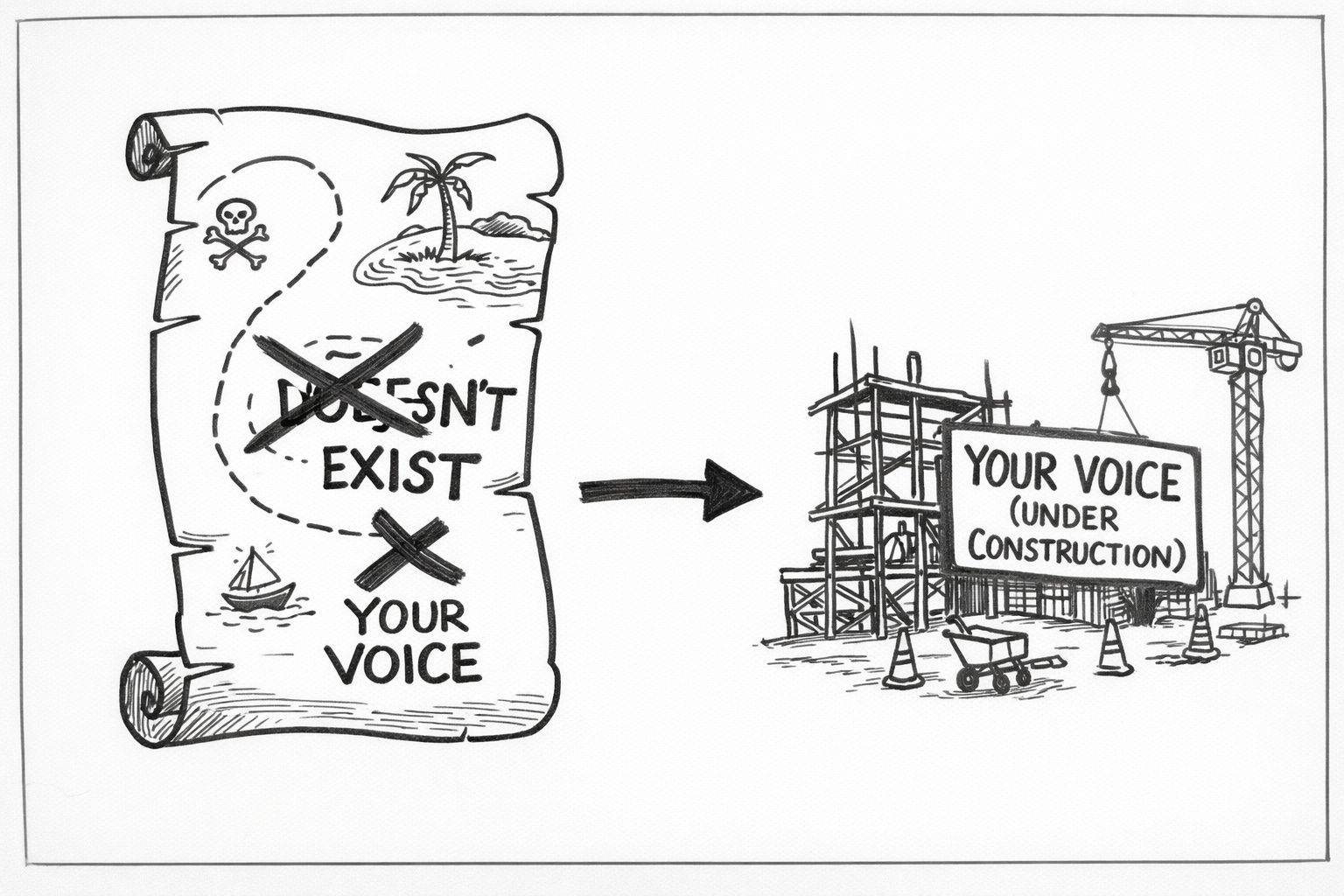
Not because I wasn’t looking hard enough. Because there was nothing there. The treasure map everyone sold me led to an empty field. And I stood in that field for three years, digging holes, wondering what was wrong with me.
Nothing was wrong with me. The map was wrong. You can’t find what hasn’t been built yet.
The Map They Should Have Given You
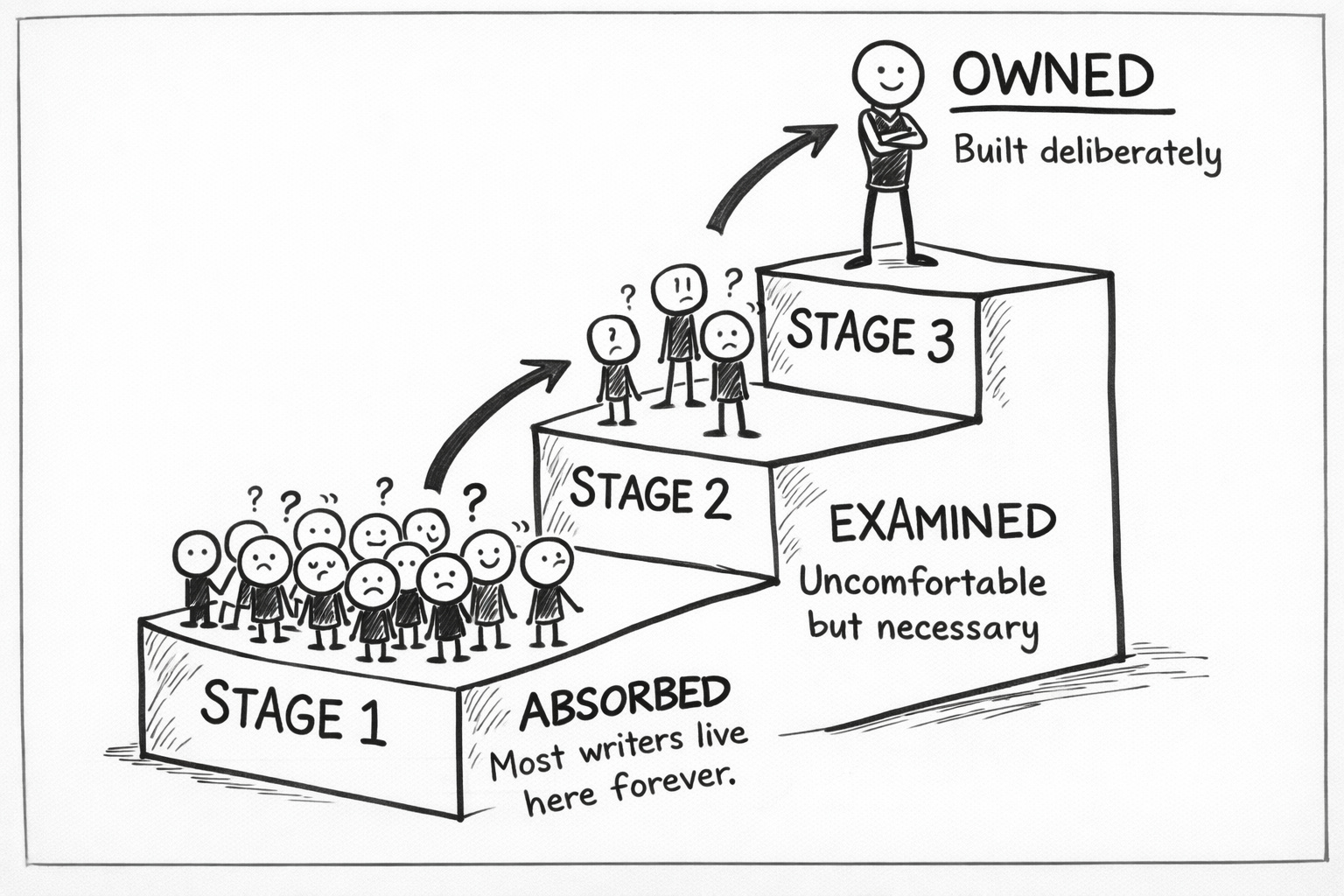
There’s a journey. It has three stages. And the cruelest part is that nobody tells you the stages exist until you’ve wasted years stuck in the first one.
(I’m going to tell you now. Consider this the map you should’ve gotten at the beginning. The one they don’t hand out because “wander aimlessly for a while” is apparently part of the creative process.)
Stage 1: Absorbed Patterns
This is where everyone begins. This is where most people stay forever, redecorating their prison cell, calling it home.
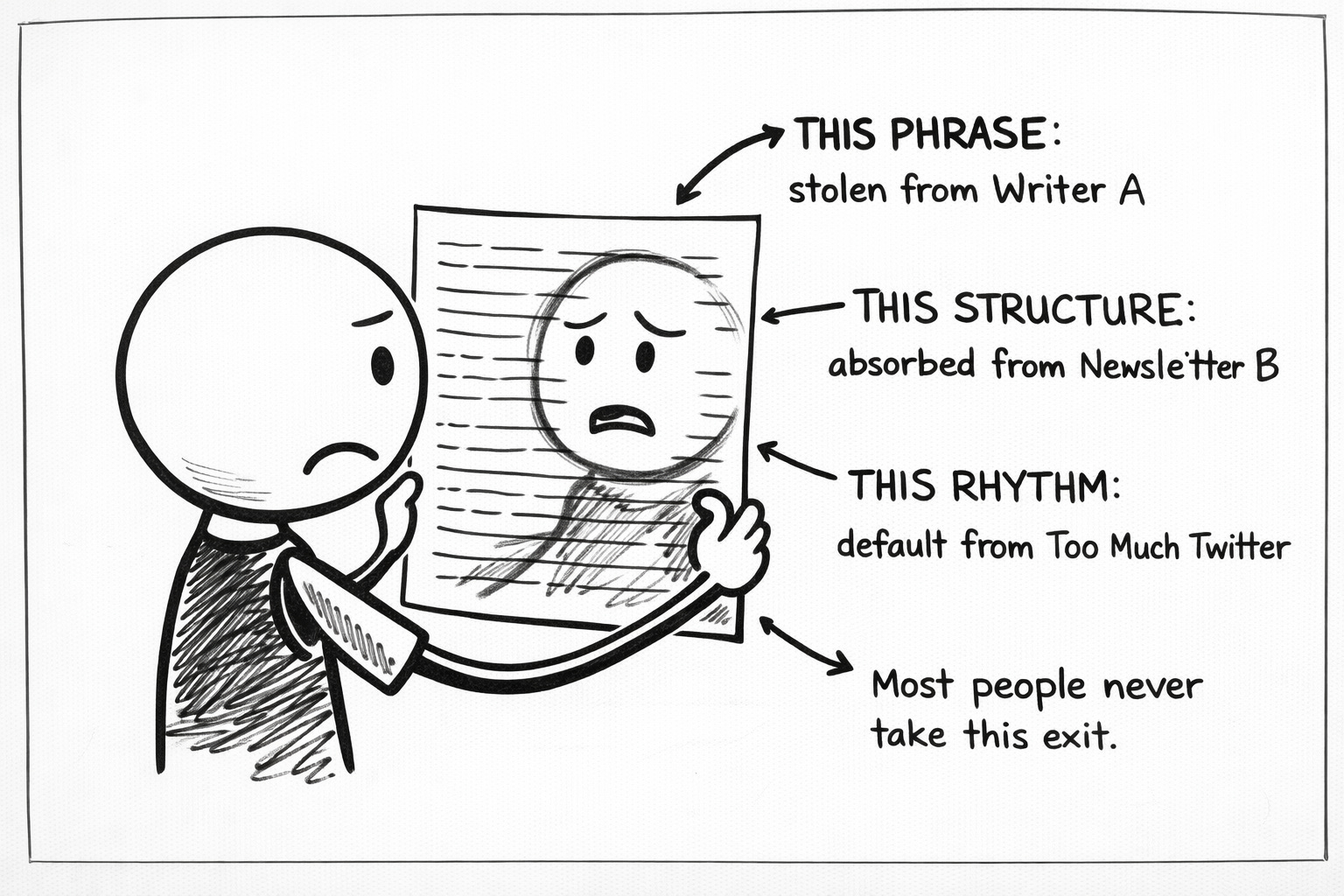
You write the way you learned to write. Your defaults come from what you’ve consumed: teachers who taught for standardized tests, books you devoured before you knew better, newsletters you binged during your “I should have a newsletter” phase, that one blog with the minimalist design and punchy paragraphs that made you think “ah, so this is what competence looks like.” (It wasn’t. It was just good font selection.)
Your sentence rhythms? Absorbed.
Your structural defaults? Absorbed.
That phrase you keep reaching for when you’re tired and need to finish the paragraph? Absorbed.
All of it. Soaked in through exposure like a regional accent you didn’t notice until you left home and someone asked where you’re from and you heard pity in the follow-up silence.
(I spent a decade sounding vaguely like every business writer I’d ever admired. A smoothie of influences with no distinct flavor. Very professional. Completely forgettable. The written equivalent of a meal you can't remember eating an hour later.)
Stage 1 isn’t bad. It’s necessary. It’s the foundation.
But it’s borrowed. Every brick in your house belongs to someone else. You’ve just forgotten which houses you stole them from.
Stage 2: Examined Patterns
This is the uncomfortable middle. The part where you realize the house you’ve been living in isn’t yours.
You start noticing your defaults. Which ones feel natural? Which ones feel like wearing a jacket that doesn’t quite fit but you’ve owned it so long you forgot you could take it off?
You read your own work with new suspicion:
Wait, do I actually think that transition works? Or did I just learn that transitions should go there?
Is this phrase mine? Or did I absorb it from that writer I binged before I understood what binging writers would do to my prose?
Why do all my paragraphs end the same way? Who taught me that? Do I even like it?
Stage 2 is destabilizing. Your writing might get temporarily worse. (Mine did. Significantly worse. I second-guessed everything until I couldn’t finish a sentence without interrogating its parents and running a background check.)
Some writers retreat to Stage 1. Unconscious competence felt better than conscious incompetence. The borrowed house was at least furnished.
But Stage 2 is where the real work begins. You can’t build what you haven’t examined. You can’t own what you’ve never named.
Stage 3: Owned Patterns
This is where voice becomes real. Where all that painful examination turns into something you can actually use.
You’ve audited your defaults. Identified what’s borrowed versus what fits. Now you deliberately develop the patterns that work for you.
You choose your vocabulary. Not “whatever comes out,” but specific words you reach for and specific words you’d rather die than type. (I don’t say “utilize.” I don’t say “leverage.” I don’t say “unlock” unless I’m literally holding keys. Life’s too short to sound like a pitch deck.)
You choose your architecture. How you open. How you close. What structures you default to and why.
You choose your stance. How close you stand to readers. How certain you sound. Whether you’re a guide, a peer, a provocateur, or some unholy combination that changes depending on your caffeine levels.
You choose your tempo. Sentence length. Rhythm. The music of your prose that readers feel even when they can’t name it.
Stage 3 writers know their voice because they built it. They can describe it, maintain it, evolve it. When someone copies their style (and people will copy, because people always copy, because originality is hard and theft is easy) they notice. Because they know what the style is made of.
This isn’t a destination. Stage 3 is ongoing. You keep refining, strengthening, occasionally tearing down walls and rebuilding.
But you’re constructing deliberately now. Not absorbing accidentally. And that makes all the difference.
The Trap That Keeps You Stuck
Stage 1 feels like progress. That’s the trap.
You’re writing. Publishing. Improving technically. Your sentences are cleaner. Your structures are tighter. You’re learning the craft.
But you’re learning the average craft. You’re getting better at producing content that sounds like content. The kind of writing that technically qualifies as writing but leaves no fingerprints at the scene.
(I published a newsletter for two years that I now cannot distinguish from forty other newsletters using the same templates. We were all very good at sounding exactly like each other. Quite an achievement, really. A chorus of indistinguishable voices all singing the same song and wondering why nobody could pick us out of the lineup.)
The problem is that nobody tells you Stage 1 is a stage. Everyone acts like this is just writing. Get better at the craft. Study the masters. Follow the rules.
The rules are absorbed patterns that got institutionalized. They’re what everyone does because everyone does it because everyone has always done it because someone decided it worked once and now we’re all trapped in a style guide nobody remembers writing.
Following the rules is how you get better at Stage 1. It’s also how you stay stuck there permanently.
Breaking rules requires first knowing you’re following them. Most writers don’t. They think the rules are just “how writing works.” They never ask: how writing works according to whom? Based on what? Says who?
(Says the people who got there first and wrote it down. That’s who. And they were making it up too. They just had better timing.)
The Bridge Nobody Wants to Cross
Moving from Stage 1 to Stage 2 requires something writers avoid like eye contact on public transit:
Looking at your work honestly.
Not “is this good?” Wrong question. The right question is: “Is this mine?”
Pick something you wrote. Anything. Read it like a stranger wrote it. Ask:
Where did these patterns come from? (Be specific. Name sources. This is uncomfortable. Do it anyway.)
Which choices did I make consciously versus default to unconsciously?
If I’d read different writers in my formative years, would this sound different?
What would I write if I weren’t trying to sound like A Writer?
That last question is the killer. Because most of what we think of as “good writing” is just absorbed patterns we’ve labeled as correct. We’re not writing well. We’re writing safely. Fitting in rather than standing out. Following the template rather than questioning why the template exists.
Stage 2 begins when the patterns stop being invisible. When you see the borrowed furniture everywhere. When you realize you’ve been living in someone else’s house and calling it home.
The nausea you feel at this point is normal. The nausea means your taste is developing faster than your skill. That gap is painful. That gap is also progress.
(The gap deserves its own piece. Possibly its own support group. For now: the discomfort is the point. Sit with it. It means something is changing.)
Building What You’ve Examined
Stage 3 isn’t mystical. It’s methodical. Tedious, even. (The tedium is a feature. It filters out people who want voice without the work. Which is most people. Which is why most people stay in Stage 1.)
Once you’ve examined your patterns, you decide which ones stay.
Some you’ll keep. They fit. They feel natural. Yes, you absorbed them, but they became yours through repetition. You’ve earned them. They’re no longer stolen furniture; they’re hand-me-downs you’ve made your own.
Some you’ll replace. They never fit. You just never questioned them. Now you can.
The work is: audit, evaluate, decide, repeat. Every piece becomes an opportunity to strengthen what you’ve chosen and discard what you haven’t.
This takes months. Sometimes years. There’s no shortcut. You can’t journal your way to distinctive voice. You can’t retreat your way there. You can’t find it because there’s nothing to find.
You build it. Draft by draft. Choice by choice. Brick by brick.
And at the end, you have something real. Something that belongs to you because you constructed it. Not because you stumbled across it in a field. Not because it was hiding inside you all along. Because you built the damn thing yourself, with your own hands and your own too-many cups of coffee and your own embarrassing drafts nobody will ever see.
That’s voice. Not found. Built.
The fortune cookie was right. (God, I hate when the fortune cookie is right.)
The only way to find your voice is to stop looking.
Start building instead.
Brick by brick. Draft by draft. Conscious choice by conscious choice. Until the day someone says “I’d recognize your writing anywhere” and you realize: oh. That’s what all that construction was for.
(It’s not romantic. It’s not mystical. It’s work. But the work produces something real. And real beats romantic every time. Even when romantic has better lighting and a catchier tagline.)
Discussion Thread: What stage do you think you’re in? And what’s one pattern in your writing you’re suddenly suspicious you might have borrowed without realizing it?
Crafted with love (and AI),
Nick "The Fortune Cookie Was Right" Quick

PS: I publish Sundays and Wednesdays. Lately it’s been daily because I have serious mental problems. Subscribe if you want to watch me work through them in public while accidentally teaching you something about writing.