
Stop Editing AI. Start Retyping It.
Your fingers already know how to write like you

I spent 45 minutes editing an AI draft last week.
Forty-five minutes. That’s a full episode of prestige television. That’s enough time to make dinner, eat it, and feel vaguely disappointed in myself. (So, a Tuesday.)
I swapped words. Shortened sentences. Added parenthetical tangents because I physically cannot write three paragraphs without my brain interrupting itself. Deleted the throat-clearing intro where AI spent 47 words saying goddamn nothing.
Read it back.
Still didn’t sound like me.
The structure was AI. The rhythm was AI. The skeleton underneath was this perfectly balanced, logically flowing, utterly soulless architecture that I was just... redecorating.
I was putting throw pillows on a corpse.
The Realization That Made Me Feel Stupid
Editing AI output is like tracing someone else’s handwriting and hoping it looks like yours.
You can press harder. Go slower. Add your signature flourishes at the end.
But the shapes aren’t your shapes. The slant isn’t your slant.
You’re following their hand, not moving your own.
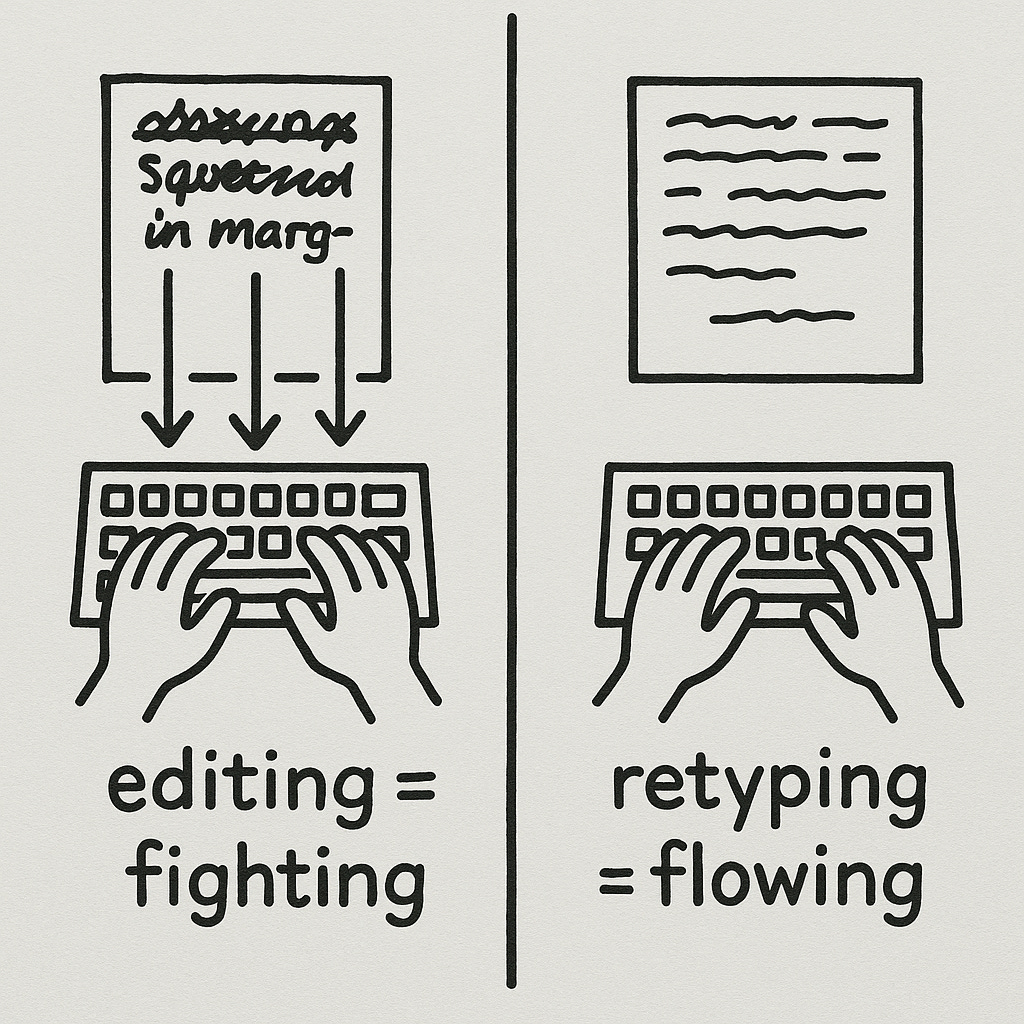
And here’s the part that made me want to throw my laptop into the Río Paraguay: I teach this stuff. I literally write a newsletter about making AI sound human. (Which makes this next part extra humiliating, but we’re three drinks in now, so let’s go.)
I deleted everything. Opened a blank doc next to the AI draft. And retyped the whole thing from scratch.
Same ideas.
Completely different output.
Took maybe ten minutes.
I’d been doing content renovation when I needed content demolition.
Why Editing Is a Trap (And I Fell Into It Like a Tourist)
When you edit AI output, you’re working inside its frame. The sentence lengths stay. The paragraph breaks stay. That smooth, frictionless, “I am a helpful assistant” rhythm stays.
You’re not rewriting. You’re accessorizing.
(This is like learning words and phrases in another language but keeping your American accent. Technically correct. The waiter still replies to me in English.)
Your readers feel this, by the way. They don’t know they feel it. They just bounce faster. Skim more. Share less. The content doesn’t land and nobody can articulate why.
It’s because the skeleton is wrong.
You can’t massage your way to a different skeleton.
Why Retyping Works (The Part Where I Sound Smart Again)
Your fingers have voice memory.
Years of muscle memory for your sentence lengths. Your rhythms. The way you stack short punches before releasing into something longer and more unhinged. The parentheticals you can’t resist adding. (Like this one. They just happen. I’ve tried to stop. I cannot stop. This is my brain now.)
When you retype from scratch—not copy, not paste, not even glancing-while-copying—you can’t help filtering through your own patterns.
It’s the difference between sampling a song and covering it.
Sampling keeps the original intact. You’re just chopping it up, rearranging the pieces, maybe adding a beat. The DNA is still someone else’s.
Covering rebuilds it through your instrument. Your vocal quirks. Your timing. The way you hold certain notes too long because you’re dramatic and you’ve accepted this about yourself.
Retyping is covering.
You’re not editing AI anymore. You’re playing its song in your key.
The Actual Mechanics (Finally, Something Actionable)
Split screen. AI output on the left. Blank doc on the right.
Read a sentence.
Type your version without copying.
Do not copy. Not a sentence. Not a phrase. Your fingers have to build each keystroke from scratch. That’s when the voice memory kicks in.
You’ll notice yourself diverging immediately. Shortening things. Breaking sentences differently. Adding asides you couldn’t resist. Swearing where AI would never swear. Making weird references that reveal exactly how chronically online you were in 2009.
Those divergences aren’t errors.
Those divergences are your voice clawing its way out of the AI prison.
The Time Math (For the Skeptics)
Retyping a 500-word AI draft: 10-15 minutes.
Editing a 500-word AI draft until it sounds like you: 30 minutes to literally never.
I’ve watched people edit the same paragraph six times and still land on something that sounds like a LinkedIn post about synergy. The frame is a prison. You can’t decorate your way out of a prison.
(Well, you can. But you’re still in prison. You just have nicer curtains.)
Retyping is faster because you’re not fighting. You’re replacing.
The Part Where I Pretend This Is Ancient Wisdom
Hollywood writers have done this forever. When they take over someone else’s script, they don’t mark it up with notes. They retype entire scenes from scratch. Same plot points, completely different delivery.
The physical act of typing engages different neural pathways than editing. You’re not reacting to someone else’s choices. You’re making your own.
Your fingers remember how you write even when your brain is too tired to enforce it.
Trust the fingers.
(Also, it’s weirdly satisfying. Like taking off jeans and putting on sweatpants. Same legs. Different experience entirely.)
The One Rule
Don’t copy-paste a single sentence.
The moment you copy, you inherit the structure. The moment you inherit the structure, you’re back to decorating the corpse.
Retype everything.
Your hands already know how to write like you.
Let them.
I’m genuinely curious—when you retype instead of edit, what does your voice change first? The sentence length? The punctuation? The places where AI hedged and you didn’t?
Try it once. Just once. Then come back and tell me what your hands did when you finally let them drive. Comment below and let me know.
Crafted with love (and AI),
Nick “Trust Your Fingers” Quick

P.S. Want the full system for collaborating with AI without sounding like AI? I’m giving away my entire Co-Write OS course for free right now. Voiceprint building, prompt frameworks, quality control checklists—everything I use. Grab it here before I come to my senses.