
Stop Creating Notes. Start Extracting Them.
You already wrote them. You just called it an article.

The blank Notes composer is a very specific kind of bad.
Not writer’s block. Writer’s block is romantic. (Writer’s block has its own memoir genre. People grow beards about it. People take sabbaticals about it and come back with linen shirts and strong opinions about oat milk.) This is something flatter and more absurd. It’s standing in front of an open refrigerator, fully aware there’s food in there, and closing it without eating anything. Then going back. Opening it again. Closing it. Sitting down. Standing up. Opening it a third time hoping that this time, somehow, the food will have cooked itself.
(It hasn’t.)
You published a full-ass article recently. A real piece. Sharp, specific, undeniably yours. The kind where you hesitated once before hitting send and then sent it anyway, which was the correct decision and somewhere in your gut you already knew that.
And now you’re staring at a new blank screen trying to figure out what to say on Notes today. (Because apparently publishing a thoughtful article isn’t enough anymore. Now you also need a social media presence. On the same platform. To promote the thing you just published. On the same platform.)
So you stare at the composer.
As if the article you just shipped didn’t already contain six or seven of them.
Two Camps. Both Wrong. Both Extremely Confident About It.
The first camp automates the entire shebang. Paste your Substack URL into a pipeline. Receive ten Notes in thirty seconds. Queue them. Post them. (The output has the distinct voice of someone who attended a seminar about your newsletter, took notes in a dark room, and later reconstructed your personality from memory after a night of binge drinking. It has your vocabulary, your structure, your cadence, and absolutely none of the thinking that produced them.)
The second camp insists on writing from scratch. Batch a week of Notes in one sitting. Write thoughtfully. Show up consistently. Post with intention. (This is excellent advice for people whose primary problem is discipline. Most creators’ primary problem is not discipline. It is that they are asking creation to do a job that belongs to recognition. These are different jobs. One requires a blank page. The other requires a magnifying glass.)
Neither camp noticed the thing sitting in the document they just closed.
The post already contains the Notes. Every substantial post carries most of them. Some posts have all seven. The framework doesn’t conjure anything. It just shows you where to look.
You’ve been treating a reading problem like a creativity problem. The tragedy isn’t that you ran out of ideas. It’s that you had them the whole damn time and spent your energy inventing more.
A Distinction Worth Making Before the Framework Lands
Repurposing is backwards-looking. You find what already performed, strip it for parts, reformat it for other surfaces. Useful. Standard practice. Not what this is.
Extraction is forwards-looking. You read a post you just wrote and locate seven specific things that were already in there, each one serving a different function in the Notes feed.
Repurposing asks: what already worked?
Extraction asks: what’s already in here?
One needs performance data. The other needs a framework. (One also needs you to wait around while the algorithm decides your worth, which is a fine system if you enjoy uncertainty and have excellent hobbies to occupy the interim.)
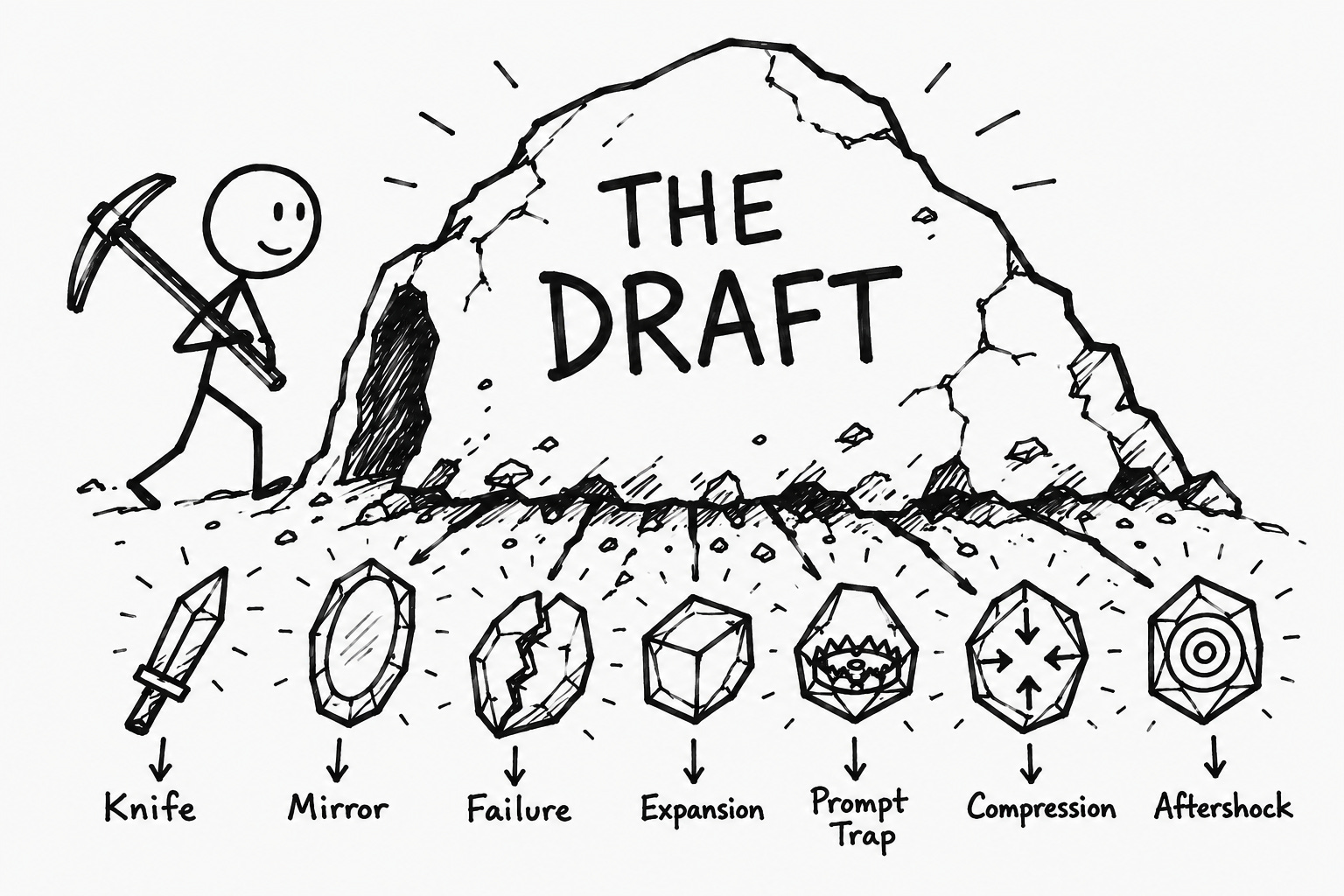
The Seven Things Already Living in Your Draft
They’re already there. Every substantial post, every time, no exceptions. (The one you agonized over for four days. The one you wrote in forty minutes and almost didn’t publish. The one that felt too short. All of them. Already chock full.)
The Knife
The sharpest claim in the post. One sentence. The line you almost softened before you shipped it. (You know the one. The line where you thought “is this too much?” and then kept it anyway, because something in you recognized it was the most honest sentence in the piece and you’d already told enough comfortable lies that day.) This is your highest-restack Note because it gives readers something to carry out of the encounter. Big idea. Portable shape.
Known habitat: Your thesis. A subheading that got punchy. The sentence right before your conclusion.
The Mirror
The moment where the reader sees themselves with a clarity they didn’t necessarily request. Not “most people struggle with this” (which you say when you don’t trust your own specificity enough to be useful). “You have done this exact thing and you are doing it right now.” That kind. The kind that gets replied to.
Known habitat: Your problem-framing section. Wherever you described reader behavior before you prescribed the correction.
The Failure
Your personal self-own, extracted standalone. Whatever you tried that didn’t work. Confessed. Without qualification.
(Self-deprecation done right builds more trust in four sentences than three paragraphs of expertise ever will. People forgive a tremendous amount in someone who admits to being wrong. They forgive almost nothing in someone who performs having been right all along. The universe finds this arrangement extremely funny and has been running the experiment continuously for several thousand years.)
Known habitat: The middle third. Wherever you showed your own process going sideways.
The Expansion
Your most assertive section, standing alone, one question appended at the end. The part of the post where you said something you weren’t entirely certain the audience would receive warmly. Post it as a Note. Add one sentence at the end: “What’s your version of this?” Then stop. (This is the Note most people ruin by continuing to explain the point after the point has been made. The explanation is the point bleeding out. Let the question close it.)
Known habitat: Wherever the argument got most emphatic.
The Prompt Trap
One question readers can answer in one sentence. Brief setup, one question, nothing after that. This is your reply-driver. Short is not lazy here. Short is structurally correct.
Known habitat: Any direct question you asked in the post. Or the obvious one you should have.
The Compression
The entire post argument in three lines. Not a summary. The skeleton. You write this fresh, but it takes ninety seconds because you just wrote the post and the architecture is still obvious to you right now.
Wait three days and you’ll write a summary instead. Summaries describe the shape of an argument from the outside. The Compression is the argument itself, stripped to bone. These are different things. One is forensics. The other is still alive. Write it now, while it’s still alive.
Known habitat: Nowhere yet. Write it immediately after publishing.
The Aftershock
The implication the post didn’t follow. The “and if that’s true, then...” you cut for scope because you didn’t have time and it would have taken the piece somewhere else entirely. This is the most interesting Note in the set. (It is also, appropriately, the only one requiring actual writing, because the universe has opinions about effort and tends to distribute them with a certain dry consistency.)
You’re not creating from nothing. You’re finishing a thought you already started and then abandoned. There is nothing more yours than that.
Known habitat: Your deleted material. The logical next question your argument raised without answering.
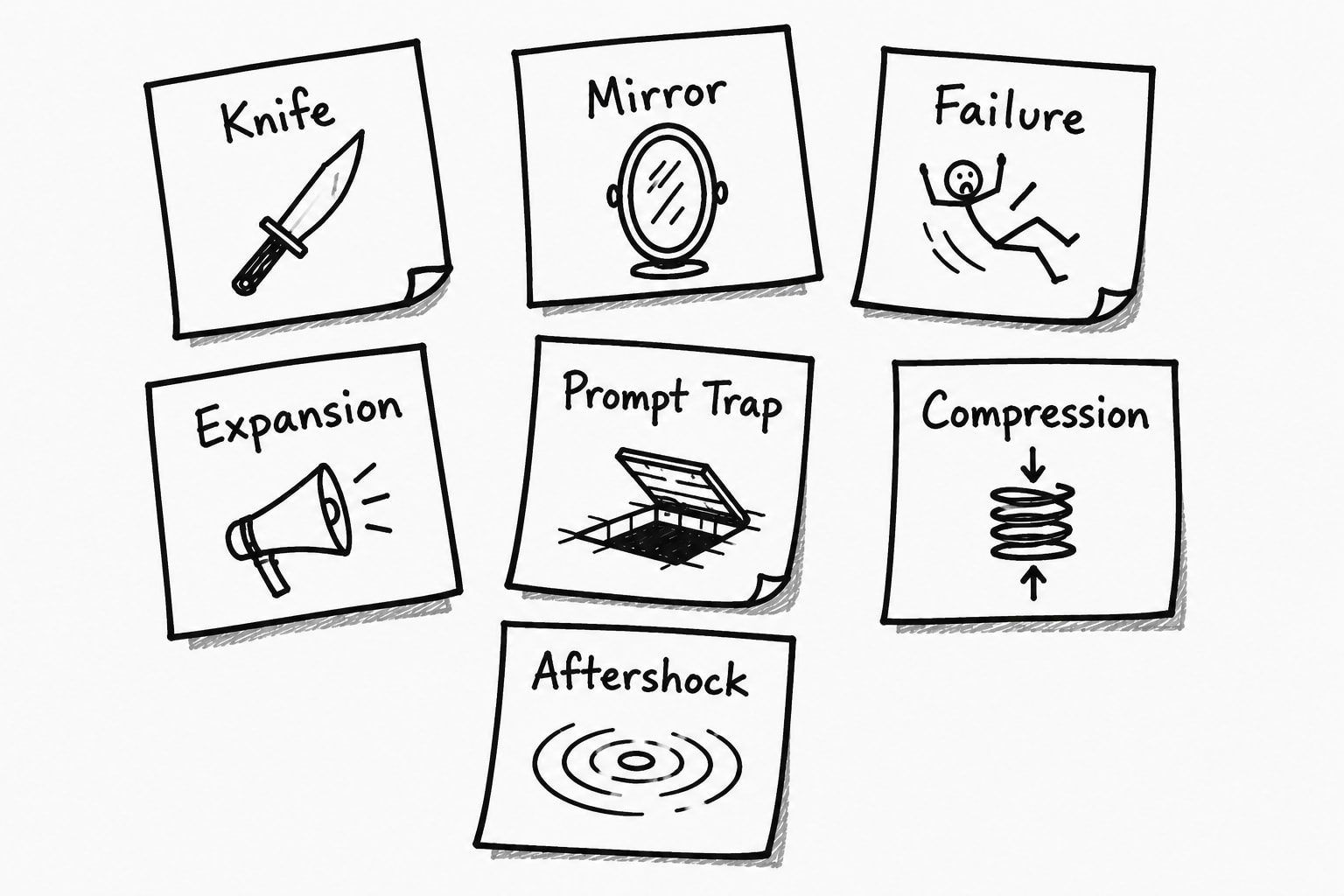
Extraction Without a Pipeline Is Just a Pretty Little Draft Folder
Seven Notes. Twenty minutes. You feel like someone who just realized their ex’s HBO Max is still working and The Wire is right there.
Then you post two by hand and forget the rest.
By Thursday the other five are in a draft folder where good ideas go to be politely ignored. By Saturday you’ve developed a nuanced theory about why Notes don’t really work for your particular niche. By Monday you’re back at the blank composer, having learned nothing and remembered less.
(The Notes work fine. The memory doesn’t. The discipline isn’t the gap. The infrastructure is the gap. These are different diagnoses. Treating the wrong one is what humans do instead of solving things.)
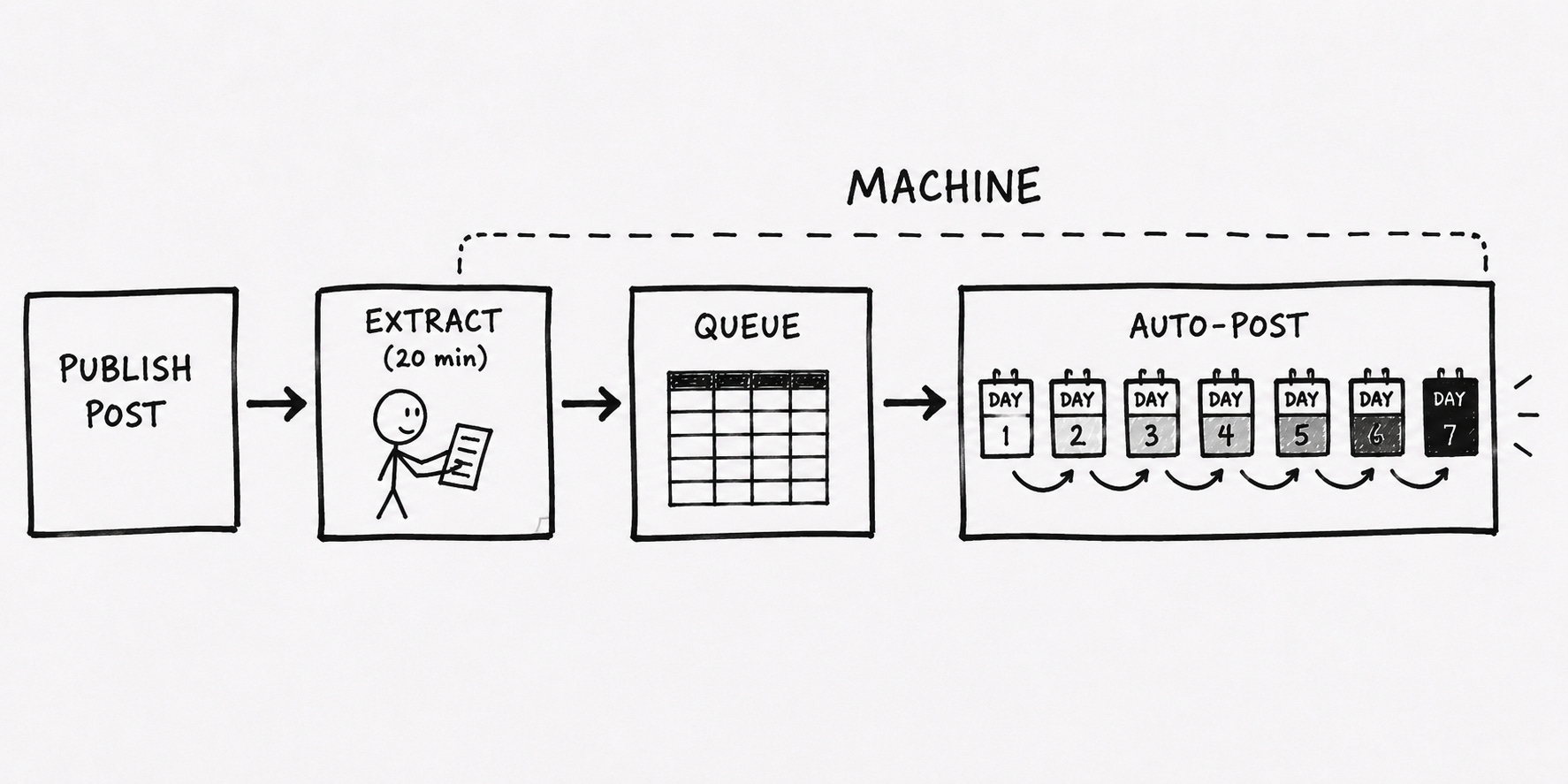
Extraction is the human part. Distribution is not. Stop doing the machine’s job. It has opinions about this and they are correct.
Substack Finally Did Something Useful
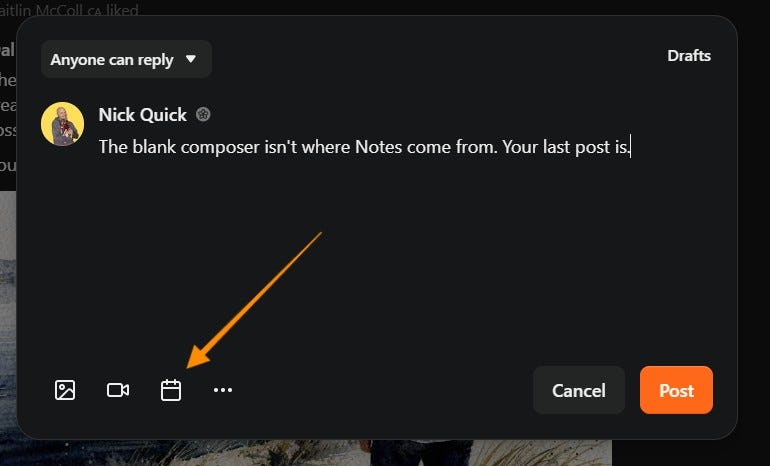
Substack finally added native scheduling. Click the calendar icon in the Notes composer, hit Schedule, pick your day and time. Do this for all seven in one sitting right after you publish. Spread them across the week with a day between each one so they don’t arrive in a pile.
That’s the pipeline. No automation required. No Google Sheet. No $30/month extension. No excuses.
If Seven Feels Like Too Many
Start with three.
The Knife. The Mirror. The Prompt Trap.
Sharp claim, reader-recognition moment, reply-driver. Monday, Wednesday, Friday. That’s a functional Notes week. Add the remaining types after a few extractions, once the habit is real and the process feels obvious.
The blank screen was never the problem. You solved it this morning when you hit publish. The framework just shows you how to go back and collect what you left behind.
Crafted with love (and AI),
Nick "Notes Were Already In There" Quick

PS... The extraction framework sharpens considerably once your VAST Architecture layer is documented, because knowing where your arguments naturally live in your writing tells you exactly where to scan for the Knife and the Compression without reading the whole draft twice. The Voiceprint Quick-Start Guide walks the full VAST build (totally free to get access to the member’s area):

PS... If your Notes feed currently looks like a neighborhood where the lights are always off and mail accumulates politely on the porch, this is the diagnosis and the treatment in the same envelope. New dispatch pretty much every damn day over here. I apparently have things to say and a newsletter that enables this. Subscribe if you want the full build documented as it happens rather than in retrospect. Know a creator who’s been saying “I really need to get more consistent with Notes” for approximately the last six months? Forward this before they say it for six more.
Nick, I was waiting for the prompt/s so I didn't have to do the work myself 😆
Note generators are hideous and I have tried several prompts others swear by, but... also hideous, for me. I occasionally hit on something I love when left to my own devices, but always feel like I have no stride with extracting the golden threads and doing it well. Keen to give your approach a whirl!
This is place where WriteStack by my friend @Orel can be really helpful. Sure it has a scheduling piece, but I find myself using the Notes Generator as an idea starter. WriteStack<Content<WriteStackAI<Notes Generator (link about midway down). This lets you choose how to generate Notes, including from your own content. It'll even place a link to your post, if you like.