
Six Thinking Tools That Make You Impossible to Copy
The divergence playbook for creators who refuse to blend in

You’ve done everything right and it’s still not working.
You studied the hooks. Copied the formats that performed. Posted when the algorithm wanted you to post. Your content is good—you know it’s good—but it’s disappearing into a feed where everything looks exactly like everything else.
That’s not a failure of execution. That’s the trap working as designed.
The internet is being squeezed from two directions. From above: enshittification—platforms rotting, burying your work under ads and sponsored garbage. From below: what I’ve been calling ensloppification—creators converging toward sameness, all of us optimizing ourselves into invisibility.
(I spent Part 1 and Part 2 of this series naming the disease and describing its nine ugly-ass heads. If you missed them, you’ll catch up. If you read them, you already know how deep this goes.)
The rot sets in earlier than you think. Before the writing. Before the outline. Before you’ve opened the doc and stared at the cursor like it owes you money.
It starts in the thinking.
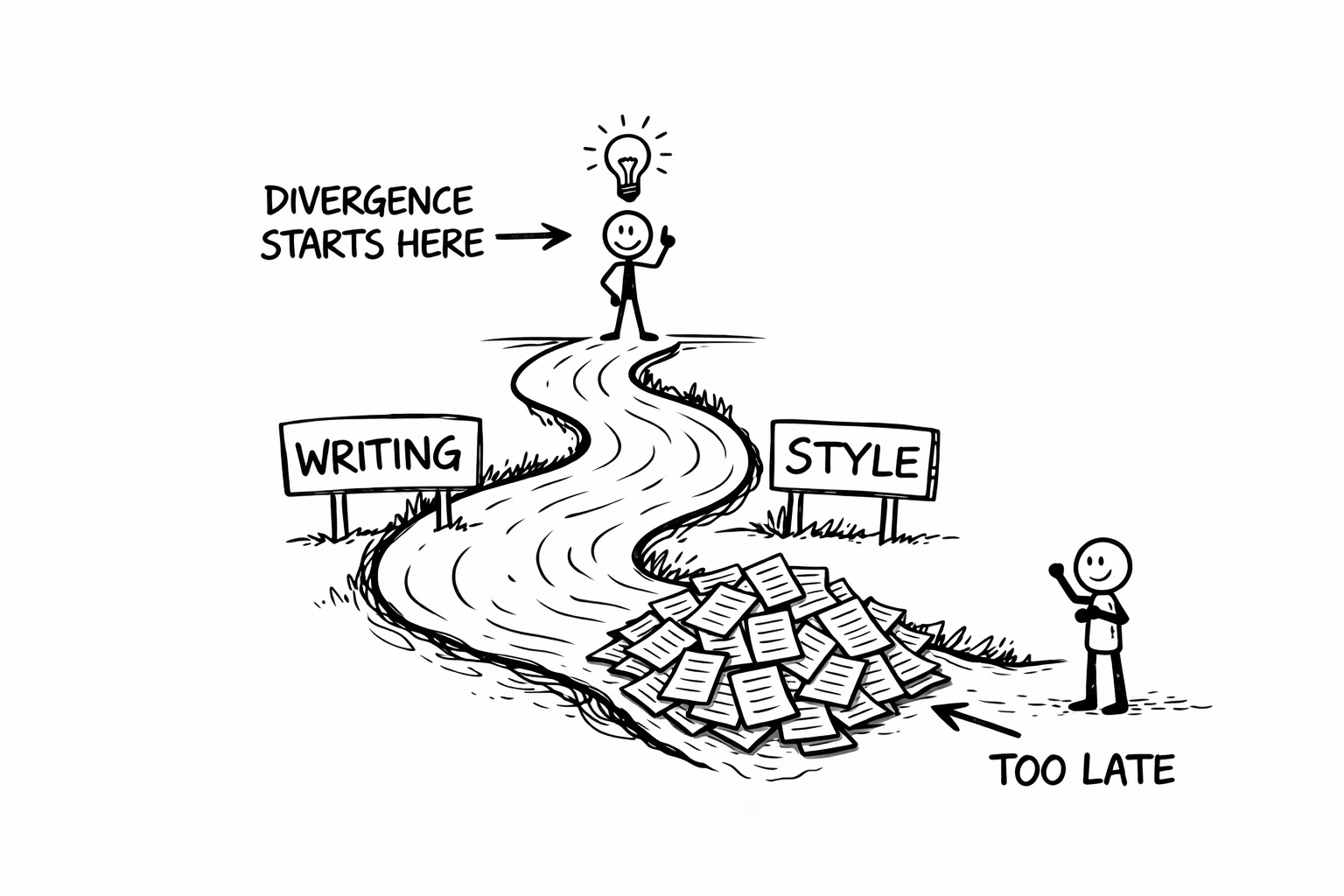
Most advice about standing out focuses on style. How you write. Your voice. Your “personal brand.” (I just threw up in my mouth a little. The phrase, not the concept.)
That stuff matters. I’ve built an entire methodology around it.
But you can have the most distinctive voice in your industry—sentence rhythms that make Hemingway jealous, metaphors so vivid they should be illegal in twenty-three states—and it won’t save you if you’re thinking the same thoughts as everyone else.
Style can’t save a convergent idea.
Divergence has to happen upstream.
So. How do you have ideas that nobody else is having?
I’ve got six tools. None of them are magic. All of them are uncomfortable. (The discomfort is a feature. We’ll get there.)
Tool #1: The Contrarian Audit
What does your niche believe that you think is wrong?
Every industry has orthodoxies. Sacred cows. Things “everyone knows” that nobody questions because questioning them feels risky or rude or like you’re about to get ratio’d into oblivion.
These are your goldmines.
Here’s the exercise:
Step 1: List 10 things your niche accepts as true. The stuff that shows up in every article, every course, every conference talk. The received wisdom.
Step 2: For each one, ask: Do I actually believe this? Or have I just absorbed it?
Step 3: Circle the ones that make you uncomfortable. The ones where you think “well, it’s more complicated than that” or “that’s only true sometimes” or “I’ve seen this fail repeatedly but nobody talks about it.”
Those circles are your content.
Not because being contrarian is automatically valuable. (Contrarian-for-clicks is its own form of slop. Looking at you, every “unpopular opinion” post that’s actually extremely popular.) But because genuine disagreement based on actual experience is rare. It’s signal. It’s you.
I’ll show you mine:
The content creation industry believes your audience knows what they want. Listen to them. Give them what they ask for. The customer is always right.
This is how you produce content people respect but don’t remember.
Your audience thinks they know what they want. They’ll tell you they want “actionable tips” and “step-by-step guides.” They’ll ask for templates and checklists and “proven frameworks.” Then they’ll scroll right past your actionable tips to watch some guy rant for nine minutes about something that pissed him off.
People say they want vegetables. They eat dessert. They say they want utility. They share the stuff that made them feel something.
The content that actually lands? It’s almost never what they asked for. It’s the stuff they didn’t know they needed until they saw it. The rant they didn’t expect. The weird angle that made them stop scrolling. The thing that made them think “I’ve never heard anyone say this before.”
If you only give people what they say they want, you’ll build a library of useful content that nobody talks about. Congratulations on your utility. (Nobody’s coming back.)
That’s a contrarian take. Not everyone will agree. But it’s mine. It came from watching my “useful” content die while my unhinged rants got shared.
Your contrarian takes are somewhere in your head right now, buried under all the “everyone knows” sediment. Dig.
Tool #2: The Experience Mine
Your lived experience is literally uncopyable. Start using it.
Here’s the weird paradox: creators will strip out everything specific about their lives and experience—the messy parts, the weird details, the stuff that feels “too personal”—and then wonder why their content isn’t connecting.
You’ve done things. Worked places. Failed at stuff. Succeeded at other stuff. Had realizations at 3am that changed how you thought about your work. Encountered situations that most people in your niche haven’t.
This is your unfair advantage. Nobody else lived your life. (If someone did, that’s a different problem. Probably involving clones. Contact your local authorities.)
The exercise:
Step 1: Pick a topic you write about regularly.
Step 2: List 5 specific experiences you’ve had with that topic. Not “I’ve worked in marketing for 10 years.” Specific. Granular. “I once watched a $50,000 campaign fail because nobody checked if the landing page worked on Android.” “I learned more about persuasion from selling knives door-to-door at 19 than I did from any copywriting course.”
Step 3: Ask: Which of these experiences taught me something most people don’t know?
That’s your content.
Generic: “Email subject lines matter.”
Experience-mined: “I A/B tested 847 subject lines in 2019 and discovered that the conventional wisdom about urgency words was exactly backwards for B2B audiences. Here’s what actually worked.”
The second one is uncopyable. Not because nobody else can test subject lines. But because nobody else ran those tests, saw those results, and drew those conclusions. It’s specific enough to be interesting and defensible enough to survive scrutiny.
Your experiences are sitting there, unused, while you write the same takes as everyone else. This is a crime. (A content crime, anyway. You won’t go to jail. But you should feel appropriately guilty.)
Tool #3: The Weird Intersection
Combine your expertise with something completely unrelated.
The most interesting ideas happen at the collision of domains.
I spent the second part of this series comparing content strategy to killing a Greek monster. The Hydra. Hercules. Cauterization. Why? Because I remembered just enough mythology to be dangerous and not enough to be accurate. (If any classics professors are reading this: I’m sorry. Also, please don’t email me.)
But the intersection of “ancient monster-killing strategies” and “modern content problems” created something nobody else was saying. Not because I’m smarter. Because I combined two things nobody else thought to combine.
The exercise:
Step 1: List your areas of expertise. The stuff you actually know cold.
Step 2: List your weird interests. The stuff you know way too much about for someone who isn’t professionally involved. (Everyone has these. Don’t pretend you don’t. I know you’ve read entire Wikipedia rabbit holes about topics that will never be relevant to anything.)
Step 3: Force a collision. Ask: What does [weird interest] teach me about [expertise]?
Some collisions will be stupid. That’s fine. You’re looking for the one that makes you go “huh, actually...” and then can’t stop thinking about it.
Some examples that could exist:
What hostage negotiators know about sales pages
What sourdough starters teach about community building
What video game speedrunning reveals about content repurposing
What air traffic control understands about editorial calendars
What my landlord’s passive-aggressive notes taught me about CTAs
The collision creates novelty. Novelty creates attention. Attention creates opportunity.
Find your weird intersection. It’s in there somewhere, probably next to your inexplicable knowledge about whatever niche thing you spent last weekend researching instead of doing something productive.
Tool #4: The Specificity Escalator
Generic observations are forgettable. Specificity is memorable.
Here’s how most content gets made:
Someone has a vague idea. “I should write about productivity.” They generate a generic observation. “Productivity tips for busy professionals.” They dress it up with some formatting, add a few bullet points, hit publish.
The result is content that fills space. It’s not bad. It’s worse than bad. It’s nothing. Bad gets remembered. Nothing just... evaporates.
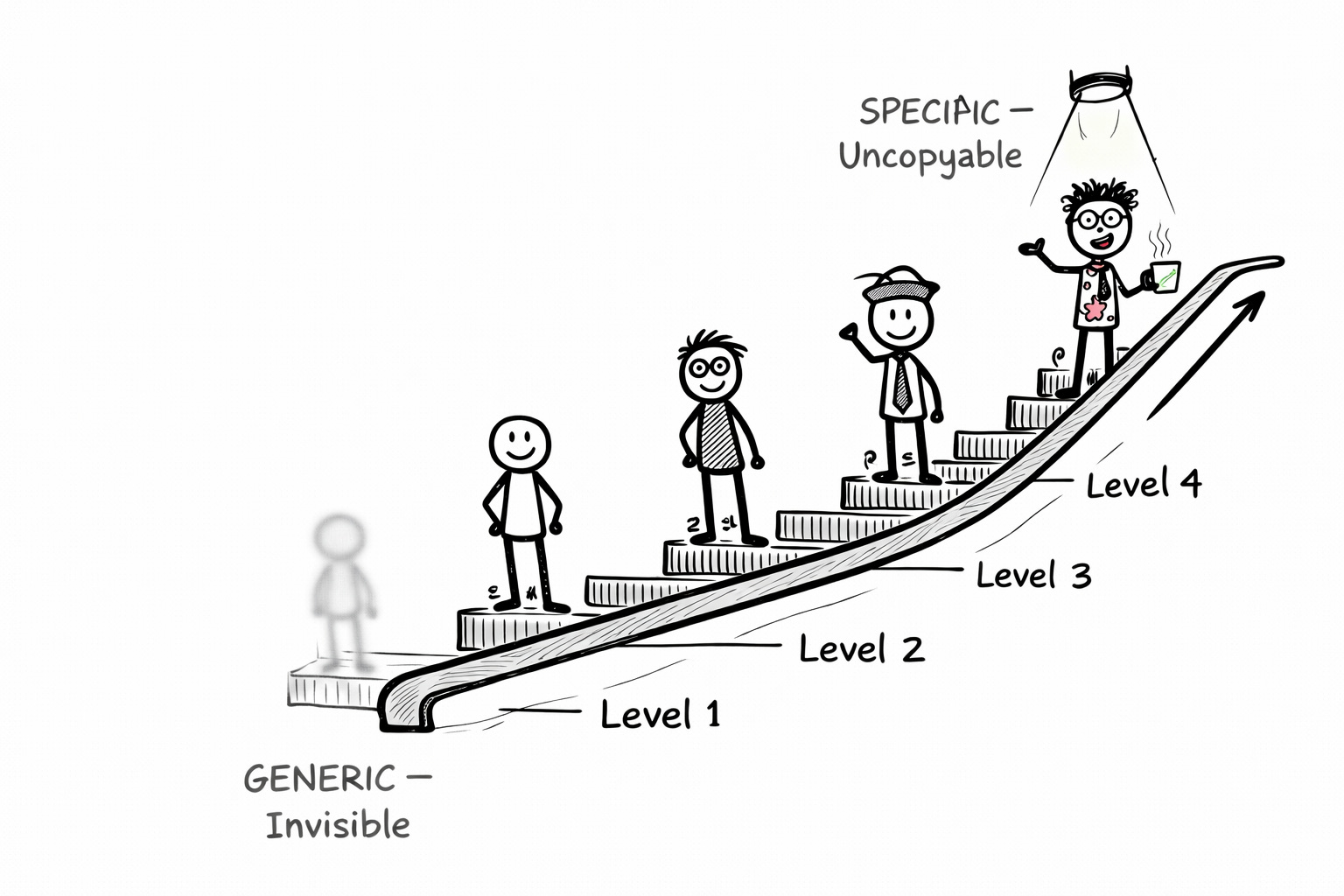
The fix is escalation. Take your generic observation and make it more specific. Then more. Then more again. Keep going until you’ve reached something nobody else would say.
The exercise:
Level 0 (Generic): “Productivity tips for busy professionals.”
Level 1 (Slightly specific): “Productivity tips for remote workers.”
Level 2 (More specific): “Productivity tips for remote workers who share their home office with kids.”
Level 3 (Getting there): “How I stay focused during Zoom calls while my 4-year-old believes she’s invisible if she stands behind my chair.”
Level 4 (Uncopyable): “The negotiation framework I developed to buy myself 47 uninterrupted minutes per day, involving a complex bribery system, a kitchen timer my daughter calls ‘the work monster,’ and the strategic deployment of Bluey episodes.”
Level 0 is what everyone writes. Level 4 is what nobody else can write.
Most creators stop at Level 1 because Level 4 feels risky. Too personal. Too weird. What if people don’t relate?
Here’s the secret: people relate to specificity more than to generality. The parent reading Level 4 thinks “holy shit, finally someone who gets it.” The non-parent thinks “this is hilarious and I’m sharing it with my sister who works from home with three kids.”
Nobody shares Level 0. It’s not that they dislike it. They just don’t remember it existed five minutes later.
Escalate until you’re uncomfortable. That’s usually the right level.
Tool #5: The Discomfort Compass
If it feels completely safe to publish, it’s probably convergent.
This tool is simple and brutal.
When you’ve finished drafting something, ask yourself:
Am I nervous to hit publish?
Not terrified. Not “I might get fired” nervous. But that slight flutter of “some people might push back on this” or “this might not land” or “I’ve never said this publicly before.”
If the answer is no—if you feel totally safe, totally confident that nobody could possibly object—you’ve probably written something so inoffensive that it’s also uninteresting. Vanilla content. Technically fine. Completely forgettable. The kind of thing people scroll past without their brain even registering it existed.
The discomfort compass points toward divergence.
Not because discomfort is inherently valuable. You can write uncomfortable garbage. (I’ve done it. Several times. We don’t talk about those posts. They know what they did.)
But because if you’ve said something genuinely new, something that came from your actual perspective rather than consensus, some part of you will be nervous about the reception. That’s the price of admission for original thought.
The exercise is simple:
Before you publish, check the compass. If you feel nothing, go back and find the angle that makes you feel something. Usually it’s hiding in the parts you edited out to be “safer.”
Put them back in.
Tool #6: The First Idea Funeral
Your first idea is everyone’s first idea. Kill it.
This is the most brutal tool and therefore the most important.
When you sit down to write about a topic, your brain generates an idea. It feels good. It’s relevant. It probably makes sense.
Bury it.
Your first idea is the path of least resistance. It’s what your brain retrieved fastest because it’s the most obvious, most available, most connected to everything you’ve consumed recently about this topic.
Which means it’s also everyone else’s first idea. You all read the same posts. Consumed the same content. Got served the same algorithmic diet of whatever’s trending. Your first idea just joined a very crowded party where nobody will notice you arrived.
The gold is deeper. The second idea. The third. The weird one that shows up after you’ve dismissed the obvious ones and your brain starts actually working instead of just retrieving.
The exercise:
Step 1: Write down your first idea about a topic.
Step 2: Say “everyone will think of that.” (Out loud if you want. I won’t judge. I talk to myself constantly. It’s fine. We’re all fine here.)
Step 3: Force a second idea. And a third.
Step 4: Keep going until you hit one that makes you think “wait, has anyone said this before?”
That’s probably your actual content.
First idea: “Kids need boundaries.”
Second idea: “Boundaries without connection just create sneakier kids.”
Third idea: “The goal isn’t obedience. It’s building someone who makes good decisions when you’re not in the room.”
Fourth idea: “Every power struggle you win teaches your kid that power struggles are how decisions get made. Congratulations—you’ve trained a future middle manager.”
The fourth idea is a newsletter. The first idea is unseasoned tofu—technically nourishing, aggressively forgettable.
Bury the first idea. Every time. Make it a ritual. Throw a little funeral. Say some words. (”You were obvious and I’m grateful for your service but you have to go now.”) Move on.
Putting It Together
Six tools. No magic. All uncomfortable.
The Contrarian Audit — Start from disagreement with your industry’s received wisdom.
The Experience Mine — Extract the unreplicable insights from your specific life.
The Weird Intersection — Collide unrelated domains for novel perspectives.
The Specificity Escalator — Generic → specific → uncopyable.
The Discomfort Compass — Follow the nervous feeling toward divergence.
The First Idea Funeral — Your first idea is everyone’s first idea. Kill it.
You don’t have to use all six every time. That way lies madness and a three-week publishing cycle. (Unless you’re into that. No judgment. Okay, slight judgment.)
But if you’re staring at a blank page, wondering why everything you think to write feels like it’s already been written—pick a tool. Any tool. Force yourself through the exercise.
The ideas are there. They’re just buried under all the convergent sludge that’s accumulated from years of consuming content that all sounds the same.
Dig.
The Escape
The slop keeps rising. The gravitational pull toward the mean keeps pulling. AI keeps averaging everything into smooth, personality-free paste.
You can’t stop that. Not alone. Not without everyone suddenly deciding to give a damn about craft, which—let’s be honest—isn’t happening anytime soon. (Have you seen Facebook lately? The call is very much still coming from inside the house.)
But you can stop contributing to it.
You can zig when everyone else zags. Have ideas nobody else is having because you started where nobody else thought to start. Say things that couldn’t have been said by anyone else because they came from your specific disagreements, your specific experiences, your specific weird intersections.
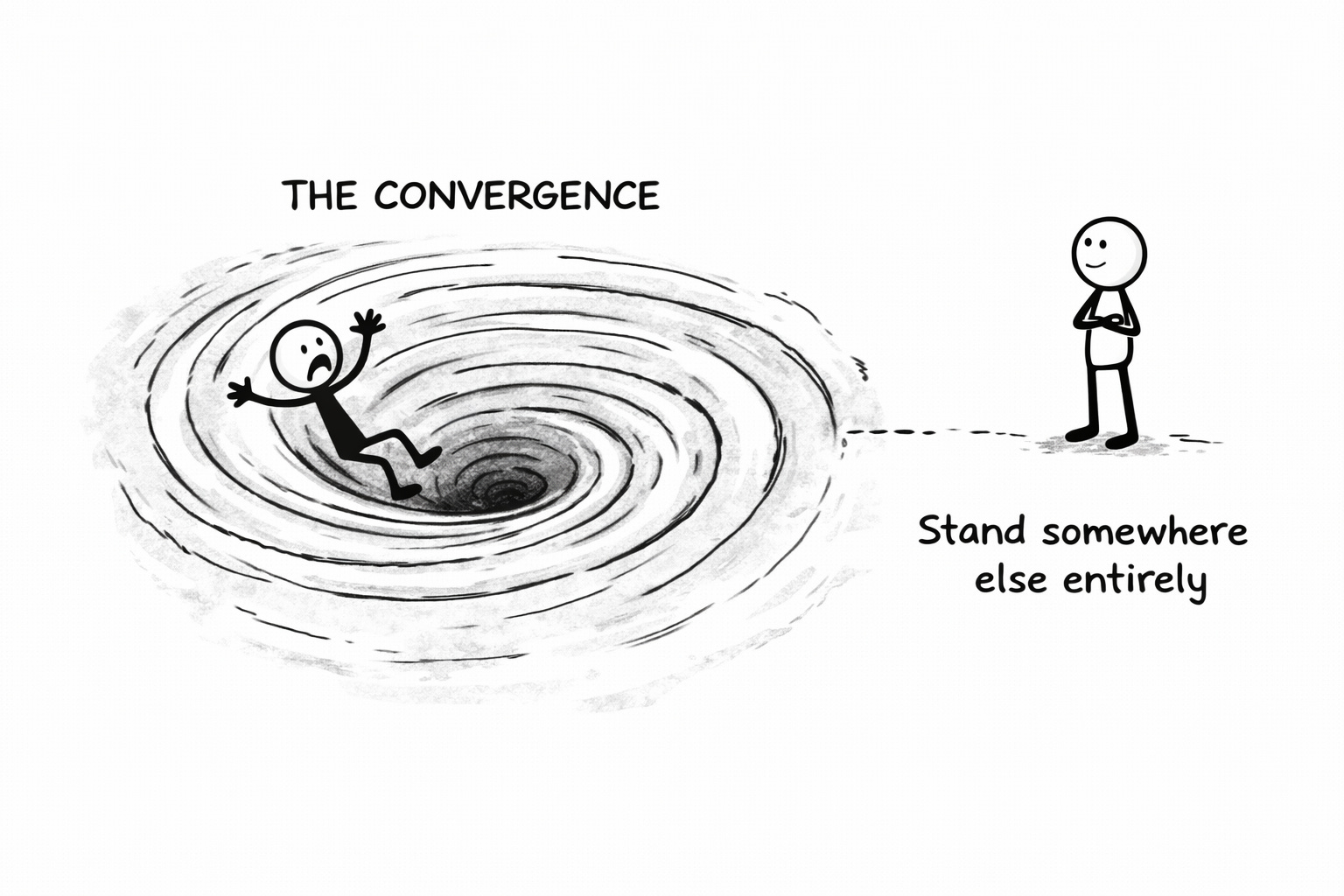
Enshittification rots the platforms from above.
Ensloppification rises from below.
Stand somewhere else entirely.
Which tool are you trying first? Reply with your pick—and if you’re brave, share what the first exercise surfaced. I read every response, and I’m collecting evidence that this stuff actually works. (So far, so good. But more data never hurts.)
Crafted with love (and AI),
Nick “Funeral Director of First Ideas” Quick

PS…This concludes the Ensloppification Trilogy. But if you want to go deeper—specifically into how to document your voice so AI can actually replicate it instead of averaging you into oblivion—that’s the Voiceprint work. Stick around. We’re just getting started.
Good stuff, thanks!
What about just being weird, unconventional and uncompromising? Does that fit any of your six tools or is it something different? I follow some creators simply because they're interesting and cannot be put in a box.
No words ever spoken have been more true! I love this Nick, you did an outstanding job with this post! 🩷🦩