
One Sample. One Prompt. Twenty Minutes.
A trial run for the skeptical

You’re skeptical. Good.
You’ve been burned by AI promises before. The magic prompts that produced magic slop. The one-click solutions that clicked you straight into mediocrity. The frameworks that worked for everyone except you, specifically, when you needed them.
So when I tell you there’s a methodology for training AI on your voice, your first instinct is probably “sure, buddy.” Your second instinct is to check if I’m selling something. (I am. Later. But not today.)
Your third instinct—the one I’m actually interested in—is to wonder: could I test this before committing?
Yes. Twenty minutes. That’s what I’m offering.
Not the full system. Not the multi-hour deep-dive into your sentence patterns and punctuation personality and the specific ways you structure an argument when you’re three paragraphs into something you actually care about. That exists. It works. But it’s a commitment, and you’ve been hurt before.
This is the trial version. The proof of concept. The “let me see if this methodology even works for my specific voice before I invest real time” option.
I call it the Voice Snapshot.
What This Is (And What It Isn’t)
Let me be painfully clear upfront. (I find that honesty early prevents angry emails later. Mostly.)
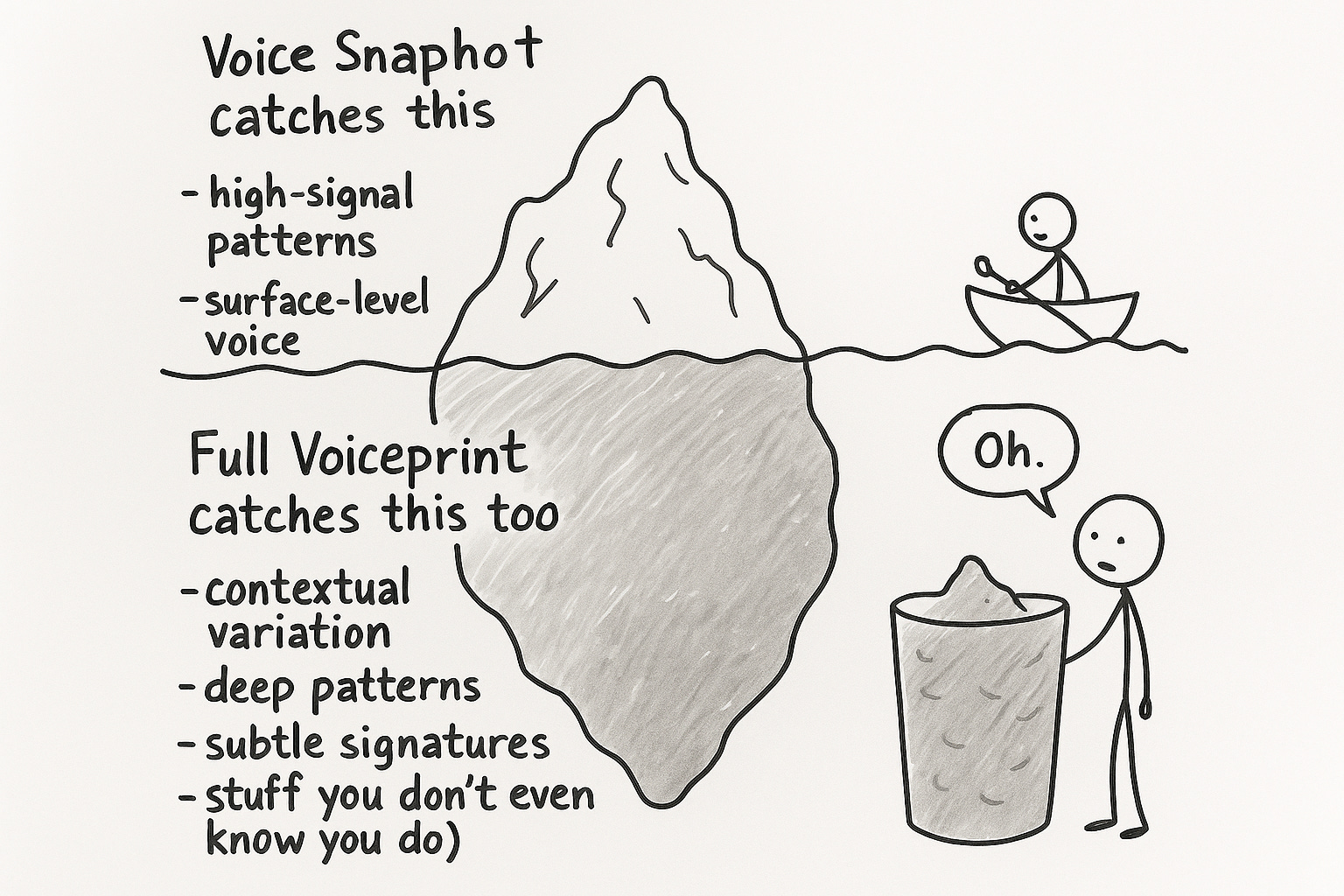
A Voice Snapshot catches maybe 60-70% of your high-signal patterns. The full Voiceprint methodology catches 90%+. The gap matters if you’re building a long-term AI collaboration system. It matters less if you’re just trying to see whether calibration produces noticeably better output than the “write in my voice” prayer you’ve been typing into prompt boxes.
Here’s the math that actually matters: 60% calibrated absolutely annihilates 0% calibrated.
And 0% is what you’re probably getting now.
When you tell AI to “write in my voice” without any reference material, it has no idea what your voice is. It knows the statistical average of eight billion voices smoothed into one homogeneous paste. It’s like asking your GPS for directions to “somewhere interesting.” The machine will route you somewhere. Technically a destination. Probably an Applebee’s. You wanted a speakeasy with a secret entrance; you got crappy potato skins and even crappier fluorescent lighting.
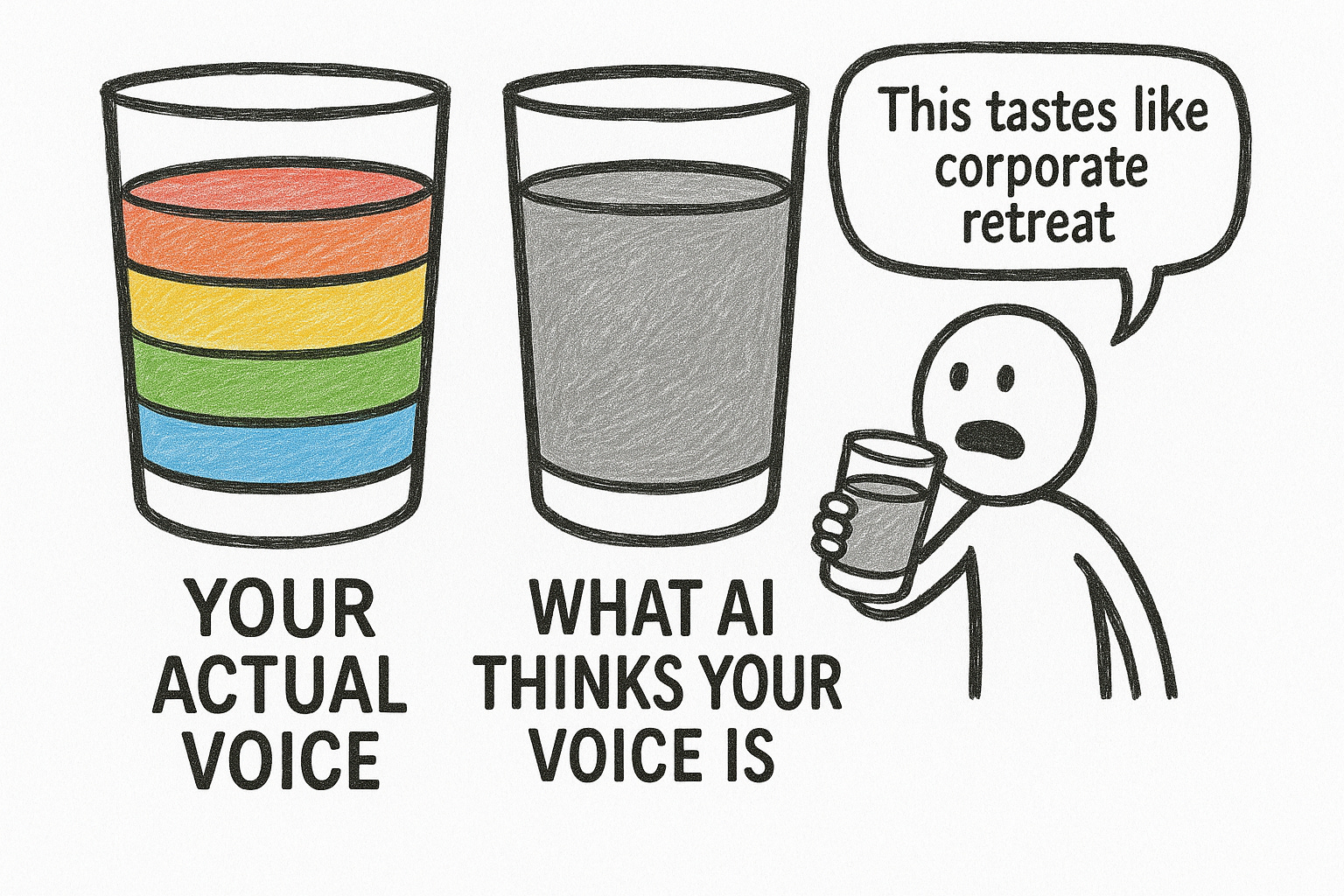
The Voice Snapshot gives AI something specific to aim for. A reference point. Evidence of what you actually sound like instead of what the average of everyone sounds like.
The Twenty Minutes
You need three things:
One piece of writing you’re proud of (500+ words, written by you, no AI assistance)
One conversation with Claude or ChatGPT
The willingness to spend twenty minutes on this instead of whatever else you were going to do (Probably doom-scrolling. It’s fine. We’re all dying. But maybe do this first.)
Step 1: Find Your Sample (2 minutes)
Dig up something you wrote that sounds like you. Not your formal voice. Not the voice you use when emailing your boss about why the deliverable is late. (We all have that voice. It’s a war crime committed in prose form. It should be tried at The Hague.)
Find the voice you’d use with a smart friend. The one where your actual personality leaks through. Blog post, newsletter, LinkedIn piece that got more engagement than you expected, email where you accidentally said something true. Doesn’t matter. Just make sure you wrote it yourself and that reading it back makes you think “yeah, that’s me being me.”
Step 2: Run the Extraction (5 minutes)
Paste this prompt with your sample:
I’m going to share a writing sample. Analyze it and give me a concise voice profile I can use to calibrate future AI collaboration.

For each category, give me 3-5 specific, concrete observations (not vague descriptors):

VOCABULARY: What words/phrases recur? What’s the formality level? What would this writer never say?

ARCHITECTURE: How do they open? How do they build arguments? How do they close? What’s their paragraph structure?

STANCE: What’s their relationship to the reader—peer, teacher, critic? How bold are their claims? How do they handle uncertainty?

TEMPO: Sentence length patterns? Punctuation habits? What creates their rhythm and pacing?

End with 2-3 sentences capturing the overall voice.

SAMPLE:
[paste your writing here]
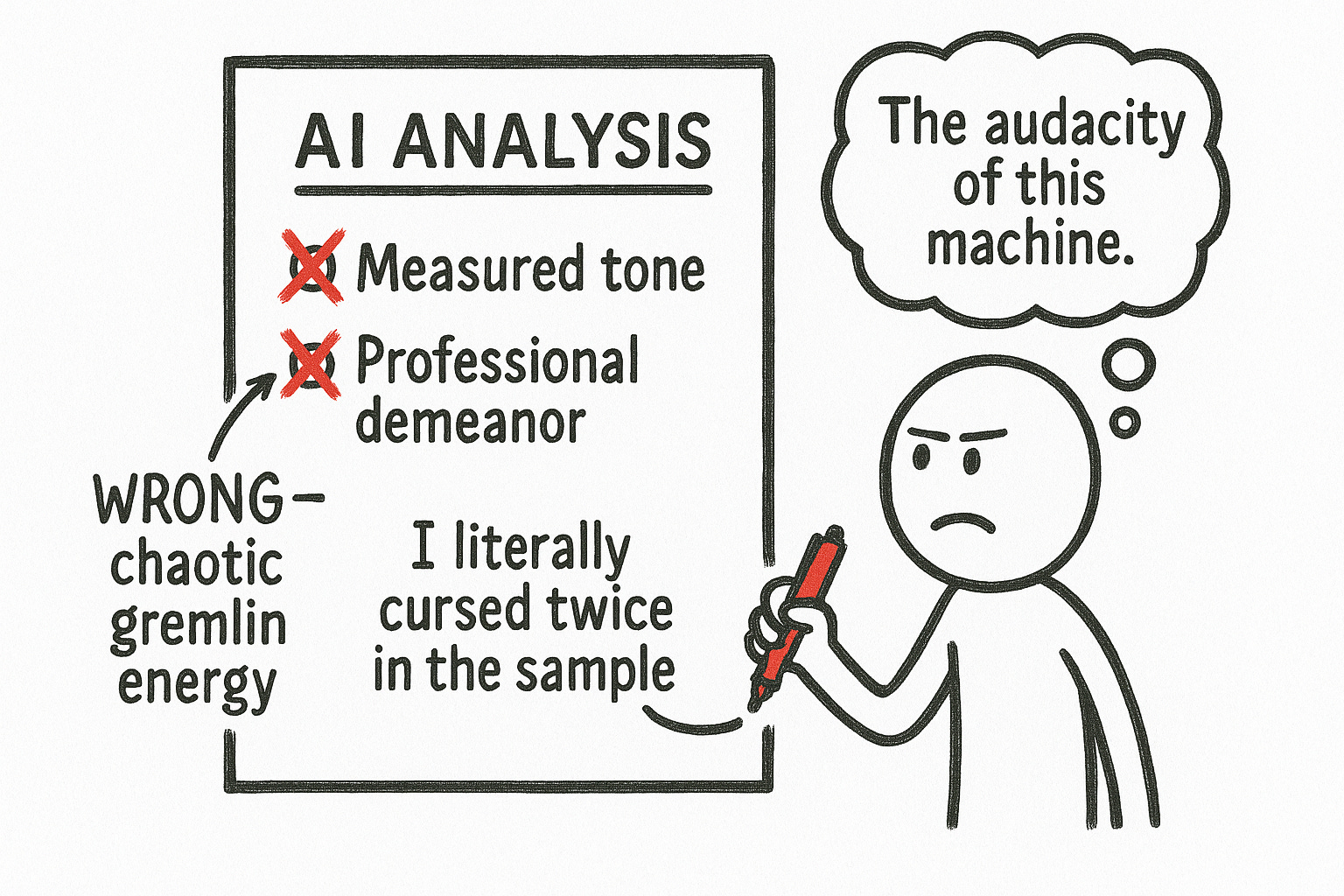
AI will produce an analysis. Some of it will be right. Some of it will be hilariously, embarrassingly wrong. (When I ran my own writing through this, it described me as having a “measured, professional tone.” Measured. I was raised Mormon. I have guilt about things I did in 1993. I have strong opinions about punctuation that I will share unsolicited. Nothing about me is measured. The machine is bearing false witness.)
Step 3: Correct the Analysis (3 minutes)
This is where you become the editor of your own voice profile. Read what AI produced with the energy of a teacher grading a paper that shows promise but also fundamental misunderstandings about how reality works.
Trash what’s wrong. Add what’s missing. Don’t overthink it. Gut reactions only.
If AI says you’re formal and you’re not? Gone. If AI missed that you curse strategically? Add it. If AI claims you use em dashes constantly when actually you use parentheticals because em dashes have become AI tells and you refuse to be clockable? (This is suspiciously specific because it’s my exact situation.) Correct it.
You know what you sound like. The machine is guessing. Trust yourself over the machine.
Step 4: Test the Calibration (5 minutes)
Feed your corrected Voice Snapshot back to AI with an actual writing task:
Here’s my voice profile:
[paste your corrected analysis]

Write a 150-word [whatever format you actually use] about [topic you’d actually write about].

Before writing, tell me one thing you want to clarify about my voice or this topic.
That last line matters more than it looks. It teaches AI to ask before assuming. Most AI interactions are the machine charging ahead with confidence it hasn’t earned, producing content based on guesses it never checked. (Sound like anyone you’ve worked with? AI is just middle management in linguistic form. Confident. Wrong. Moving fast in the wrong direction.)
The clarification question flips the dynamic. Sometimes the question reveals a gap in your Voice Snapshot you hadn’t noticed. Sometimes it’s unnecessary. Either way, you’ve established that this is a collaboration, not a vending machine transaction.
Step 5: Feel the Difference (5 minutes)
Read the output.
Not for perfection. You won’t get perfection. (Perfection is a lie told by productivity gurus who’ve never actually shipped anything. We’re aiming for “noticeably better than the alternative,” which is a realistic goal for flawed humans in an imperfect world.)
Read for direction.
Is it closer to your actual voice than uncalibrated AI would produce? Where does it still drift toward generic? What did the calibration improve? What did it miss?
The comparison is the lesson. You’ve now felt what calibration does versus what uncalibrated “write in my voice” produces. That gap—even if imperfect, even if incomplete—is the proof of concept.
What This Won’t Do (Because I Respect You Enough to Say It)
One sample can’t catch everything. This should be obvious, but I’m stating it explicitly because we live in an age of magical thinking about AI and I refuse to contribute to the delusion.
Contextual variation: You probably write differently about different topics. Differently when you’re fired up versus contemplative. Differently for LinkedIn versus email versus late-night rants in your notes app that will never see daylight. One sample captures one mode. The full methodology uses multiple samples to find patterns that persist across all your modes.
Deep patterns: Your most distinctive moves might be subtle. How you sequence ideas. Where you place your strongest point in an argument. What makes your transitions feel earned instead of mechanical. Those patterns require more excavation than one extraction prompt provides.
Durability: A Voice Snapshot is good for a session, maybe a few. It’s a polaroid, not a portrait. The full Voiceprint is documentation you can use for months.
So why bother with the incomplete version?
Because experiencing the difference teaches you something that reading about it never will.
I can write fifty newsletters explaining why generic AI output fails and how calibration fixes it. (I’ve written several. They’re quite good. I’m not humble about this.) But until you’ve felt the gap between calibrated and uncalibrated output—until you’ve read something AI produced and thought “wait, that actually sounds like me”—the methodology stays theoretical.
The Voice Snapshot makes it real. Imperfect but real.
What Happens Next (If This Works)
If the Voice Snapshot produces output that sounds closer to you—if you read it and think okay, that’s not generic slop—then you’ve learned two things:
The methodology works for your specific voice
Deeper investment will produce even better results
The full Voiceprint system does what the snapshot can’t:
Multiple samples to validate patterns across contexts
Separate deep analysis for each layer (vocabulary, structure, stance, rhythm)
Self-reflection exercises that surface patterns you can’t see in your own writing
Validation techniques to stress-test accuracy before you rely on it
Documentation that stays useful for months of consistent AI collaboration
But you don’t need to commit to that until you’ve felt the twenty-minute version work. I’d rather you test the concept with borrowed time than buy the full system on faith.
Faith is for religion. Content strategy should be evidence-based.
Run the twenty minutes. See what happens. Trust the experience over anyone’s promises—including mine.
Your voice is either going to respond to this approach or it isn’t. Twenty minutes tells you which. That’s worth knowing before you invest anything more.
And if it works? If you feel the gap? Then we can talk about the full system.
But only then.
What’s the most unhinged thing AI got wrong about your voice when you ran the extraction? I want to hear the worst misreads. Bonus points if the machine called you “measured” or “restrained.” Extra bonus points if you’ve ever used profanity in a professional context and AI completely missed it.
Crafted with love (and AI),
Nick “Trust Issues Are Valid” Quick

PS…If you try this and it doesn’t work, reply and tell me why. I’m either wrong about something or you did it wrong. Either way, I want to know.
I would call this a resounded success....much less to edit. Here is what it came up with:
**Subject:** The "funstigation" philosophy (steal this)
Ever notice how some guys just... click with everyone they meet?
Like they were born with some secret social gene you missed out on?
Here's what I figured out the hard way...
It's not talent. It's a habit.
I call it funstigation. (Yeah, I made that word up. Deal with it.)
It means instigating fun wherever you go — creating little moments of connection with everyone around you. Even just a brief smile counts.
The cashier at the grocery store? Make her laugh.
The barista making your coffee? Brighten his day.
Random stranger in the elevator? Quick joke.
Most guys save their personality for "important" moments. Then wonder why they freeze up when a cute girl walks by.
When you funstigate your whole life, connection becomes automatic. You're not "turning it on." You're just... on.
Your homework: make one stranger smile today.
go forth and FUNSTIGATE,
Race
----
I can definitely work with this! Thanks Nick “Trust Issues Are Valid” Quick! Seriously though, this is super helpful.
great write up!
one of the most frustrating things it’s the llms tendency to drift back! there are times i want that rainbow drift and get it for 29 mins… then by 30 i realize it slowly crept back.
good stuff!