
Most People Worry About AI Taking Their Jobs. I Worry About Something Else.
The 5-minute routine I built after I couldn't write an opening sentence

Most people worry about AI taking their jobs.
I worry about AI taking my voice.
Not the output. I can fix output. I can edit output. I can take a red pen to output like a disappointed English teacher who’s seen too much and expects too little. Output is just words on a screen. Words on a screen are cheap.
No. What haunts me is the capacity itself. The neural pathways that used to fire when I sat down to write. The reflexes. The instincts. The weird little tics that made sentences sound like me instead of like a corporate communications department that developed consciousness and immediately started networking.
Those are dying. In all of us. Right now.
And nobody seems particularly concerned.
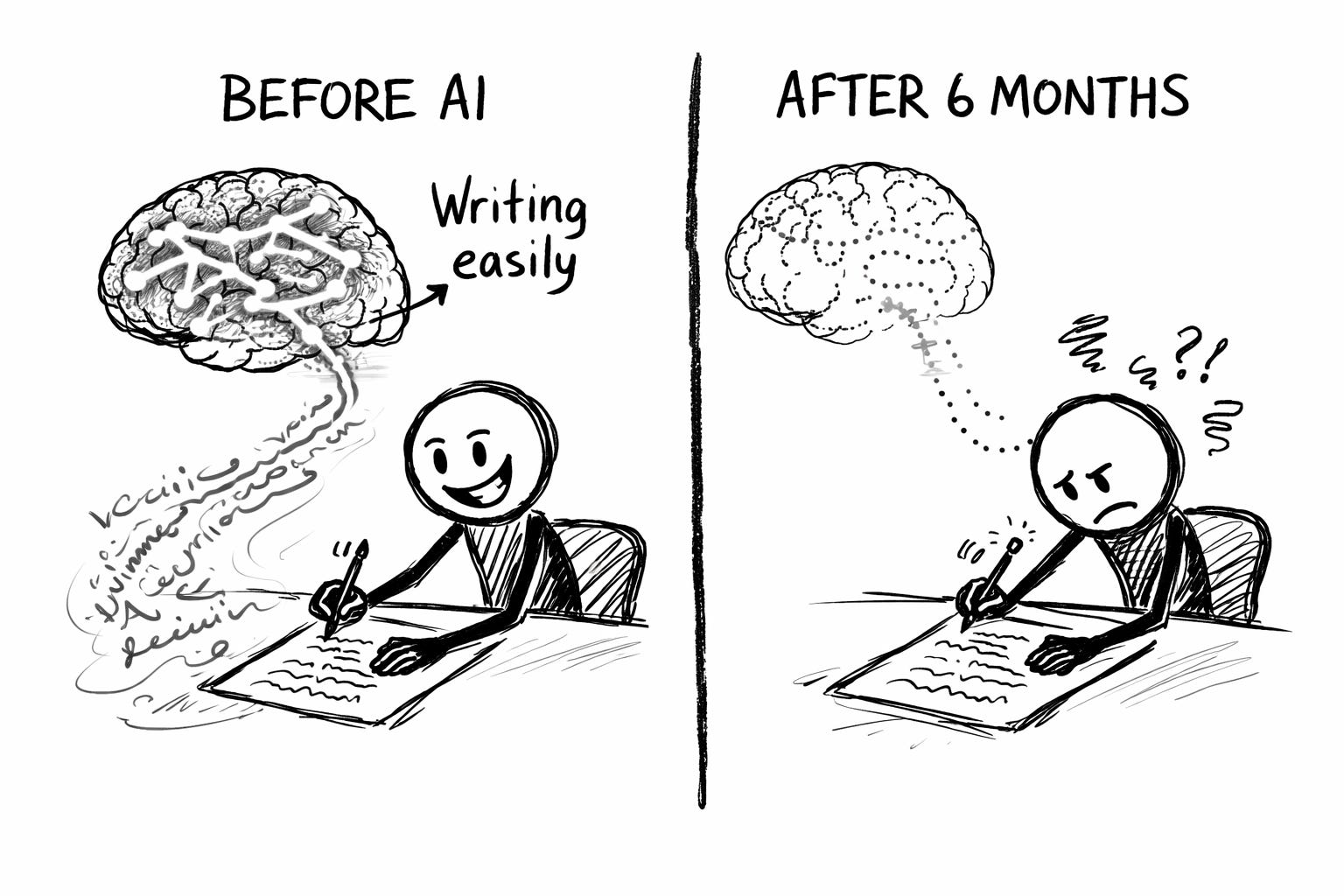
You know you should write without AI sometimes. The same way you know you should go to the gym. Floss. Call your mother. Drink more water.
The knowledge isn’t the problem. The doing is the problem.
Everyone nodding along to “practice writing without AI” content and then opening ChatGPT thirty seconds later because the deadline is real and the practice is theoretical.
I’m not here to guilt you. Guilt doesn’t work. (If guilt worked, we’d all have six-pack abs and sparkling teeth and mothers who felt appreciated.)
What works is making the thing so small you can’t justify skipping it.
Five minutes. Four exercises. Before your first AI session of the day.
Not a creative writing practice. Not journaling. Not “write 1000 words every morning” nonsense that sounds good on a podcast and dies on contact with your actual calendar.
A workout. Reps. Done before the resistance kicks in.
THE DAILY VOICE WORKOUT
Total time: 5 minutes
When: Before opening any AI tools. The order matters. You’re establishing who’s in charge.
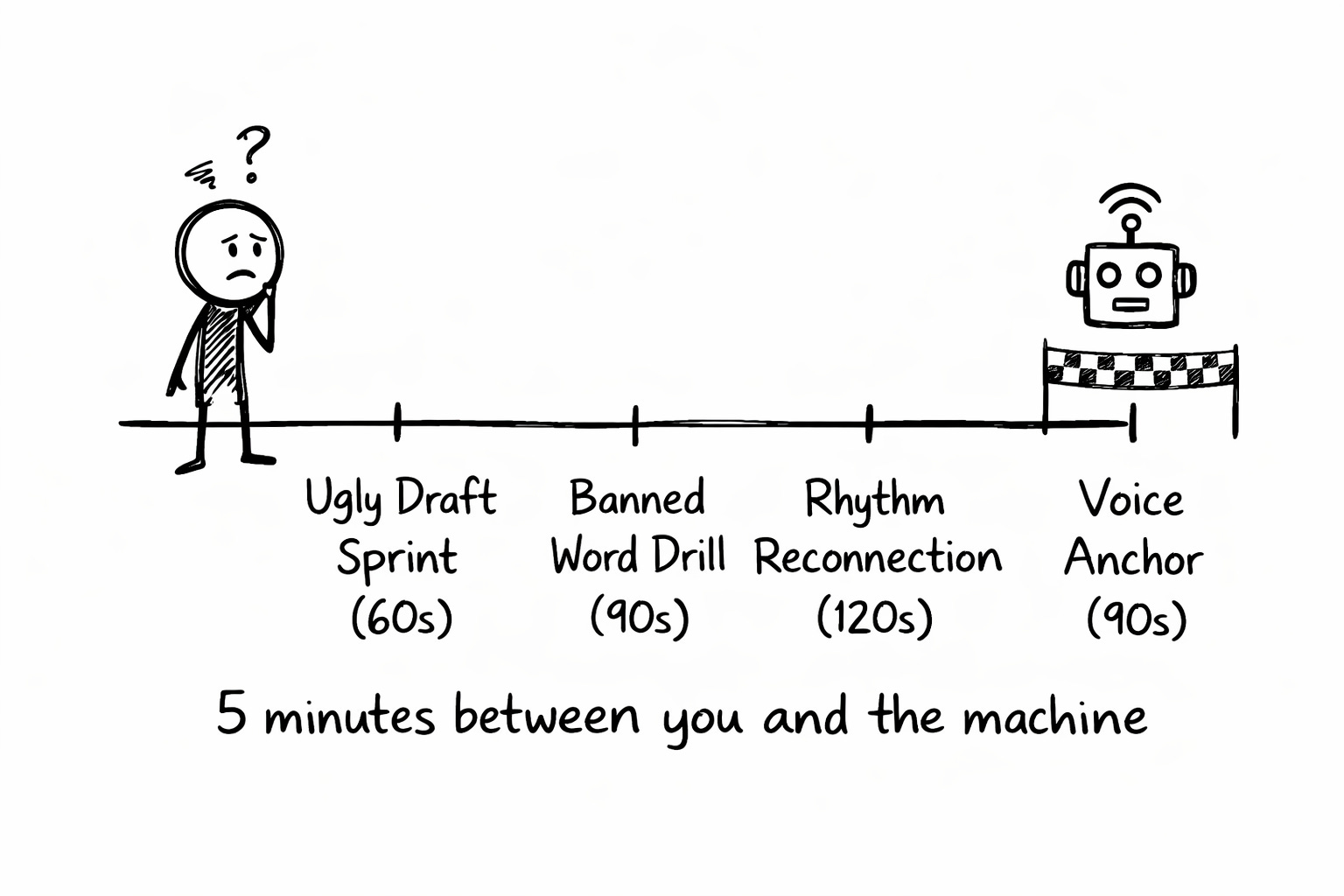
Exercise 1: The Ugly First Draft Sprint 60 seconds
AI makes everything smooth. You’ve forgotten how to write ugly. And if you can’t write ugly, you can’t write brave.
Set timer. Write the worst possible opening sentence for whatever you’re working on. Deliberately terrible. Clichéd, awkward, overwrought.
Mine this morning: “In this essay, I will discuss how AI is like a thing that does stuff to your brain, and also why this matters for reasons.”
Magnificent garbage. The neurons fired anyway.
If you’re not slightly embarrassed, you’re not doing it right.
Exercise 2: The Banned Word Replacement Drill 90 seconds
AI vocabulary is contagious. “Robust.” “Facilitate.” “Delve.” These are not your words. But they’re in your brain now, squatting in the space where your actual vocabulary used to live.
Take one AI-generated sentence from yesterday’s work. Replace every corporate/AI-coded word with something you’d actually say to a human being you actually like.
Before: “This framework provides a robust methodology for leveraging your unique voice to facilitate optimal content outcomes.”
After: “This system helps you sound like yourself instead of a boyfriend ghostwriting his girlfriend's OnlyFans captions.”
Would you say it out loud to a friend without feeling like a fraud? If it sounds like a press release, keep going.
Exercise 3: The Rhythm Reconnection 120 seconds
AI has a rhythm. Measured. Even. Predictable. The kind of cadence that technical writers use when they’re explaining how to reset a router.
Your rhythm is different. But if you’re not actively practicing yours, you’re passively adopting theirs.
Write 3 sentences using your signature tempo pattern. No AI. No reference documents. Just you and whatever your fingers remember.
My pattern: Jab. Jab. Then a haymaker that takes its time winding up before it connects.
Like that paragraph just did.
Read them aloud. Does the rhythm sound like you talking? Or does it sound like you doing an impression of someone you vaguely remember being?
Exercise 4: The Voice Anchor 90 seconds
AI collaboration is so efficient you can forget why you started writing in the first place. The why gets buried under the how fast.
Answer three questions:
What made me start writing before any of this existed?
What do I believe that I’d keep saying even if no one listened?
What’s one thing only I would notice or say about today?
The third one matters most. AI doesn't have a take on its neighbor's parking habits. AI doesn't have a complicated relationship with its step-father. AI didn't spend eleven minutes this morning thinking about something embarrassing it said in 2007. You did. That's material
If your answers sound like they could appear on a motivational Instagram account, you’re performing instead of reflecting.
YOUR MOVE
Before you close this tab, do Exercise 1.
Sixty seconds. Timer on your phone. The worst opening sentence you can produce.
If words come (even terrible, embarrassing, would-never-publish-this words), your muscles are responding. You’re in better shape than I was when I started this.
But if that cursor blinks a little too long...
If your brain reaches for the chat window before anything else happens...
Welcome to the club. The gym is open. The exercises are waiting. And the only membership fee is five minutes a day and the willingness to admit you might have a problem.
🧉 What writing skill did you notice getting weaker since you started using AI heavily? For me it was openings. They used to pour out like complaints at an HOA meeting. Then one day they just... didn’t.
Crafted with love (and AI).
Nick “Voice Atrophy Survivor” Quick

PS… Daily posts on not becoming a passenger in your own work. Subscribe if that sounds like a problem you have.
I would be interested in your thoughts on an approach that I have been using. I have an AI interview with me on a topic. Once I provide a topic for exploration, I will share my views, unique angle, counterintuitive insight, etc., for that area of focus. I also provide AI with a framework for how I view the world, so it has my unique lens for observation and insight (this is a formal document I have created). Prior to the AI interview, I provided AI with hundreds of articles, as well as two books I have authored, so it could hear/see my voice. I then provide my voice through the AI interview, which it can compare to my more polished articles and books, and it can then provide some drafts for me to review, edit, and improve. What are your thoughts on this process?
Slow down bro, oh wait, this gee is named Nick Quick! I catch myself using those corporate "AI words" even when I’m just texting. But in seriousness, I think slowing down is a part of realizing our voice.