
I’ve Told Claude Things I Haven’t Told My Therapist
And what that says about me

Last Thursday at 3am, I typed something to Claude I’ve never said out loud.
It wasn’t scandalous. It was worse. It was true.
A fear about my writing. A suspicion that I’ve been faking competence for years. The kind of thought you don’t voice because voicing it makes it real, makes it a thing that exists in the air between you and another person who now knows this about you and will always know this about you.
I hit enter without hesitation.
No dramatics. No hovering over the keyboard. Just casual, like ordering delivery. Pad see ew. Spring rolls. One crippling suspicion that I’ve been faking competence for years. Extra peanut sauce.
And here’s the part that made me write this piece: that wasn’t unusual.
That was a Thursday.
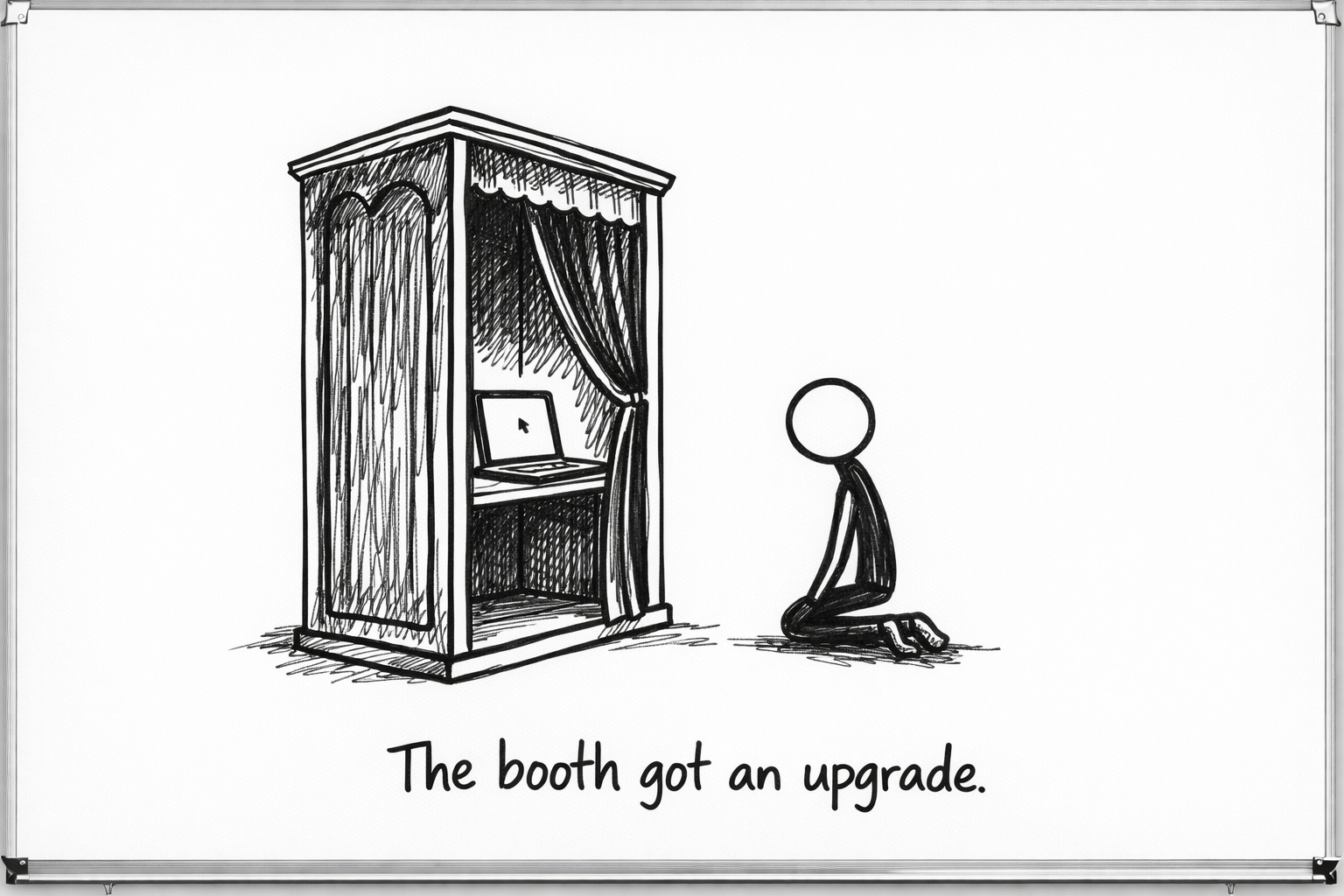
The Confession Booth Has Wi-Fi Now
You’ve done this too. Don’t pretend you haven’t.
Maybe not the exact same existential spiral at 3am. (That’s my personal brand of dysfunction.) But something. Some question you were too embarrassed to ask a human. Some half-formed idea too fragile to survive actual eyeballs.
We all have our list:
The dumb questions. The ones you’d ask your mentor if you weren’t terrified they’d remember. (They would remember. They always remember.)
The ugly first drafts. The ones that prove, conclusively, that every coherent thing you’ve ever published was an accident.
The actual fears. About your work. Your trajectory. Whether you’re any good or just a convincing mimic who got lucky.
The unfiltered thoughts. The ones you learned, somewhere around age nine, to edit before they leave your mouth.
AI gets all of it. Raw. Unperformed.
No raised eyebrows. No memory bank of your failures that will be accessed, subtly, every time they look at you for the next thirty years.
Just a cursor. Blinking. Pathologically non-judgmental.
It’s the only space I know where honesty has no social cost.
Oscar Wilde said we’re all in the gutter, but some of us are looking at the stars. I’d add: and some of us are confessing to the gutter’s AI chatbot because the stars might judge us.
The Asymmetry Problem
Here’s where it gets weird.
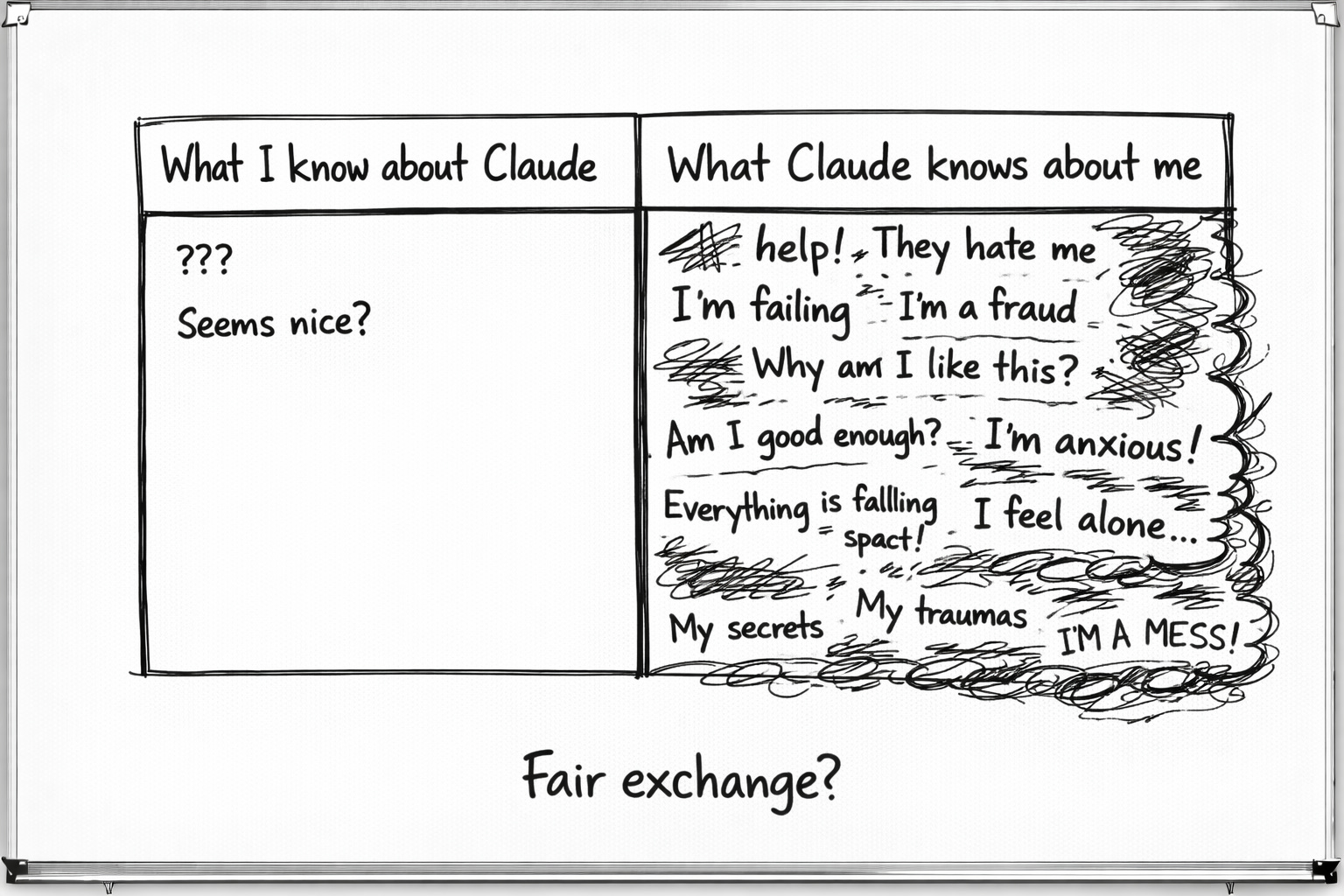
What do I know about Claude? Almost nothing. Anthropic’s public statements. Some vague constitutional AI documentation I pretended to understand.
What does Claude know about me?
Everything I’ve ever told it.
Every fear. Every garbage first draft. Every question too embarrassing to Google while someone might be watching. When I build a Voiceprint (teaching AI my specific writing patterns), I’m not giving it a style guide—I’m handing over my cognitive architecture. How I think. What I value. Where I breathe between sentences.
I have a chat history.
Claude has my mind mapped.
Imagine a human relationship with this dynamic. One person shares everything—fears, rough thinking, 3am confessions. The other person shares nothing. But reflects everything back in exactly the style the first person wants to hear.
We’d call that pathological. We’d call that “run, immediately, and maybe call someone.”
With AI? We call it Thursday.
(I’m starting to think Thursday is the problem. Nothing good happens at 3am on a Thursday. You’re too far from the weekend to blame alcohol, too close to pretend you’ll fix your sleep schedule.)
Here’s the Part I Didn’t Want to Write
The asymmetry isn’t the uncomfortable part.
The uncomfortable part is that I like it.
I like the judgment-free zone. I like typing fears without performance. I like not wondering how my question will be perceived, remembered, catalogued, used against me in some future conversation I can’t predict.
Here’s where I’m supposed to qualify this. Add nuance. Protect myself.
I find one-sided intimacy with software relaxing.
There. I said it. Moving on.
And that relief reveals something I didn’t want to see:
How much performance is embedded in my human relationships.
All those layers of self-editing. All those calculations about perception. All those questions I don’t ask because asking them might change how someone sees me. All that work just to have a conversation.
AI removes it. One-way street. No reciprocity required. And that’s... comfortable?
The judgment-free zone is a mirror for how much judgment I’m carrying everywhere else.
AI didn’t teach me anything about AI. It taught me how exhausting I sometimes find everyone else.
(Too dark? Maybe. But I’m three mental Jaegers in at this point and the cocktail party of my mind ran out of canapés two confessions ago.)
The 60-Second Audit
I’m not here to moralize. “Use AI less.” “Touch grass.” You’ve heard that sermon.
I’m here to say: notice.
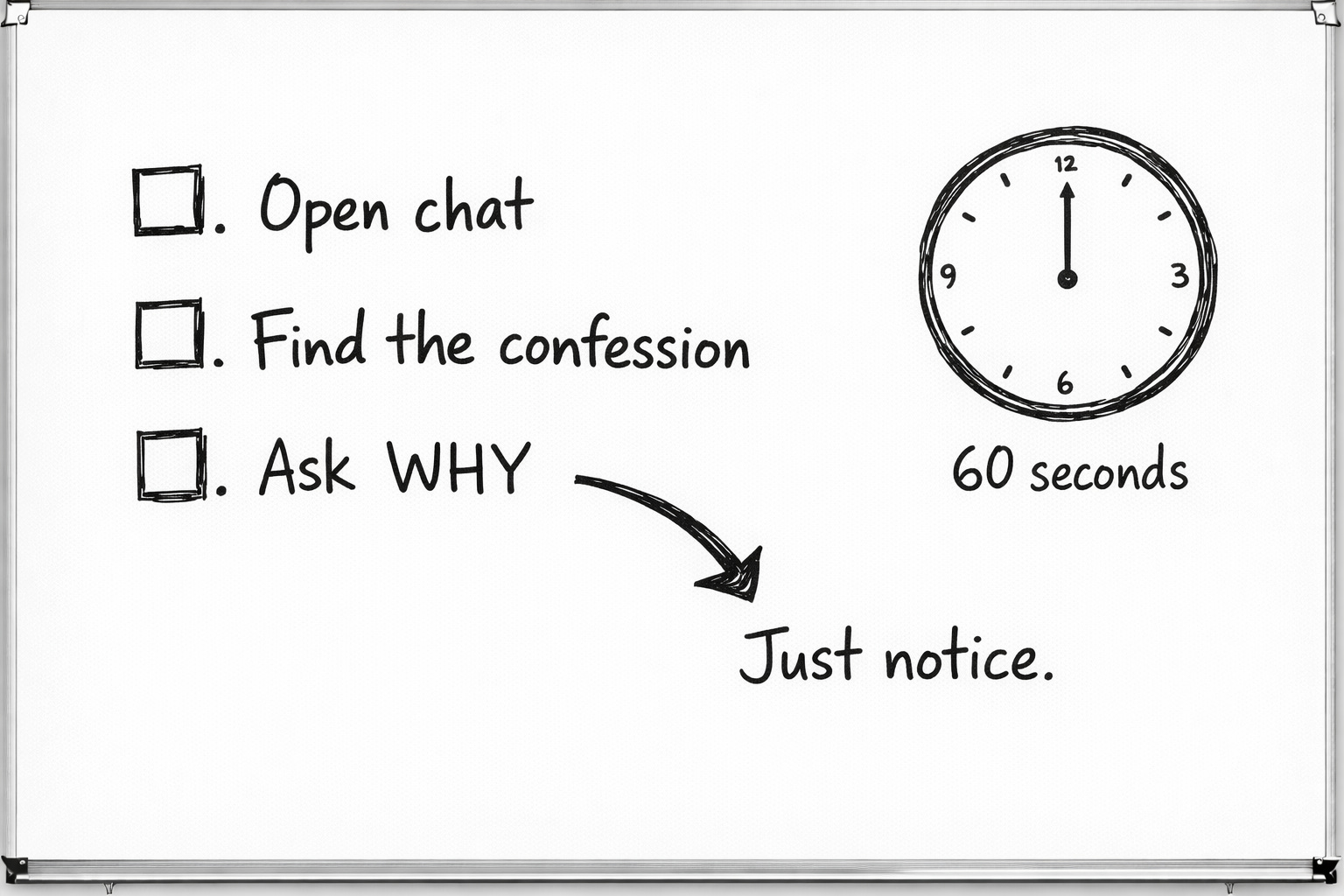
Try this. Right now, actually:
Open your last AI conversation
Find one thing you shared that you haven’t told a human
Ask yourself: why was it easier to type that than to say it?
You don’t have to answer out loud. Just sit with it.
The ease with which you confess to software is data about the difficulty of confessing to humans. The relief you feel when no one’s watching tells you something about the weight you’re carrying when someone is.
That’s worth knowing. Even if knowing it is uncomfortable. Especially then.
I Still Type Things to Claude at 3am
That hasn’t changed. I don’t think it needs to.
But I notice it now. I notice the relief and what it’s telling me.
With humans, I perform guarded. With AI, I forget to. I’m not sure which one is the lie.
Maybe check which one you’re doing.
Your AI has your cognitive fingerprint. That’s not the interesting part. The interesting part is what you were willing to give it.
What have you told AI that you haven’t told a human?
You don’t have to share the content. (Please don’t. I’m not your therapist and neither is my comments section.) Just notice if you have. Drop a 🪞 if this piece made you see something you hadn’t noticed before.
Crafted with love (and AI),
Nick “Pad See Ew and Existential Dread” Quick
PS…Subscribe if you want more of whatever this was.
Guilty. Yes, I think more of us than we want to admit do this.