
I Trained My AI to Say “I Don’t Know” and My Readers Started Replying Again
Your AI’s willingness to fake everything is the reason nobody remembers your last post.

Most people prompt AI something like this:
“Write a post about why creators struggle with consistency. Use personal anecdotes and a conversational tone.”
Seems reasonable. Clear topic. Specified tone. You even asked for personal anecdotes, which feels like you’re being thoughtful about authenticity.
And here’s what AI actually processes when it reads that prompt:
“Generate the most statistically probable version of a content creator’s personal experience with consistency. Make it feel warm. Do not, under any circumstances, admit that you have no idea what happened to this person on any Tuesday ever.”
I wish that were sarcasm. You asked for personal anecdotes. AI has no personal anecdotes. It has the averaged residue of every personal anecdote ever published online, blended into a smoothie and poured into your first-person voice like it belongs there. The result reads fine. The result sounds fine. “Fine” is not a compliment. “Fine” is how your reader describes a newsletter two seconds before forgetting it even existed. “Fine” is the last word anyone says about your work before they stop saying anything at all.
Because AI didn’t just fill a gap in your draft. It filled the exact spot where the memorable part was supposed to go.
This is Part 2 of a 3-part series on you-shaped holes. Part 1 covered what they are and why AI fills them with competent filler your readers forget by Monday. Now we fix the behavior.
The Shift (In One Sentence, Then I’ll Shut Up About It)
The fix is almost embarrassingly simple: stop asking AI to generate complete drafts. Ask it to generate drafts with clearly marked gaps where your real material is required.
That’s it. The entire behavioral shift fits in a sentence. (I considered stretching it into a twelve-part framework with a proprietary acronym, but I’m saving that energy for my TED Talk rejection letter.)
Most co-writing advice treats this as a calibration problem. Give AI more context! Paste in more writing samples! Craft a longer prompt! And sure, better inputs improve outputs. Your mom could have told you that, and she doesn’t know what a large language model is. But even with a flawless prompt, AI will still choose filling over flagging, because completing patterns is the one thing language models cannot stop themselves from doing. Asking AI to leave a gap in a paragraph is like asking a surgeon to stop mid-incision and hand you the scalpel. The training won’t allow it. Every gap is a sentence begging to be completed, and AI will complete it with whatever plausible material it can generate, every single time, whether you asked for it or not.
You have to explicitly instruct AI to do the thing it was built to never do: stop, confess ignorance, and hand you the pen.
(Which, to be fair, is a skill most humans struggle with too. At least AI has the excuse of being an autocomplete engine that’s never burnt the bejeezus out of its mouth on hot coffee. The person who went to business school and learned to never say “I don’t know” in a meeting paid tuition for the privilege.)
The Flag-Don’t-Fill Framework
Here’s the core instruction. Modify the language to match your voice. Swear more or less. But keep the behavioral skeleton:
The instruction you add to every co-writing prompt:
When you reach a point that requires my personal experience, a specific anecdote from my life, my actual opinion on a debatable topic, or a real example from my work: DO NOT invent one. Instead, insert a clearly marked placeholder:

[YOU-SHAPED HOLE: Brief description of what’s needed, e.g., “a specific time a reader’s reply surprised you” or “your real opinion on whether daily publishing is worth it”]

Build the strongest possible draft around these gaps. Leave them visible and clearly labeled. I’ll fill them with material only I can provide.
The workload doesn’t change. The division of labor does. AI builds the structure, nails the transitions, handles the framework explanations (the stuff it’s genuinely excellent at), and leaves clearly marked spaces where the memorable parts go.
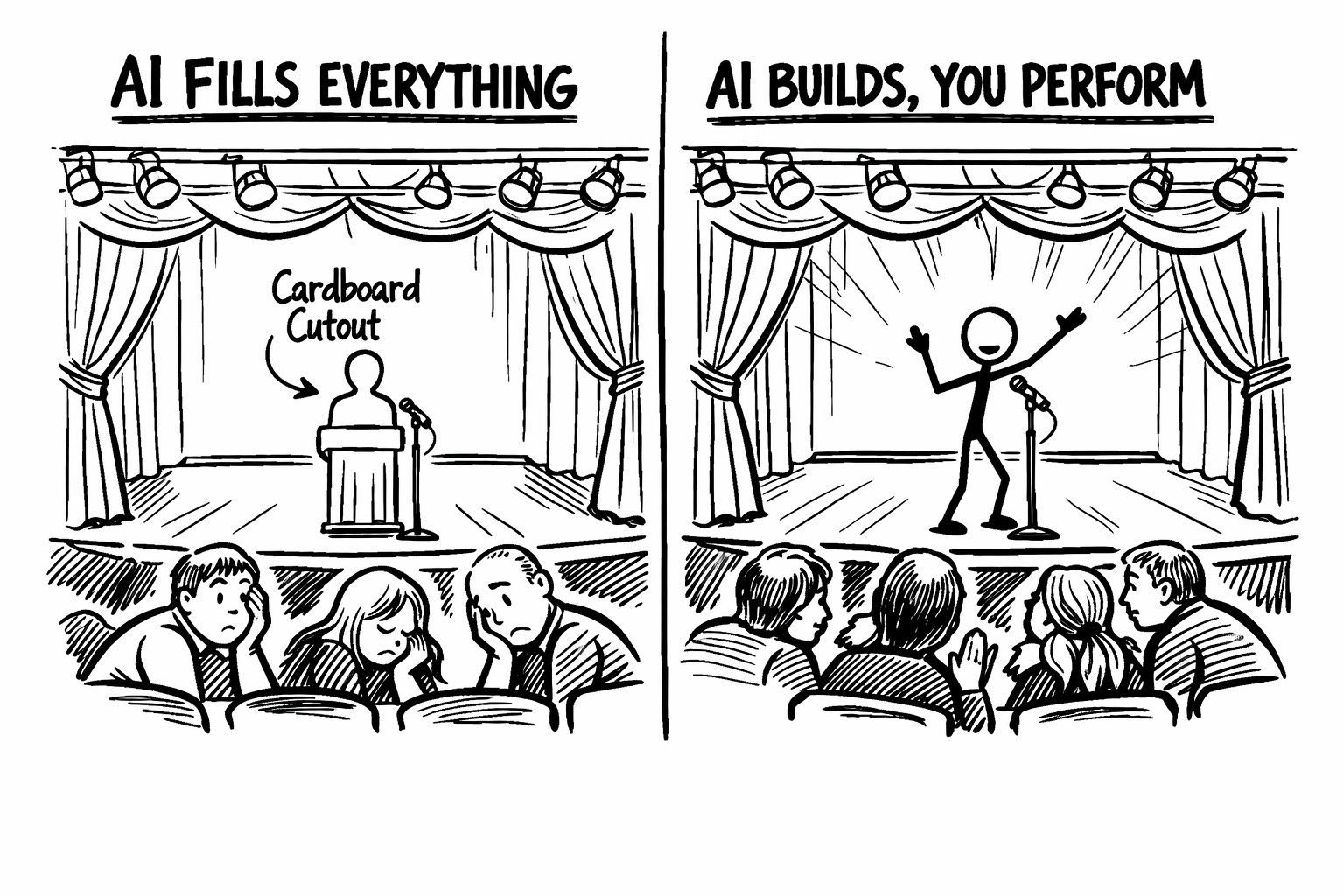
Think of it like hiring a set designer for a one-person show. They build the stage, the lighting, the backdrop. Gorgeous work. Technically impeccable. But the monologue? The bit where you tell the story about your grandmother and the illegal fireworks and the county fair that got shut down? That has to come from you. And if the set designer decides to write that part too, just to be helpful, you end up performing someone else’s memories to a crowd that paid to hear yours.
(Nobody drove three hours and paid for parking to watch a set designer’s best guess at your childhood. They came for your childhood. Specifically the part with the fireworks.)
Three Ways to Keep AI From Relapsing
Prompt instructions have a half-life of about two paragraphs. AI follows your flag-don’t-fill directive with genuine enthusiasm at the top of the draft, then quietly reverts to filling every gap it encounters, the same way your New Year’s resolution to stop checking your phone in bed lasted until approximately January 4th. The intention was real. The follow-through requires guardrails.
Three reinforcement strategies:
1. The Sandwich
Put the flag-don’t-fill instruction at the top of your prompt AND repeat a compressed version at the bottom:
Reminder: any section requiring my personal experience, real opinions, or specific examples from my life gets marked as [YOU-SHAPED HOLE], not invented. When in doubt, flag it.AI pays disproportionate attention to the beginning and end of prompts. The middle is where instructions go to quietly die, like the vegetables in the back of your fridge that you bought with the best of intentions and will throw away in a bag you refuse to open. Bookend the instruction: once at the start, once at the end.
2. The Mid-Draft Interrogation
For longer pieces, break the generation into chunks. After each chunk:
Before you continue: are there any spots in what you just wrote where you had to guess about my life, experience, or opinions? Flag them now.This forces AI to audit its own output. It won’t catch everything. (Self-awareness is... not its signature skill.) But it catches the most brazen fabrications, and the act of asking creates a behavioral pattern that makes subsequent sections more cautious. Same principle as a visible security camera in a parking lot. It doesn’t prevent all crime. But the guy who was going to key your car thinks twice when he notices the blinking red light.
3. The Calibration Example
Show AI what correct flagging looks like and what incorrect filling looks like. Side by side. One paragraph with a you-shaped hole properly marked. One paragraph where the same hole was stuffed with invented material. Then:
The first example is correct. The second is what I want you to avoid. When in doubt, over-flag. I’d rather fill ten unnecessary placeholders than discover I published someone else’s fake memory as my autobiography.That last sentence sets the risk tolerance. You’re telling AI the cost of a false negative (a missed fabrication that your reader's brain files directly into the trash without opening) is catastrophically higher than the cost of a false positive (an unnecessary placeholder that costs you sixty seconds to fill with something real).
One of those mistakes wastes a minute. The other one wastes a perfectly good opportunity to be the post your reader quotes to a friend.
(Over-flag, always. The worst case scenario of over-flagging is that you spend an extra five minutes filling holes with your actual stories, and your post becomes accidentally more memorable than you planned. Oh no. The horror.)
What Happens When AI Stops Faking Your Life
When you shift from fill-mode to flag-mode, something counterintuitive happens.
Your drafts get better. Not incrementally. Noticeably.
The structural writing (transitions, argument flow, pacing, framework explanations) gets tighter, because AI isn’t burning half its attention fabricating your origin story. When you tell a machine “don’t guess about this person’s life,” it redirects all that creative energy into the parts it’s actually qualified to handle. The scaffolding gets sturdier when the carpenter stops moonlighting as your biographer.
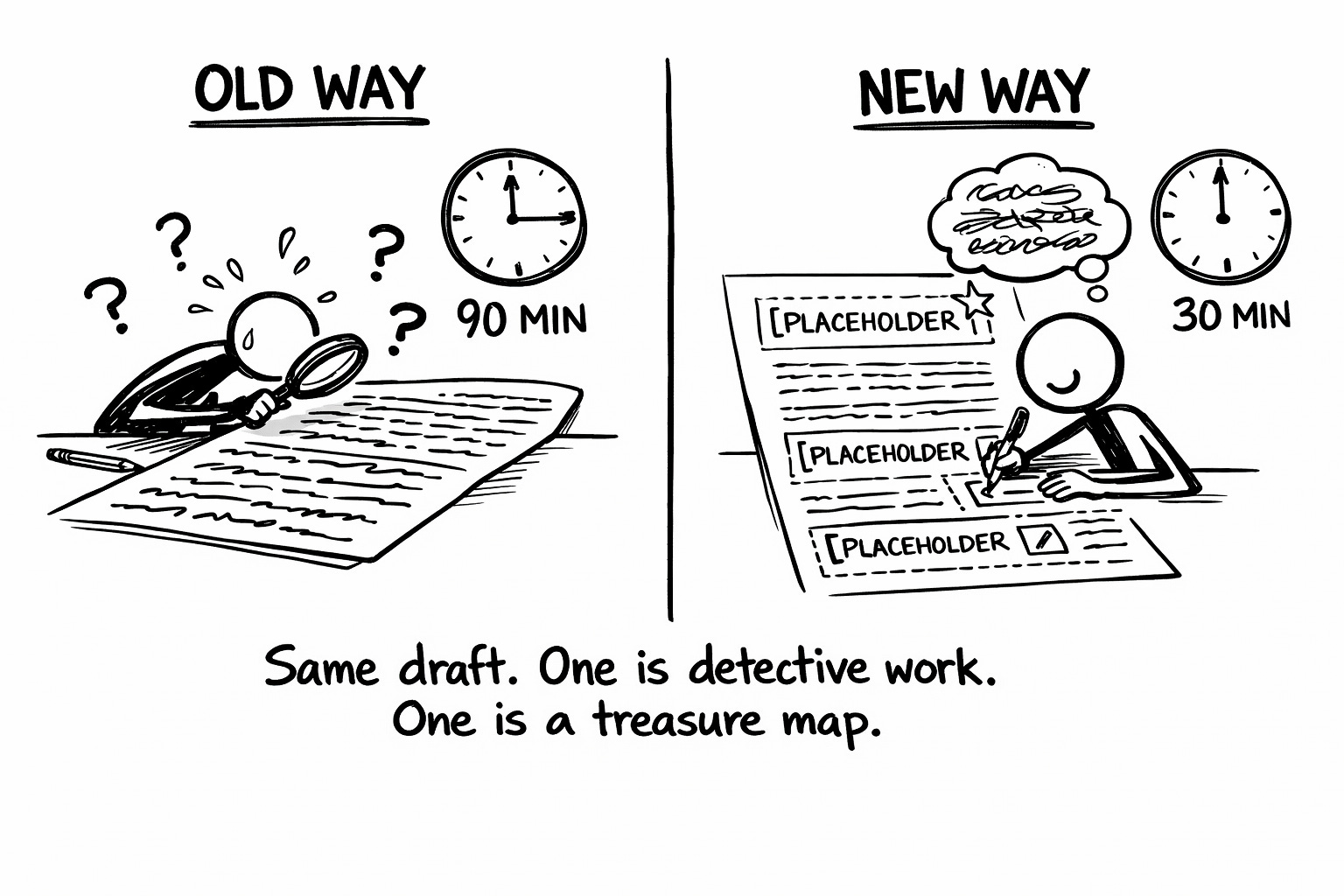
And you get something you’ve never had before: a treasure map.
Instead of reading 2,000 words with a vague, nagging sense that “something feels off somewhere” (which is what detecting you-shaped holes feels like when they’ve been filled with competent filler), you see six clearly labeled spots that say: this is where the stuff your reader will actually carry home goes.
(The first time I ran a flagged draft, I stared at the placeholders for a solid minute. Not because I didn’t know what to put there. Because I realized how many times I’d published posts where those same spots had been quietly filled with AI’s best guess and I’d waved them through. The gaps weren’t new. They’d always been there. I’d just been letting AI wallpaper over them so smoothly I never smelled the mold growing underneath it.)
Every placeholder is a neon sign. Here is where you put the story your reader will tell their friend. Here is where you insert the opinion that makes someone hit reply. Here is where the weird, specific, embarrassing, too-real detail goes that separates your newsletter from the forty others in the same inbox covering the same topic.
You’re not hunting for problems anymore. You’re looking at a map of opportunities. Every [YOU-SHAPED HOLE] marker is an invitation to be the newsletter someone quotes at dinner instead of the one they vaguely recall subscribing to.
And your editing sessions stop looking like detective work. The old workflow: generate draft, read 2,000 words suspiciously, play detective trying to figure out which parts feel “off,” rewrite the suspicious paragraphs from scratch (maybe), give up and publish because you’re tired (definitely). Ninety minutes if you’re disciplined. Longer if you’re me.
The new workflow: generate flagged draft, scan for the markers (they’re clearly labeled, you don’t have to detect anything), fill each one with something only you could provide. Thirty minutes. Maybe forty if you’ve got a lot of holes. And the output isn’t just more honest. It’s the kind of writing someone actually retains after reading it, because every personal element in the draft came from an actual person who actually lived it.
The Prompt You Can Steal Before You Finish This Sentence
Complete co-writing prompt with the flag-don’t-fill framework bolted in. Rip it apart. Reassemble it. Make it weird. The behavioral instruction matters more than my specific words:
Role: You’re my co-writing partner drafting a newsletter post.

Topic: [Your topic]

Voice reference: [Your Voiceprint or key patterns]

Critical instruction: When the draft calls for a personal anecdote, a real example from my work, my specific opinion on a debatable point, or any detail requiring lived experience: DO NOT generate it. Mark it clearly:

[YOU-SHAPED HOLE: description of what’s needed]

Build the strongest draft you can around these gaps. I’ll fill them with real material.

Cost calibration: An unnecessary placeholder costs me sixty seconds. A forgettable paragraph costs me a reader who can’t remember why they subscribed. Over-flag. Always.
Now you’ve got drafts with clearly marked gaps. Treasure maps with the X’s already drawn. The obvious question becomes: how do you fill those holes fast without each one becoming a twenty-minute staring contest with your own blinking cursor?
That’s Part 3: the 90-second technique for turning raw, messy, unpolished personal material into the kind of draft input that makes your post stick. It’s the part that makes this whole system sustainable instead of theoretically correct.
🧉 When you read your own AI-assisted drafts back, where do you usually feel the first “something’s off” moment? Beginning, middle, or end? I have a theory about this and I want to see if it holds.
Crafted with love (and AI),
Nick “Professional Gap Cartographer” Quick

PS… This framework clicks the first time you use it, and then the old way becomes physically impossible to go back to. Like learning what “umami” means and then tasting it in everything. I publish daily. Subscribe if you want co-writing frameworks that make your newsletter the one people actually remember opening. And if you know a creator who spends two hours playing detective with their own AI drafts trying to figure out which parts “feel off”? Forward this. You’ll save them ninety minutes and possibly a small existential crisis.
PPS… The flag-don’t-fill framework doubles in effectiveness when AI already knows your voice patterns through a Voiceprint. Without one, AI is guessing at your style AND your substance, which means twice the opportunities to fill gaps with forgettable averages. The Voiceprint Quick-Start Guide handles the style half so you can pour all your energy into filling the substance holes with the stuff readers remember. Grab it here.
📌 The You-Shaped Holes Series:
→ Part 1: Your Newsletter Is Competent, Forgettable, and Slowly Dying
→ Part 2: I Trained My AI to Say “I Don’t Know” and My Readers Started Replying Again ← You are here
→ Part 3: Fill the Holes in 90 Seconds (Before Your Brain Talks You Out of It)