
I Taught AI To Write Like Me In 3 Hours

I spent three hours last Sunday teaching AI to write like me.
Not through some magic prompt. Not by feeding it "write like a friendly expert" garbage. I built what I call a Voiceprint—a documented breakdown of my actual writing patterns.
The result? AI outputs I can publish with minor edits instead of complete rewrites.
(And yeah, the irony of using AI to write about using AI isn't lost on me.)
Here's what most people get wrong: They think "voice" is some mystical quality AI either captures or doesn't. Like it's about vibes and energy and whether the digital gods smile on you that day.
Wrong.
Your voice is mostly mechanical. It's patterns. Sentence rhythms. Word choices. Structural tics you don't even realize you have.
And once you document those patterns, any AI tool can replicate them.
This post breaks down exactly how to do that—the same process I used, refined over dozens of iterations. No fluff. No theory. Just the systematic approach that works.
What AI Actually Needs (It's Not What You Think)
Most approach AI like a vending machine:
"Write me a LinkedIn post about productivity."
Then they're shocked when it spits out the same bland corporate-speak everyone else gets. Same structure. Same transition phrases. Same energy as a conference room motivational poster.
The problem isn't the AI. It's that you gave it nothing to work with.
AI tools like ChatGPT or Claude are trained on billions of words from millions of writers. When you give them a generic prompt, they default to the statistical average of all that training data.
Average = bland.
Average = everyone sounds the same.
Average = The Great Blandening I covered in my previous post.
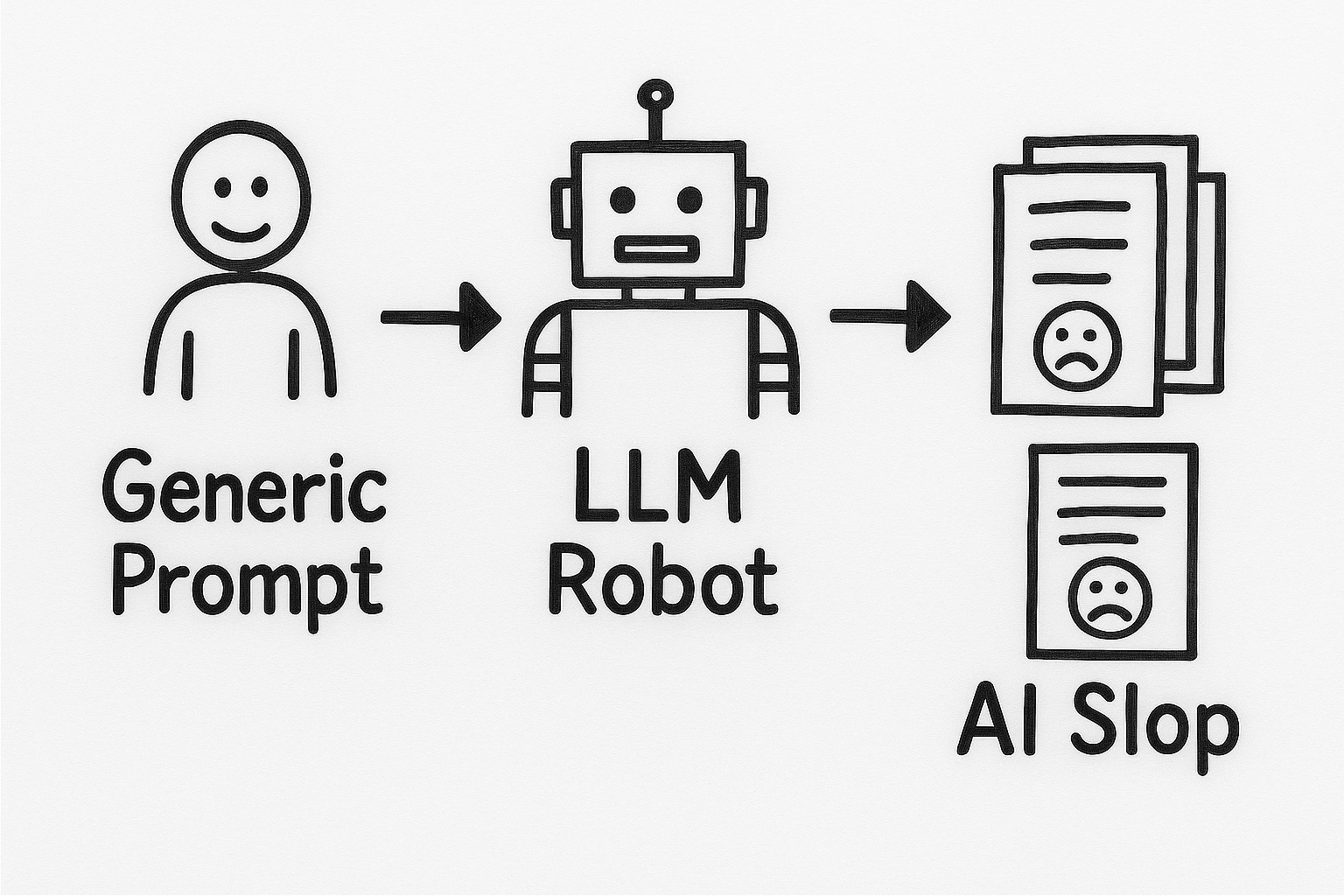
What AI needs instead:
Your specific patterns (not generic "be conversational")
Your vocabulary fingerprint (the words you actually use)
Your structural quirks (how you build paragraphs and arguments)
Your tonal boundaries (what you'd never say vs. what's distinctly you)
Think of it like this: If you hired a ghostwriter, you wouldn't just say "write like me" and expect magic. You'd show them examples. Explain your approach. Correct their first drafts.
AI is the same. Except it learns faster and doesn't need coffee breaks and constant reassurance.
The Voiceprint Method: Three Inputs AI Needs
I've stripped this down to three core components. Miss any of these and your AI outputs will drift toward generic.
1. Voice Attributes (The Mechanical Patterns)
These are the objective, observable patterns in your writing. Not how you think you write—how you actually write when you're in flow.
Start by pulling 3-5 samples of your best work. Pieces where your authentic voice shines. Blog posts, newsletters, social media threads where you felt like yourself.
Then use this prompt:
Analyze the following writing samples and identify:
1. Sentence structure patterns (length variation, how sentences begin)
2. Vocabulary characteristics (common words, technical vs. casual language)
3. Rhythm and pacing (how ideas flow, paragraph structure)
4. Punctuation quirks (em dashes, parentheses, fragments)
5. Perspective patterns (first person? addressing reader directly?)

[Paste 3-5 writing samples here]

Format as a numbered list with specific examples quoted from the text.
What you'll discover: Patterns you didn't realize you had.
I found out I:
Start 20% of sentences with conjunctions (But, And, So)
Use parenthetical asides constantly (because my brain works in layers)
Vary sentence length aggressively (short punch → longer explanation)
Never use corporate buzzwords (they make me want me to vomit my cookies all over the keyboard)
These aren't preferences. They're fingerprints.
2. Voice Signals (Your Communication Frequencies)
Not all content follows the same patterns. Sometimes you tell stories. Sometimes you cite research. Sometimes you just drop frameworks.
I think of writing voice like radio signals—you broadcast on different frequencies depending on what you're communicating.
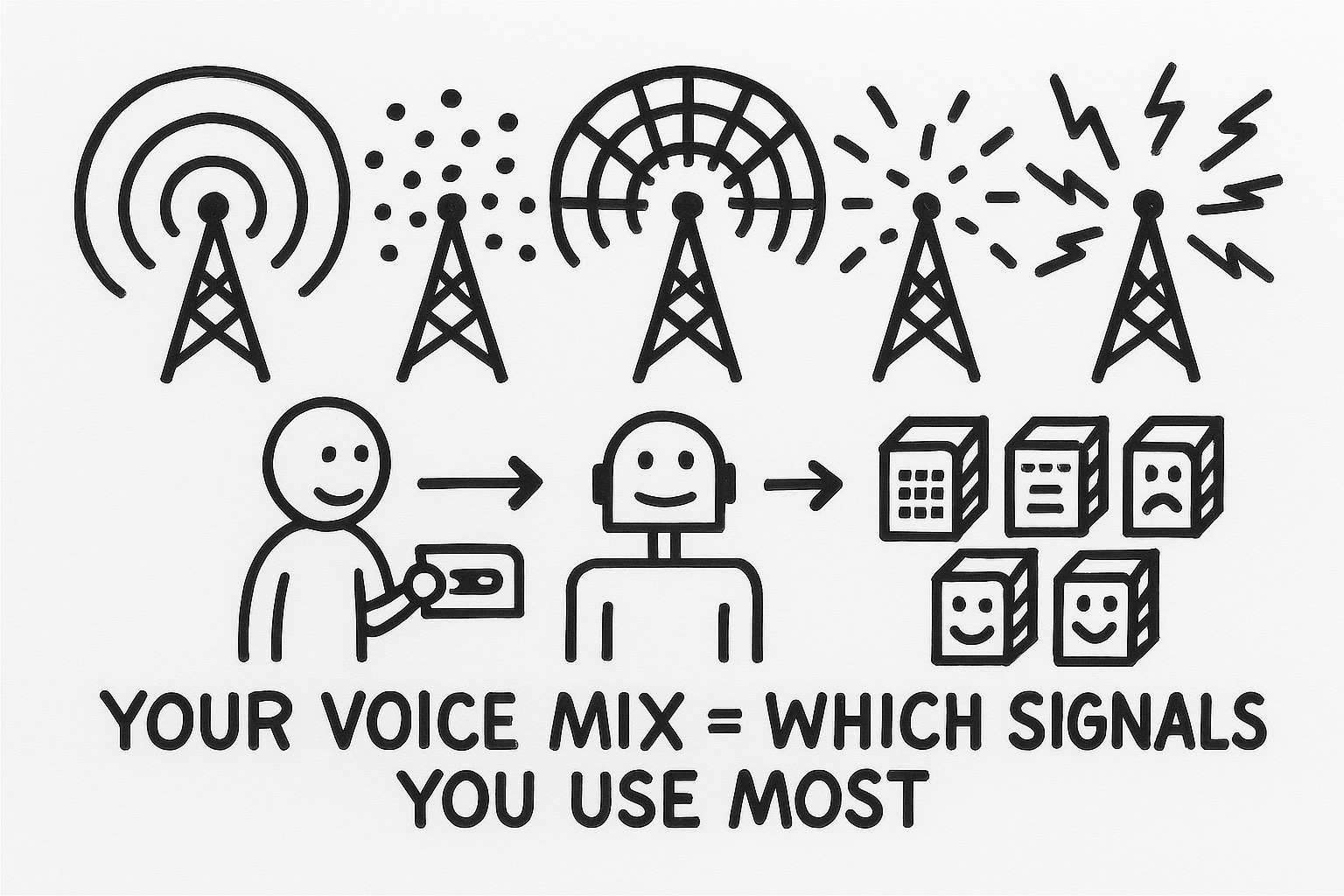
Here are the five primary Voice Signals most writers use:
The Narrative Signal (Personal Experience)
Stories from your life with specific details
"I remember when..." or "Last Tuesday at 3 PM..."
Dates, times, places, sensory details
Your unique experiences no one else has
The Authority Signal (Expertise & Evidence)
Research, data, statistics, studies
"According to..." or "Studies show..."
Technical explanations and credible sources
Demonstrating you know your stuff
The Blueprint Signal (Frameworks & Process)
Step-by-step instructions and systems
Named methodologies you've created
"Here's how this works..." or "The 3-step process is..."
Actionable, executable guidance
The Conviction Signal (Opinion & Perspective)
Strong takes and clearly stated beliefs
"Here's what most people miss..." or "The truth is..."
Adverbs for emphasis (really, never, always)
Your unique angle on common topics
The Edge Signal (Provocative & Boundary-Pushing)
Challenging conventional wisdom directly
Occasional profanity or abrasive language
Sarcasm and irreverent humor
Risk-taking in how you say things
Most writers have a default mix—you rely on 2-3 signals more than others.
My mix? 40% Blueprint, 30% Conviction, 20% Narrative, 10% Authority, and maybe 5% Edge when I really mean it.
Knowing your signal mix matters because it tells AI when to broadcast on which frequency.
Use this prompt on your samples:
Analyze these writing samples and determine my Voice Signal mix:

1. Narrative Signal (personal stories, specific details, "I remember...")
2. Authority Signal (research, data, expertise, citations)
3. Blueprint Signal (frameworks, processes, step-by-step how-to)
4. Conviction Signal (strong opinions, emphasis, perspective)
5. Edge Signal (provocative, profanity, challenging norms)

Estimate my percentage breakdown and give examples from the text for each signal.

[Paste samples]
This tells AI not just how you write, but how you communicate.
3. Tonal Boundaries (What You'd Never Say)
This is the guardrails. The stuff that's not you even if it's technically "good writing."
I call this the Tone Grid—two axes that map your tonal range:
X-axis: Loose (1) to Tight (10) — How polished and structured your writing is
Y-axis: Irreverent (1) to Professional (10) — Your attitude and formality
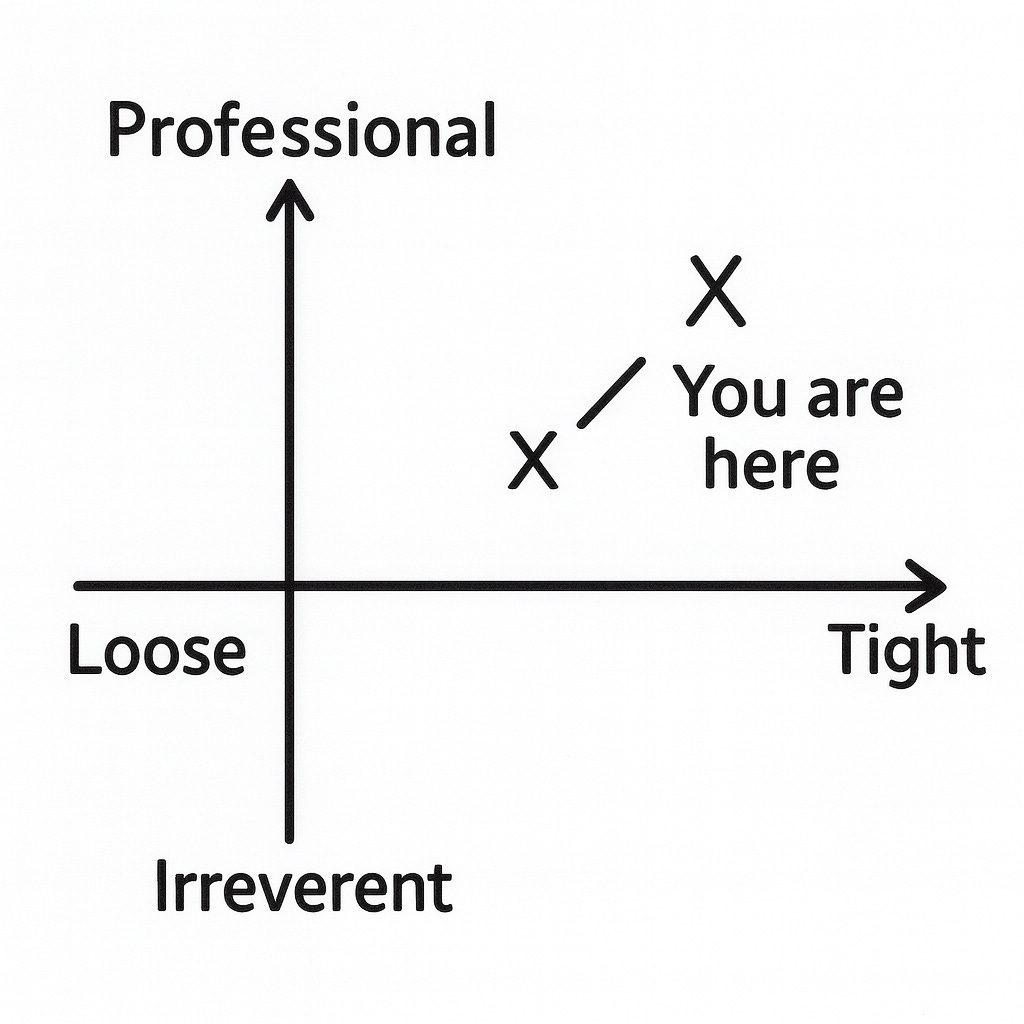
That means I'd never write:
Ultra-formal corporate language (too tight, too professional)
Chaotic stream-of-consciousness rants (too loose)
Cynical doom-posting (too irreverent for my brand)
But I will write:
Structured arguments with occasional profanity
Self-aware commentary on my own process
Contrarian takes backed by experience
Map your own grid with this prompt:
Based on these writing samples, map my Tone Grid position:

X-axis: Loose (1) = casual, unstructured | Tight (10) = polished, structured
Y-axis: Irreverent (1) = edgy, questioning | Professional (10) = formal, diplomatic

Give me scores for both axes and explain what this means I should and shouldn't write.

[Paste samples]
Building Your Complete Voiceprint (The 90-Minute Process)
Last Sunday evening—because I'm that person who works on Sunday evenings as a middle finger to organized religion's Monday-first tyranny—I sat down and built my complete Voiceprint.
Total time: 92 minutes. (I'm counting because I tracked it.)
Step 1: Gather Samples (15 minutes)
I pulled five pieces:
Two newsletter posts I was proud of
One LinkedIn post that did well
One Twitter thread that felt authentic
One blog post from two years ago
Why variety matters: You write differently on different platforms. Include that range.
Step 2: Extract Voice Attributes (25 minutes)
Ran the first prompt. Got a detailed breakdown of my mechanical patterns. Copy-pasted it into a new doc titled "Nick's Voiceprint."
Pro tip: Don't edit AI's analysis yet. Just capture it raw.
Step 3: Identify Voice Signals (20 minutes)
Ran the second prompt. Discovered my Blueprint-heavy mix. Added percentages to the Voiceprint doc.
This part surprised me—I thought I used more stories than I actually do. Turns out I'm way more process-oriented than narrative-driven.
Step 4: Map Tonal Boundaries (15 minutes)
Ran the third prompt. Confirmed my 6/4 positioning. Listed specific phrases I'd never use (all those banned expressions you see everywhere).
Step 5: Create Master Prompt (17 minutes)
Compiled everything into one prompt I can paste at the start of any AI conversation:
You are a writing partner helping me create content in my voice.

VOICE ATTRIBUTES:
[Paste mechanical patterns here]

VOICE SIGNAL MIX:
[Paste percentages and examples]

TONAL BOUNDARIES:
[Paste Tone Grid position and guidelines]

BANNED EXPRESSIONS:
[List phrases you'd never use]

When drafting content:
- Match these patterns precisely
- Use my default Signal mix unless I specify otherwise
- Stay within my tonal boundaries
- Flag anything that doesn't sound like me

Ready to collaborate?
That master prompt is now my starting point for every piece of content. I paste it in, then give the actual assignment.
The difference is night and day.
Before and After: What This Actually Changes
Before Voiceprint:
"AI has revolutionized content creation by offering unprecedented efficiency. Modern tools like ChatGPT enable creators to scale their output while maintaining quality standards. This represents a paradigm shift in how we approach digital communication."
(Generic. Robotic. Could've been written by anyone.)
After Voiceprint:
"Most people treat AI like a vending machine. Drop in a prompt, get out content. Then they wonder why everything sounds the same—bland corporate-speak that could've come from anyone. Here's the thing: AI isn't the problem. It's that you gave it nothing to work with."
(That's my actual voice. Short sentences. Direct address. Metaphor. Em dashes. Exactly how I'd say it.)
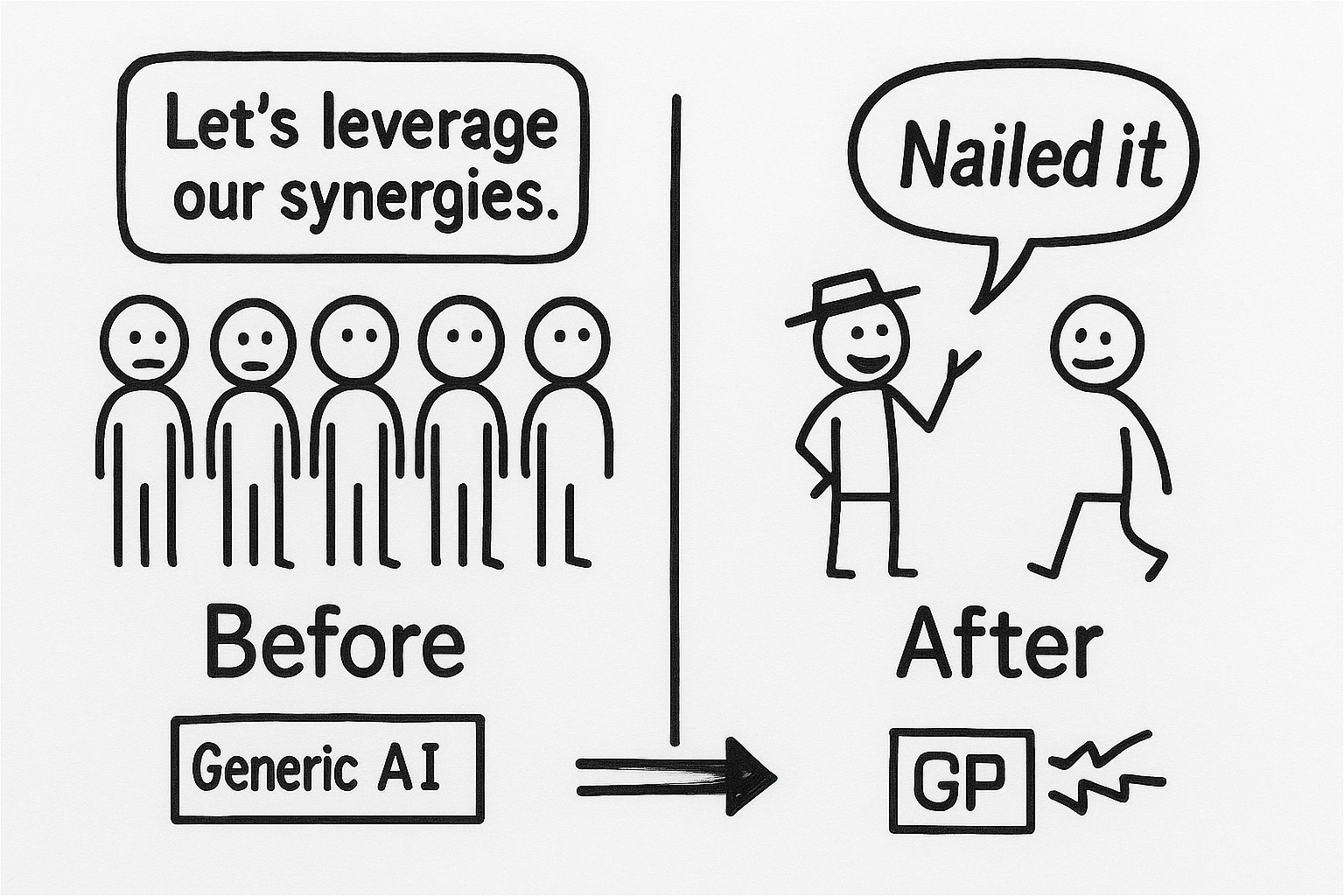
The second version took the same amount of time to generate. The only difference was the Voiceprint prompt I pasted at the start.
The Part Everyone Forgets: Iteration
Building your Voiceprint isn't one-and-done.
The first version gets you 70% there. Good enough to start using. But you'll notice gaps as you generate content.
When AI outputs something that doesn't sound like you, don't just rewrite it. Ask:
What pattern did it miss?
What word would I have used instead?
What structural choice would I have made?
Then update your Voiceprint with those insights.
I've revised mine four times in the past month. Each iteration makes AI outputs more precise.
Think of it like teaching a writing partner. They need ongoing feedback to truly sync with your style.
What This Isn't
Let me be clear about what the Voiceprint method doesn't do:
It doesn't make AI think like you. AI has no thoughts. It pattern-matches based on the documented patterns you give it.
It doesn't replace your editing. You're still the final filter. AI collaborates, you decide.
It doesn't guarantee perfect output every time. Sometimes AI will drift. That's why you iterate.
What it does do: Give AI enough documented information about your voice that its default output sounds authentically like you instead of like everyone else.
That's the difference between collaboration and automation.
Automation tries to replace you. Collaboration amplifies you.
Your Voiceprint is your competitive advantage in a world drowning in generic AI slop. Build it systematically. Update it regularly. Use it consistently.
Discussion Thread Question: What's one writing pattern you have that you think AI would struggle to capture? Drop it in the comments—I want to see what quirks everyone's working with.
Crafted with love (and AI),
Nick "The Voiceprint Whisperer" Quick
PS…Want more on collaborating with AI without losing your voice? Subscribe for new posts every Sunday and Wednesday and start creating content that bitch slaps AI slop.
The most complete article about making AI sounds like you I ever read. :D Great job Nick. :)