
I Stole My Best Idea from a Plumber
A Field Guide to Ethical Intellectual Theft

I stole my best idea from a plumber in Paraguay.
Not metaphorically. An actual plumber. Standing in my apartment in Asunción, delivering news about my pipes with the resigned expression of a doctor telling you the tumor is inoperable.
Some context: I live in a country where you can’t flush toilet paper. You read that correctly. There’s a little trash can next to every toilet. You get used to it. (You never fully get used to it.) The plumbing infrastructure here was apparently designed by someone who lost a bet, and every pipe in my building is a relic from an era when “good enough” was the engineering gold standard.
So when the water pressure dropped to what I can only describe as “aggressive drip,” I called a plumber. He showed up three hours late, which in Paraguay means he was early, and started explaining the problem.
“It’s not the water,” he said. Gestured vaguely at the wall like it had personally offended him. “It’s the pipes. You could connect the Paraná River directly to this building. If the system can’t carry it, you get...” He made a sad little pfft sound with his mouth. Universal language for “you’re screwed.”
I was half-listening. Nodding at appropriate intervals like a person who definitely understands plumbing. (I do not understand plumbing. I once spent forty minutes trying to figure out which way “righty-tighty” went. The answer, it turns out, is context-dependent. Nobody warns you about this.)
But some part of my brain was chewing on a client problem back in the States. Good writer. Great content, actually. Posting consistently. Getting absolutely nowhere. Providing value into a void so complete it had its own gravitational pull.
Then the plumber’s words caught up to me.
Wait.
What if audience attention worked like water pressure? What if the problem wasn’t the content at all? What if the content was the Paraná River and the pipes were the problem?
I paid the man. Tipped well. (You tip your plumber when they accidentally hand you a career-defining framework while standing in your bathroom that can’t handle Charmin. This is basic manners.)
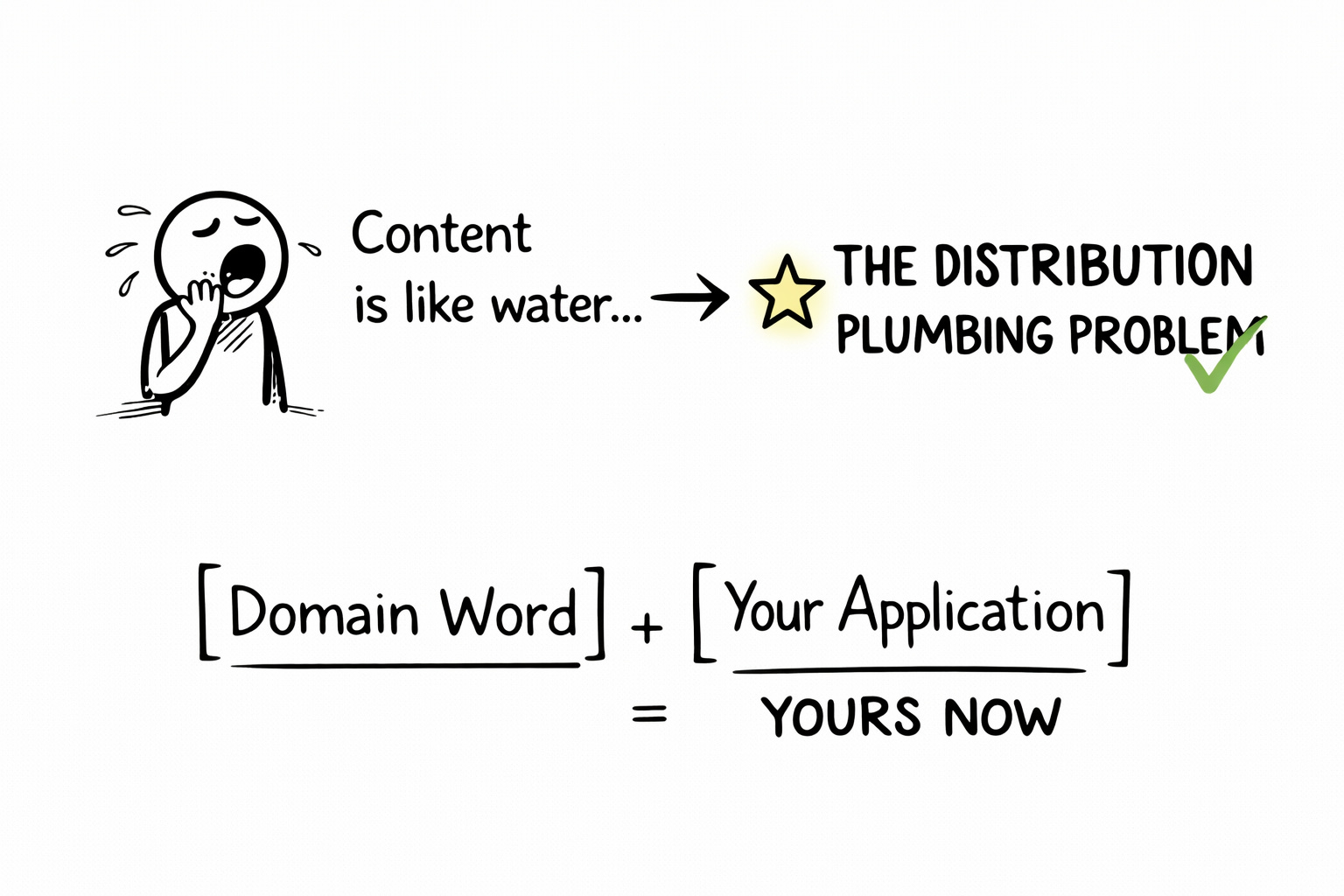
That stolen idea became something I’ve used with every client since. I call it “The Distribution Plumbing Problem.” Sounds fancy. Came from a guy explaining why my shower had the water pressure of a tired sneeze.
I’ve made more money from that borrowed insight than from anything “original” I’ve ever produced.
And here’s the uncomfortable truth I’m going to ruin your afternoon with: Your most original ideas aren’t original either.
They’re immigrants. Concepts that snuck across disciplinary borders in the dead of night, looking for better opportunities. You didn’t create them. You smuggled them.
This is called synthesis. And there’s a method to doing it well.
(Which is good news, because otherwise I’d be telling you to move to a country with questionable infrastructure and befriend local tradespeople. That’s not scalable advice. Trust me. I’ve tried scaling it. The visa situation alone is a nightmare.)
Your Field Has Been Picked Clean
Every obvious insight in your domain has already been posted. Tweeted. Threaded. Carouseled. Turned into a $997 course by someone whose headshot makes them look like they iron their t-shirts.
You’re not competing with your peers anymore. You’re competing with the entire accumulated wisdom of everyone who’s ever had a thought about your topic and an internet connection.
The mine is empty. Everyone’s standing around with pickaxes, looking at each other, wondering who forgot to order more gold.
And now AI has wandered into this exhausted landscape like a very confident intern.
Large language models produce content by averaging patterns from their training data. The output is optimized for “statistically probable.” Which is a technical way of saying “sounds like everything else that’s ever been written on this subject, blended together, strained through cheesecloth, and served at room temperature.”
Generic is now infinite. Any competitor can generate infinite generic content. Today. For free. While eating a Hot Pocket that’s burning the roof of their mouth despite being frozen in the center.
So where do original ideas actually come from?
Not from reading more in your field. That’s panning for gold in a river that’s been worked by ten thousand people before breakfast. You’ll find flecks. Maybe. If you’re patient and your standards are flexible.
The people producing genuinely original work aren’t smarter than you. (Some of them are remarkably dumb about everything except their one weird thing. I say this with love. I am also this person.)
They’re reading differently.
They’re committing what I call category crimes. Forcing concepts across disciplinary borders where they have no business being. Making ideas work in contexts they were never designed for.
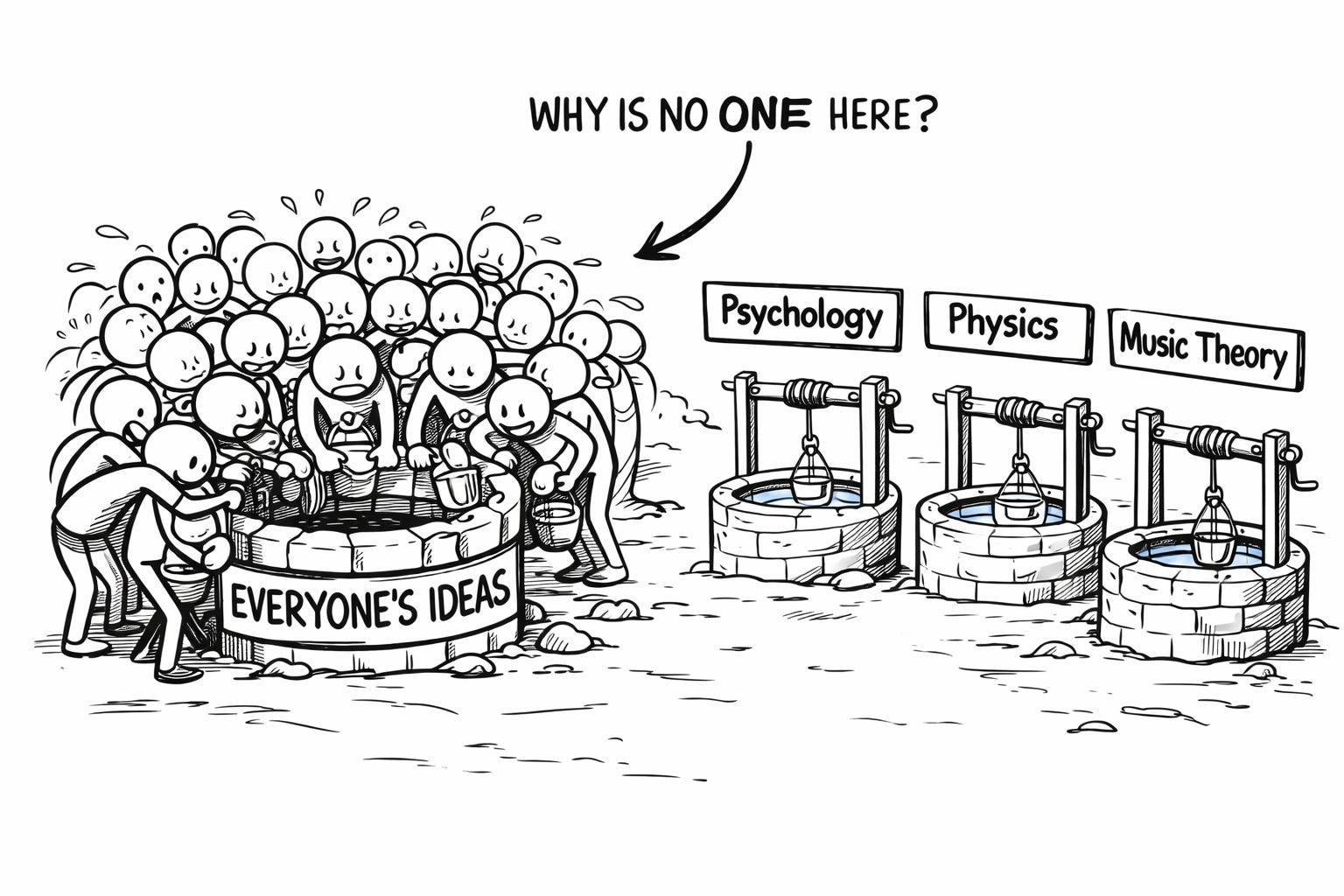
AI struggles with this.
Not because AI is stupid. (It’s disturbingly not-stupid about most things, which is its own problem we can discuss when I’m more emotionally prepared.)
AI struggles because synthesis requires seeing connections the training data never made explicit. When I realized content distribution works like Paraguayan water pressure, I created something AI couldn’t generate without being explicitly prompted. And even if you prompted it, the AI would smooth out the weirdness. File down the edges. Remove the exact strangeness that makes it memorable.
AI averages within domains because that’s how it was trained. It categorizes. It stays in lanes. It’s a very good student who always follows the rules and produces B- work and has never once woken up with an idea scribbled on a cocktail napkin it doesn't remember writing.
The most human thing you can do intellectually is commit category crimes.
(Also: jaywalking. But that’s less relevant to your content strategy.)
The Method, If You Can Call It That
I’ve been doing this long enough to notice patterns in how synthesis happens. It’s not magic. It’s not waiting for inspiration to strike while you’re in the shower. (Though that does help. Something about the water. Maybe the plumber was onto something bigger. Maybe that’s why he looked so wise. Hard to say.)
It’s four phases. Think of it as a heist. You’re not creating from nothing. You’re identifying valuable concepts in foreign territories, smuggling them across borders, and putting them to work in your domain before anyone notices they don’t have the right paperwork.
Phase 1: Build Your Evidence Locker
Most swipe files are useless.
I know. You have one. You’ve been curating it for years. It’s full of interesting things you saved and never looked at again. A digital graveyard of good intentions.
The problem isn’t what you’re saving. It’s how you’re organizing it.
Standard swipe file: organized by topic. Marketing insights in the marketing folder. Writing tips in the writing folder. Productivity hacks in the productivity folder. (Where they sit, untouched, making you feel productive without actually being productive. The folder equivalent of a gym membership in February.)
When you need an original idea, you open the relevant folder and browse... your own domain’s exhausted insights. You’re searching for gold where everyone else already searched.
The synthesis-ready swipe file is organized by domain of origin.
Psychology. Biology. Architecture. Music Theory. Physics. Military Strategy. Economics. Medicine. Whatever the hell is happening with octopuses.
When you save something interesting, the question isn’t “what is this about?” The question is “where did this idea come from?”
An insight about habit stacking from behavioral psychology? File it under Psychology. Not “productivity.”
A framework about minimum viable products? That’s Engineering. (Lean manufacturing, specifically. The startup guys borrowed it and forgot to cite their sources. Typical.)
That thing about how ant colonies make decisions? Biology. Even if you saved it because you thought it might apply to team dynamics. Especially then.
This takes 30 minutes to set up. It pays dividends until you die. (And then it stops mattering because you’re dead and swipe files become someone else’s problem. So it goes.)
Phase 2: Case the Joint
You need a stuck problem.
Not a solved one. Not something everyone’s already written about adequately. Those are answered questions. You’re not going to make a name for yourself by answering questions that already have good answers. That’s just homework. (Unless you’re getting paid for homework, in which case, carry on, but that’s consulting, not content.)
A stuck problem is a question your field keeps circling. The conversation that repeats every six months without resolution. The thing everyone has opinions about but nobody’s framework for has actually worked consistently.
For me, it was content distribution. Everyone said “be consistent” and “provide value.” Standard advice. Fine as far as it goes. Which isn’t very far.
People followed that advice perfectly and still got nowhere. Posting into the void. Providing value to an audience of Russian bots and their ex-girlfriend’s finsta.
Why? Nobody knew. The conventional wisdom was failing, and everyone just... shrugged and kept repeating it. Like we were in a cult where the prophecy didn’t come true but we kept showing up to the meetings anyway.
That’s a stuck problem. Write it as a question: “Why does [standard approach] fail when [specific condition]?”
Phase 3: Find the Entry Point
Now you browse your evidence locker. By domain, not topic.
“What does biology say about this?” “What would physics suggest?” “How do musicians think about this kind of problem?” “What the hell does military strategy have to offer?” (Often more than you’d expect. Clausewitz had things figured out that marketing bros are still discovering and putting on slides.)
You’re looking for structural similarities. Not surface metaphors.
Surface metaphor: “Marketing is like warfare because... battles?”
Structural similarity: “Distribution systems have common physics whether they’re moving water or attention. The capacity of the system matters more than the quality of what’s being distributed.”
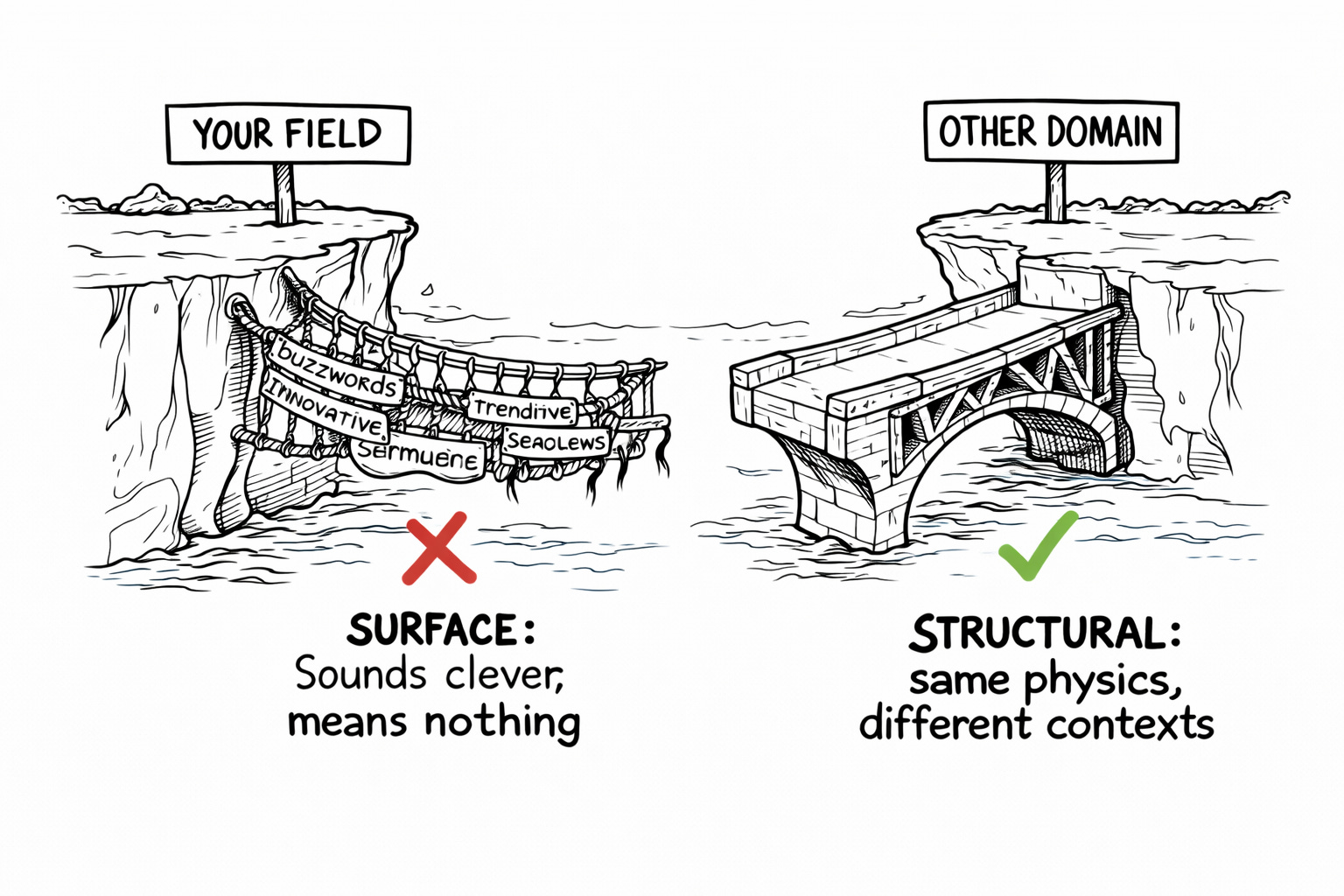
The plumber’s insight worked because pipes are pipes. Whether they’re carrying water through Paraguayan infrastructure that predates the concept of quality control, or carrying attention to your posts about artisanal coffee, the principle holds. The system’s capacity determines flow.
When you find a promising concept, test the bridge: “If I apply [concept from Domain X] to [my stuck problem], what insight emerges?”
Some bridges don’t hold. They look good until you put weight on them, and then they dump you into the canyon like a cartoon coyote. (Meep meep.) That’s fine. You’re not married to your first attempt.
Phase 4: Stress-Test and Name
Not every synthesis survives scrutiny. Some are clever but useless. The kind of insight that gets you nods at cocktail parties but changes nobody’s behavior. Intellectual party tricks. Impressive and forgettable.
The stress test is simple: Can you explain the bridge in one sentence without jargon from the source domain?
Pass: “Content distribution works like water pressure. The system’s capacity determines flow, not just content quality.”
Fail: “So in fluid dynamics, there’s this principle called Bernoulli’s equation, and if you consider laminar versus turbulent flow as a function of Reynolds number...”
If you need two paragraphs of source-domain education before your insight makes sense, the synthesis is weak. Too dependent on the metaphor. The idea hasn’t actually traveled; it’s just visiting on a tourist visa.
But when you find one that holds? When the bridge supports weight?
Name it.
Unnamed synthesis is forgotten synthesis.
“Content flows like water” is forgettable. You’ll write it, people will nod, everyone will move on with their lives.
“The Distribution Plumbing Problem” is a framework. People reference it. Steal it. (Which, given the subject matter, is appropriately circular.)
The naming formula: [Source Domain Word] + [Your Application] = Your Framework
“Insurgent Audience Strategy.” “The Orchestra Problem.” “The Fermentation Principle.”
When you name it, you’ve completed the heist. The idea isn’t borrowed anymore. It has your fingerprints on it. It’s entered your intellectual jurisdiction and applied for citizenship.
No lawyers required. (Lawyers are never required for the good things in life, I’ve noticed.)
The 60-Second Version (For Those of You With Somewhere To Be)
If you’ve scrolled to this point looking for the quick hit, I respect the hustle. Here’s the compressed version:
Right now: Open Wikipedia. Click “Random Article.” I’m serious. Do it.
For two minutes: Read whatever comes up. Look for structural principles, not surface information. Ask: “Is there a how or why buried in here that might apply to literally anything else?”
Force a connection: To whatever you’re currently working on. Even if it’s stupid. Especially if it’s stupid. The stupid connections are often the ones that stick.
Most attempts fail. That’s the point. You’re building the muscle, not producing the output.
I once spent twenty minutes trying to connect deep-sea bioluminescence to email marketing. It didn’t work. (Or hasn’t yet. I’m not ruling anything out. “The Anglerfish Principle” would be a hell of a framework name. Those fish have a light dangling from their heads to attract prey. There’s something there. I can feel it.)
Here’s what I’ve learned from years of doing this badly before doing it slightly less badly:
The ideas worth having are rarely where you’re looking. They’re in conversations with Paraguayan plumbers who show up three hours late. Wikipedia rabbit holes about ant colonies at 1am. That documentary about jazz you watched because you were too tired to find the remote and the algorithm had plans for you.
Your weird interests? They’re not distractions. They’re R&D.
That conversation with someone from a completely different industry that felt irrelevant? Potentially gold you walked past without noticing.
The book you read that has nothing to do with your work? Seeds. All of it, seeds.
AI will keep averaging. It’ll get better at averaging. Produce more competent, more polished, more thoroughly generic content. An ocean of B- work, stretching to every horizon, as far as the eye can see, forever.
Your job is to do what it can’t: see the connections nobody’s made explicit. Force collisions between domains that have never been introduced. Be the weird one who asks “but what would a plumber say about this?”
Commit the category crimes.
The plumber’s still out there somewhere in Asunción. Probably has three more frameworks I need hiding in that head of his. I should call him about my garbage disposal. For research purposes.
(Also because it’s making a sound that I can only describe as “mechanical despair.” But mostly research.)
Your field has been strip-mined. Other fields? Still full of veins of gold. The only question is whether you’re willing to dig somewhere weird.
What’s the strangest field you’ve ever borrowed an idea from? Or what stuck problem in your domain is begging for someone from a completely different discipline to accidentally solve it? I want to hear the collisions.
Crafted with love (and AI),
Nick “The Idea Smuggler” Quick

PS: I’ve been publishing with the frequency of someone who clearly has no hobbies. Subscribe if you want more on AI collaboration that doesn’t make you sound like a fortune cookie written by committee of simpletons.