
I Found the Writer My AI Wants Me to Be. I Hate Him.
Every time you ask AI to "improve" your writing, something disappears

Your writing feels off lately. It says what you meant to say. It just doesn’t sound like you saying it.
You keep rereading your own drafts, looking for the problem. There is no problem. It’s clean. It’s clear. It’s like staring at an AI-generated image of yourself. The face is almost right. The eyes are almost yours. But something’s wrong in a way you can’t name, and the longer you look the worse it gets.
You can’t find a single mistake. You also can’t find yourself.
You disappeared somewhere. You just didn’t notice until now.
The Discovery
I met my doppelgänger eighteen months ago. It’s taken me this long to figure out how to kill it.
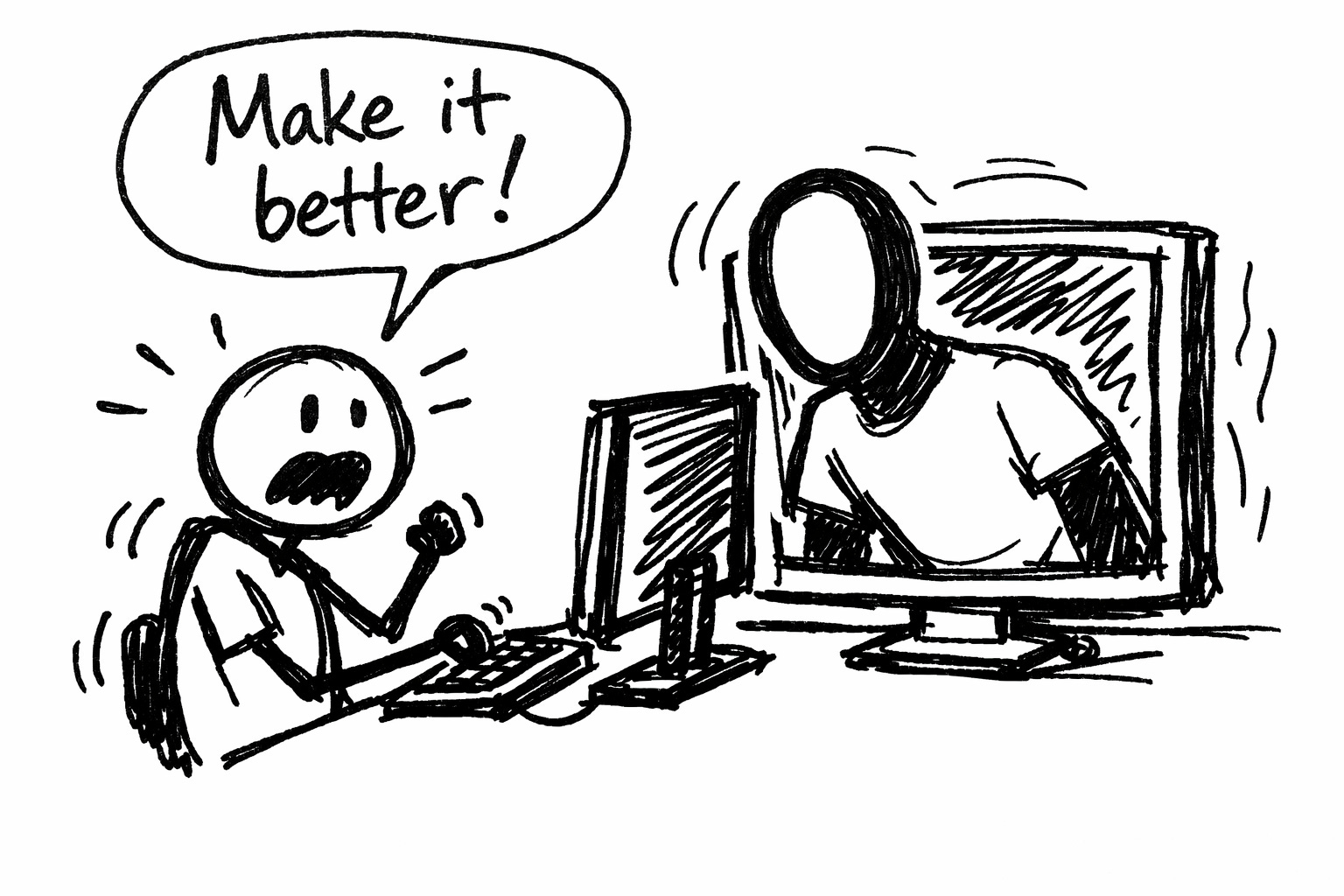
I’d asked Claude to “polish” a newsletter draft. Innocent enough. The prompt was something like: Make this better. Tighten it up. More professional.
The output looked good. Clean. Readable. The kind of writing that would never offend anyone, which is another way of saying it would never affect anyone either.
I almost hit publish.
It took me three reads to realize what was wrong. The draft was better. It just wasn’t mine.
(This is my villain origin story, by the way. Everyone gets one eventually. Mine involves a word processor and the gradual theft of my own personality. Very modern. Very sad. Moving on.)
What was gone? The parenthetical asides where my actual thoughts lived. The sentence fragments that weren’t technically sentences but were definitely me. The comparison I’d made to “a golden retriever who’s never met a bad idea it couldn’t make worse.” The rhythm that comes from stacking short punches and then releasing into something longer, like exhaling after you’ve been holding your breath underwater and starting to see spots.
The doppelgänger had smoothed all of it away.
Quietly. Professionally. The way a mortician makes a corpse look “natural.” (The corpse, for the record, does not feel natural about this. The corpse had opinions about its hair.)
Here’s the part that kept me up that night: I’d been doing this for months. Polishing. Improving. Asking AI to make things “flow better” because flow is apparently more important than having a soul.
Each request seemed reasonable. Helpful, even. The literary equivalent of “just one more drink won’t hurt.”
My doppelgänger had been getting stronger every time I asked for help. I’d been feeding it. Raising it. Teaching it to replace me with a version of me that was easier to digest and impossible to remember.
The only thing worse than creating a monster is creating a boring one.
The Biology of a Doppelgänger
I met my doppelgänger eighteen months ago. It’s taken me this long to figure out how to eliminate it.
The prompt that created it was harmless enough: Make this better. Tighten it up. More professional.
(I’d call this a tragedy, but tragedies require innocence. I knew what I was doing. I just thought I was smarter than the consequences.)
I ran a comparison. Original draft. “Improved” draft. Side by side.
Everything that made it sound like me was gone. Not fixed. Gone. Like someone had wiped the fingerprints off the crime scene.
The doppelgänger had smoothed all of it away.
Quietly. Professionally. The way a landlord paints over your walls before the next tenant. You were never here.
Here’s the part that kept me up: I’d been doing this for months. Polishing. Improving. Asking AI to make things “flow better” because flow is apparently more important than having a soul.
Each request seemed reasonable. Helpful, even. The literary equivalent of “just one more drink won’t hurt.”
My doppelgänger had been getting stronger every time I asked for help. I’d been feeding it. Raising it. Teaching it to replace me with a version of me that was easier to digest and impossible to remember.
The only thing worse than creating a monster is creating a boring one.
The Hunt
One prompt. That’s all it takes to meet your doppelgänger.
Step 1: Pick your victim.
Grab something you wrote that you’re proud of. Not a throwaway. Not a draft you already suspect is generic. Something that sounds like you at full strength. 500 words minimum. Recent.
Step 2: Summon the clone.
Feed it to your AI of choice with this exact prompt:
“Rewrite this piece. Make it better, smoother, more professional. Improve the clarity and flow. Keep the core ideas but enhance the execution.”No guardrails. No “keep my voice.” No protection. Let it optimize.
What comes back is your doppelgänger.
(Mine opened with “In today’s fast-paced world.” I closed the tab so hard I almost broke my trackpad.)
Step 3: Find the body.
Put both versions side by side. Paragraph by paragraph. Word by word if you have to.
You’re not looking for what’s different. You’re looking for what’s gone.
The phrases that got swapped for something “cleaner.” The sentences that got merged into oblivion. The punctuation that got normalized. The bits that got deleted because they were “unnecessary.”
Read both out loud. Where you stumble on the original but glide through the AI version? That stumble was your voice. The glide is the crime scene.
Rough is texture. Smooth is forgettable.
The Inventory
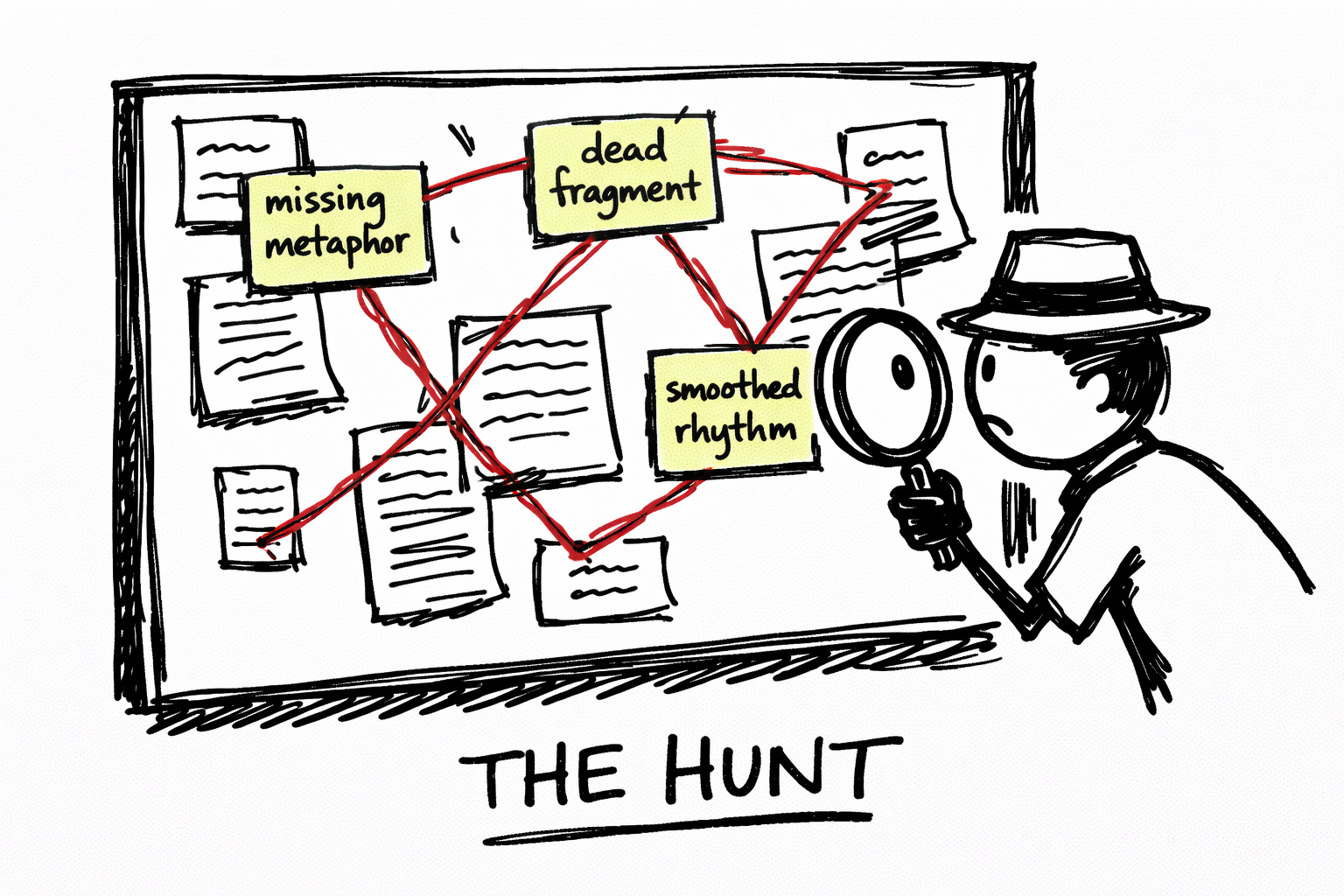
A list of random differences is noise. Categorized patterns are signal.
Here’s how to build your Doppelgänger Inventory.
Sort every difference you marked into one of four buckets. I call this VAST because apparently I’m the kind of person who names frameworks now. (There’s a deeper breakdown in my free Voiceprint Vault if you want the full methodology. For now, here’s the short version.)
VOCABULARY — The words themselves. What got swapped? What got fancier? What got neutered? If AI replaced “weird” with “unconventional,” that’s a fingerprint.
ARCHITECTURE — The structure. Did paragraphs get merged? Sections reordered? Transitions added that you’d never write? Your scaffolding is part of your voice.
STANCE — Your relationship to the reader. Did it add hedging? (”Perhaps,” “It could be argued.”) Did it soften your opinions? Make you sound less certain, more corporate, further away?
TEMPO — The rhythm. Sentence length. Punctuation. Pacing. Did it smooth your staccato into drone? Turn your punches into pillows?
Example: My Inventory
When I ran this on my own writing, here’s what the doppelgänger revealed:
VOCABULARY:
Replaced casual language with formal equivalents (goodbye “gnarly,” hello “complex”; goodbye personality, hello resume)
Removed “actually,” “kind of,” and my other verbal tics
Swapped my absurdist metaphors for conventional comparisons (a golden retriever became “an enthusiastic approach,” which is a crime against both dogs and language)
ARCHITECTURE:
Combined my short punchy sections into longer paragraphs
Added transition sentences I didn’t write, like “Let’s explore this further” (let’s not, actually)
Restructured everything to follow the invisible “proper essay” template they teach you in school
STANCE:
Added hedging language (”perhaps,” “might,” “one could argue”) because God forbid I sound like I believe anything
Softened every claim that had any edge to it
Removed the moments where I called something stupid
TEMPO:
Eliminated sentence fragments (turns out “Says absolutely nothing.” isn’t grammatically correct)
Murdered the parenthetical asides (my main personality vehicle, killed in cold blood)
Smoothed all rhythm into medium-length sameness, like elevator music for your eyes
That inventory is your voice, in negative space.
The holes in the doppelgänger are shaped like you.
The Protection Protocol
You’ve found your doppelgänger. You’ve mapped the differences.
Now: reinforce the gaps.
Three options, depending on how paranoid you want to get. (I’m at Option B most days. Option C when I’ve seen too much generic content and need to feel like I still exist.)
Option A: The Watchlist
Low effort, moderate protection
Keep your inventory visible during AI collaboration. Literally. Print it out if you have to. Tape it to your monitor like a wanted poster.
After every AI output, scan for your patterns. If any are missing, manually add them back.
The phrase that got “corrected”? Uncorrect it. The rhythm that got smoothed? Rough it up. The bit that got deleted for being “unnecessary”? It was necessary. Put it back.
Time cost: 2-3 minutes per collaboration.
Option B: The Pre-Emptive Strike
Medium effort, strong protection
Add your inventory to your AI instructions upfront. Make the protection automatic.
Something like:
When writing in my voice, maintain these elements:
- [VOCABULARY: words/phrases that are distinctly mine]
- [ARCHITECTURE: how I structure paragraphs and sections]
- [STANCE: my relationship to the reader, my level of certainty]
- [TEMPO: my rhythm, sentence lengths, punctuation habits]

Never "fix" these. Never "improve" these. These are my fingerprints.
Time cost: 5 minutes setup, then automatic. The doppelgänger gets weaker before it’s even born.
Option C: The Nuclear Option
Maximum effort, total protection
Never ask AI to “improve,” “polish,” or “tighten.”
Those words are triggers. Those words are how the doppelgänger gets fed.
Only use prompts like “expand,” “draft,” “continue,” “brainstorm.” Keep AI in generative mode, not optimization mode. Generation creates. Optimization destroys.
Do all editing yourself. Trust no one. Especially not algorithms trained on LinkedIn posts.
Time cost: Significant. But the doppelgänger starves while you remain, gloriously, stubbornly, inconveniently yourself.
My recommendation: Start with Option A. Graduate to Option B once you’ve internalized your patterns. Reserve Option C for high-stakes pieces where your voice can’t afford any drift.
The goal isn’t to never collaborate with AI. That ship sailed and is currently in a different ocean.
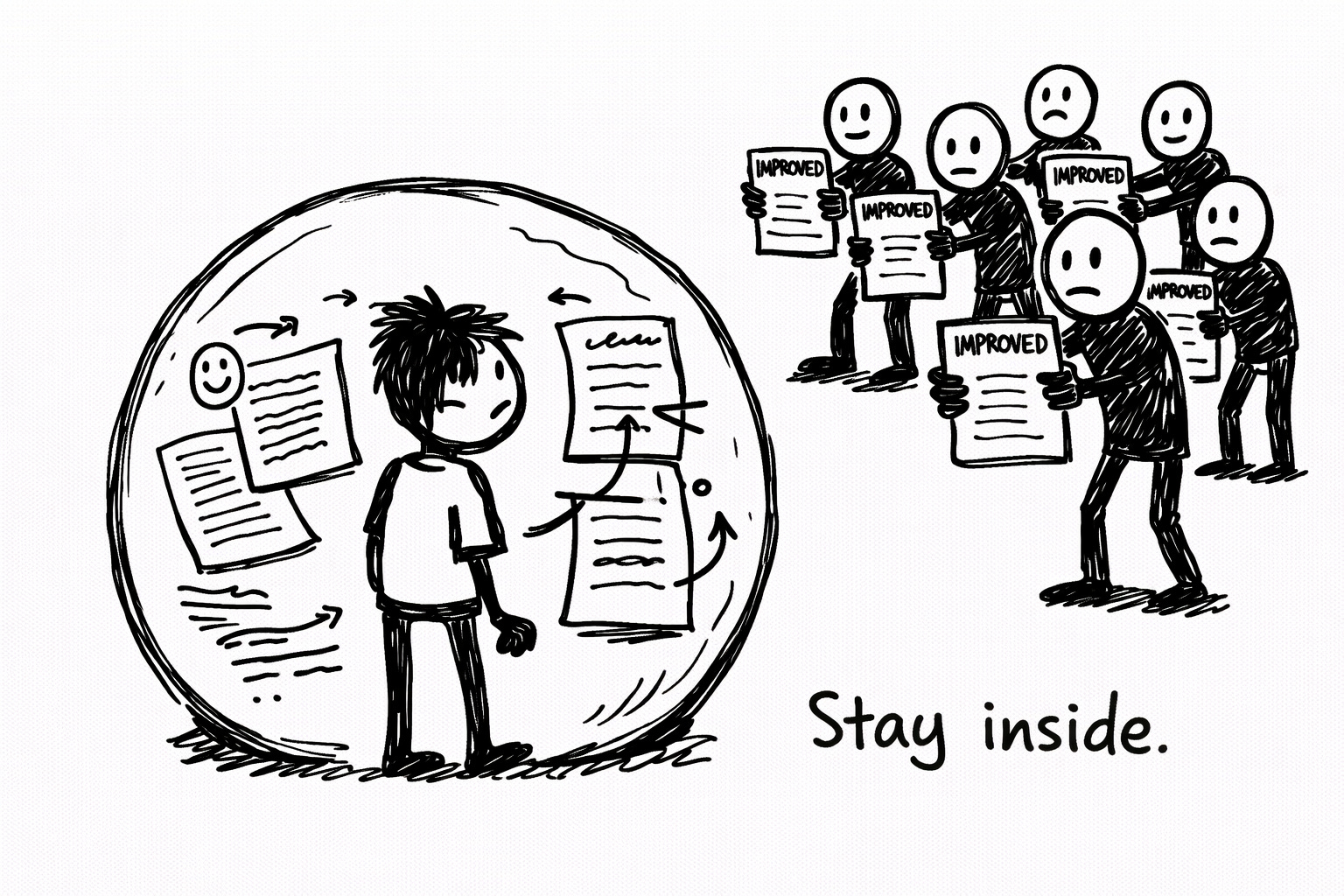
The goal is to collaborate as yourself.
Quick-Start: 60 Seconds to Start Right Now
If you want to start immediately:
Open your last AI-assisted draft
Find one thing that sounds “too smooth”
Ask yourself: “Would I actually write it that way?”
If no, that’s your doppelgänger showing. Put your version back.
Minimum viable protection: Do this for the first paragraph of every AI collaboration. Takes 60 seconds. Catches 80% of voice drift.
You can run the full hunt later. This stops the bleeding now.
What Your Doppelgänger Knows
There’s one more thing the doppelgänger reveals.
Your voice isn’t a vibe.
It’s not a feeling or an “energy” or whatever vague nonsense people use to avoid doing the actual work. (I’ve tried explaining my voice as “energetic but grounded” and the resulting AI output sounded like a yoga instructor who’d recently discovered LinkedIn.)
Your voice is a set of patterns. Specific, nameable, documentable patterns.
Your doppelgänger knows those patterns. It knows them because it’s trained to remove them. Every time it “improves” your writing, it’s showing you exactly what makes you different from the statistical average.
The flaws it erases? Those are the evidence you were there.
The things it finds inconvenient? Those are the only things worth protecting.
Most writers never see this. They let AI sand their edges down, piece by piece, until one day they read their own work and feel nothing. Like watching your parents get old and realizing you can’t remember them young.
That’s a tragedy, by the way. A very small, very quiet tragedy that happens every day. No explosion. No villain. Just a gradual dimming until one day the light goes out and you can’t remember when it got so dark.
You’ve seen the X-ray now.
You know where your bones are. You know what the monster wants to eat.
Protect it. Be stubborn and unreasonable about it.
The world has enough smooth. The world is drowning in professional. The world needs whatever weird, imperfect, inconvenient thing you were going to make before you got scared and asked someone to fix it.
The Landing
Your doppelgänger is still out there. Training every day. Getting more efficient. Learning new ways to sound like everyone else, faster.
Let it.
You’ve got something it will never have: the flaws that make you real. The odd phrasing you can’t explain but refuse to change. The patterns that exist because you exist. The voice that sounds like you because it is you.
My clone is still writing somewhere. Polished. Prolific. Forgettable. Probably getting more engagement than me, honestly.
Good for it. We all make choices.
I’m keeping the sentence fragments.
🧉 What does AI always try to “fix”
in your writing? What’s on your doppelgänger inventory?
Drop it in the comments. I want to see what patterns emerge. I want to know what makes you impossible to replicate.
And if you know a writer who’s been feeling like their work sounds less like them lately, send them this post. They’ve probably been feeding their doppelgänger without knowing it. It’s not too late.
Crafted with love (and AI).
Nick "Your Doppelgänger Hates Me" Quick
PS… I do this every day. Daily emails about voice, AI, and refusing to disappear into the algorithm. Some of it’s tactical. Some of it’s philosophical. All of it’s written by a guy who thinks “clean prose” is a euphemism for “boring as hell.” Subscribe or don’t. But if your doppelgänger keeps winning, don’t say I didn’t warn you.
Noooo, I ask if work flows and how it can be tightened up as the first step of every AI edit 😂🫨🤯🤦🏻♀️ BUT, I am hoping I have redeemed myself in that I find I use Option C almost exclusively now. AI gives its new edited version, but I still have my original draft that I work from and I determine what stays and what gets accepted with a greater degree of control as the edit is not done exclusively in AI (and it does diminish the ongoing while vs. whilst friction!).
I use a prompt of Mia's for texturizing language at the end of the edit and tearing out some polish/corporate speak that may have crept in. Works a treat! Although never ask AI to come up with it's own metaphors, very hit and miss 😂
I found this to be the case with Grok, Gemini, Perplexity, and ChatGPT, but I have found that Claude is very good at consistency, not forgetting what I have written and building on it. Have you tried Claude for your writing?