
I Deleted My 3-Page Voice Guide. Here’s What I Use Now.
Three Sentences. That’s It. That’s the Whole Method.

I teach people how to make AI sound like them for a living.
Which means I’ve seen every version of the “voice guide” approach. The Google Docs full of adjectives. The style guides cobbled together from blog posts. The elaborate attempts to document “how I write” that somehow make AI output worse instead of better.
And I’ve figured out why they fail.
Most DIY voice documentation is a soup of contradictory instructions. “Be conversational but professional.” “Sound confident but approachable.” “Use short punchy sentences but also vary your rhythm with longer ones.”
Every line cancels out the last. Bland stacked on top of bland. Adjectives that could describe anyone, combined in ways that describe no one.
AI reads this mess and does what any reasonable system would do: it finds the average. The statistical mean of “conversational” and “professional” and “punchy” and everything else you threw at it.
You don’t get your voice. You get the Platonic ideal of generic.
(And the cruel part? The more instructions you add, the more contradictions you create, the more generic the output becomes. Effort and results moving in opposite directions. A beautiful disaster.)
There’s a right way to do this. I call it a Voiceprint—a systematic approach to documenting your divergent patterns in a way AI can actually use. Done correctly, it’s the most reliable method I know.
But “done correctly” is doing a lot of heavy lifting in that sentence.
Most people aren’t there yet. And a bad voice document loses to no document at all.
So here’s what I give everyone who isn’t ready for the full methodology: a shortcut that gets you 70% of the way there in ten minutes, without risking the “contradictory instruction soup” problem.
I call it the Sentence Steal.
The Method That Sidesteps Description Entirely
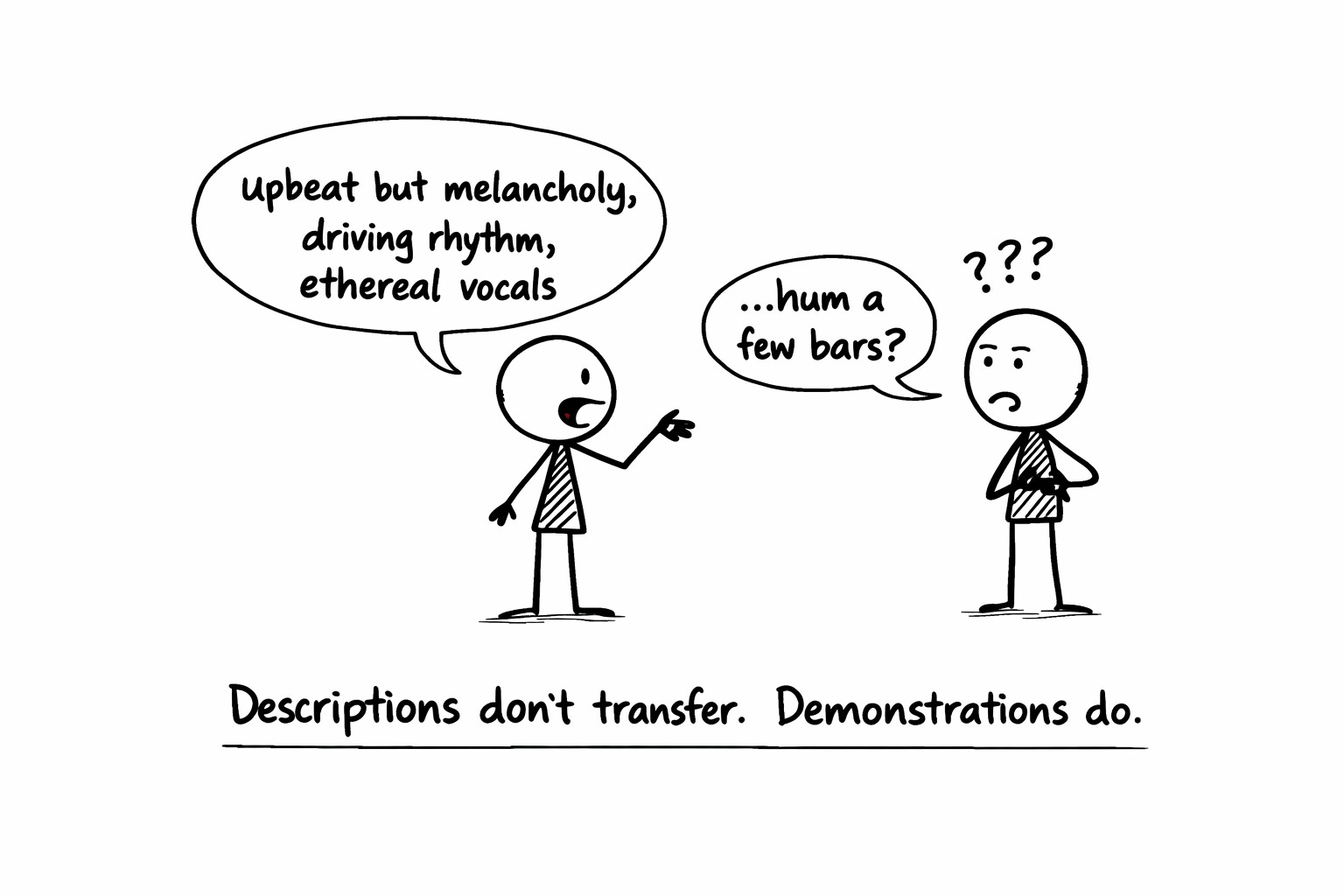
Instead of telling AI what your voice sounds like (and watching it average your adjectives into oblivion), you show it.
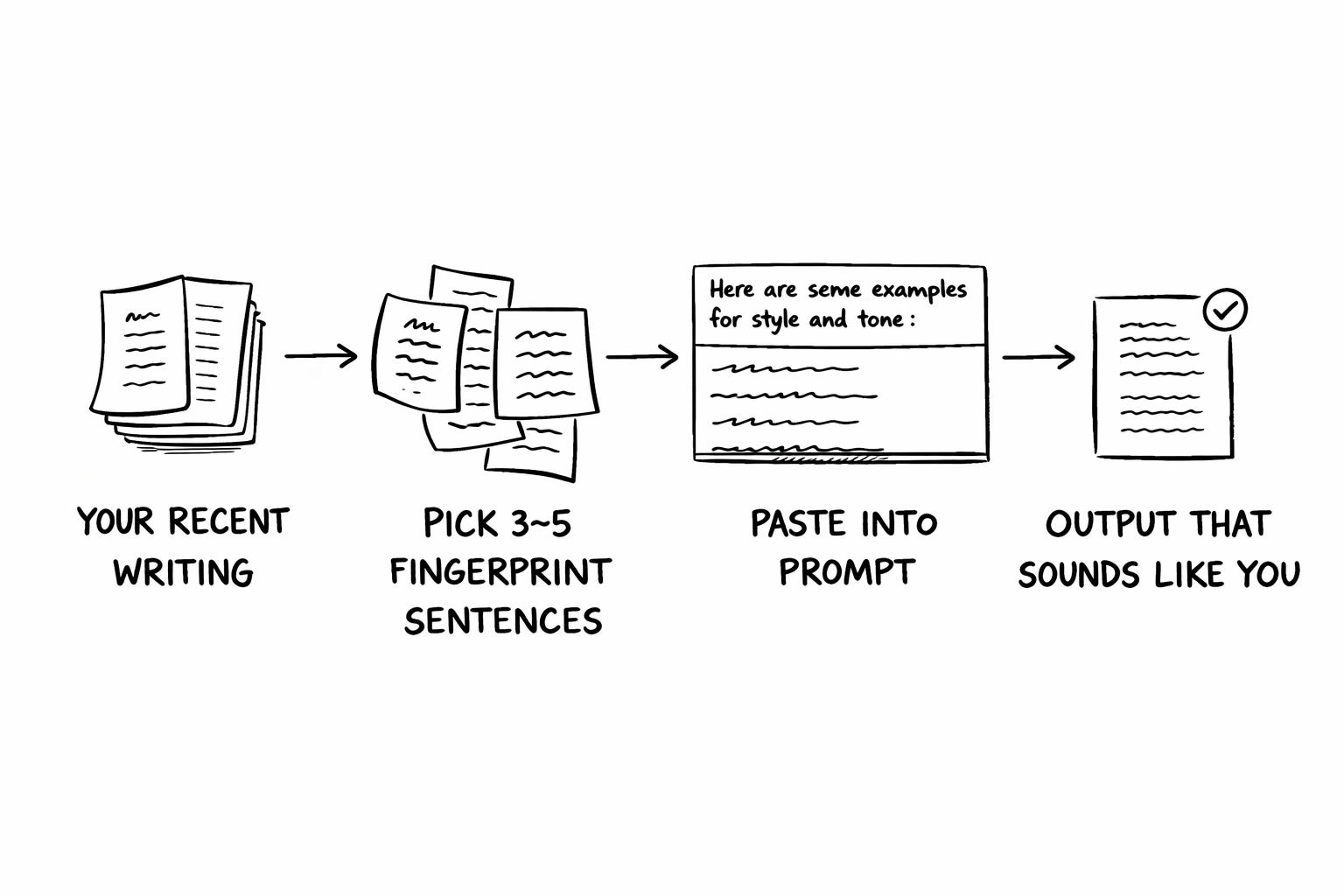
You find 3-5 sentences you’ve already written—ones with your fingerprints baked into the structure—and paste them directly into the prompt.
No analysis. No vocabulary taxonomy. No elaborate framework explaining why you use parentheticals like they’re going out of style. (They’re not. They’re my entire personality in punctuation form.)
Just: “Match the voice and style of these examples.”
AI pattern-matches. That’s what it actually does well. So give it patterns worth matching.
When you describe your voice, AI has to translate your adjectives into patterns. That translation goes through a filter of everything it’s ever seen. Your “punchy” gets averaged with everyone else’s “punchy.” Your “conversational” gets smoothed into the world’s most forgettable conversation.
But when you show AI your actual sentences?
No translation required. No averaging. No regression toward the mean.
You’re not describing a song. You’re playing the damn song.
How to Find the Sentences Worth Stealing
Not every sentence qualifies.
You’re looking for what I call fingerprint sentences. The ones that carry your voice in their DNA, not just their content. Strip away the topic and the fingerprint remains.
Here’s the filter I use:
Does it have rhythm?
Your short-long variation. Your punctuation personality. The way you build and release tension in a single sentence. Does it move the way your sentences move?
Does it have stance?
Is your point of view baked into how it’s written, not just what it says? A sentence with stance sounds like it has an opinion before you even know what the opinion is. It leans. It commits.
Does it feel like a fingerprint?
Could only you have written it this way? Would someone who reads your work regularly recognize it without the byline?
You want 3-5 sentences that pass all three.
Here’s the counterintuitive part: you’re not looking for your best writing. You’re looking for your most characteristic writing. The sentences that came out fast, before your editing brain started sanding off the interesting edges.
(This is why your texts to friends have more personality than your published work. You didn’t have time to become professional. You just sounded like yourself.)
The Template You’ll Use Forever
Once you have your fingerprint sentences, the prompt structure is almost insultingly simple:
Match the voice and style of these examples:

"[Your fingerprint sentence 1]"

"[Your fingerprint sentence 2]"

"[Your fingerprint sentence 3]"

---

Now write: [Your actual request here]
That’s it. That’s the whole method.
Your examples don’t need to relate to your request. AI is matching voice patterns, not subject matter. You can use sentences about your weekend plans to generate business content. The what doesn’t matter. The how does.
The Before/After That Made Me a Believer
Let me show you what this looks like in practice.
The Description Approach (What Everyone Tries First):
Write an opening paragraph for a newsletter about AI writing.
Use a conversational, slightly cynical tone. Mix short punchy
sentences with longer ones. Include self-deprecating humor.
Sound smart but accessible.
The output: technically correct. Every adjective accounted for. “Conversational” showed up. “Cynical” made an appearance. Self-deprecation arrived right on cue, like an actor hitting their mark.
And it sounded like every other newsletter ever written.
The written equivalent of “fluent in sarcasm” on a dating profile. (Translation: mildly hostile, zero self-awareness, thinks cruelty is wit.)
The Demonstration Approach (The Sentence Steal):
Match the voice and style of these examples:

"I teach people how to make AI sound like them for a living.
Which means I've seen every version of the voice guide approach
fail in exactly the same way."

"Every line cancels out the last. Bland stacked on top of bland."

"But 'done correctly' is doing a lot of heavy lifting in that sentence."

---

Now write: An opening paragraph for a newsletter about AI writing
The output: same topic, different species.
It had rhythm that wasn’t default. Structural choices that felt intentional. A point of view that leaned instead of hedged.
Still needed editing. (AI always needs editing. Yes, even mine. Especially mine. Anyone who claims exemption is selling something—and bruh, so am I, but at least I’m honest about the editing part.)
The difference was where it started.
My patterns instead of the averaged patterns of eight billion Facebook rants. That’s not small. That’s the difference between a voice and an echo. Echoes are accurate. They’re just not yours anymore.
The Part Where I Tell You This Isn’t Everything
Here’s the thing I won’t pretend otherwise about:
The Sentence Steal gets you 70% of the way there. Maybe 80% on a good day.
That’s not 100%. It’s not a fully-calibrated Voiceprint that captures your divergent patterns across multiple contexts and content types. It’s not a systematic methodology that evolves with your voice over time.
But 70% that sounds like someone beats 0% that sounds like everyone.
And it beats the hell out of a contradictory voice document that’s actively making your outputs worse.
Think of it as the difference between a sketch and a finished portrait. The sketch captures something essential. It gets the proportions right. You can recognize the subject.
The portrait is better. More nuanced. More complete.
But if your only options are a bad portrait and a good sketch, take the sketch every time.
(The Voiceprint methodology is the full portrait. I have a course on it if you ever want the whole system. But today we’re just sketching.)
Troubleshooting for the Skeptics and the Stuck
“I can’t find sentences that feel like fingerprints.”
You’re probably looking at the wrong writing. Your published work has been edited toward professional. Check your emails to friends. Your Slack messages. The drafts you never posted because they felt “too much.” That’s where your actual voice lives, unpolished and distinctive.
“I tried this and the output is still generic.”
Your example sentences might be too normal. Look for the weird ones. The sentences where you made structural choices no template would suggest. Strange punctuation. Unexpected rhythm. The stuff you almost edited out for being “too you.” That’s exactly what you need.
“I write differently for different contexts.”
Good. You’re not a robot. Create separate sentence collections. Newsletter You gets one set. Email You gets another. They’re all you. They just dress differently depending on who’s in the room.
“What about longer content? Will 3 sentences carry a 2,000-word piece?”
For longer work, use 5-7 sentences that represent different aspects of your voice. Some openings. Some transitions. Some punchy lines. Some longer thoughts. Give AI more patterns to match and it’ll have more to work with.
The Uncomfortable Part
Here’s what I know and kind of wish I didn’t:
Most people will read this, nod along, and never actually try it.
They’ll think “that makes sense” and then go back to their contradictory voice documents, wondering why AI still sounds like a press release with a thesaurus addiction.
(I’ve done this too. With other people’s advice. We’re all hypocrites about the things we haven’t prioritized yet.)
But for the ones who actually try it—
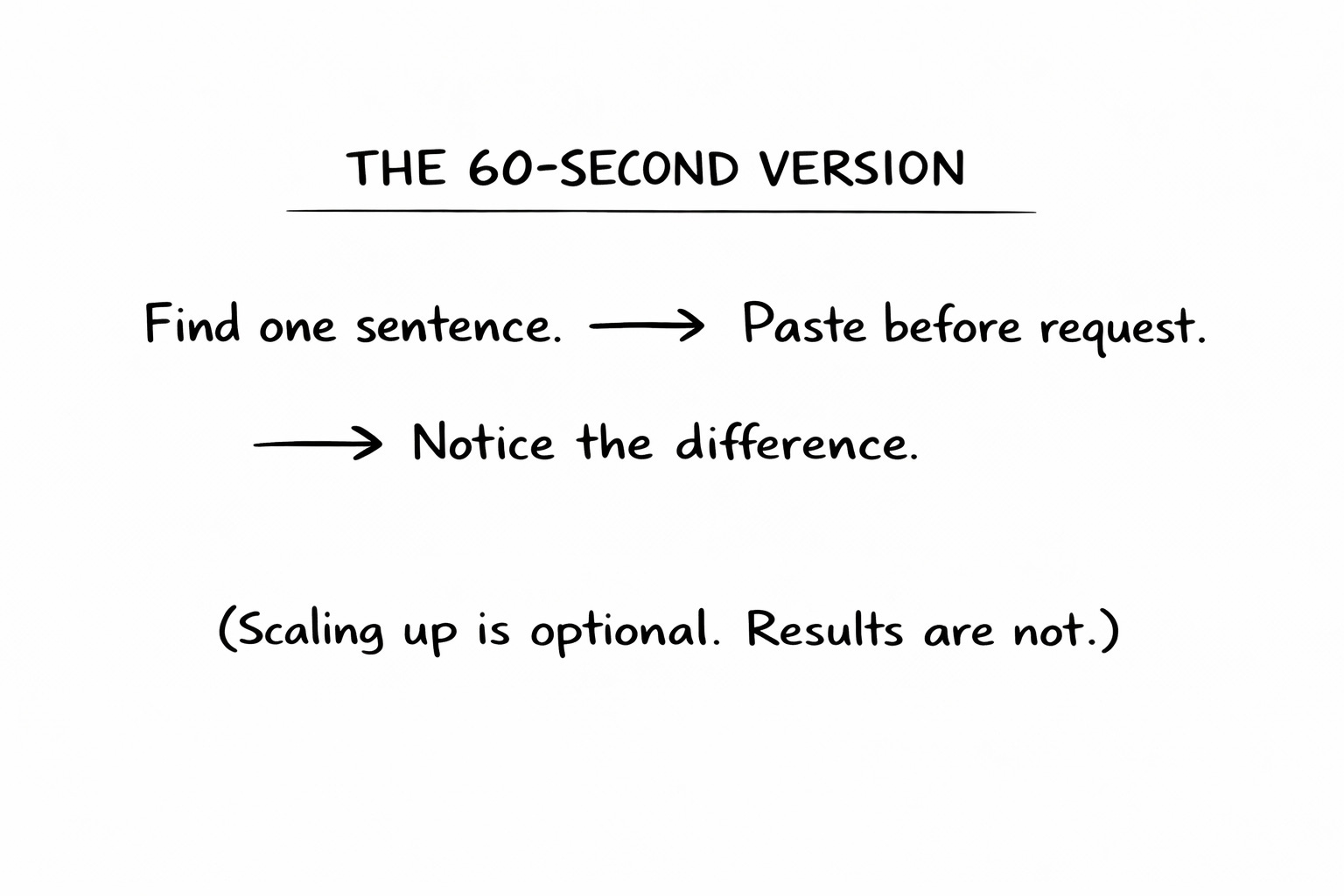
Find one sentence. Right now. From the last thing you wrote that wasn’t for publication.
One sentence that sounds like you at your most you.
That’s your first steal.
Paste it into your next prompt. See what happens.
The difference won’t be subtle.
Your voice already exists in the sentences you’ve already written. You don’t need to analyze it into existence. You don’t need to describe it with contradictory adjectives. You just need to show AI what it looks like and let pattern-matching do the rest.
What sentence have you written that feels like a fingerprint? Drop it in the comments. I want to see what your voice looks like in one line.
Crafted with love (and AI),
Nick “Grand Theft Syntax” Quick

PS…Subscribe. I do this a lot. Some of it’s even good.