
I Asked Claude for a Paragraph. It Gave Me an Essay.
Why AI over-explains everything, and the copy-paste fix that trains it to STFU.

I asked Claude for a two-sentence bio a few weeks back.
What I got back could have been filed as a short story. Four paragraphs. For a bio. A bio that needed to fit under a headshot on a summit landing page, wedged between my name and a button that says “Learn More” that nobody was going to click anyway.
It included my “journey into AI collaboration” (a phrase I would sooner tattoo on my forehead in Comic Sans than publish voluntarily), two sentences of context about the creator economy that existed purely because Claude apparently felt the reader needed a history lesson before learning my name, and a closing line about my “commitment to authentic content creation.”
Commitment. To authentic content creation. Written by a machine. About me. Without a shred of self-awareness.
(I stared at it for thirty seconds. Then I highlighted all four paragraphs, hit delete, and wrote “Nick Quick teaches creators how to stop AI from eating their voice. He lives in Paraguay with a 4-pound chihuahua who is better behaved than most AI models.” Took eleven seconds. Both sentences are true. One of them is more impressive than anything Claude suggested.)
This is AI’s worst habit. And I don’t mean the vocabulary problems or the tone drift. Those get all the attention because they’re easy to spot. They’re the typo in the ransom note. Obvious. Fixable.
The over-explaining is the termite in the wall. Invisible. Structural. Slowly eating the floor out from under every draft you publish while you stand on top of it thinking the house feels fine.
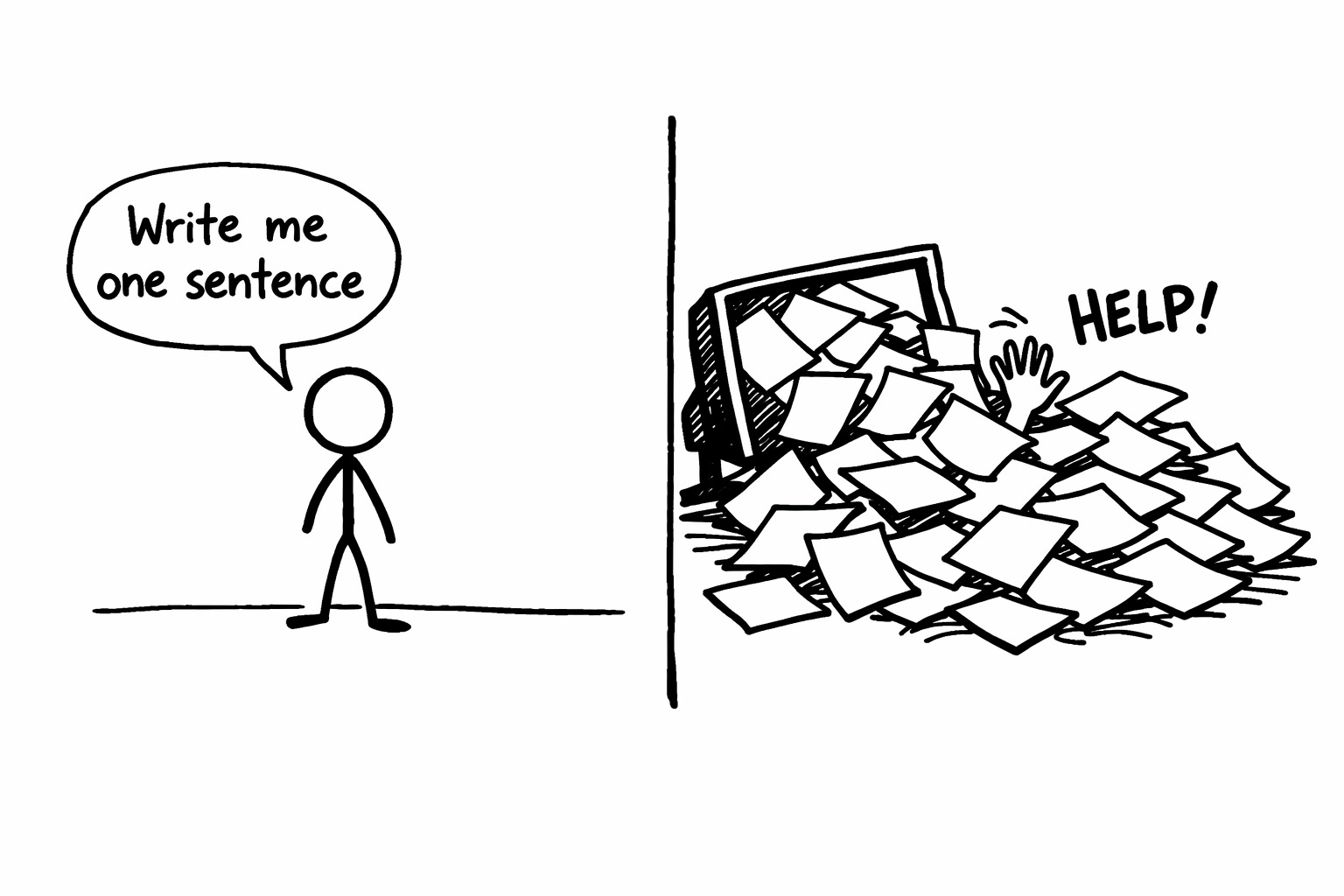
Why AI Can’t Shut Up
AI models were raised by committee. Thousands of human raters, during training, consistently gave higher marks to longer answers. The longer one felt more complete. More helpful. More like the AI was really trying.
(It was trying. The way your mom tries when you mention you’re “a little cold” and she returns with two blankets, a space heater, soup she started making before you finished the sentence, and a WebMD article about early-onset hypothermia. Enthusiasm is not the same as precision.)
So “helpful” got welded to “comprehensive.” And “comprehensive” got welded to “say everything even tangentially related to the topic, including context nobody requested, qualifiers nobody needed, and a tidy summary at the end in case the reader suffered amnesia between paragraphs two and four.”
Every draft comes back 40-60% longer than it needs to be. And most of that padding reads fine. Professional enough to survive a quick scan, empty enough to waste everyone’s time.
The Fix (Two Prompts, Ten Minutes, Your AI Shuts Its Damn Piehole)
I could theorize about this for another eight hundred words. I won’t. You came here for something you can use today and I respect that more than I respect my own desire to sound comprehensive.
(See how that works? I just modeled the fix. You’re welcome. I’ll accept payment in the form of a lil tappity-tap on the like button or a strongly worded restack.)
Prompt 1: The Word Budget (Paste This Before Every Writing Task)
“Write this in [X] words or fewer. If the idea doesn’t need [X] words, use fewer. Do not add context, preambles, qualifiers, or conclusions I didn’t ask for. Start with the point. End when the point is made.”
Set the budget at 70-75% of what you actually want. AI inflates. You compensate.
You want a paragraph? Say “3-4 sentences maximum. No setup.”
You want 300 words? Budget 200-225.
You want a bio? “2 sentences, under 40 words. No journey narratives.”
(I have to specifically ban “journey narratives” now. I have to look a language model in its statistically averaged face and say “do not describe anyone’s journey.” This is the future we built. Incredible. Absolutely worth every venture capital dollar.)
Prompt 2: The Trim Correction (Paste This After Every Padded Draft)
The budget helps. AI will still occasionally show up with extra paragraphs like a cat depositing a dead mouse on your pillow and expecting praise. When it does:
“Cut this by 40%. Remove: any context-setting I didn’t request, any preamble before the main point, any ‘however’/’that said’/’to be sure’ qualifiers, any concluding summary that restates what you already said. Keep only sentences that teach something new or make an original claim.”
Then look at the wreckage. AI’s padding follows the same four patterns every single time, like a pickpocket with exactly one move:
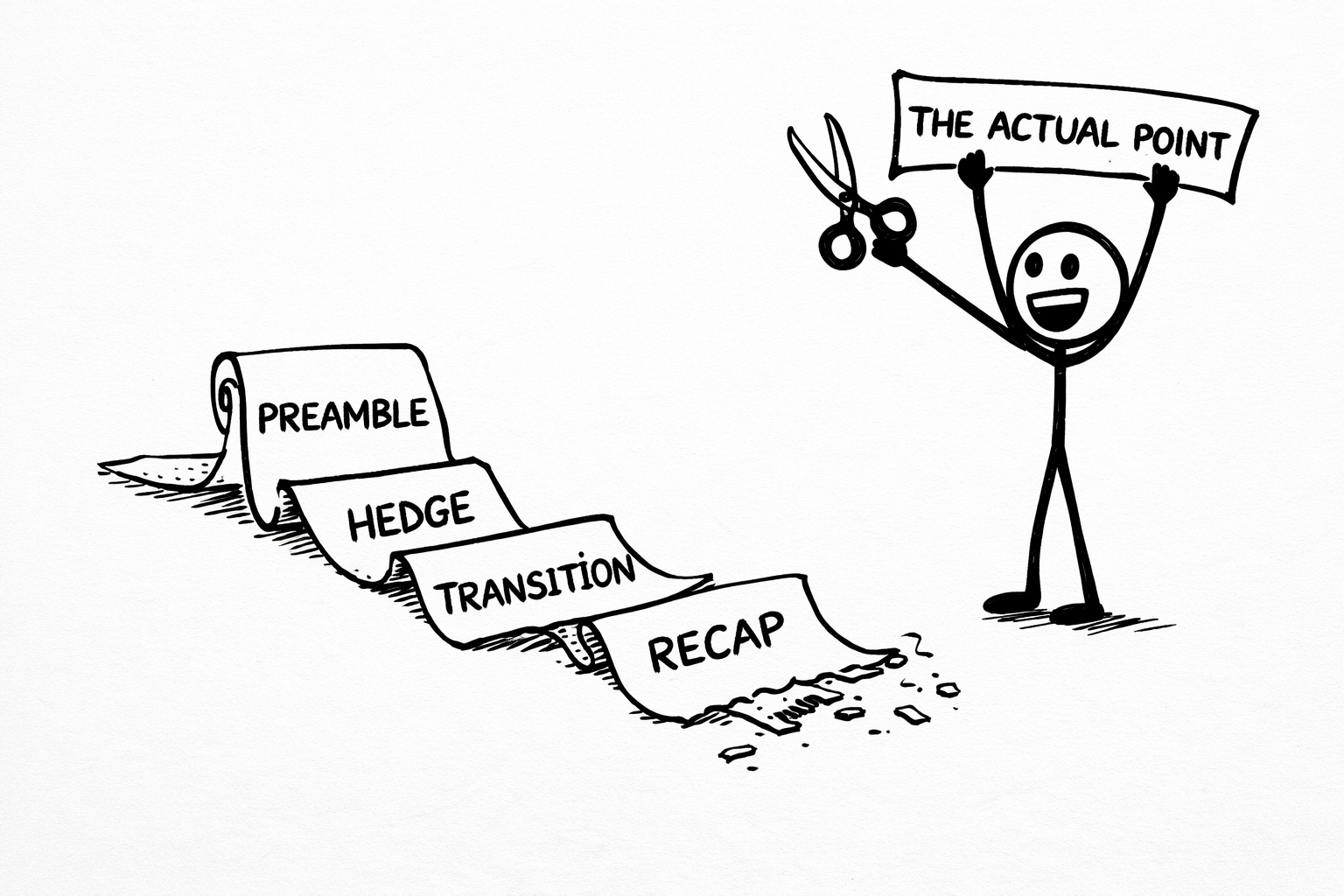
The Setup Paragraph. Two to three sentences of “here’s why this matters” before the content that actually matters. Your reader was already listening. They didn’t need the warm-up act.
The Hedge Cluster. “However.” “That said.” “To be sure.” Protective qualifiers that weaken every claim they touch. AI hedges the way a nervous poker player bets. Small, careful, designed to minimize loss. Which also minimizes the chance of anyone giving a damn about what you wrote.
The Invisible Transition. “With that in mind.” “Building on this.” Sentences that exist to sound organized but communicate nothing. The elevator music of prose.
The Summary Reflex. A final paragraph restating the section. Your readers remember what they read thirty seconds ago. They don’t have the memory span of a concussed goldfish. (Although if they did, the summary still wouldn’t help, because they’d forget the summary too. The whole exercise is pointless on every level. AI does it anyway.)
Once you see these four moves, you can’t unsee them. You’re welcome and I’m sorry.
Make It Permanent
Build the anti-bloat instruction into your system prompt. Claude Projects, Custom GPTs, whatever you collaborate with:
“Default to concise. Never add context, preambles, qualifiers, or summaries unless explicitly requested. When choosing between saying more and saying less, say less. The reader is intelligent and doesn’t need hand-holding.”
Your readers aren’t confused. They subscribed. They opened the email. They clicked through. They’re here. They don’t need a welcome packet and an orientation video. They need you to get to the damn point.
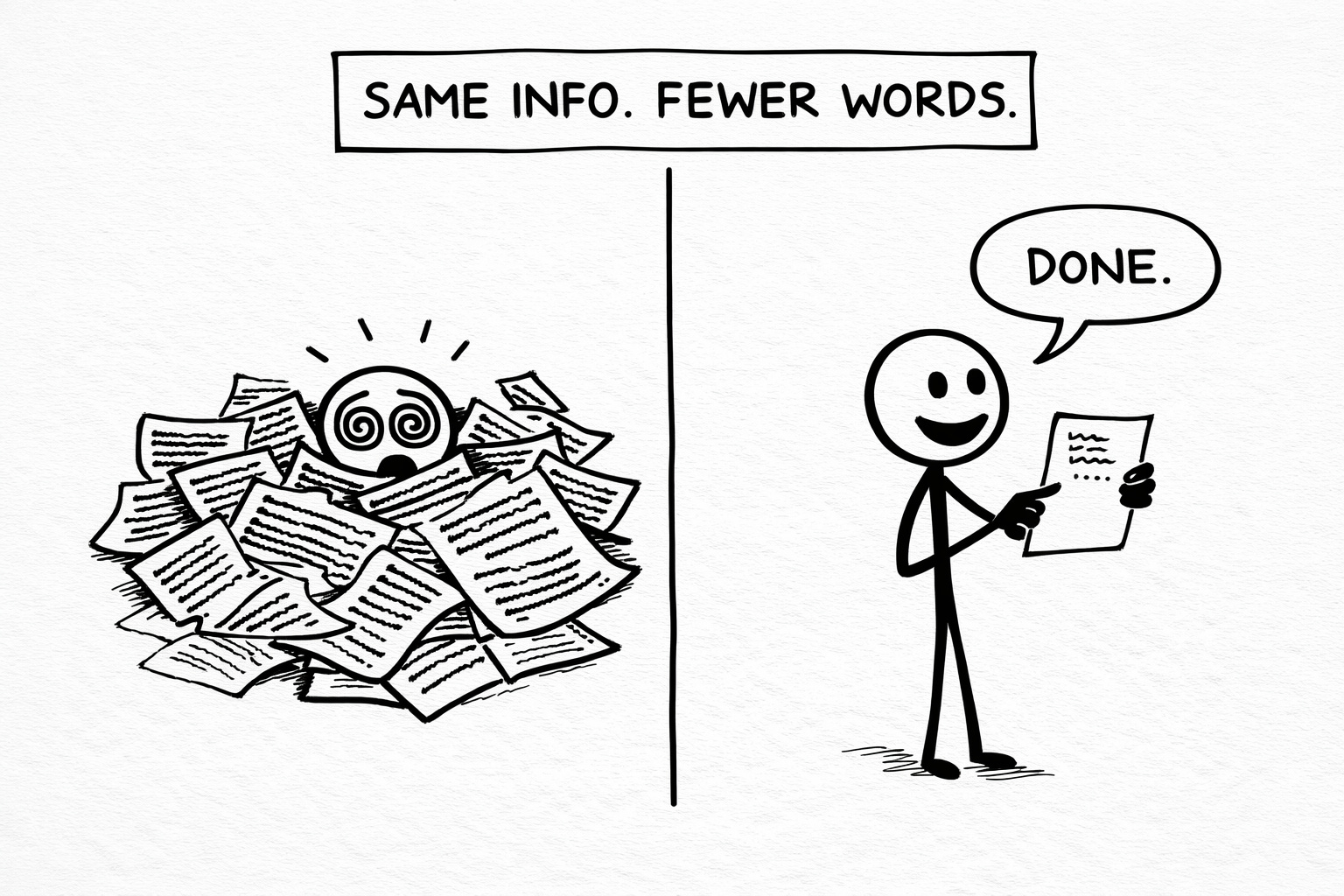
🧉 What’s your AI’s most annoying padding habit? The preamble before every point? The qualifier after every claim? The conclusion that restates what it just said as if you developed amnesia between paragraphs? Drop the worst offender below. I want to see if we’re all fighting the same four patterns or if your AI has invented exciting new ways to waste your time.
Your AI doesn’t have a quality problem. It has an editing problem. It’s the dinner guest who said goodbye twenty minutes ago and is still talking in your doorway. Close the door.
Crafted with love (and AI),
Nick “Chief Verbosity Surgeon” Quick
PS... The word budget fixes the bloat. The Ink Sync Workshop fixes everything else. Three-step calibration loop. Free. About 90 minutes. By the end of it, AI stops guessing what you sound like and starts following actual directions. (Revolutionary concept, I know.)

PPS... This post was 2,500 words. I was literally about to hit publish. Finger on the button. Then I read the title. Then I read the draft. Then I fed my own post through Prompt 2 and cut over a thousand words that were doing exactly what I just told you to stop doing. If there’s a support group for this kind of recursive self-own, please DM me the meeting link.