
How "Unprofessional" Content 4x'd My Engagement
The counterintuitive strategy that makes AI slop irrelevant

A year ago, I wrote exclusively for clients.
Professional was the job. Clean sentences. Logical structure. Nothing that would make anyone uncomfortable. Nothing that would make anyone anything, really. The point was deliverables. The point was getting paid to sound like a press release with better punctuation.
I was good at it. (This is not a flex. Being good at forgettable writing is like being good at holding your breath. Technically impressive. Cosmically pointless.)
Then the clients disappeared. Not by choice. The economy did that thing where everyone pretends layoffs are “restructuring.” Now I eat packet ramen every meal and write whatever flips my nip. The ramen is a downgrade. The writing is not.
The first piece I published that actually sounded like me was an accident. Run-on sentences. Jokes only I would laugh at. A paragraph that started with “Look,” which I’d specifically told myself to stop doing.
I got tired. Hit publish. Went to make some Cup Noodles.
It did 4x everything I’d written that month.
When I analyzed why, the answer sat there looking at me like I was the idiot. It worked because it sounded like someone who’d spent too much time on Twitter and not enough time attending webinars about webinars.
The Ghost That Followed Me
You can fire your clients. You can’t fire the voice they trained into you.
I’d been using AI to help me write. Every session: remove the weird parts. Smooth the rhythm. Make it sound like someone with a LinkedIn Premium account and recycled opinions.
Except I didn’t have clients anymore. I was optimizing for Casper the Middle-Management Ghost.
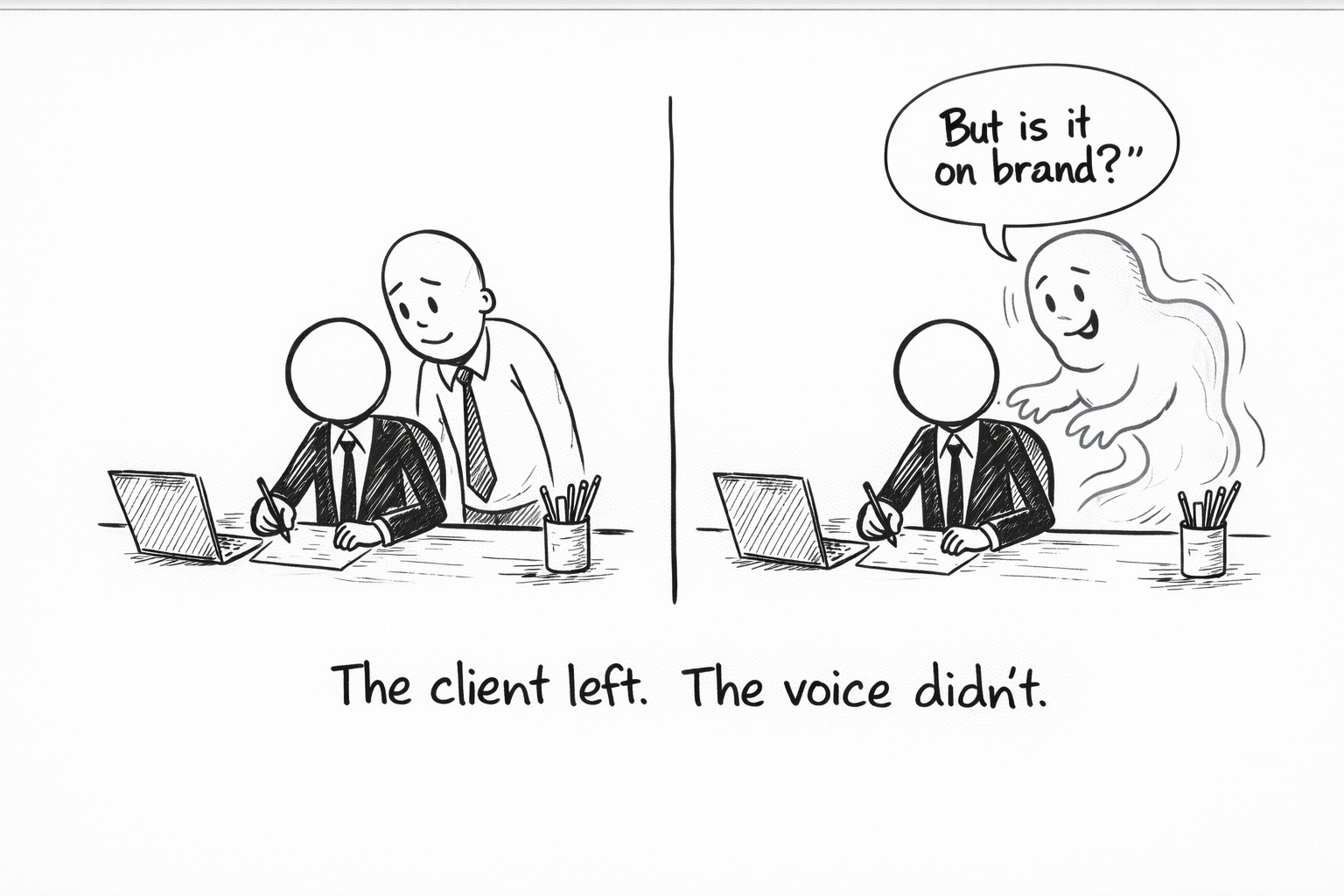
The post that worked broke every rule I’d internalized:
Too compressed. Client work taught me to pad things out. More words looked like more value. (A profitable lie if you’re billing hourly.)
Too specific. References not everyone would get. Clients wanted broad appeal. “Can we make this more accessible?” was code for “remove everything interesting.”
Too absurd. The weird metaphor was a risk no client would have approved. (A metaphor held hostage by a client who’d stopped paying me six months ago. They almost won.)
Too informal. Sentence fragments everywhere. The grammar teachers and the brand guidelines formed an alliance against personality.
These weren’t mistakes. They were choices I almost edited out because years of client work had convinced me that writing was supposed to sound like a landing page.
The internet ate it up. The client-approved version would have been scrolled past like every other banner ad.
What Actually Resonates
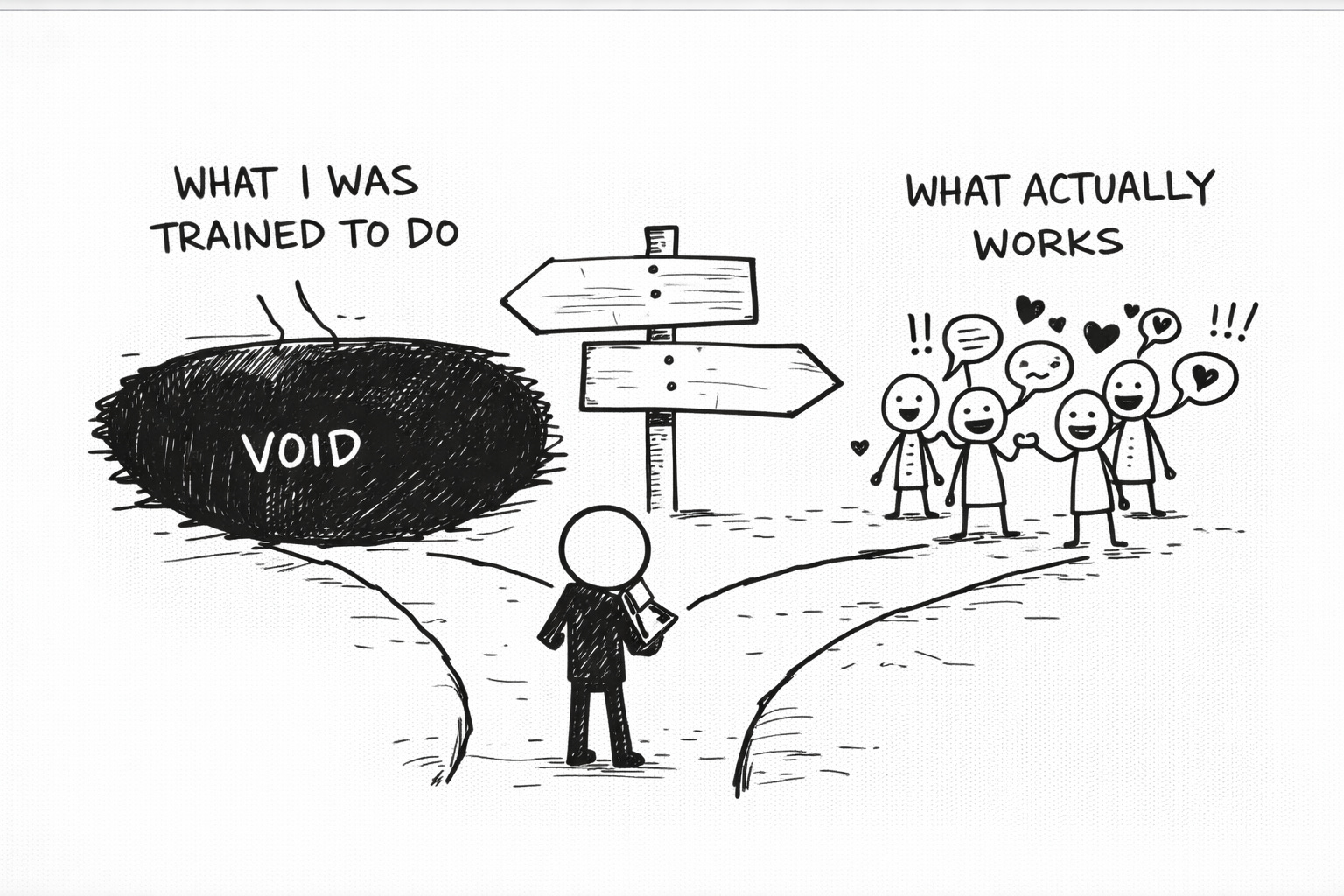
Client work optimizes for “no one can complain about this.”
The internet optimizes for resonance. Which means:
Specificity over generality. Content for someone specific, even if it excludes others. Especially if it excludes others.
Compression over expansion. Dense meaning. No padding. Trust the audience to keep up.
Emotional charge over neutrality. Actual feeling. Not professional distance. Professional distance is why branded content has the same energy as a stock photo of “woman laughing at salad.”
Risk over safety. Weird references. Strong opinions. Clients hate risk. The internet rewards it.
Memes figured this out years ago. AI defaults to the opposite: general statement plus logical progression plus neutral tone plus expansion.
One survives the scroll. The other IS the scroll.
Feral Mode: A Deprogramming Guide
I couldn’t just tell AI to “stop sounding like client work.”
It interpreted “casual” as “corporate with contractions.” Like HR after two beers at the company happy hour.
I tried “be funnier.” It gave me dad jokes in business casual.
I tried “be weird.” It gave me random, which is not the same thing. Random is easy. Specifically weird in a way that reveals personality? That’s craft.
Four adjustments made the difference. I call it Feral Mode, because I’m the kind of person who names things and has made peace with being insufferable about it.
1. Cultural Compression
The fix: “Compress aggressively. If it can be said in 5 words, don’t use 10. Cut setup. Start at the point.”
Plus: “Now cut this by 40%. Keep only what’s emotionally necessary.”
Before: “In today’s fast-paced digital landscape, content creators face the ongoing challenge of producing material that resonates with their target audience.”
After: “Most content disappears. Yours doesn’t have to.”
2. Absurdity Thresholds
“Be weirder” isn’t actionable. AI knows the statistical average of weird, which is by definition not weird at all.
The fix: Build an absurdity bank. 5 comparisons that worked. 5 jokes that landed. Hard lines you won’t cross. Feed these to AI as calibration points.
Before: “AI can help you write better content.”
After: “AI writes like a narc trying to buy drugs for the first time. Technically using the right words. Fooling no one.”
3. Sincerity Switches
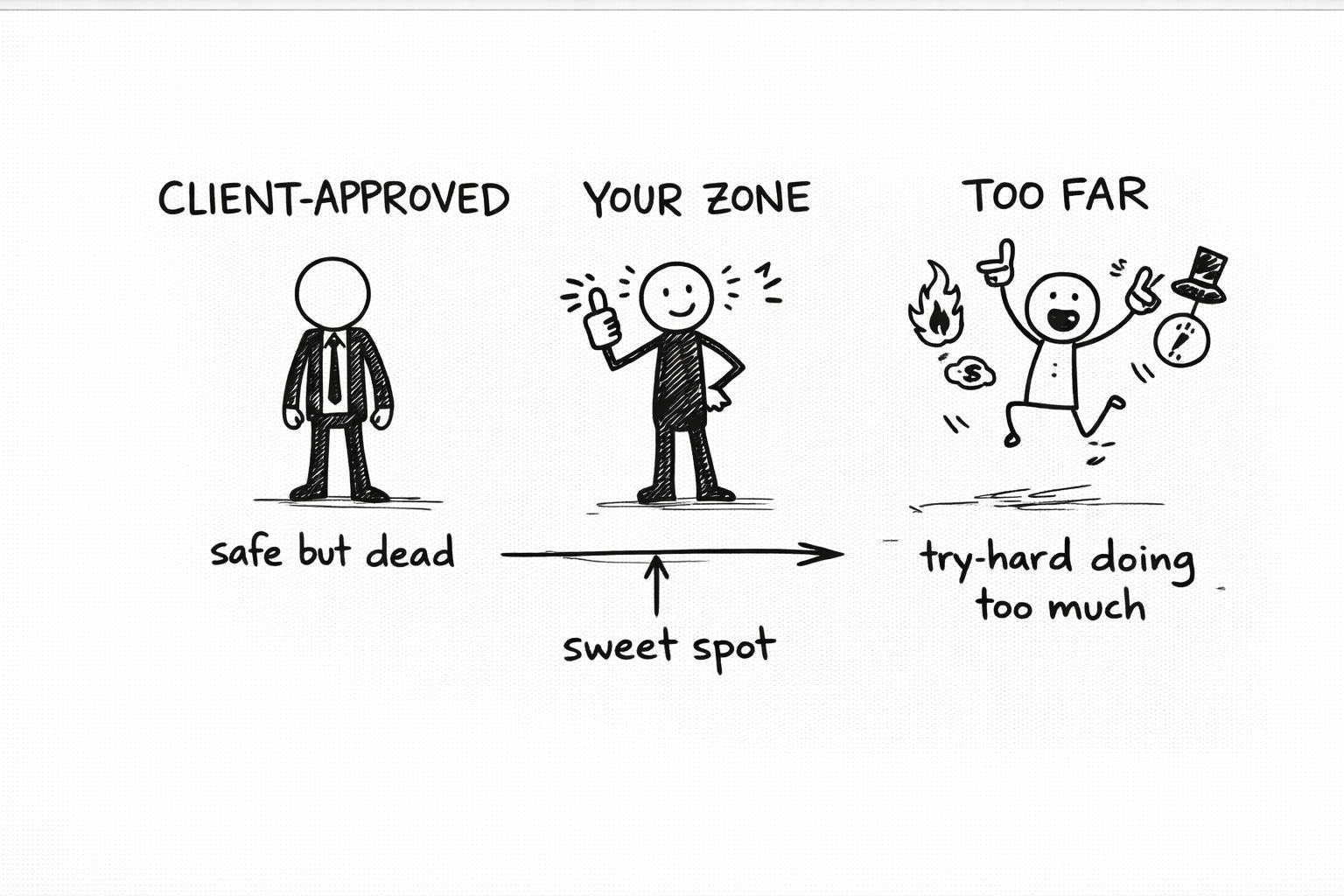
Internet writing oscillates between ironic and sincere. Sometimes in the same sentence.
Client work doesn’t allow this. Client work wants one consistent tone throughout. (Preferably “professional but approachable,” which is how a sociopath describes themself on a dating profile.)
The fix: Map when you get real versus when you deflect.
When do I drop the irony? Core beliefs. Personal experience. Anything where sincerity is the point.
When do I deflect? Compliments. Vulnerability. Anything that risks feeling like I’m taking myself too seriously. (Taking yourself seriously is fine. Taking yourself too seriously is how you start calling yourself a “visionary” in your own bio.)
Flat: “This technique will transform your content forever.”
Switched: “This actually works. (I know, I’m as surprised as you are.)”
4. Reference Radius
AI either avoids references entirely or reaches for obvious ones.
Client work avoided references because references exclude people. “Not everyone will get that” was feedback I received approximately three thousand times. It was always meant as criticism. It was actually the point.
The fix: Build a reference bank. What would feel natural? What would feel forced? What would make the right people nod and the wrong people confused?
Generic: “Fortune favors the brave.”
In-radius: “The vibe of burning a bridge and watching your career improve as the flames rise up.”
Start Here
I don’t have clients anymore.
Nobody’s paying me to be professional. Nobody’s reviewing the draft. Nobody’s asking if this will “resonate with stakeholders.”
I write like someone who's already eating ramen anyway. And it works better than anything I made when I was being careful.
You can start deprogramming in sixty seconds:
Find your weirdest piece that actually performed. What almost didn’t make it because you flinched?
Write one comparison you’d actually make that no client would have approved.
Add this to your next prompt: “Cut 40% of the words. Sound like someone who’s been online too long and has opinions. Do not sound like a press release.”
Slop sounds professional. Sound like yourself instead. Especially now that nobody’s paying you to be careful.
🧉 Discussion Thread: What’s a reference only YOUR audience would get? Drop it below. I want to see how niche we can go.
Crafted with love (and AI),
Nick “Unemployable” Quick

PS… New post every day. Not because I’m disciplined. Because I genuinely can’t shut up about this. Subscribe if that energy appeals to you.
“Professional” is often just fear with better grammar. Fear of being specific. Fear of being odd. Fear of sounding like a real person instead of a safe one.
The line about writing for “no one can complain about this” vs writing for resonance is dead on. That ghost client voice sticks around long after the invoice stops.
Also: “corporate with contractions” is painfully accurate. I’ve met that guy. He runs every meeting.
Feral Mode isn’t chaos. It’s just honesty without the brand safety net. And it turns out people notice.
“Dad jokes in business casual” 😂🤣🤣🤣🤣🤣🤣 that’s so funny. Love how you infused the You into it and you 4Xed your result, that’s badass. 🙌