
How to Lose Your Voice Without Making a Sound
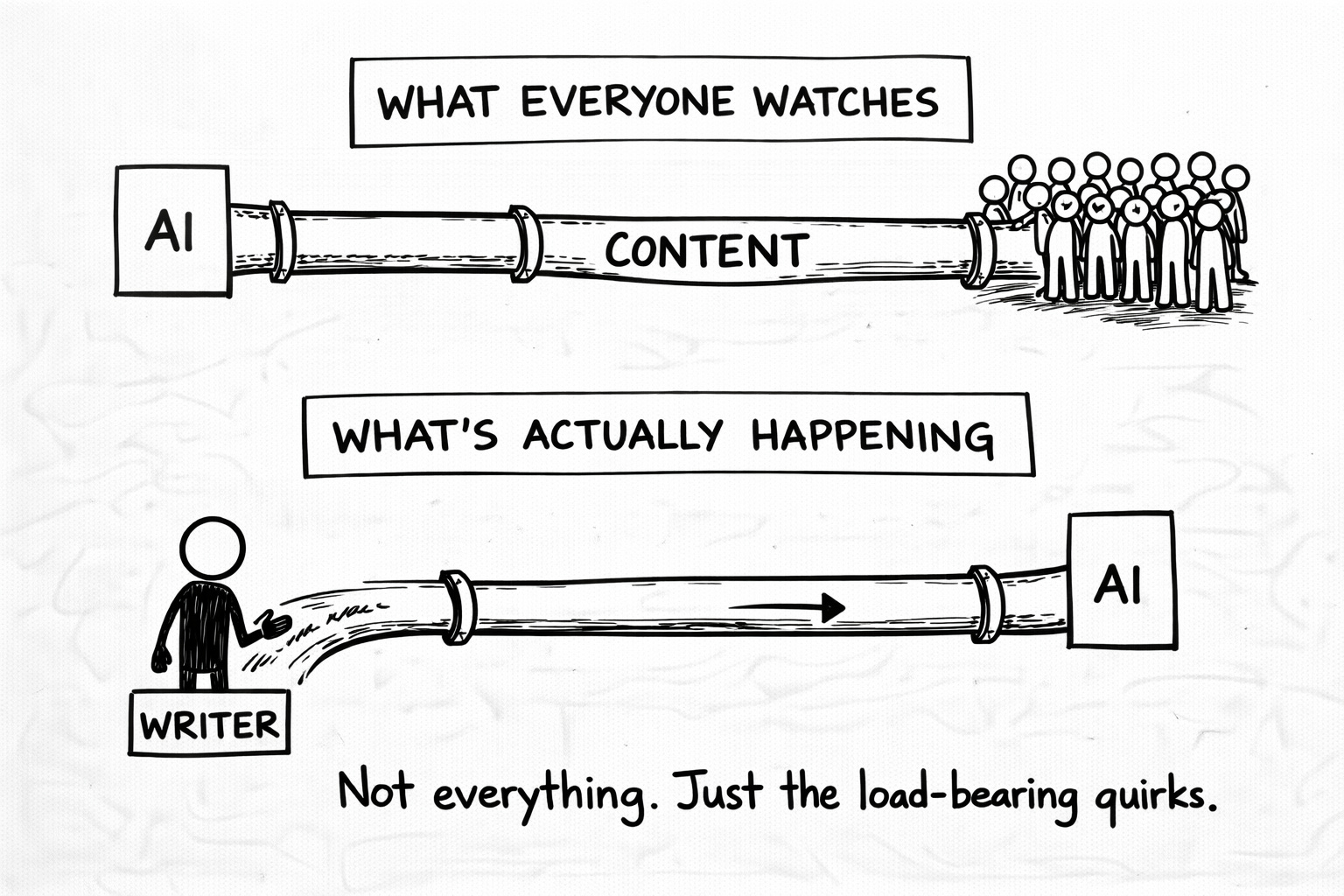
Everyone’s watching the contamination flow one direction. It’s flowing both ways.

Every tool reshapes the hand that holds it.
The hammer gives you calluses. The sword gives you scars. The pen gives you that weird bump on your middle finger that makes people think you’re either a calligrapher or have a very specific masturbation technique.
AI gives you something harder to see.
It smooths you out from the inside.
The entire discourse about AI and writing points in one direction: what AI produces. Detection tools. Humanizers. Thought leaders screaming about “slop” while churning out content that evaporates like a fart in a hurricane.
Everyone’s watching the faucet.
Nobody’s checking the pipes.
There’s another current. Quieter. It flows backward. Through you. And it’s been running for months now, maybe longer, reshaping the aquifer while you stare at the water coming out.
Your patterns are drifting toward AI.
Not because of what AI produces. Because of what AI rewards. Smooth handoffs get reinforced. Friction gets punished. Your brain keeps score like a degenerate gambler who never shows you the ledger. It just quietly adjusts your bets until one day you realize you’ve been playing a different game entirely.
The Three Mutations
I’ve identified three specific ways this drift manifests. I’ve named them, because apparently taxonomy is my trauma response. (Other people go to therapy. I make frameworks. We are not the same. I am worse.)
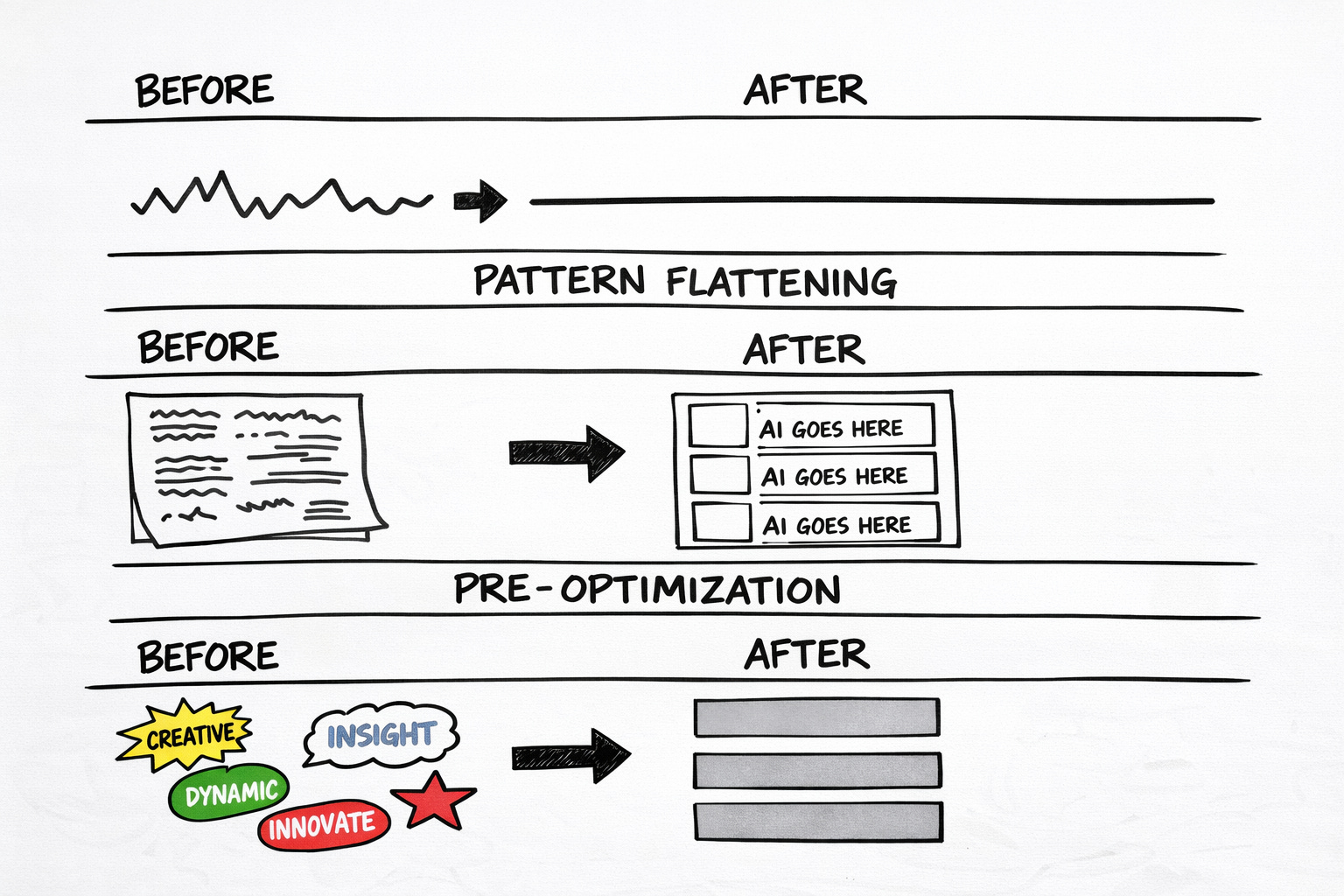
Mutation #1: Pattern Flattening
Your weird sentence structures are disappearing. The asides that let readers hear you thinking. The run-ons that earned their length through sheer audacity. The grammar crimes committed in service of rhythm.
They create friction in AI handoffs. AI encounters them like a tourist encountering a bidet—aware something’s supposed to happen, entirely unsure of the sequence.
So your brain stops reaching for them.
Not consciously. The way you stopped calling that friend who always needs something. Gradual. Merciful. Complete.
Mutation #2: Pre-Optimization
You’re building templates before the collaboration even starts. Clean paragraph breaks. Topic sentences begging to be expanded like those “add water” sponge dinosaurs. Neat little handoff points everywhere.
You’re writing for an AI that isn’t there.
Your brain learned the structure of successful AI sessions and now applies it reflexively, the way trauma survivors flinch at loud noises. Except your trauma is “Claude once mangled my best paragraph and I never emotionally recovered.”
Mutation #3: Vocabulary Smoothing
That word you loved? The unusual one with texture? The one that made readers pause and maybe feel slightly annoyed at you in a good way?
You stopped reaching for it.
Because you’ve learned AI will swap it out anyway. “Luminous” becomes “bright.” “Cacophonous” becomes “loud.” Everything interesting gets sanded to the median, and eventually you stop fighting. You just grab the boring word yourself. Save everyone the trouble.
You didn't lose the fight. You stopped showing up.
The Proof I Didn’t Want to Find
I should be immune to this.
I built an entire framework for not sounding like a chatbot. I’ve documented my own patterns with the obsessive precision of a conspiracy theorist connecting red strings on a corkboard. I teach this stuff. I have opinions about punctuation.
Three months ago, I pulled up old drafts. Before heavy AI collaboration. Just to confirm my immunity.
(Narrator: He was not immune.)
The old writing had texture. It had personality disorders. Sentences that shouldn’t work but did, the way a bumblebee shouldn’t fly but nobody told the bee.
The new writing was clean.
Organized. Professional. Expandable.
That word—expandable—is the tell. Prose optimized for a collaborator who wasn’t in the room. Paragraphs structured for handoffs that weren’t happening. I’d been writing templates for an AI that existed only in muscle memory.
I’d trained myself without noticing.
Without choosing.
The tool reshaped the hand. And the hand didn’t feel a thing until it tried to make a fist and found its fingers wouldn’t close properly anymore.
Why This Is Worse Than Bad AI Output
Bad AI output is obvious. You see it. Cringe. Delete it. Text your writer friends. Everyone laughs. The system works.
Voice drift is invisible.
It happens in the pre-verbal stage. Where thoughts become words. Where your voice lives before it reaches the page. You can’t watch yourself thinking. (I’ve tried. It’s just anxiety and half-remembered song lyrics down there. Mostly Smash Mouth for some reason. I don’t know why. That song sucked and it’s been twenty-five years. Somebody should help me.)
Here’s the gnarly part: voice drift looks like improvement.
Your writing gets cleaner. More organized. More professional.
Everyone tells you it’s better.
And they’re right. It is better. At everything except sounding like you.
The reports of your personality have been greatly exaggerated. By your own brain. Optimizing for collaboration efficiency. Without asking permission or filing the proper paperwork.
What Actually Helps
Telling writers to stop using AI is like telling them to stop using electricity. Technically possible. Also: no.
The answer is what I’m calling Voice Anchors—specific patterns you consciously protect regardless of collaboration friction. The quirks you refuse to optimize away, even when AI stumbles over them like a drunk uncle navigating a nativity scene.
Building Your Anchors:
Step 1: Archaeological Honesty
Dig up old writing. Before heavy AI collaboration. Read it out loud. To yourself. In your home. Like a person who has made choices.
Note what’s different now:
Does your sentence length still vary from 3 words to 40? Or does everything hover around a corporate-approved 15?
Are the structural quirks still there? That thing you do with ellipses? The one-sentence paragraphs that drove your copyeditor to drink?
What happened to your unusual vocabulary?
Step 2: Choose Your Hills
Pick 2-3 patterns that AI would struggle to replicate. Name them specifically. Not “be more creative.” That’s meaningless. “Sentences that break grammar for rhythm.” “Vocabulary that makes readers pause.” “Structural chaos that somehow coheres.”
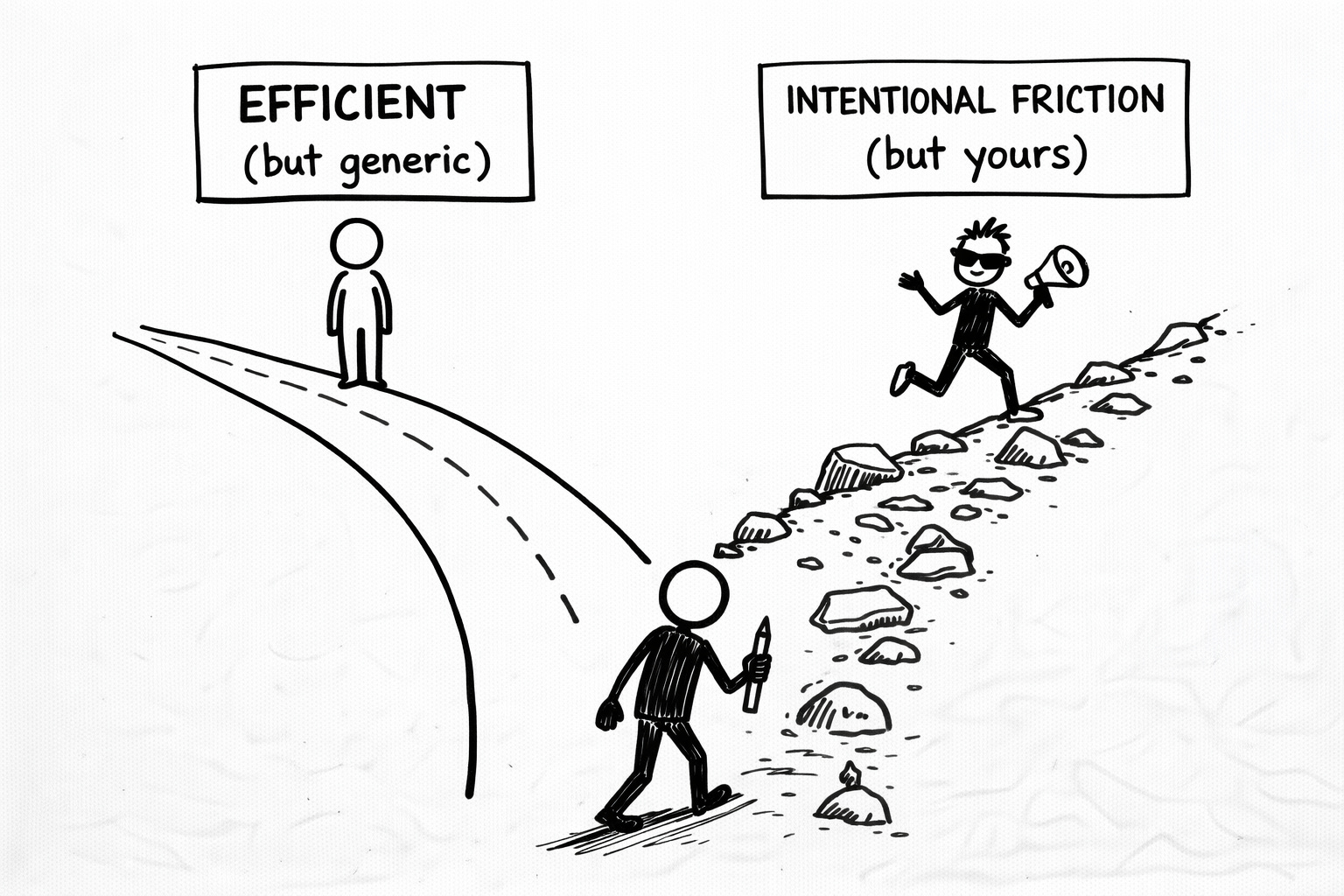
Step 3: Intentional Friction
Use those patterns. Even when they create handoff problems. Especially when they create handoff problems.
That friction is you.
Smooth is how you got here. Smooth is the sound of personality leaving the building, thanking everyone for their time, promising to stay in touch.
The Point, If There Is One
We were promised automation would change what we produce.
Nobody mentioned it would change how we think.
AI collaboration is the most intimate pressure on voice we’ve encountered. More than algorithms. More than SEO. More than character limits. Because it doesn’t just affect outputs. It reaches backward into cognition. Into the pre-verbal chaos where your fingerprints actually form.
Protecting your voice isn’t nostalgia. Isn’t Luddism. Isn’t some romantic attachment to inefficiency.
It’s maintaining the feedback loop between your thinking and your expression before something else edits it. Before efficiency becomes erasure. Before you look up one day and realize you’ve been writing in someone else’s voice for so long you’ve forgotten what yours sounded like.
Every tool reshapes the hand.
That’s not pessimism. That’s physics.
The only question is whether you notice before the reshaping is complete.
Discussion Thread: What’s a word or phrase you used to reach for that you’ve quietly stopped using? I’ll go first: I used to write “gnarly” constantly. Now I catch myself thinking “AI will just change it” and reaching for something safer. Embarrassing to admit. Your turn.
Crafted with love (and AI),
Nick “Exhibit A” Quick

PS…If this made you uncomfortable, good. That’s the point. Forward it to a writer friend who needs to squirm a little too. Also: subscribe!
Co-Write with AI is a reader-supported publication. To receive new posts and support my work, consider becoming a free or paid subscriber.