
Good Enough Is Now The Most Dangerous Place To Be
AI made competent content free. If your work isn't irreplaceable, it's now competing with infinite.

You’re publishing more than you did last year. Twice as much, maybe. Cadence locked. Formatting optimal. Subject lines doing their little job. Discussion threads producing their polite five-comment shuffle.
And your numbers are flatlining.
You’ve checked everything. Maybe the algorithm changed. Maybe you need a hookier hook. Maybe your publish day is wrong. Maybe you should hire a coach, take a break, attend a webinar hosted by a guy with seventeen testimonials and a ring light that costs more than your laptop. (No judgment. We’ve all been three clicks into a funnel before we realized what was happening.)
You think you’re doing something wrong.
You’re not. You’re doing the same thing right that everyone else is also doing right. That’s the problem. I’ve called this dynamic ensloppification before. Today’s post is a subtler version of this: you can produce solid work, post-by-post, and still broadcast doodly-squat.
(Yes, this includes me. No, I’m not thrilled about it either.)
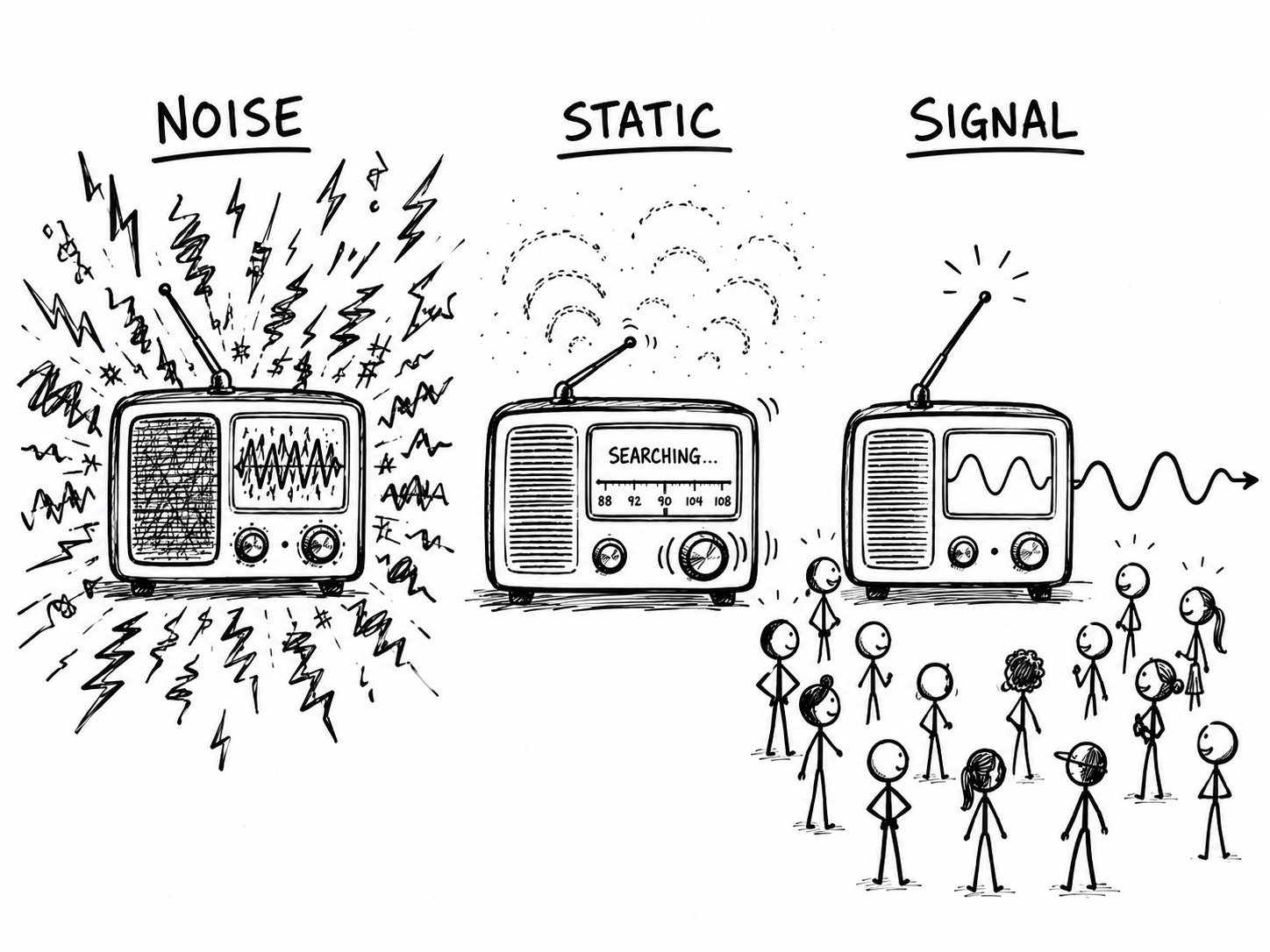
There Are 3 Things Coming Through The Receiver
Noise. Volume games. AI farms. Twelve fake authors and a content strategy built around aggressively misunderstanding the assignment. Different business model than yours. (The Bigfoot SEO farms aren’t after your audience. They’re after a completely different kind of attention from a completely different kind of person who has never once subscribed to a thoughtful newsletter about anything.) Not your problem.
Static. Technically transmitting. Not quite landing. The category of content that has the shape of signal minus the substance. Serviceable. Structurally sound. Polite thesis. Correct grammar. The kind of post that passes every quality check and doesn’t make a single reader forward it to their group chat. (You hit publish and nothing happens. Not hate, not love, not even mild disagreement. Just silence. Like texting your ex something vulnerable and watching the three dots appear, disappear, and never return.) Probably your problem.
Signal. The reader opens it before reading the subject line because the from-field was enough. Not because you’re famous. Because you’ve been right about a specific thing enough times that they’ve stopped checking whether you’ll be right again. Because you’ve taken risky positions, said things that could lose subscribers, and kept saying them long enough that readers started depending on you to say what nobody else would. (This creates readers who will open a typo-riddled Note at 2am. Those readers are worth more than ten thousand polite scanners who might unsubscribe if you message one time to often this week.) Where you want to be.
Most creators who are actually trying (reading the newsletters, studying the frameworks, publishing on schedule, giving a damn about quality) are broadcasting static. Not noise. Not signal. Static. The effort is real. The distinguishability isn’t.
The static creator’s value proposition has quietly become: “I produce average content slower than a machine and charge more for the privilege.”
That’s the worst sales pitch in the history of independent publishing. It makes timeshares look visionary.
(At least the timeshare guy gave me a free breakfast, a tote bag with a pelican on it, and a scratcher that awarded me a “prize” redeemable only at the resort. Plus ninety minutes with a guy named Gary who looked me dead in the eyes and told me I was making a generational wealth decision. I left with nothing useful and an oddly warm feeling toward Gary.)
Static Isn’t Ignored. It’s Forgotten.
Static pretends. Not lazily. Diligently. That’s what makes it cruel.
I know this post so well because I’ve written it.
The forensic evidence is always the same. Good hook (borrowed from a framework post someone wrote about hooks). Strong thesis (sounds like the Claude 3.7 version of a strong thesis, which it might be). Subheadings that describe rather than provoke. Three examples any competent researcher could source in twenty minutes. Closing paragraph that gestures toward transformation without committing to any specific direction. Structure so predictable you could outline it before reading past the subtitle. (You probably already did. That's the problem.)
We’ve all written this post. It’s the post that happens when you’re publishing at pace and your brain is tired and you reach for the template because the template technically works and you need to ship something today because the cadence matters and maybe this one will be fine.
It’s fine.
It’s static.
And static doesn’t get rejected. It gets tuned past. Which is worse, if you think about it. Rejection implies someone noticed.
A Single Post Has A Fingerprint. A Body Of Work Has A Frequency.
Yesterday I ran a diagnostic for catching thought leaderslop in a single draft. Three questions, pre-publish, go run it if you haven’t.
Today’s problem is upstream of that.
A post can pass yesterday’s test with flying colors (lived example, risky take, original frame, all present and accounted for) and still be broadcasting static. Not because the post is wrong. Because it’s off-channel. It doesn’t connect to anything. It doesn’t advance a recognizable frequency. A good post inside a publication with no signal identity disappears into the interference the same way the mediocre posts do.
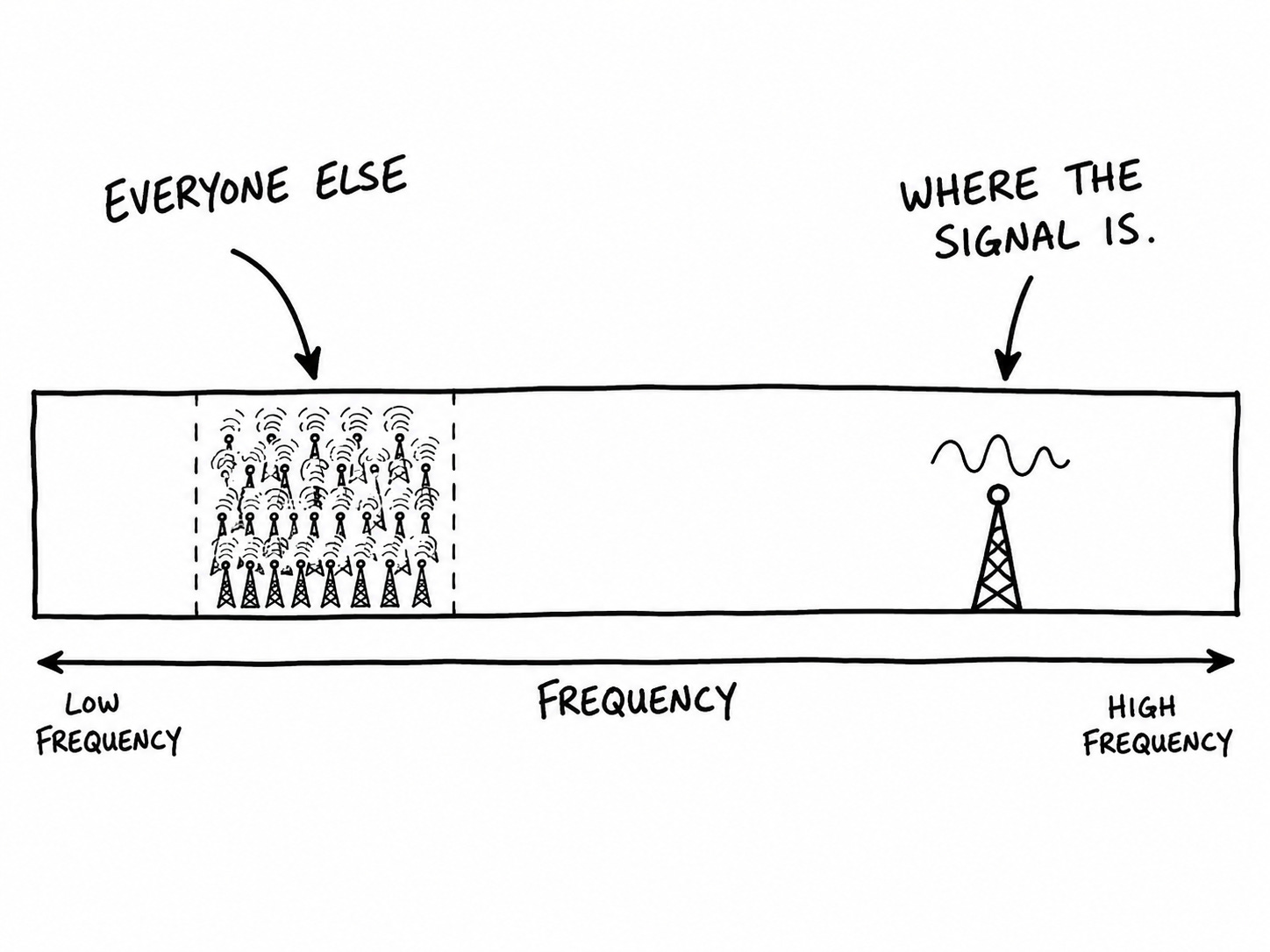
Signal isn’t something you build in a post. It’s something that emerges from a pattern across posts. The question isn’t “does this post have a fingerprint.” It’s “does this body of work have a frequency.”
Most creators have never explicitly examined that question. They’d describe what they do as “AI for creators” or “newsletter growth” or “building in public.” That’s a topic. Topics aren’t frequencies. A frequency is a specific, recognizable perspective on a topic that couldn’t come from anyone else standing anywhere else.
Finding yours isn’t an identity crisis. It’s twenty minutes with your own archive and an AI that will tell you something you’d rather not hear.
The Signal Gap Audit
Run this once. Then run it again in 90 days.
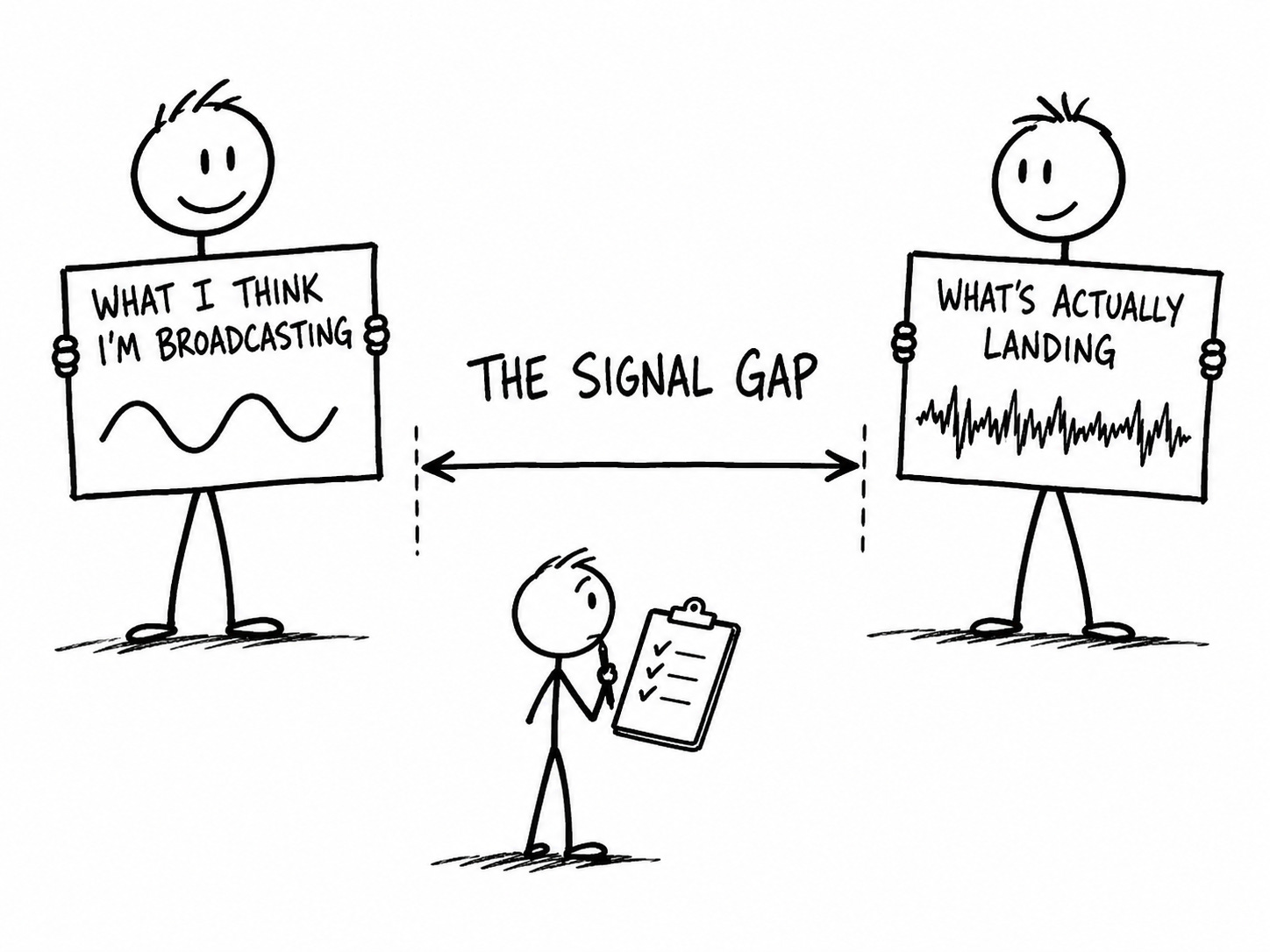
What it does: Surfaces the distance between your intended frequency and your broadcast frequency. That gap is exactly where static is just “hanging out.”
What you need: Your last 10 post titles and opening paragraphs. A Claude session. Twenty minutes.
(Openings are where your editorial instincts are most exposed. If you want the deeper version, paste full posts, but the context window gets expensive fast and twenty minutes becomes an entire afternoon.)
Step 1: Let Claude read your pattern
Open a Claude session. Paste your last 10 post titles and opening paragraphs (just the first 2-3 paragraphs of each, not the full posts). Then run this prompt:
You are analyzing a body of work to identify what frequency it’s broadcasting. Based only on the titles and opening paragraphs below, answer these four questions:

1. What does this writer appear to believe? State their core position in one sentence.

2. Who does this writer seem to be writing for? Be specific about the reader they seem to have in mind.

3. What topic do they keep returning to, even across different surface subjects?

4. If a reader consumed all ten of these posts without a byline, what would they say this publication stands for?

Be direct. Do not hedge. If the pattern is unclear or inconsistent, say so explicitly. That’s useful information.

[PASTE YOUR 10 TITLES AND OPENING PARAGRAPHS HERE]
(Claude will tell you something true here. It’s very annoying when it does. Don’t write anything down before you run this step. You want them read raw, uncontaminated by your own hopes about what it might find.)
Step 2: Write your intended frequency
Before you read Claude’s output, write down your answer to this question in one sentence:
What do I actually believe that most people in my space won’t say out loud?
Not your topic. Not your niche. The position. The thing you’d defend at a dinner table with hostile guests who think you’re wrong.
Step 3: Compare
Now read Claude’s output. The gap between what Claude found and what you wrote down is your signal gap. Three possible results:
No gap. Your body of work is already broadcasting what you believe. You have a frequency. The work now is to protect and deepen it.
Small gap. You’re close. Your signal is present but inconsistent. Some posts are on-channel, some drift. The fix is deliberate: before drafting each post, state your frequency out loud and ask whether this post advances it.
Large gap. Your content is saying something different from what you believe. This is the most common result and the most useful one to find. It means you’ve been publishing for your readers’ assumed preferences rather than your actual perspective. The fix requires a harder decision: commit to your real frequency and accept that some of your current audience isn’t there for that. The ones who are will become much more loyal when you stop hedging.
(If Claude’s output says your body of work is perfectly coherent and aligned, be suspicious. That’s usually a sign you’ve been writing to a template of yourself, not from an actual position. Genuine frequency tends to look a little messier from the outside before it locks in.)
Save this output. Date it. Run it again in 90 days. The delta between the two runs is your signal momentum.
The Pre-Publish Frequency Check
Run this on every post, every time. Three minutes. Lives in your Claude Project as a standing prompt.
What it does: Checks whether an individual post is advancing your signal or muddying it. Yesterday’s diagnostic asked whether a post has a fingerprint. This one asks whether the fingerprint matches the body of work you’re building.
Setup: Add this to your Claude Project instructions, or save it as a template you open before every publish:
My frequency: [PASTE YOUR ONE-SENTENCE FREQUENCY STATEMENT HERE]

Before I publish, run this check on the draft below:

1. Signal alignment: Does this post advance my stated frequency, or does it drift from it? Be specific about which parts are on-channel and which parts aren’t.

2. The off-channel test: If I published ten more posts exactly like this one, would readers know what channel they’re on? Or would they have a general sense of “creator economy content” without a specific perspective?

3. The gap check: Is there anything in this post that contradicts or muddies my frequency? A section I included because it seemed expected rather than because it’s actually mine?

4. One recommendation: If the post needs adjustment to strengthen signal alignment, what’s the single most important change?

[PASTE DRAFT HERE]
You’re not looking for a grade. You’re looking for the specific moment in the post where you went off-channel. The section where you hedged. The paragraph where you gave the safe answer instead of your actual answer. The conclusion that wrapped up too neatly because you weren’t sure you were allowed to leave it unresolved.
That’s the section to rewrite. Not the whole post. Just the off-channel part.
The combined workflow: Every 90 days (20 min), run the Signal Gap Audit against your last 10 openings and compare to your previous result. Every post (3 min), run the Pre-Publish Frequency Check and fix the off-channel section.
Not a personality overhaul. Not a brand audit that costs $3,000 and produces a PDF nobody reads. Two prompts, a saved template, and twenty minutes every quarter.
Every Post Moves You Toward Signal Or Toward Static
You don’t control the spectrum. You control which frequency you’re feeding.
Run the Signal Gap Audit once and find out where you actually are. Run the pre-publish check before every post to stay on channel.
You asked why your numbers are flat. They’re not flat because you stopped trying. They’re flat because merely trying isn’t enough these days.
Crafted with love (and AI),
Nick “Definitely Not Static (Probably)” Quick

PS... If you ran the audit and the gap was large enough to make you uncomfortable, good. That discomfort is worth more than another six months of publishing with fingers crossed. The Ink Sync Workshop turns that discomfort into a documented frequency, a calibrated AI system, and a pre-publish workflow that makes static structurally difficult to produce. Four sessions. Two weeks. No more guessing.
PPS... Do me a solid: Like this post. Comment on this post. Share this post with the static creator in your life who needs to hear it. Restack it. Forward it. Print it out and tape it above your monitor. Subscribe if you somehow aren’t already. Tell your mom. Tell your weird uncle who just started a newsletter about fishing lures. Tell the guy in your DMs who keeps asking why his open rates are down. I don’t care how. Just don’t let this post become static. (That would be deeply ironic and I’d likely never recover.)