
Bad Content Drives Out Good (And AI Just Sped It Up)
A 500 year old law explains why you publish copper and hide gold

Last Tuesday I got caught in the act.
Not doing a crime-crime. Just the creator version: pretending I’m being strategic while quietly sabotaging myself.
I was walking my dog. His name is Butters. He’s a chihuahua (I can feel you forming the mental image) but he’s not a yappy ankle-biting gremlin. He doesn’t bark. Doesn’t bite. Doesn’t start beef with toddlers.
He just follows me around like I’m the last human on earth and he’s been assigned to document my existence for the court record.
A tiny furry stalker.
Affectionate. Watchful. Mildly disappointed at all times.
We were in that half-dissociated walk state where your legs handle navigation and your brain runs off into the woods to chew on weird thoughts like a raccoon with a bright, shiny object.
And then it happened.
Not a normal thought. Not a “huh, interesting” thought.
The other kind.
The kind that makes you stop mid-stride and reach for your phone like you’re trying to save a human life (because if you don’t write it down, it’s gone forever, buried in the same graveyard as your ‘why did I walk into this room?’ moment and the name of that actor who’s always “that guy from that thing”).
The thought was this:
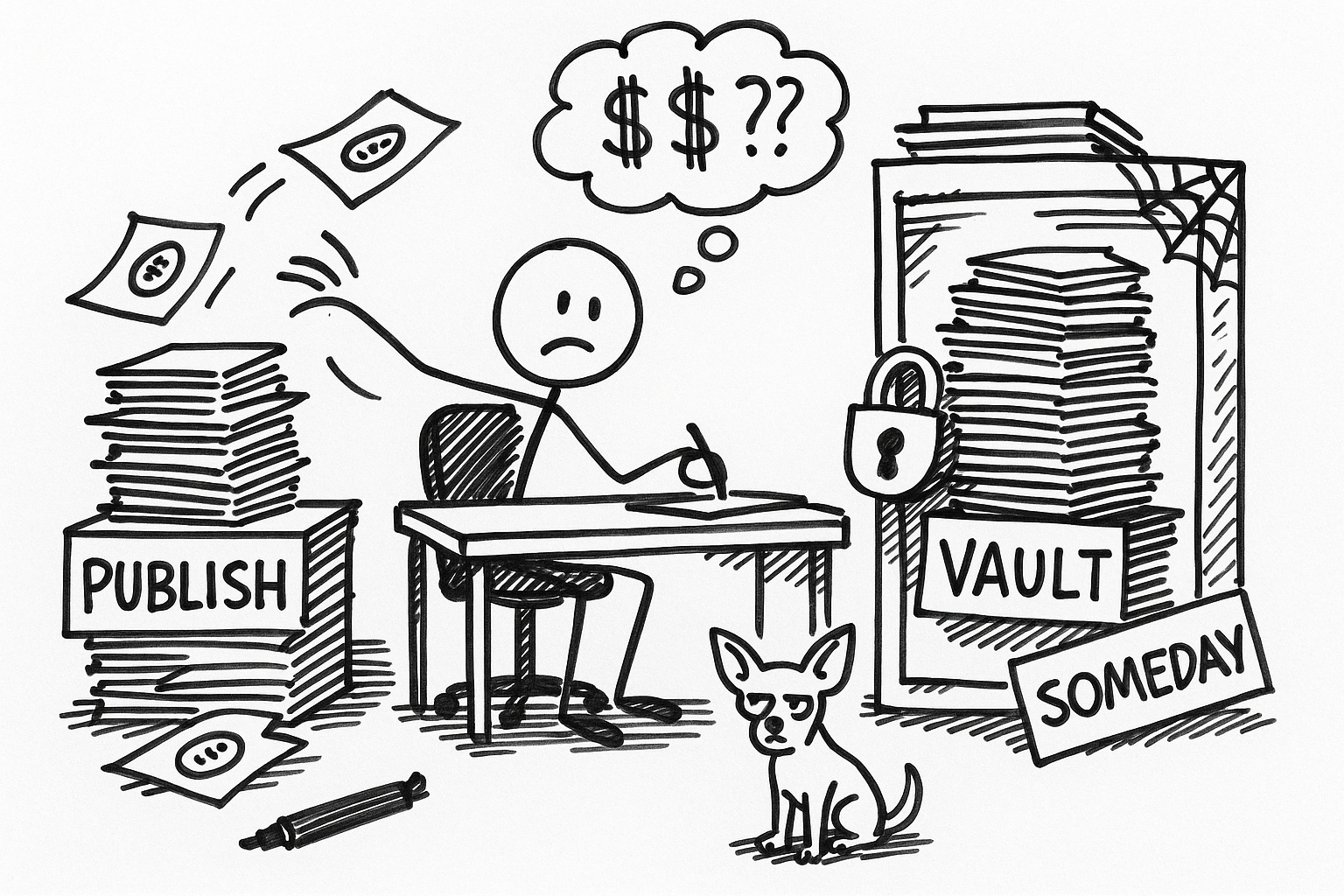
I’ve been hoarding my best stuff.
Not metaphorically. Literally. Sorting ideas into two piles like a smug little content accountant:
Good enough to publish
Too valuable to share yet
And I’ve been calling that “strategy.” Like this is a rollout, not building a vault while trying to pay for my Top Ramen packets with pocket lint.
Then right behind it came the second thought. The one that made me laugh and wince at the same time:
And so is everyone else.
Butters looked up at me and did his head tilt.
Usually it’s adorable.
This time it felt like a verdict.
Fair.
The Vault I Didn’t Know I Was Building
Once I noticed the pattern, I couldn’t un-notice it.
It was everywhere.
That framework I’ve been developing for months? The one that finally clicked into something teachable? Too valuable for a free newsletter. Save it for when the audience is bigger. (An audience that will definitely appear because of my... not sharing valuable things. Flawless logic. No holes.)
That embarrassingly specific story about the first six months of AI collaboration? The failures, the cringe, the pieces I published that I now wish I could unpublish and bury in a shallow grave? Too personal. Maybe for a keynote someday. (The keynote I’ll get invited to because of my reputation for... not being personal. This plan is airtight.)
That systematic breakdown of exactly how I audit my own writing for voice drift? The thing that actually made everything else work? Course material. Don’t give away the product. (I have courses. They exist. They’re sitting in my Skool community right now. And I’ve been treating my free content like an extended trailer for them instead of like... content.)
I’d been constructing a vault without realizing it.
Not a cool vault. Not an Ocean’s Eleven vault with laser grids and a handsome crew. More like my grandmother’s basement. Full of stuff she was “saving for later.” China that never got used. Clothes that never got worn. Ideas that never got shared.
She died with a basement full of later.
(Sorry. That got dark. Butters is tilting his head again.)
The pattern was clear: Every time I had an idea that felt genuinely valuable, some internal algorithm sorted it into “too good for now.” The public newsletter got the copper coins. The gold stayed locked away for... later. Someday. When it matters.
And the justification was always the same:
Be strategic. Build toward something bigger. Don’t give away the farm.
It sounds so reasonable. Like something a smart person would say. Like advice from a LinkedIn post with too many emoji.
But I started wondering: where did I learn this? Why does “save your best stuff” feel like obviously correct advice that everyone just knows?
Then I found the answer in a dead economist from 1558.
(Which is exactly how I expected to spend my Tuesday evening. Learning about Elizabethan monetary policy. Living the dream.)
The Financial Advisor Who Explained My Content Strategy
Sir Thomas Gresham had a problem.
(Not a fun problem. Not a “too many party invitations” problem. An economic collapse problem. The other kind.)
As financial advisor to Queen Elizabeth I, he watched England’s money supply behave in ways that seemed irrational. Until you understood the logic. Then it seemed terrifyingly inevitable.
Here’s what happened:
The crown had been debasing coins. Mixing cheaper metals into silver, keeping the face value the same, pocketing the difference. Short-term clever. (Kings have been running this play since kings were a thing. It never ends well. But it always feels like it’s going to work this time.)
The merchants weren’t stupid. They could feel the difference between a heavy silver coin and a light mixed-metal one. Same number stamped on it. Different weight in your hand.
So they did the obvious thing:
They spent the debased coins. They hoarded the pure ones.
Why spend real silver when fake silver buys the same bread?
Gresham wrote it up as a principle. It’s been taught in economics classes ever since. You’ve probably heard it, even if you didn’t know the name:
“Bad money drives out good.”
The mechanism is stupid simple: When two currencies trade at the same face value but have different intrinsic worth, people spend the cheap one and save the expensive one.
Every. Single. Time.
Not because they’re greedy. Because it’s rational. Because the incentives are screaming at them to do exactly this. Because keeping the good stuff and spending the garbage is just... what makes sense.
The result was equally predictable: Good money vanished from circulation. Bad money flooded the streets. The currency everyone actually used got progressively worse while the valuable stuff hid in mattresses and vaults and probably a few shallow graves. (People were weird about money back then. People are weird about money now. People are weird.)
I read about Gresham’s Law on a random Tuesday evening because my algorithm knows I have problems.
By Wednesday morning, I understood exactly what I’d been doing to my own content.
The Part Where AI Made Everything Worse (Surprise)
Here’s what old Sir Thomas didn’t live to see:
AI doing to content what debased coins did to currency.
The math changed overnight. Like, literally overnight. ChatGPT launched and suddenly the economics of content production underwent a complete restructuring and nobody sent a memo.
Before AI, there was a floor on content quality because there was a floor on production cost. Even phoned-in content required some effort. You had to sit there. Type words. Occasionally think. The minimum viable piece still demanded hours of your life.
That floor just fell through the basement and kept going until it hit magma.
Now? The minimum viable piece takes minutes. A prompt. Some light editing. Maybe not even the editing part, judging by my LinkedIn feed. (My LinkedIn feed is a war crime. I have thoughts.)
The gap between “good enough to publish” and “actually represents my best thinking” became a canyon. Not a metaphorical canyon. Like, a Grand Canyon situation. You could throw a rock across and not hear it land.
And when that gap is visible—really, undeniably, embarrassingly visible—you start making calculations you never made before:
This AI-assisted draft is fine. Adequate. Hits the marks. Maintains the publishing schedule. It’s the content equivalent of gas station sushi. Technically edible. Nobody’s inspired.
But THIS idea? The one that would require actual excavation? Real thinking? Vulnerability? That’s worth more than a free Wednesday newsletter to my current subscriber count. (Which I’m not going to share because it would undermine my authority but let’s just say it’s not a number that gets its own Wikipedia page.)
Spend the cheap stuff publicly. Hoard the expensive stuff for when it “matters.”
Gresham’s Law. Operating on my content strategy. Without anyone teaching it to me.
I didn’t decide to debase my public content. The economics just... made it rational. The same way 16th-century merchants didn’t decide to destabilize the currency. They just responded to incentives. They did what made sense. They were being smart.
Individual rationality. Collective destruction.
(This would be a great place for me to say “but I’m different.” I’m not different. Nobody’s different. The incentives are the incentives.)
Narrator: Everyone Was Doing It
I started paying attention to other creators. Not reading their content. Reading their patterns.
And I saw the vault everywhere.
Once you have the lens, you can’t unsee it.
Newsletters that feel like extended trailers for a course that doesn’t exist yet. Lots of “what” with the “how” suspiciously absent. Value, but value held at arm’s length. Like a kid showing you their Halloween candy but not letting you touch.
Podcasters who casually mention their best insights are “in the community” or “in the premium tier.” The free content is the sample platter. Slightly stale bread. Suspicious mystery sauce. Enough to get you interested but never enough to satisfy.
Writers who publish consistently but never vulnerably. The rhythm is there. The revelation isn’t. Like clockwork, except the clock doesn’t actually tell time.
Thought leaders whose frameworks have frameworks. (I’m personally responsible for at least three of these. I’m not proud.) But the framework that actually changed their results? Coming soon. Premium only. Inner circle. Pinky swear.
Everyone’s spending copper. Everyone’s hoarding gold. Everyone thinks they’re being strategic.
(Narrator: They were not being strategic.)
And here’s what that creates:
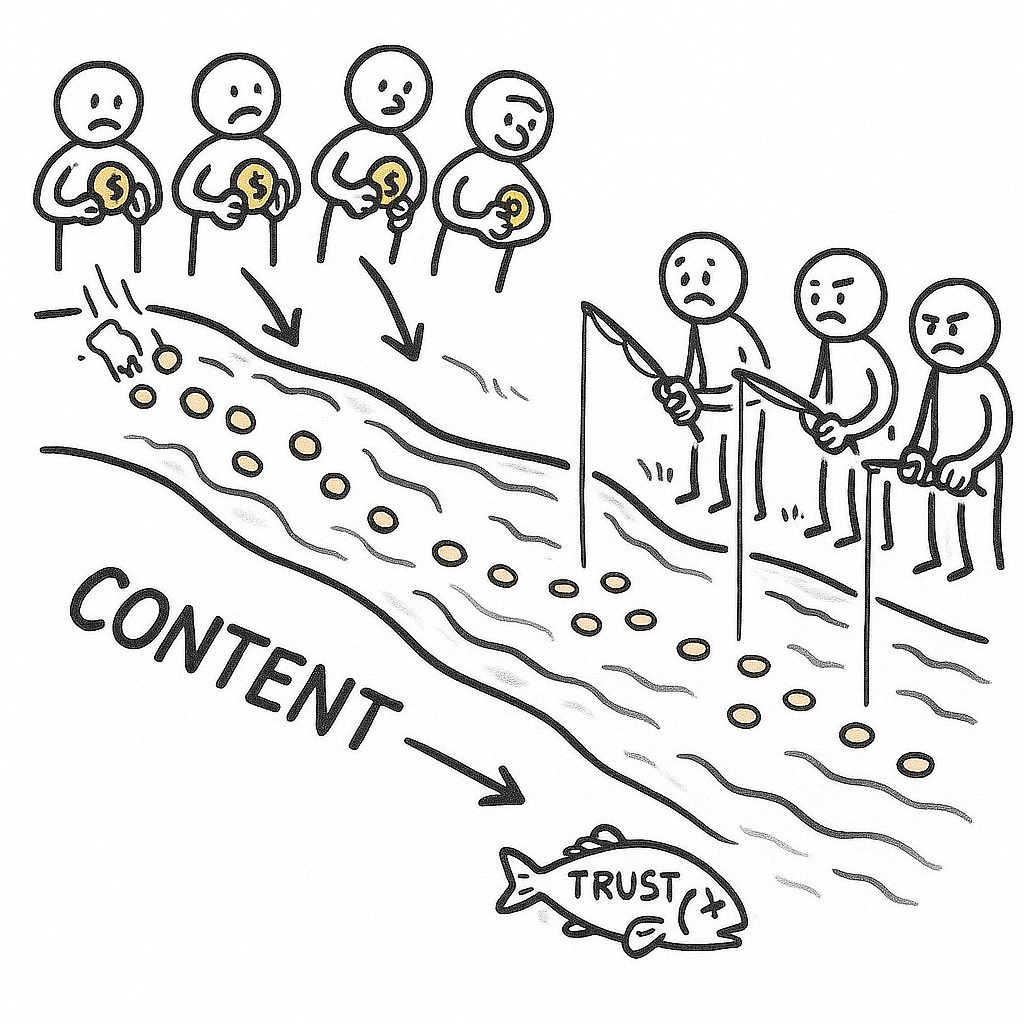
The public commons—the free content, the open internet, the stuff anyone can access without a credit card—fills with debased currency. Not because creators are lazy. Not because they’re greedy. Because they’re being strategic. Because some LinkedIn guy with a blue checkmark told them to be strategic. Because hoarding your best stuff feels like smart business in an attention economy.
Meanwhile, readers wade through copper coins. They develop skepticism. They start assuming everything is slop until proven otherwise. (A reasonable assumption, given... gestures at the entire internet.) They don’t invest enough attention to recognize quality when it actually appears because why would they? Every time they’ve invested before, they got burned.
Which makes quality content even less competitive.
Which makes hoarding feel even more justified.
Which floods the commons with more copper.
And the cycle accelerates. And the commons degrade. And everyone wonders why content feels worse even though more of it exists than ever.
This is fine. Everything is fine. (This is not fine.)
The Questions That Won’t Leave Me Alone
So here’s where I’ve landed. And I don’t love it.
What if “save your best stuff” is bad advice?
Not morally bad. I’m not here to moralize. (Okay, I’m a little here to moralize. But mostly I’m here because I think we’re all making a strategic error while congratulating ourselves on our strategy.)
What if the rational, sensible, obviously-correct approach to content is actively destroying the very thing that makes content valuable?
Like. What if we’re all so busy being smart that we’re accidentally being stupid?
Follow me here:
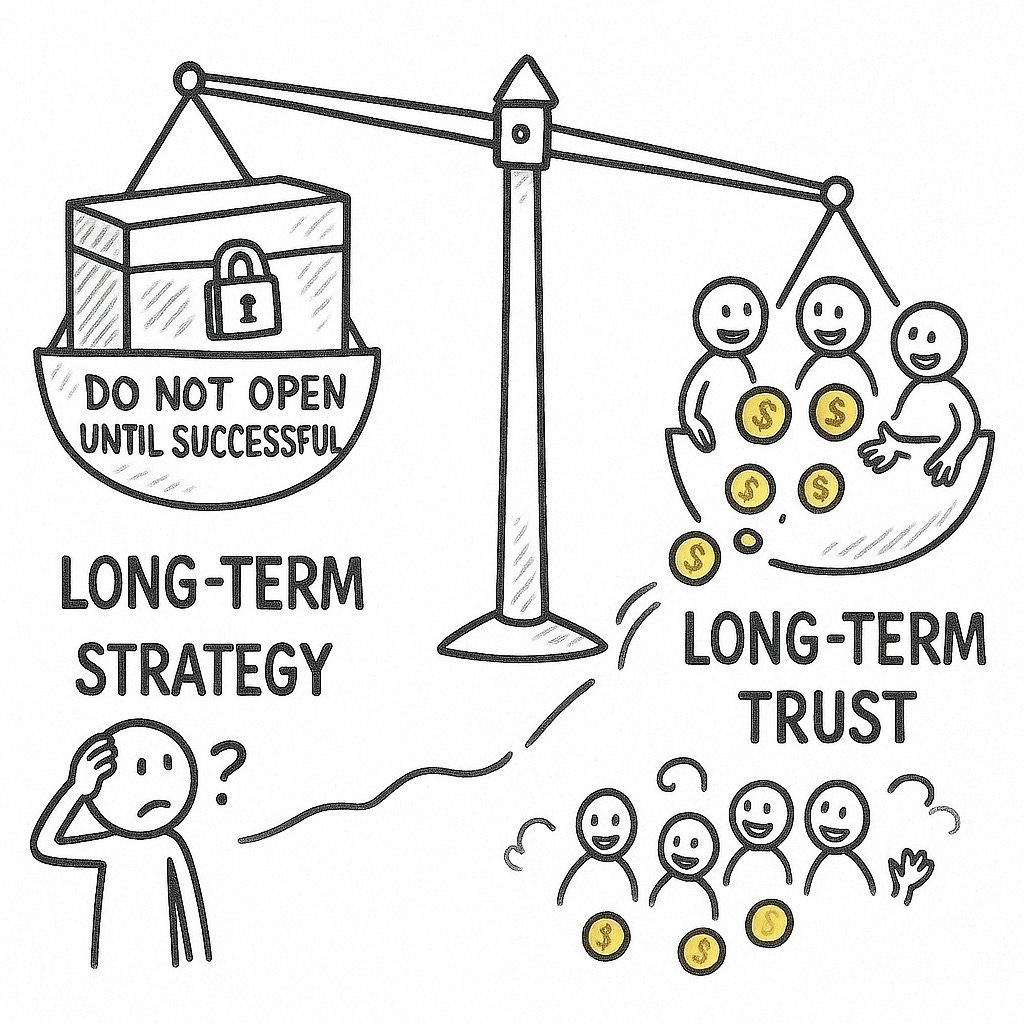
The audience you’re saving content for doesn’t exist yet. You’re hoarding gold for a future subscriber base that is currently being trained on your copper. You’re teaching them, right now, today, what to expect from you. And what you’re teaching them is: adequate. When you finally release the gold—if you ever release the gold—they might not even recognize it. You’ve spent months conditioning them to expect gray. Now you’re surprised they don’t respond to technicolor.
“Later” isn’t guaranteed. That course you’re saving your best framework for? You might not build it. Life happens. Motivation fluctuates. That thing you swore you’d launch “next quarter” has been next quarter for six quarters. The vault is filling up with content that never ships. Your best ideas are dying of old age in there, surrounded by other best ideas, all waiting for a someday that increasingly looks like never.
Hoarding trains you to hoard. Every time you sort an idea into “too good for free,” you reinforce the instinct. The threshold creeps higher. Pretty soon everything good feels too valuable to spend. The vault grows. Your public presence calcifies into a highlight reel of strategic adequacy. You become someone who has great ideas but never actually shares them. Which is functionally the same as not having them.
The reformation is coming. At some point, reader skepticism collapses trust so completely that only demonstrated track records matter. The creators who spent gold consistently will have proof of quality. The hoarders will have vaults full of gold that nobody believes is real anymore.
(I’m going to write a whole post about that reformation. What it looks like. When it’s coming. How to be on the right side of it. But not today. Today is about recognizing the vault exists.)
I keep coming back to this:
Every piece of copper I spend instead of gold is a vote for the world where gold doesn’t matter.
Every “good enough” I publish is a lesson I’m teaching my audience about what to expect.
Every best idea I save for later is a bet that later will arrive. And that I’ll still care. And that the idea will still be relevant. And that I’ll have built the audience who can receive it.
That’s a lot of bets.
The Nuance I Need to Name (Before Someone Yells at Me)
I can already hear the objection forming:
“So we should never charge for anything? Everything should be free forever? Monetization is evil?”
No. That’s not what I’m saying.
The vault problem isn’t “I have a paid product.” The vault problem is “my free content is just a commercial for my paid product.”
There’s a difference between:
Creating genuine value publicly AND creating premium offerings that go deeper
Giving away trailers publicly while hoarding all the actual substance
The first one is sustainable. Ethical. Smart, even.
The second one is what’s flooding the commons with copper while people wonder why nobody trusts free content anymore.
The question isn’t “should I ever monetize?” The question is: “Am I spending gold publicly, or am I only spending copper?”
You can have paid products AND be generous with your free content. The two aren’t mutually exclusive. In fact, the generous-with-free approach might be what makes the paid stuff work—because people trust you’ve already given them value without demanding a credit card first.
I have courses. They exist. (They’re in my Skool community, gathering dust while I summon my inner Don Draper to actually sell them.) The existence of those courses isn’t the problem.
The problem is when I catch myself thinking “that insight is too good for the newsletter—save it for the course.”
That’s the vault. That’s the hoarding. That’s Gresham’s Law eating my content strategy.
What I’m Trying to Do About It (Emphasis on “Trying”)
I don’t have this figured out.
(If someone tells you they have this figured out, they’re either lying or they’re not playing a big enough game. The figured-out people are boring. Give me the people still wrestling. They’re more interesting at parties.)
But here’s the experiment I’m running:
The instinct to hoard is now my signal to share. When I catch myself thinking “this is too valuable for free content,” that’s exactly when I know I need to publish it. The internal resistance is the compass pointing toward what matters.
I’m auditing my vault. What have I been saving? Why? Is the “later” I’ve been waiting for ever actually going to arrive? Or am I just comfortable with the hoarding?
I’m treating my free content as the product. Not a commercial for the product. Not a trailer. The thing itself. If someone never pays me a dollar, they should still walk away with genuine value. That’s the standard.
I’m betting on the reformation. (There’s that word again. I really am going to write that post.) At some point, the creators who spent gold consistently will own what comes after the flood. I want to be on that side when it happens.
Is this naive? Maybe.
But the alternative—hoarding gold while the commons drown in copper, waiting for a “later” that might not come, training myself and my audience to expect less—that feels like a slower kind of failure. The kind where you don’t notice you’re failing until you’ve already failed.
The Part Where I Put My Money Where My Mouth Is
I’m going to tell you something I probably shouldn’t.
Part of me wrote this newsletter because I don’t want to be alone in cracking open the vault.
There. I said it.
It’s easier to spend gold if other people are spending gold too. If the commons start improving. If I’m not the only idiot giving away my best stuff while everyone else hoards and builds “strategic premium ecosystems” and does whatever it is that the blue-checkmark people tell you to do.
There’s safety in collective action. There’s also—honestly—motivation.
So this is half-confession, half-invitation.
But here’s the thing about invitations: they’re cheap if they’re not backed up with action.
So let me back it up.
This post is me opening the vault. Not just talking about opening the vault. Actually opening it. The Gresham’s Law frame, the hoarding pattern, the reformation that’s coming—this was supposed to be “course material.” I caught myself thinking exactly that. And then I remembered what I’m trying to do here.
And this is just the start. Over the next few months, I’m going to share the frameworks I’ve been hoarding. The specific processes. The uncomfortable confessions about what actually works and what’s just theater. The stuff I was “saving for later.”
Later is now. The vault is open.
Butters approves. (He tilted his head in what I’m choosing to interpret as approval. He might also just want a treat. It’s hard to tell with him.)
The vault is comfortable. The vault feels safe. But the vault is where good ideas go to die waiting for a “later” that never comes. Crack it open. Spend the gold. Trust that it matters more in circulation than in storage.
What’s in your vault? What idea are you “saving for later” that might be exactly what your audience needs right now? Drop it in the comments. Not the fully-formed thing—just the topic. Sometimes naming what you’re hoarding is the first step to spending it.
Crafted with love (and AI),
Nick “Bad Money” Quick

PS: Speaking of opening vaults—I mentioned I have courses gathering dust in my Skool community. One of them is called “Co-Write OS.” It’s my entire system for collaborating with AI without sounding like everyone else. I was going to sell it eventually. Maybe I still will. But right now? It’s free. Because I’m done hoarding.
Join the community and get the course here.
No credit card. No “free trial.” Just... the thing. Consider it my first gold coin in the commons.
Regarding the topic of the article, I wonder if AI's speed truely diminishes good content, or just floods the zone? Your insight into self-sabotage is really sharp.