
A Eulogy for the Writer I Was Last January
PLUS the 90-minute autopsy that explained what happened

I spent three hours last week reading everything I wrote this year.
This was a mistake.
Not because the content was bad. (Some of it was bad. We’ll get to that.) But because reading your own writing is like watching home videos of yourself at parties. You remember being charming AF. The footage suggests otherwise.
Some pieces made me proud. The kind of proud where you finish reading and think, okay, I’m not a complete fraud.
Some pieces made me want to fake my own death and start over as someone who raises alpacas in the high Andes of Perú. (I used to live in Perú. This fantasy is disturbingly specific.)
But here’s the discovery that actually stung:
The pieces that embarrassed me most weren’t the failures.
They were the good ones. The polished ones. The pieces that sounded like I knew what I was doing. Competent. Professional. The kind of writing that gets you hired to write more writing that nobody remembers reading.
I’d spent the year systematically lobotomizing my own voice. Each edit a tiny act of self-deletion. Death by a thousand improvements.
And the worst part? I didn’t even notice until I looked back.
So it goes.
Most Year-End Reflection Is Performance Art for an Audience of One
You know the ritual.
December arrives. You feel the gravitational pull toward reflection. Maybe you pour wine. Maybe you light a candle. Maybe you open your Notes app like it’s about to reveal something profound. (Narrator: It reveals forty-three abandoned grocery lists.)
Then you skim your highlights. Nod at the wins. Cringe at the obvious disasters. Write some goals that are vague enough to feel achievable and specific enough to sound serious.
Call it growth.
Here’s the problem: you already knew what you were going to conclude before you sat down.
This isn’t reflection. This is a closing argument you’re delivering to yourself. The verdict was in before you entered the courtroom.
Self-congratulation and self-flagellation look like opposites. They’re not. They’re the same lie. One feels worse. Neither helps. Both let you feel like you did something while protecting you from actually understanding what happened.
Real reflection is forensic.
You treat your content like it belongs to someone else. Someone you’re investigating. Someone whose patterns you’re trying to crack. You’re not celebrating or criticizing. You’re diagnosing.
(Confession: The first time I did this, I felt like I was reading the work of a stranger who had somehow gotten access to my publishing accounts. A well-meaning stranger. A stranger with decent ideas. But definitely not me.)
The year’s content is a crime scene. Here’s how to process the evidence.
The Four Ways Your Voice Can Betray You
Your writing shifted this year. Guaranteed. The only question is where.
I use a framework to map voice drift. Four layers, each capable of sneaking off in the night without telling you where it went:
Vocabulary — The words you reach for when you’re not thinking about reaching. Your pet phrases. Your banned expressions. The language that’s distinctly yours versus the language you’ve borrowed from everyone else.
Architecture — How you build the damn thing. Your opening moves. Your transitions (or strategic lack thereof). How you land a point versus how you let it fizzle into nothing like a toast no one raised their glass to.
Stance — Your relationship with the reader. Are you a peer? A guide? An expert handed down from Mount Expertise? How bold are your claims? How honest are you about what you don’t know?
Tempo — The rhythm underneath the words. Short sentences. Long sentences. Fragments that break the rules. The punctuation choices that create music only some people can hear.
Each layer drifts at different speeds.
Vocabulary shifts fast. You pick up phrases from things you read, people you follow, AI outputs you accept without fixing. (Everyone’s using “unpack” now. I blame podcasters. Specifically, all of them.)
Stance drifts slow. So slow you don’t notice until you’ve become someone you didn’t choose to become.
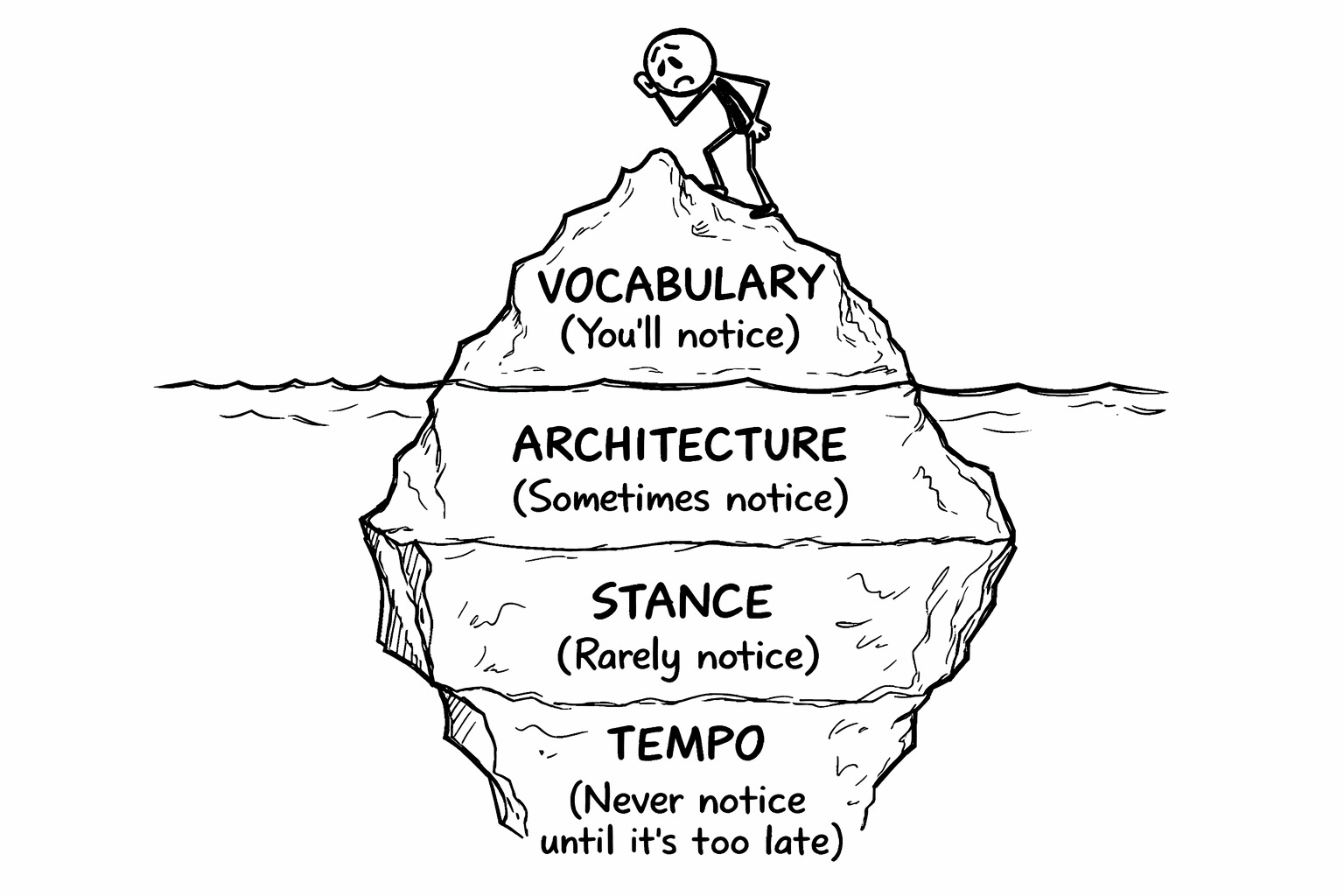
My big discovery this year? Stance betrayed me.
I started January writing like a peer. Someone figuring things out in real time. Sharing discoveries as they happened. Admitting when I was still confused.
By December, I’d drifted toward Expert with a capital E. Explaining things I knew to people who didn’t. More authority. More distance. More of that professional polish that makes writing feel like a document instead of a conversation.
I didn’t decide to become that guy. Nobody decides to become that guy. You just wake up one day and realize you’ve been writing like someone giving a TED talk instead of someone having a beer with a friend.
The drift you don’t catch in real-time is the drift that compounds.
By December, you might be writing like someone you never set out to become. Someone with better grammar and fewer fingerprints. Someone technically competent and fundamentally forgettable.
Welcome to the club. We serve terrible refreshments.
Step One: The Sorting (or, How to Ruin Your Evening)
Here’s the audit process. Total time: 90 minutes. You can do this tonight instead of pretending you’re going to a party (like I’m currently doing.)
First, gather the evidence.
Pull 15-25 pieces from throughout the year. Newsletter archive. Blog posts. Social content. Whatever you published. Doesn’t need to be exhaustive. Representative sample. The greatest hits and the songs you wish hadn’t made the album.
Now sort them into three piles based entirely on gut reaction.
This is important: You get 10 seconds per piece. MAX. No thinking. No rationalizing. No “well, this was good considering the circumstances.” Gut reaction only.
Pile 1: Proud. Content that still makes you feel something positive. You’d point to this if a stranger asked what your writing looks like at its best.
Pile 2: Fine. No strong reaction either way. Professional. Adequate. The kind of content that technically exists.
Pile 3: Burn. You wish you could delete this without anyone noticing. Content that makes you question your life choices.
Speed matters because your analytical brain is a defense attorney. Given time, it will construct elaborate justifications for everything. Your gut doesn’t have time for arguments. It just knows.
My distribution: 15% Proud. 60% Fine. 25% Burn.
That middle number is the one that should worry you.
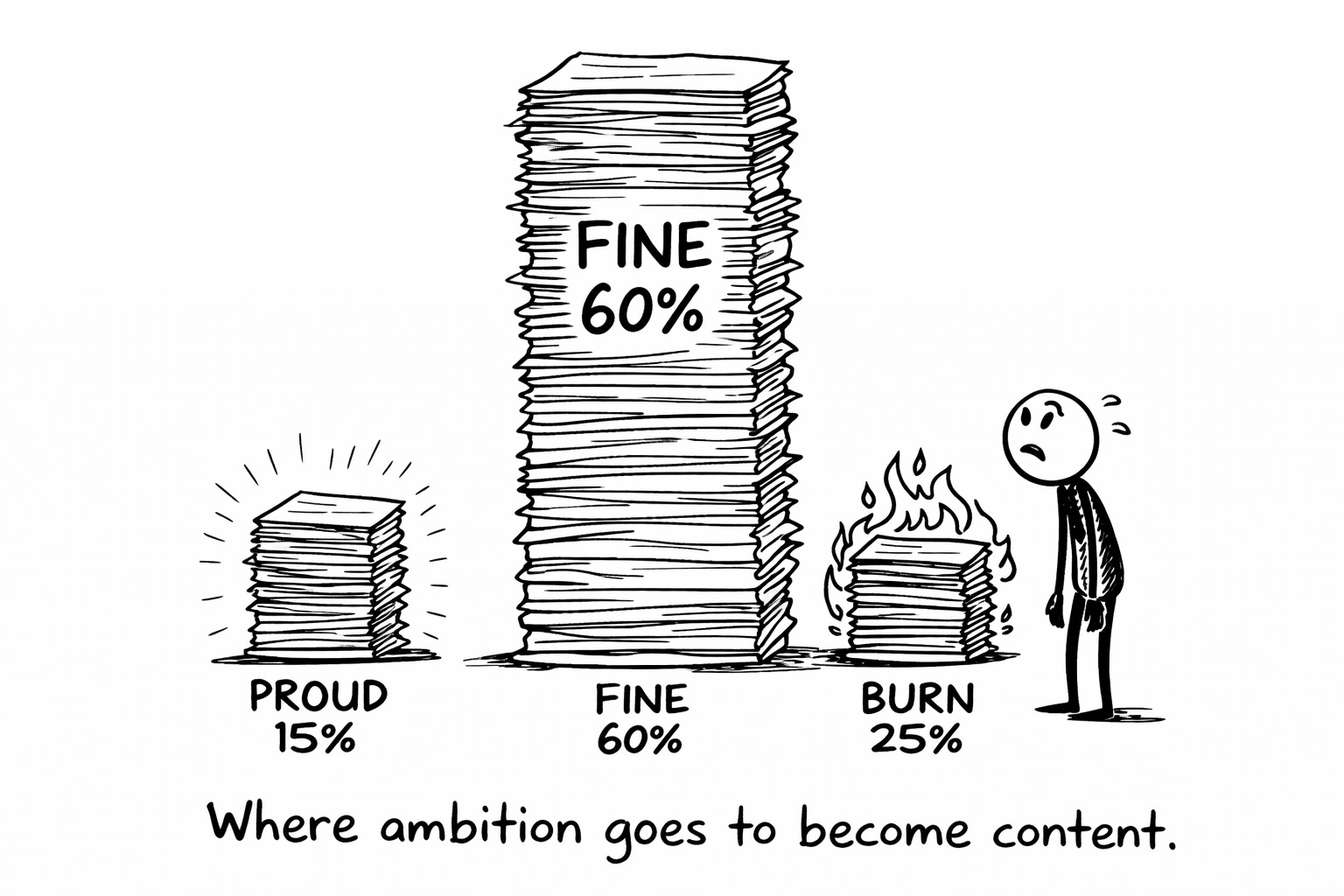
Here’s what most people miss: The “fine” pile is where voice goes to die.
Not the burns. Burns are easy. You look at them, you cringe, you learn something, you move on. They’re spectacular failures, and spectacular failures at least have the decency to be instructive.
The “fine” content is different.
That’s where you were on autopilot. Default mode. Not bad enough to trigger alarm bells. Not good enough to matter. Just professional competence that could belong to anyone with a keyboard and a passing familiarity with sentence structure.
Sixty percent of my year’s output was was the safety demonstration on your 51st flight.
Sixty percent.
I published all those words, and for most of them, I might as well have been captioning stock photos (“Woman laughing alone at her salad for some reason”). Technically correct. Spiritually absent.
(This is a cry for help disguised as a newsletter.)
Step Two: The Interrogation
Now we find out what happened.
Pull 2-3 pieces from the Proud pile. Pull 2-3 from the Burns. Set them side by side. You’re looking for the difference between you at your best and you on the worst day you were still willing to hit publish.
You could stare at these and hope insight strikes. (It won’t. You’ll get distracted and end up reorganizing your desktop folders.)
Or you could make AI do the tedious comparison work.
Here’s the prompt I used:
THE INTERROGATION PROMPT
I’m going to share two sets of my writing samples.

SET A (Proud): Content I’m genuinely proud of—my voice at its best.

SET B (Burn): Content that makes me cringe—something went wrong.

Analyze the differences between these sets across four layers:

VOCABULARY: What words/phrases appear in Set A that never appear in Set B? What words infest Set B that are absent from A? How does the formality level differ? Where do I draw metaphors from in each?

ARCHITECTURE: How do Set A pieces open vs. Set B? How do I structure arguments in each? How do I transition between ideas? How do I close?

STANCE: What’s my relationship to the reader in each set? How bold are my claims? How do I handle uncertainty? Am I a peer, a guide, or a professor?

TEMPO: Analyze sentence length patterns in each set. What punctuation habits dominate? Which set has more rhythm variation? Which sounds more like natural speech?

Be specific. Quote examples. I want to see the patterns I can’t see myself.

SET A: [Paste 2-3 Proud pieces]

SET B: [Paste 2-3 Burn pieces]
(Fair warning: The output will be uncomfortably accurate. AI is annoyingly good at pattern recognition when you give it something to compare against.)
What I found in my interrogation:
My Burns all had the same filthy disease. Sentences too long. Too smooth. Too professional.
I’d been mimicking polish. Chasing some imaginary standard of “good writing” that I’d absorbed from reading too many thought leaders who all sound like they’re being paid by the word to not say a goddamn thing.
My Proud pieces were messier. More fragments. More interruptions. More of me arguing with myself mid-paragraph. (Like this.) More rhythm variation. More of what someone once called my “chaotic energy.” Which I’m choosing to interpret as a compliment.
I’d been improving myself out of my own voice.
Each edit, a tiny betrayal. Every polish, a small step toward sounding like everyone else. Improving. Smoothing. Sanding down every rough edge until what remained was aerodynamic and anonymous.
The patterns I was most proud of were the exact ones I’d been trained to remove.
There’s probably a metaphor here about society or conformity or something, but I’m too depressed by my own editing choices to reach for it.
The Secret Witness You Didn’t Know You Had
If you’ve been collaborating with AI this year, you have another evidence source. One you’ve been compiling without realizing it.
Your correction patterns.
Every time you fixed something AI produced. Every time you added “too formal” or “make it punchier” or “this sounds like a robot learned English from insurance policy documents.” (That last one might just be me.)
Those corrections are testimony. Data points showing the gap between what AI thinks you sound like and what you actually sound like.
But here’s the darker revelation:
The corrections that disappeared over the year.
My most frequent correction in Q1: “Too formal. More punchy. Shorter sentences.”
By Q4, I noticed I was making that correction less.
Not because AI got better. Not because it finally understood my voice.
Because I’d stopped noticing the drift.
I’d normalized it. Accepted the generic. Started thinking that smooth, professional output was actually mine because I’d been accepting it for so long.
The correction you stop making is the drift you’ve surrendered to.
(Tattoo that somewhere painful. My pee-pee hurts.)
Your AI conversation history is a real-time audit you’ve already been conducting. You just weren’t reading it as evidence.
Now you have to.
Step Three: The Prescription
The audit produces three outputs. Three categories that turn discovery into something you can actually use.
1. Patterns to Protect The stuff in your Proud pile that makes it proud. Your fingerprints. Your distinguishing marks. The patterns that AI doesn’t generate and that you shouldn’t edit away. Document them like you’re preserving evidence. Because you are.
2. Drift to Correct The stuff in your Burn pile that signals you’ve wandered off course. Warning signs. Tells. The specific patterns that show up when you’ve stopped being you and started being whoever the algorithm wanted.
3. Updates to Make Where your documented voice (if you have one) no longer matches reality. Your patterns evolved. Maybe for the better, maybe not. But the documentation needs to catch up either way.
For me, the update was humiliatingly specific:
Add to Tempo documentation: “More fragments. More interruptions. More parenthetical asides that derail the sentence and then somehow make it better.”
I’d had it exactly backwards. I thought my writing needed to smooth out. Grow up. Get professional.
It needed to stay rough. Stay weird. Stay the written equivalent of someone grabbing your arm mid-sentence because they just thought of something irresistibly stoopid.
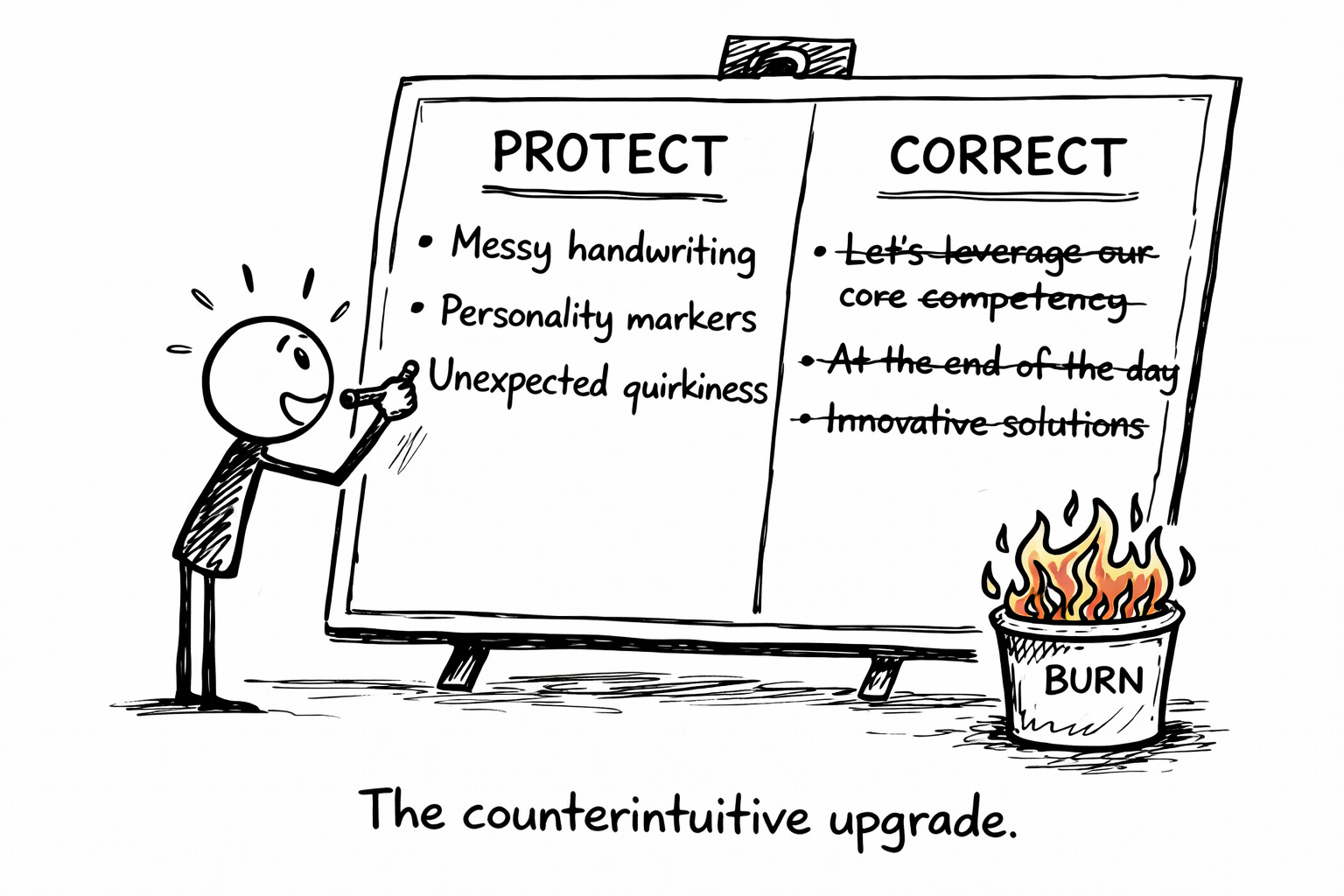
The audit is complete when your documentation matches the writer you actually are in your best moments.
Not who you were in January. (That person’s gone. They always are.)
Not who you think you should be. (That person is boring. They always are.)
Who you are when you’re firing on all cylinders and not performing for anyone. (That person’s the whole point. Always was.)
The 90 Minutes That Might Save Your Voice
You have tonight. Or tomorrow morning while everyone else recovers from decisions they’ll pretend to regret.
Here’s the compressed protocol:
30 minutes: The Sorting Pull 15-25 pieces. Sort into Proud / Fine / Burn. Gut reaction only. No lawyers allowed.
45 minutes: The Interrogation Compare Proud and Burn across VAST layers. Read pieces aloud. (Yes, out loud. Your mouth catches things your eyes forgive.) Document every difference you notice.
15 minutes: The Prescription Write down patterns to protect. Write down drift to correct. Update your voice documentation if you have it. Start one if you don’t.
Before you close this, do one thing.
Pull up something you wrote in January. Doesn’t matter what. Just something with your name on it.
Read it.
Notice how it feels different from what you’re writing now.
That gap is what you’re auditing.
The pieces that embarrassed me weren’t failures. They were evidence. Evidence that I’d been slowly, methodically, edit-by-edit, turning myself into someone professional enough to be forgettable.
I won’t make that mistake next year.
(Probably. No promises. The road to generic content is paved with good intentions.)
Discussion Thread: What’s the biggest drift you’ve discovered in your own writing? Which layer betrayed you? I’m genuinely curious what you’ll find when you actually look. Sometimes the crime scene tells you things you didn’t want to know.
Crafted with love (and AI).
Nick "Alpaca Contingency Planner" Quick

PS…This audit is a preview of what’s possible when you actually document your voice. The full Voiceprint methodology—mapping all four VAST layers, calibrating AI to follow your patterns instead of ignoring them, catching drift before it compounds—that’s what Co-Write OS teaches. If 90 minutes showed you how much your voice matters, imagine what happens when you build a system to protect it.
PPS…Subscribe. Sundays and Wednesdays minimum. More when I can’t help myself.
I really appreciated this, Nick.
I went through a period recently where I could feel my writing drifting toward “fine,” more polished, more professional, and somehow less alive. Around the same time, I got physically run down and actually lost my voice. That pause forced me to stop and really listen. I reworked a piece I was about to publish, stripped it back to something truer, and felt the difference immediately. Interestingly, my physical voice came back right after. Whether people frame that as intuition, nervous system feedback, or something else, it was a clear signal for me: when the voice goes generic, the body notices. This piece articulated that drift really well.
Cool perspective!