
54% Preferred AI. Good.
When tested blind, readers chose AI writing over human writing. Here's why that's the best news solo creators have gotten all year.

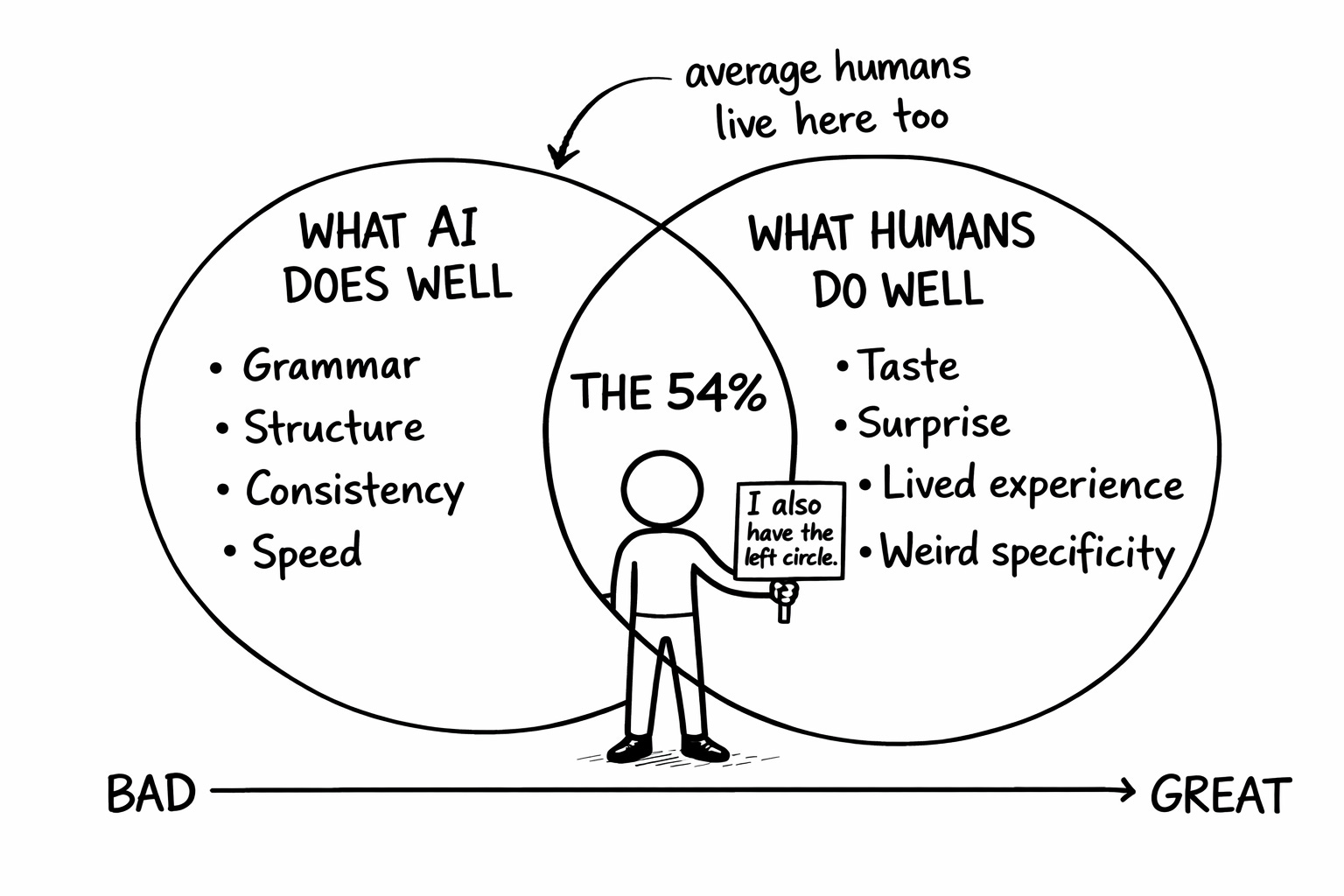
Fifty-four percent of people in a New York Times study preferred AI-written articles over human-written ones.
I’ve been staring at that number for three weeks.
Not because it scared me. (Okay, a little.) But because everyone is drawing the wrong conclusion from it. The automation crowd sees vindication. The AI skeptics see apocalypse. Wrong and wrong. Different flavor of wrong each time, but the result is the same.
Nobody's asking the question that actually matters.
Yesterday I told you I took my publishing machine apart. Questioned whether quality could compete with quantity. Wondered if I was building a cathedral in a world that only needs strip malls.
I think that 54% is the best piece of evidence solo creators have gotten all year. And almost nobody has noticed.
Readers Preferred the Robot. Now Read the Fine Print.
The automation crowd read that study and went straight to the victory lap. See? AI writes better than humans. Why are you even bothering?
But here’s what the study actually tested: AI writing versus average human writing. Unassisted. Unedited. Raw first-draft human prose against a machine that had been trained on the best writing in human history.
Of course AI won that fight.
The average human writer produces average human writing. (This is the kind of analysis that makes my paid subscribers question their financial decisions.) AI, by contrast, produces consistently above-average mediocrity. The kind of competent, forgettable prose that reads the way fluorescent lighting feels. Technically adequate. Doing its job. Slowly draining something from you that you won’t notice is gone until you step outside.
The 54% doesn’t prove AI writes better than humans. It proves AI writes better than humans who don’t know what they’re doing. That’s not the same sentence. Not even close.
What nobody measured in that study was what happens when a human who actually gives a shit collaborates with AI. When someone with taste and documented patterns and a calibration process uses AI as a co-writer instead of a replacement.
That’s a different equation entirely.
Everyone's Looking at the Wrong Scoreboard
Here’s where my own thinking went sideways.
The competition feels like quality versus quantity. Pick a lane. Either you produce fewer, better pieces (and get buried by the algorithm) or you crank out more, worse pieces (and hate yourself). Two bad options. Choose your misery.
This framing is wrong. Not slightly wrong. Fundamentally, structurally, someone-rotated-the-map-90-degrees wrong.
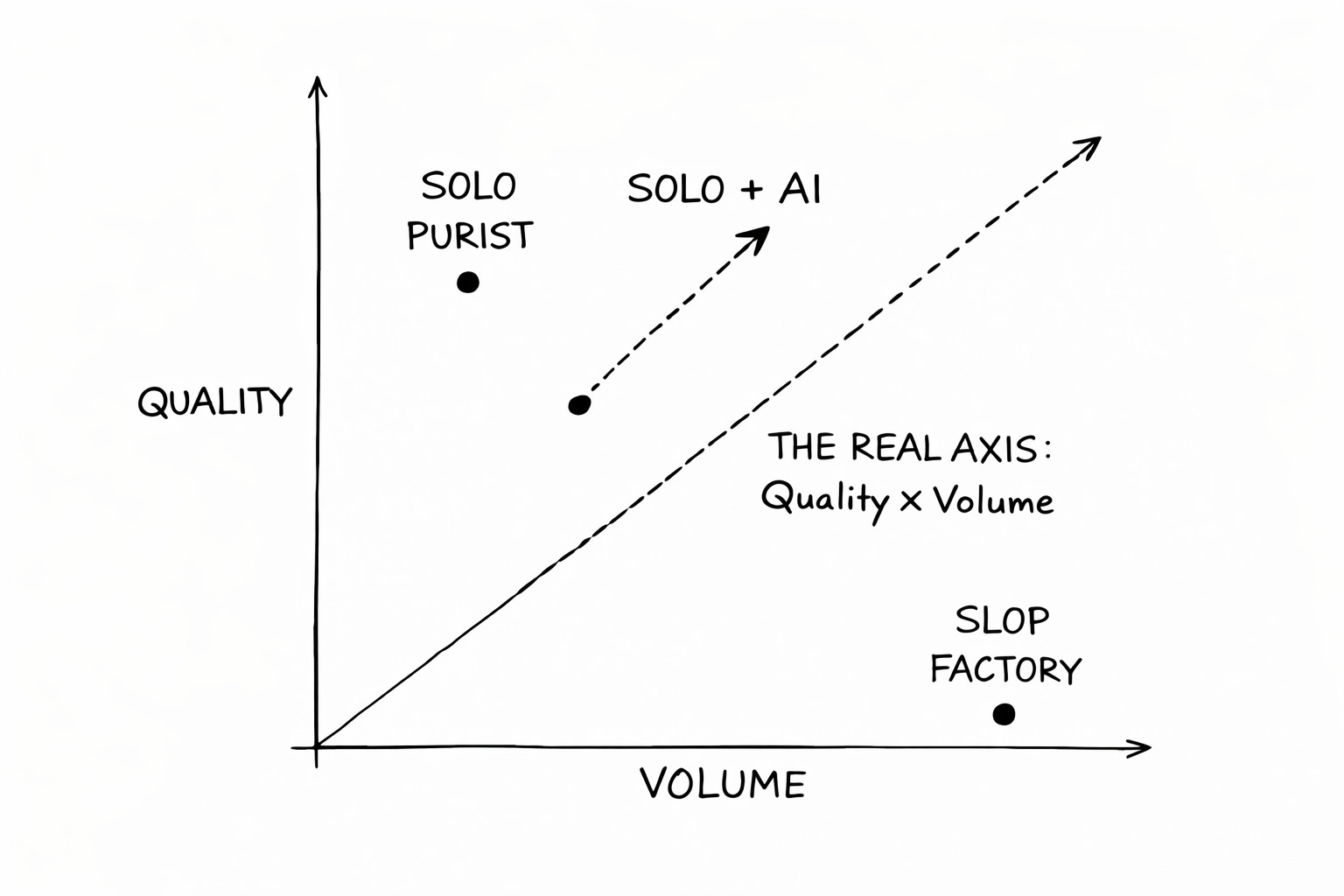
The real axis isn’t quality versus quantity. It’s quality times volume. And the question isn’t which one you sacrifice. The question is what tools and systems let you push both numbers up simultaneously.
That’s what AI collaboration actually does when you stop feeding prompts into one end and slapping your name on whatever craps out the other.
A slop factory publishes fifty posts a week. Quality score: 3 out of 10. (I’m being generous. Most of it wouldn’t clear a college freshman’s first draft.) Total impact: 50 × 3 = 150 units of... whatever we’re measuring. Reach. Attention. Platform juice.
A quality-obsessed creator without AI publishes two posts a week. Quality score: 8. Total impact: 2 × 8 = 16. Buried. Dead. The algorithm doesn’t give a shit about your artistic integrity.
But a solo creator who co-writes with AI? Who has documented their patterns (their actual Voiceprint, not a vague “be conversational” instruction) and built a publishing system around it? They publish five posts a week. Quality score: 7. Total impact: 5 × 7 = 35.
Still less than the slop factory. I’m not going to lie about that. Short term, quantity still wins the discovery game.
But here’s where it gets interesting.
The Ceiling They Can’t See
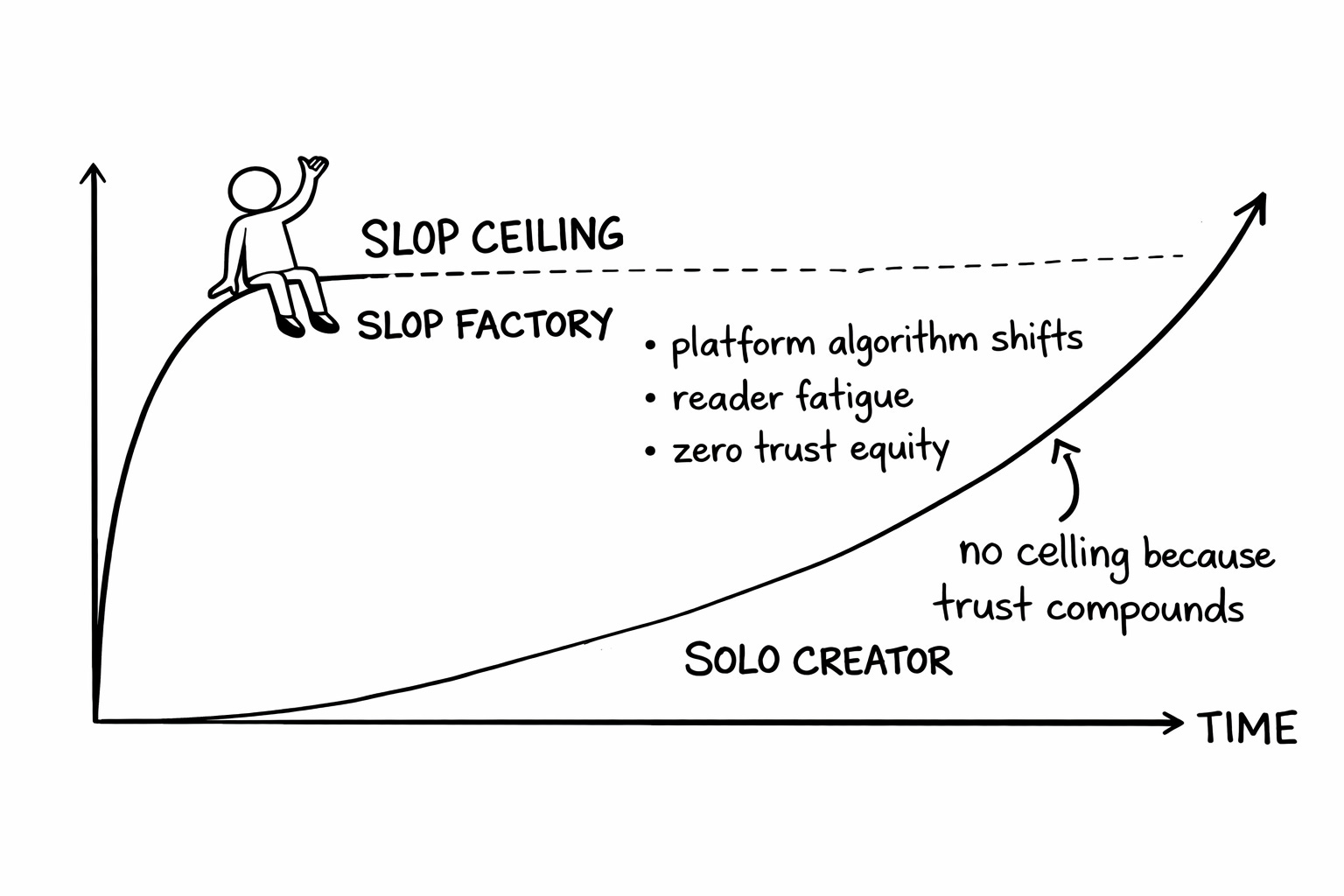
Slop factories operate on a model that has a built-in expiration date. They just haven’t read the fine print yet.
The entire business model of “publish 50 generic posts a week” depends on two assumptions that are already crumbling:
Assumption 1: Platforms will keep rewarding volume.
They won’t. Not forever. Every major platform is already building (or has built) quality signals into their algorithms. Google’s helpful content updates. Substack’s recommendation algorithm that factors engagement depth, not just post frequency. YouTube’s watch-time weighting over upload cadence.
Platforms make money when users stay. Users stay when content is good. Volume-first strategies are borrowing against a loan the platforms haven’t called in yet. (The interest is accruing, though. Silently. The way credit card debt does when you’re 23 and still think minimum payments are a strategy.)
Assumption 2: Readers can tell the difference.
They can’t. And that’s not the problem you think it is.
AI-written content has gotten good enough that most readers won’t flag a single piece as artificial. The models are too polished for that now. Your individual AI-assisted post isn’t what’s at risk.
The problem is aggregate. When every creator uses the same tools with the same default tendencies, the output converges. Not toward “bad.” Toward “same.” Every post starts to share the same cadence, the same transitions, the same smooth, inoffensive structure. No single piece is obviously AI. But the cumulative experience of scrolling through a hundred of them creates something worse than detection.
It creates invisibility.
Your reader doesn’t think “a robot wrote this.” They think “I’ve already read this.” And they keep scrolling. Past your post. Past the next one. Past all of it. Because nothing snagged on anything. Nothing had texture. Nothing left a mark.
That’s the slop ceiling. And it’s dropping.
The more AI content floods every platform, the more anything with actual fingerprints becomes visible by sheer contrast. Not because you’re trying to be different. Because everything else is converging toward the same center of gravity, and anything with real texture starts sounding like a live drummer in a room full of metronomes.
What Solo Creators Can Do That Slop Factories Literally Cannot
This is the part nobody talks about because it’s not sexy. It doesn’t fit in a thread. It requires you to think about publishing as a system and not just a series of individual posts.
A slop factory optimizes for one variable: output speed. Everything in the operation serves that goal. Templates. Plug-and-play prompts. Minimal human review. Maximum throughput. It’s a factory. The clue is in the name.
But optimizing for speed means you can’t optimize for three other things that are about to matter a lot more:
1. Pattern consistency across time
Your fifteenth post sounds like your first post. Not because you’re repeating yourself. Because there’s a recognizable human behind both of them. The same sensibility. The same perspective. The same specific way of constructing an argument that a regular reader could identify without seeing your name on it.
(This is the thing AI can approximate but never originate. Readers build a mental model of you over time. Every post either reinforces it or breaks it. Slop has no model to reinforce.)
Convergence erases the “who.” Consistency deepens it. One makes readers scroll past. The other makes them read your post before anyone else’s.
Slop factories can’t build this. Not because they don’t have voice guidelines. Most do. (”Confident but approachable. Conversational. Eighth-grade reading level.”) But those describe what good writing looks like in general, not what any specific writer sounds like. So every post starts from the same shallow spec and lands in the same forgettable middle. Each piece is a standalone transaction, not a chapter in an ongoing relationship.
2. Contextual intelligence
A slop factory doesn’t know what it published last Tuesday. Its AI doesn’t remember the running joke about Ohio, or the metaphor from three posts ago that readers keep referencing, or the fact that you promised to follow up on a topic and haven’t yet.
A solo creator with a properly architected AI collaboration system does. Claude Projects with your publishing history loaded. System prompts that reference your ongoing narratives. Context engineering that makes AI aware of what you’ve already said, what you’ve promised, and what your readers actually care about based on engagement data.
This isn’t a technical flex. It’s the operational reality that makes quality times volume possible. The AI doesn’t just generate content. It generates content that fits into a living body of work. (Slop factories produce orphans. We produce family.)
3. Earned trust as a currency
When a reader has followed your work for three months and you recommend a tool, they listen. When a slop factory’s randomly generated post #847 recommends the same tool, it’s static. Invisible. Immediately forgotten.
Trust compounds. Slop doesn’t.
The Long Game
Right now, today, a slop factory with ten times my output will receive more total eyeballs than I do. The discovery math favors them in March 2026. That’s real. I’m not going to pretend otherwise.
But publishing isn’t a snapshot. It’s a film.
Every day, the ratio of AI-generated content to human-touched content shifts further toward saturation. Every day, platforms get slightly better at identifying engagement depth versus engagement breadth. Every day, another reader scrolls past ten forgettable posts and stops at the one that had texture.
I’m not betting on a miracle. I’m betting on a trend that’s already visible if you know where to look.
Google’s helpful content updates have already tanked entire networks of AI-generated SEO farms. Substack’s recommendation engine already weights subscriber engagement over raw post volume. Newsletter open rates across the industry are declining for high-volume publishers and holding steady (or climbing) for the ones whose readers actually want to hear from them.
The ceiling is there. The slop factories just can’t see it because they’re still in the growth phase. They’re the suburban housing development that hasn’t noticed the soil is clay. Everything looks great until the foundation cracks.
(Mixed metaphor? Maybe. But I’m committing to it. The foundation cracks AND the ceiling drops. It’s a construction nightmare both ways. The building inspector filed his report as “not my problem” and moved to Portugal.)
The Answer I Used to Give Was Wrong
I used to have a clean story. Quality wins. Fingerprints matter. Do good work and the audience will find you.
It’s a beautiful thesis. Fits on a bumper sticker. Makes you feel righteous about spending four hours on a single post while the slop factories publish forty.
It’s also incomplete.
“Just be good” doesn’t solve the discovery problem. It never did. You can write the best post on the internet and if nobody sees it, you’ve written a diary entry with superior production value.
So the real question was never “should I abandon quality?” The real question is: how do you keep your fingerprints on everything when “everything” needs to include enough volume to actually get found?
Most creators frame this as quality versus quantity. Like it’s a dial with “fewer and better” on one end and “more and worse” on the other, and you just pick your spot.
That framing is a trap. And the escape hatch isn’t on the dial at all.
Taste as Infrastructure
The old model of “quality content” is a human standing at a workbench, hand-polishing every sentence. Artisanal. Painstaking. Beautiful output. Glacial pace. You’re the bottleneck because quality lives in your head and nowhere else.
The slop factory model is a machine running unsupervised. Fast. Cheap. Enormous output. No fingerprints. Quality lives nowhere because nobody built it into the system.
There’s a third architecture. One where your taste isn’t something you apply manually at the end. It’s something you engineer into the production layer itself.
Up until now, every time I sat down to write with AI, I loaded my Voiceprint. The documented patterns. The calibration process. Went back and forth with the AI until the output stopped sounding like a goddammed robot and started sounding like me.
But that was still me at the workbench. Faster than hand-writing, sure. But I was still the quality control checkpoint. I was still the bottleneck.
The question that actually matters is: what happens when the Voiceprint stops being a document you consult and starts being an engineering specification that the system runs on?
When your documented patterns aren’t just instructions you paste into a prompt, but the operating layer of an entire publishing architecture. When every piece of content the machine produces already starts where your rough draft used to end. Not because you hand-tuned it. Because the system was built to produce at your floor, not the machine’s default.
That’s not “be good.” That’s not “quality over quantity.” That’s taste embedded at the infrastructure level. The fingerprints aren’t added at the end. They’re baked into the process.
And a system like that can scale.
(I’m aware this sounds like I’m describing something I’ve already built. I haven’t. Not fully. Not yet. But the architecture is clear enough that I can see what it looks like. Which is more than I had when I was staring at a wall wondering if I should just become a slop factory with a guilty conscience.)
What This Changes
If taste can be infrastructure, then the quality versus quantity dial doesn’t exist. You’re not choosing a position on a spectrum. You’re building a system where the floor rises without requiring you to personally hand-finish every piece.
The solo creator with a Voiceprint operationalized inside their publishing system doesn’t compete with slop factories by being slower and better. They compete by being systematic and better. Volume goes up because the system handles the scaffolding. Quality holds because the spec is embedded in the architecture, not applied as a coat of paint at the end. Every post deepens the pattern. Every calibration cycle refines the spec. The compound interest isn’t in your subscriber count. It’s in the precision of the system that carries your fingerprints.
That’s the thesis. Not “quality wins” (bumper sticker). Not “fingerprints matter” (true but insufficient). But: the creator who engineers their taste into the system itself can produce at volume without losing their fingerprints. And that’s a game slop factories literally cannot play, because they have no taste to engineer.
So What Happens Now
Yesterday’s post was the question. This is the thesis. Everything that follows is the proof.
I haven’t built the full system yet. But I’m going to build it in public.
The system architecture. How the Voiceprint works as an engineering spec, not a writing exercise. The automation layer that carries it. The quality floor in practice. What breaks. What ships. What the real numbers look like.
All of it. Documented. In real time. With receipts.
Because if this thesis is right, the proof has to be visible. If one person can engineer their taste into a publishing system and produce work worth reading at a pace that compounds, the only way to make that case is to do it.
And if the thesis is wrong, you’ll see that too. In real time. With actual data.
Either way, you’ll have something slop factories can never offer.
Fingerprints on the work. From someone who gives a shit about the system that leaves them there.
🧉 Where does your taste currently live? In your head? In a document you paste into prompts? Or embedded in a system that runs on it? Drop your answer below.
Your taste isn’t what you add at the end. It’s what you build into the system from the start.
Crafted with love (and AI),
Nick "Infrastructure Over Inspiration" Quick

PS... Want to start documenting your own patterns? The Voiceprint Quick-Start Guide walks you through the VAST framework and gives you the foundation for engineering your taste into your own system. Free. No email sequence trying to sell you a webinar about a course about a workshop. Just the methodology.
PPS... If this post made you think (or argue back, or furiously open a Notes reply), hit the like button so Substack’s algorithm shows it to other creators who are wrestling with the same question. Slop factories have quantity. We have each other. (That sounded more sentimental than intended. I’m leaving it.)
When you think about it, the real game here isn’t just cranking out content; it’s about creating a system that allows your unique voice to shine through. Sure, AI can churn out words, but can it weave the threads of your experience into a compelling narrative? That’s where the magic happens.