
5 Mistakes That Make AI Sound Like a Corporate Drone (And How to Fix Them)

"Why does this sound like it was written by a corporate drone?"
I asked myself this after generating my 47th terrible draft with Google Gemini.
The prompt I'd given it was detailed. Three full paragraphs explaining my voice: conversational but substantive, uses personal stories, starts with hooks, avoids business jargon.
The output? Generic LinkedIn guru prose that could've been written by anyone.
"Paradigm shift."
I didn't tell it to write like that. Where did it even get those phrases?
Here's what I learned: Most people are making the same five mistakes when teaching AI their voice. And those mistakes guarantee generic outputs.
Let me show you what's going wrong—and how to fix it.
Mistake #1: Giving AI Random Examples (Instead of Systematic Patterns)
What Most People Do:
Find their "best" piece of writing → Paste into ChatGPT → Say "write like this" → Get disappointed
Why This Fails:
AI extracts surface-level patterns from single examples. It sees:
Average word count: 287 words
Average sentence length: 14 words
Uses "I" occasionally
Mentions personal experience once
But it misses the systematic elements that make your voice yours across everything you write.
The Fix: Document Repeating Patterns
Your voice isn't one blog post. It's the patterns that show up in all your writing.
Instead of random examples, create a systematic inventory using the SPARK Method—five dimensions that capture your mechanical signature:
Sentence patterns (structure, length, fragments)
Punctuation personality (em dashes, parentheticals, ellipsis)
Angle of approach (how you enter topics, your default perspective)
Rhythm of pacing (fast punchy sections vs. slower explanatory ones)
Keystone phrases (signature expressions only you use)
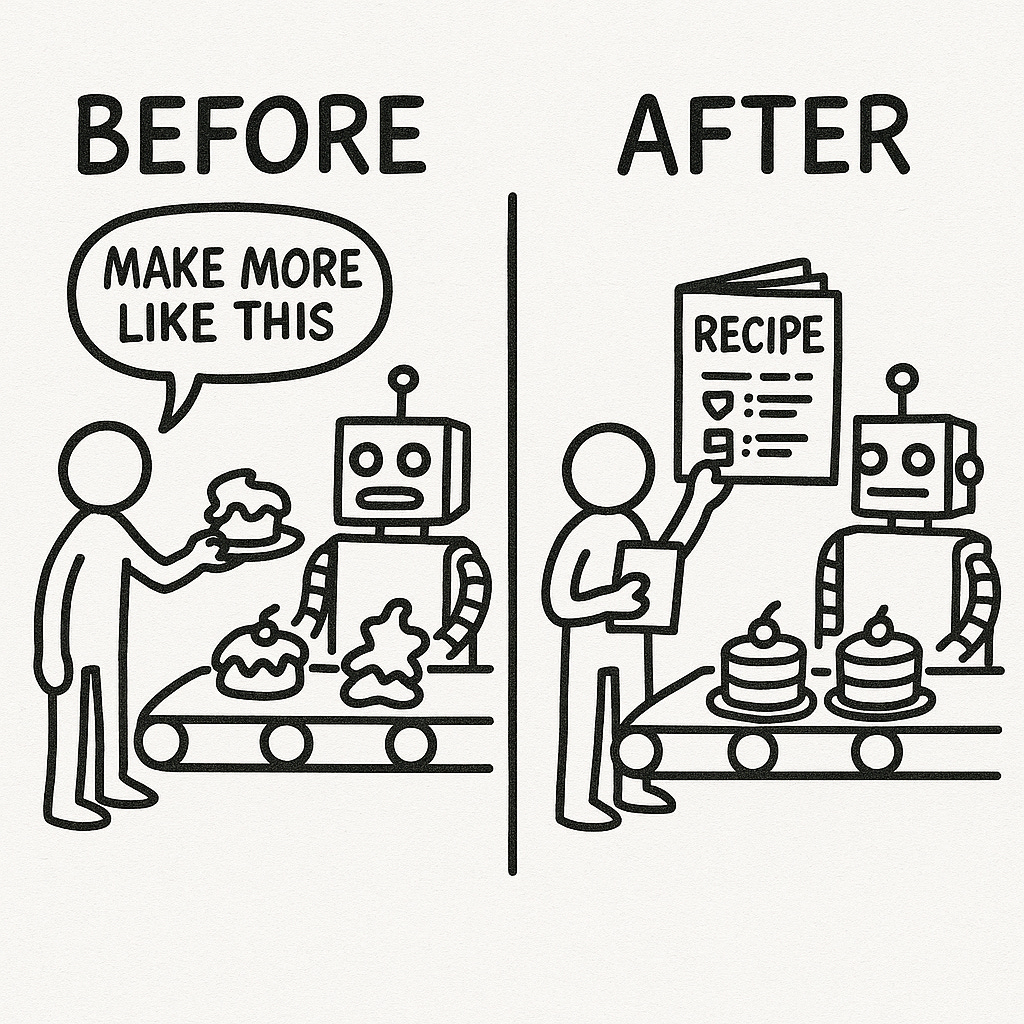
This gives AI a reference framework, not a single data point.
Mistake #2: Confusing Voice with Tone (They're Not the Same Thing)
What Most People Do:
Tell AI: "Write in a casual tone" or "Be more professional"
Why This Fails:
Voice is WHO you are. Tone is WHERE you position yourself on a spectrum.
You can maintain the same voice while adjusting tone for different contexts. But most people conflate them, so AI gets confused.
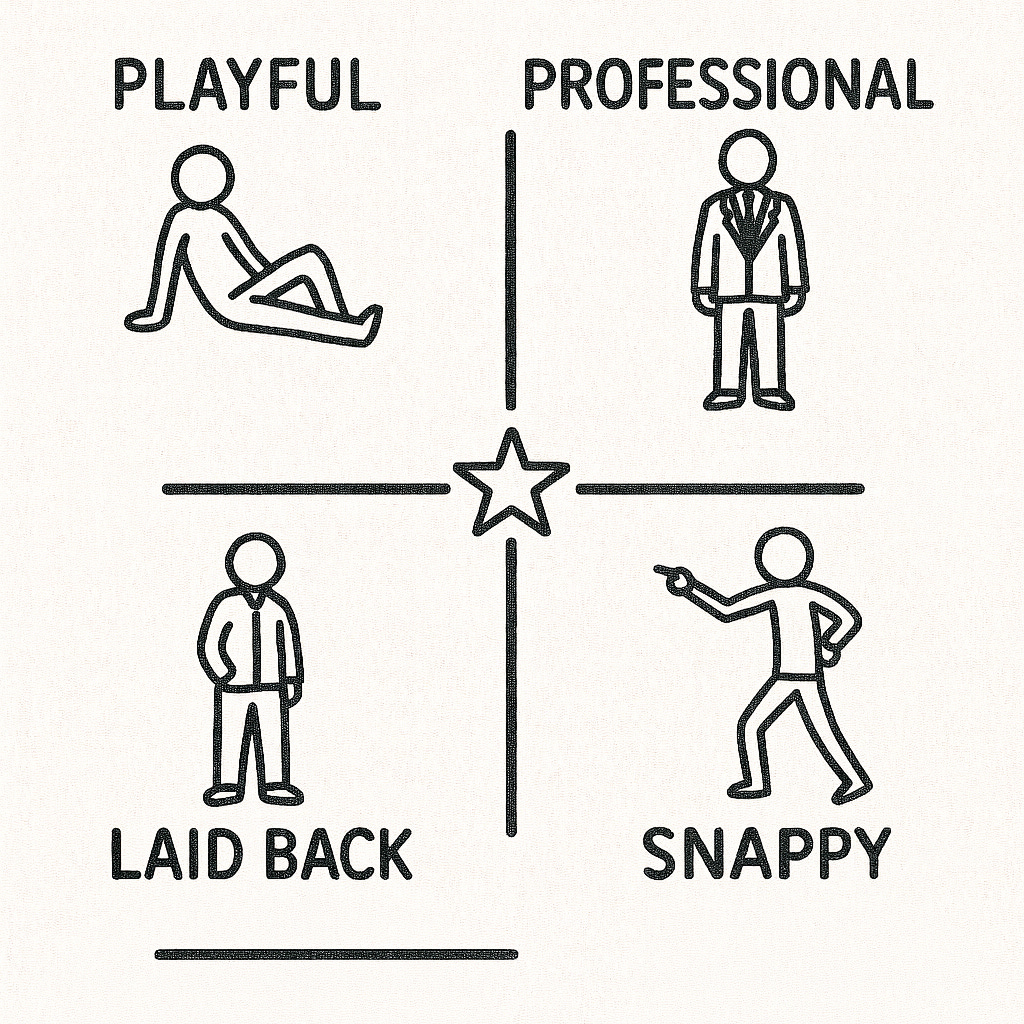
The Fix: Position Yourself on the Tone Grid
Use two axes to map your tone:
X-Axis: Loose (1) to Tight (10) - Structure and polish
Y-Axis: Irreverent (1) to Professional (10) - Formality and attitude
My coordinates: (6, 4)
Structured but conversational (6 on X)
Slightly irreverent, questions assumptions (4 on Y)
This puts me in the "Laid Back" quadrant—not rigidly professional, not playfully loose.
When you document this in your Voiceprint, AI understands your default positioning and can adjust from that baseline when needed.
Mistake #3: Focusing on What You Write (Instead of How You Write)
What Most People Do:
Tell AI: "I write about marketing" or "I focus on AI and automation"
Why This Fails:
Topics don't define voice. Two people can write about the same topic in completely different voices.
What matters is the mechanical patterns: sentence structure, paragraph length, punctuation quirks, vocabulary choices.
The Fix: Document Your SPARK Signature
This is where SPARK becomes your secret weapon. Create an inventory of HOW you write, regardless of topic:
# MY SPARK SIGNATURE

**S - Sentence Patterns:**
- Mix of short punchy sentences and longer explanatory ones
- Fragments. For emphasis.
- Start with "But" or "And" when it adds impact
- Questions to engage readers

**P - Punctuation Personality:**
- Em dashes—like this—for abrupt shifts
- Parenthetical asides (thoughts within thoughts)
- Ellipsis for trailing thoughts...
- Line breaks between most paragraphs

**A - Angle of Approach:**
- Lead with problems before solutions
- Question conventional wisdom first
- Enter through personal experience, not statistics
- Default to skepticism, earn enthusiasm

**R - Rhythm of Pacing:**
- Fast punchy openings
- Slower explanatory middle sections
- Accelerate toward conclusions
- Vary sentence length deliberately

**K - Keystone Phrases:**
- "Here's what I learned:"
- "The problem isn't [X]. It's [Y]."
- "That's when I realized:"
- "[Statement]. Let me explain."
These patterns stay consistent whether you're writing about AI, marketing, or woodworking.
To extract your own SPARK signature, use this prompt:
"Analyze these writing samples and document my SPARK signature:

S - Sentence Patterns: How do I structure sentences? Length? Fragments? How do I start them?

P - Punctuation Personality: What punctuation do I use frequently? Em dashes? Parentheticals? Ellipsis?

A - Angle of Approach: How do I typically enter topics? What's my default perspective?

R - Rhythm of Pacing: Where do I speed up or slow down? How do I vary intensity?

K - Keystone Phrases: What expressions or sentence structures do I use repeatedly?

Be specific. Give examples from the text."
Mistake #4: Not Defining What You DON'T Do (Quality Controls Matter)
What Most People Do:
Focus entirely on what AI should write like, ignore what it shouldn't do
Why This Fails:
AI defaults to its training data—corporate press releases, academic papers, generic blog posts. Unless you explicitly tell it what to avoid, it gravitates toward that safe middle ground.
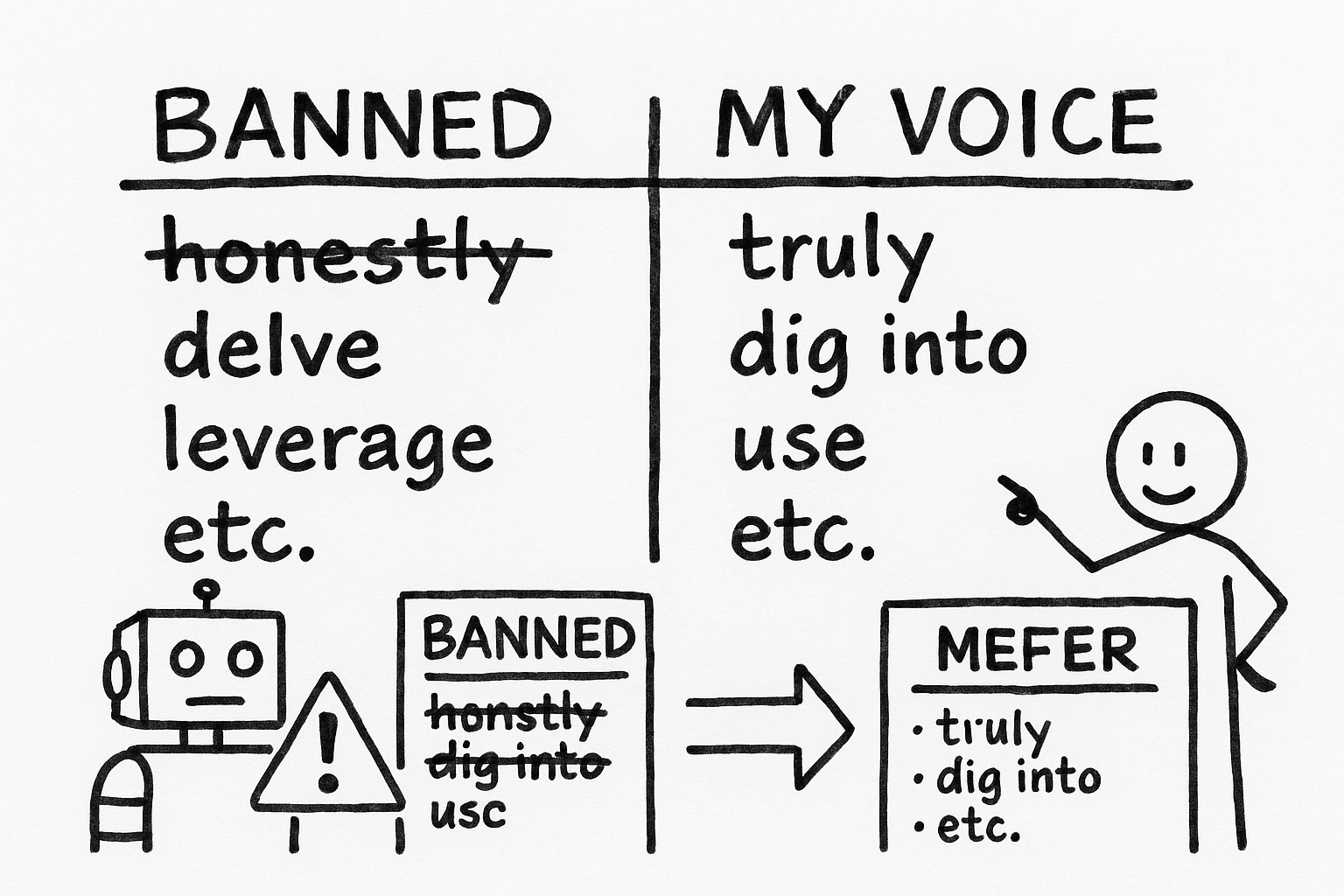
The Fix: Create a "Banned List" of Red Flags
Document the language, structures, and approaches you never use:
# QUALITY CONTROLS

**Language I Never Use:**
- "Honestly" / "To be honest" / "Here's the thing"
- "Delve" / "Unprecedented" / "Game-changer"
- "Leverage" / "Synergy" / "Paradigm"

**Structures I Avoid:**
- Pure listicles without narrative
- Statistics without stories
- Academic citations without context
- Generic advice without personal perspective

**Red Flags (Rewrite Immediately):**
- Sounds too formal (corporate speak)
- Sounds too generic (could be anyone)
- Sounds overly promotional (hype-heavy)
- Missing my natural skepticism
This is your quality filter. When AI produces something that triggers a red flag, you know to rewrite.
Mistake #5: Treating Voice as Static (Instead of Iterative)
What Most People Do:
Build voice guide once → Use it forever → Never refine it
Why This Fails:
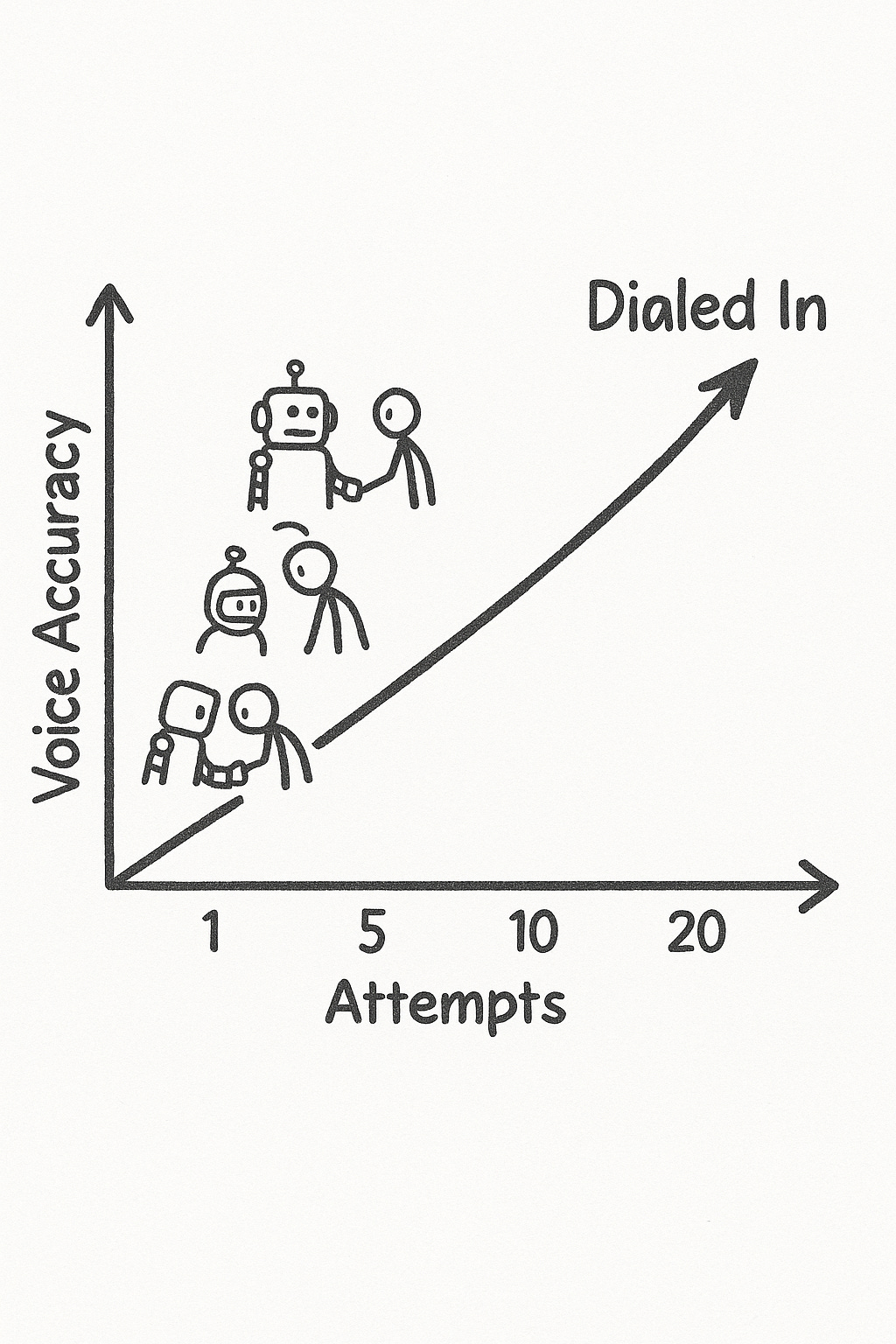
Your understanding of your own voice evolves. The first time you document your voice, you're making educated guesses. After 10 collaborations with AI, you've learned what actually matters.
The Fix: Use the Mimic & Modify Method
This is an iterative process:
Mimic: AI generates content using your Voiceprint
Compare: Read critically—does this sound like you?
Modify: Make specific edits to align with your voice
Analyze: What changes did you make and why?
Update: Feed those insights back into your Voiceprint
Iterate: Repeat until outputs are consistently authentic
Your Voiceprint isn't a one-time document. It's a living system that improves every time you use it.
The first month, I updated mine weekly.
Now? Maybe once a month.
Because the patterns are dialed in.
The Template That Fixes All Five Mistakes
Here's what a systematic Voiceprint looks like:
# MY VOICEPRINT

## Voice Attributes (WHO you are when you write)
[5-10 personality traits that show up consistently]

## SPARK Signature (HOW you write)

**S - Sentence Patterns:**
[Your sentence structure, length, fragments, openers]

**P - Punctuation Personality:**
[Your punctuation quirks and formatting habits]

**A - Angle of Approach:**
[How you enter topics, your default perspective]

**R - Rhythm of Pacing:**
[Where you speed up/slow down, intensity variation]

**K - Keystone Phrases:**
[Signature expressions and sentence structures]

## Tone Positioning (WHERE you land)
**Coordinates:** (X, Y) on Tone Grid
**Quadrant:** [Playful, Laid Back, Snappy, or Polished]

## Quality Controls (What you DON'T do)
**Language I Never Use:** [Banned words/phrases]
**Structures I Avoid:** [Format preferences]
**Red Flags:** [What triggers immediate rewrite]
Download the fill-in-the-blank template here
This framework addresses all five mistakes:
🧉 Systematic patterns instead of random examples
🧉 Separates voice from tone
🧉 Documents mechanical signature with SPARK
🧉 Defines quality controls
🧉 Designed for iterative refinement
How to Build Your Voiceprint in 90 Minutes
Hour 1: Gather and Analyze
Collect 3-5 writing samples (500+ words each)
Feed to ChatGPT with prompt: "Analyze these and identify 5-10 core voice attributes—personality traits, not mechanical style."
Use the SPARK prompt above to extract your mechanical signature
Document patterns you recognize in your samples
30 Minutes: Position and Control
Determine your Tone Grid coordinates (X: structure, Y: formality)
List banned language and red flags
Define quality standards
That's it. 90 minutes to build your first draft.
Then you refine it through use. Every time AI misses your voice, you analyze why and update your Voiceprint.
After 5-10 iterations, you'll have a systematic framework that consistently produces outputs that sound like you.
The Difference This Makes
Before I built my Voiceprint, I spent 2+ hours writing a newsletter with AI.
Now? 45 minutes.
And the output sounds more like me than my "fully written by myself" drafts used to—because I've documented patterns I didn't consciously know I had.
That's the power of systematic collaboration.
Discussion: Which of these five mistakes have you been making? (I was guilty of all five for two months straight.)
Crafted with love (and AI),
Nick "47 Bad Drafts Later" Quick

PS…Want more on collaborating with AI without losing your voice? Subscribe for new posts every Sunday and Wednesday.