
156 First Dates with the Same Person
Three moves that build relationships between sends

Someone left a comment on a post last month that made me stare at my screen for a solid thirty seconds like a dog processing a magic trick.
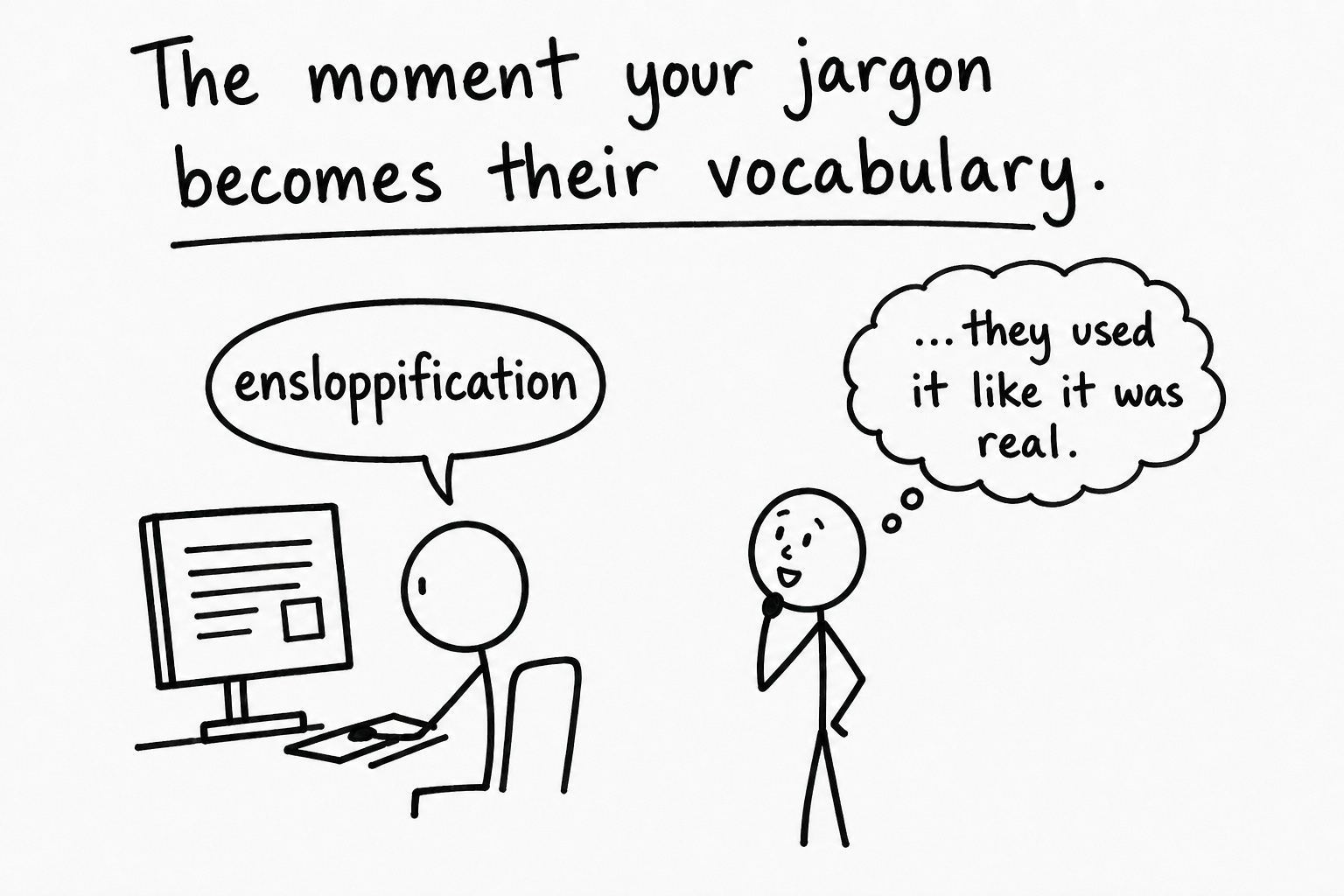
They used “ensloppification“ in a sentence. No quotation marks. No link back to the post where I coined the term. No “as Nick Quick calls it.” They just used it. Mid-paragraph. Like it was always a word. Like it had been in the dictionary the whole time, wedged somewhere between “enslavement” and “entanglement,” patiently waiting for someone to notice it existed.
(It is not in the dictionary. I made it up. I made it up while trying to describe what happens when millions of creators each make rational decisions toward sameness until the entire internet tastes like hotel lobby air freshener. The fact that this word now shows up in other people’s paragraphs without attribution is either the highest compliment I’ve ever received or proof that I’ve accidentally released a linguistic parasite into the wild. I have made peace with both possibilities.)
But that’s not the part that got me.
The part that got me was realizing I didn’t need to explain what they meant. And neither did anyone reading their comment. The word landed, fully loaded, no footnote required, because somewhere over the last several months a vocabulary had built up between us. Not because I defined it well once. Because I used it in enough different contexts, across enough posts, that it stopped being my jargon and started being our shorthand.
Nobody A/B tested that. No one split-tested the terminology. No growth hack created it. It accumulated. Quietly. Across months of shared reference points that no single post created and no metric has a column for.
That’s the cross-post throughline.
And until now, this series hasn’t touched it. Part 1 was the hook economy. Part 2 showed what a single post deposits into the ongoing relationship. Part 3 gave you four techniques for making each paragraph earn the next one. All of that was about making one post land.
This post is about what builds in the space between sends. The invisible conversation accumulating between you and a reader who’s been showing up long enough that the two of you have started developing your own vocabulary, your own shorthand, your own history that no subject line, no hook, and no split-tested preview text will ever replicate.
Three moves. All of them are about building the relationship that none of those tactics can replicate.
Name Your Frames
Here is how most writers reference their previous work:
“As I mentioned in my last post...”
“If you missed my Tuesday piece on content systems...”
“Building on the framework I introduced two weeks ago...”
Each of these is a polite way of saying: I don’t trust the previous work to be memorable on its own, so I’m manually inserting a hyperlink into your consciousness. It’s someone showing you a photo on their phone and then narrating the photo while you’re looking at it. I can see the beach, Kevin. I have functioning eyes. I can also see the timestamp, the geotag, and the fact that you were wearing socks with sandals (which I was planning to address privately but here we are.)
That’s not a callback. That’s a footnote with self-esteem issues.
A real callback doesn’t announce itself. It uses previous material as a building block so quietly that new readers get the surface meaning and returning readers get the encrypted layer underneath. Two readings of the same sentence, both valid, one of them richer because of shared history.
And it starts with a decision so simple it borders on embarrassing: name your frames.
An unnamed idea has the shelf life of a sneeze. You describe it, the reader nods, they move on, it dissolves. Next week you describe it again. From scratch. The reader nods again. Neither of you remembers this has happened before. (This is most newsletters. A weekly cycle of mutual amnesia punctuated by subscribe buttons.)
A named idea sticks to the wall. “Ensloppification“ isn’t a word because I used it once. It’s a word because I’ve used it across dozens of posts in dozens of contexts until it stopped needing quotation marks and started being vocabulary. (I refuse to count the exact number of times. It’s higher than anyone’s comfort level, including mine. My editor, who is me, has raised concerns. My response, which was also me, was “noted.” The issue remains unresolved.) Same with VAST. A four letter acronym. If you’ve been here longer than a few weeks, you already hear Vocabulary, Architecture, Stance, Tempo without me spelling it out. If you’re new, you parsed it as “some framework” and kept moving. Both responses are correct. The returning reader just got the encrypted layer underneath.
Unnamed frames decay after one read. Named frames compound across months.
Marie Kondo didn’t invent the feeling of looking at something you own and knowing you should get rid of it. She named the opposite: “Does it spark joy?” A simple question. Now millions of people hold up a sweater and hear her voice without ever having read the book. The phrase left her and became theirs. (I have never read the book. I have used the phrase eleven thousand times. I am the proof and the problem.)
That’s what naming does. It gives the idea legs. An unnamed observation dies in the paragraph where it was born. A named one gets carried out of your post and into someone else’s vocabulary, their DMs, their own drafts, their way of seeing the thing you both care about. The name is how the idea survives between sends.
The principle: mine the shelf before inventing from scratch. Give an idea a name the first time. Use the name every time after. The vocabulary accumulates. The accumulation is your throughline
End on Weight, Not Resolution
Most writers write conclusions.
I know this because I’ve read thousands of them and have somehow arrived on the other side with most of my cognitive function intact, which I attribute to a combination of stubbornness and an inability to learn from repeated punishment. (Neither of these qualities has been praised by anyone in my personal life. Both have been diagnosed.)
The problem with conclusions is that they conclude things. They satisfy. They resolve. They hand the reader a polished reason to feel complete, which is a polite way of handing them a receipt and holding the door open.
Four ways writers snip their own throughline clean. I will be clinical about this because getting emotional would imply I still have hope.
“In conclusion...” (The flight attendant announcing your final descent when the wheels are already on the tarmac. If you have to tell the reader you’re concluding, the preceding paragraphs failed to build toward anything they’d have noticed on their own.)
“I hope this was helpful.” (The written equivalent of sneezing near someone’s child at a holiday gathering. Nobody asked for it. Nobody wanted it. Everyone is now mildly contaminated by something they can’t quite name.)
“Until next time!” (The “drive safe!” of publishing. Technically a farewell. Emotionally a non-event. You’re waving at the dust their departure kicked up.)
“Let me know what you think in the comments.” (This has produced zero comments of value since the invention of the comments section. Not low-value comments. Zero. The comments section did not need your permission to exist, and your invitation to participate in it carries roughly the same authority as a squirrel gesturing welcomingly toward a public park bench.)
(I could dissect these all day. This is my version of true crime. Same forensic fixation, fewer victims, roughly equivalent levels of concern from my friends about what it says about me as a person.)
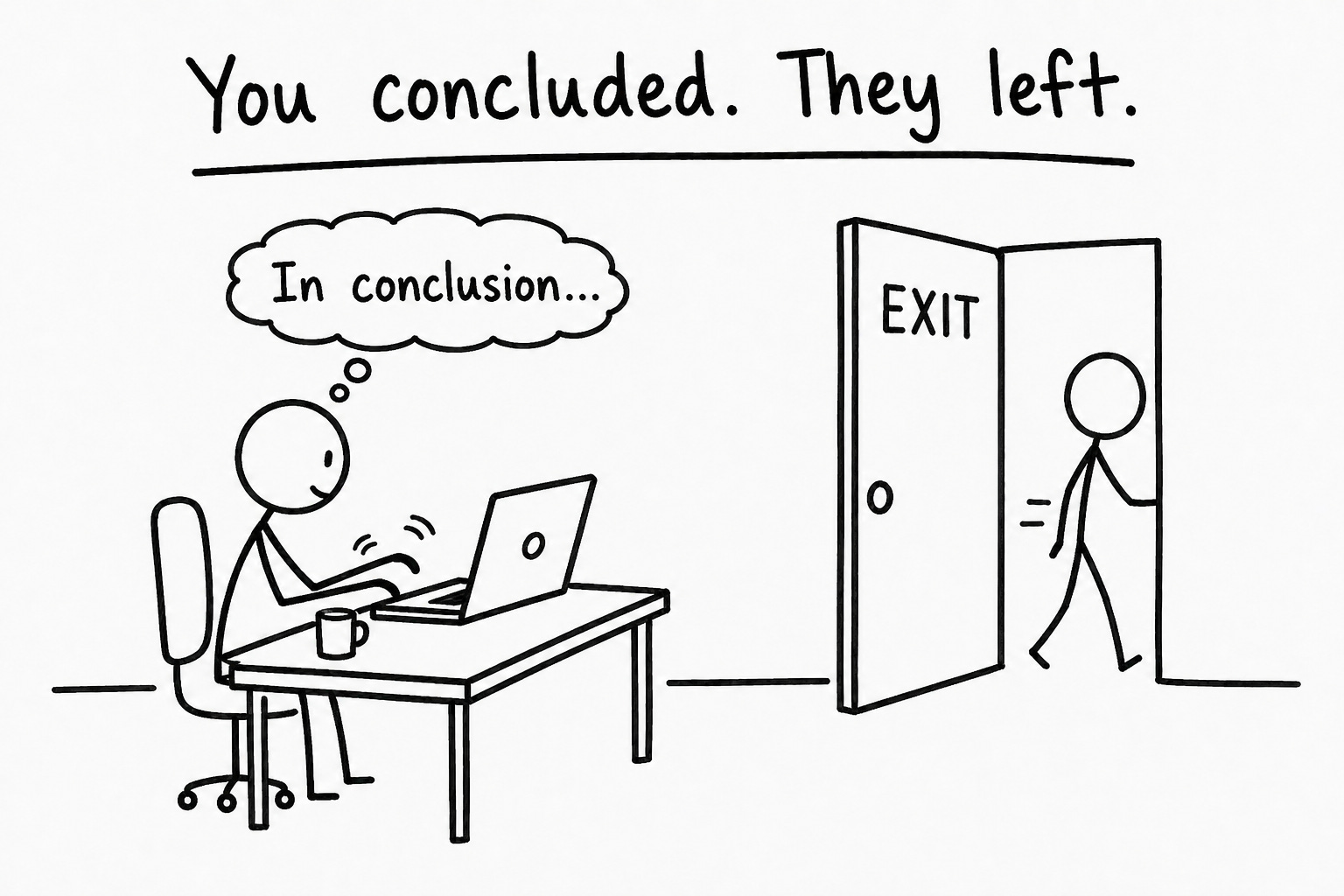
Every one of those is a resolution. A ribbon. A period at the end of a thought. And every one does the same thing to the throughline: snips it clean.
Because a reader who feels complete has no reason to lean forward into the next send.
The alternative is weight. An ending that deposits something rather than wrapping something up. A question the reader didn’t have before they sat down. A complication that makes the concept heavier instead of a bow that makes it presentable. (Cliffhangers can do this too, sparingly. But a cliffhanger withholds. Weight adds. A cliffhanger makes you need the next post. Weight makes you need to sit with this one.)
The hook gets you opened. The ending decides whether you get opened again. And the relationship between sends starts in how you end.
Deepen What Exists
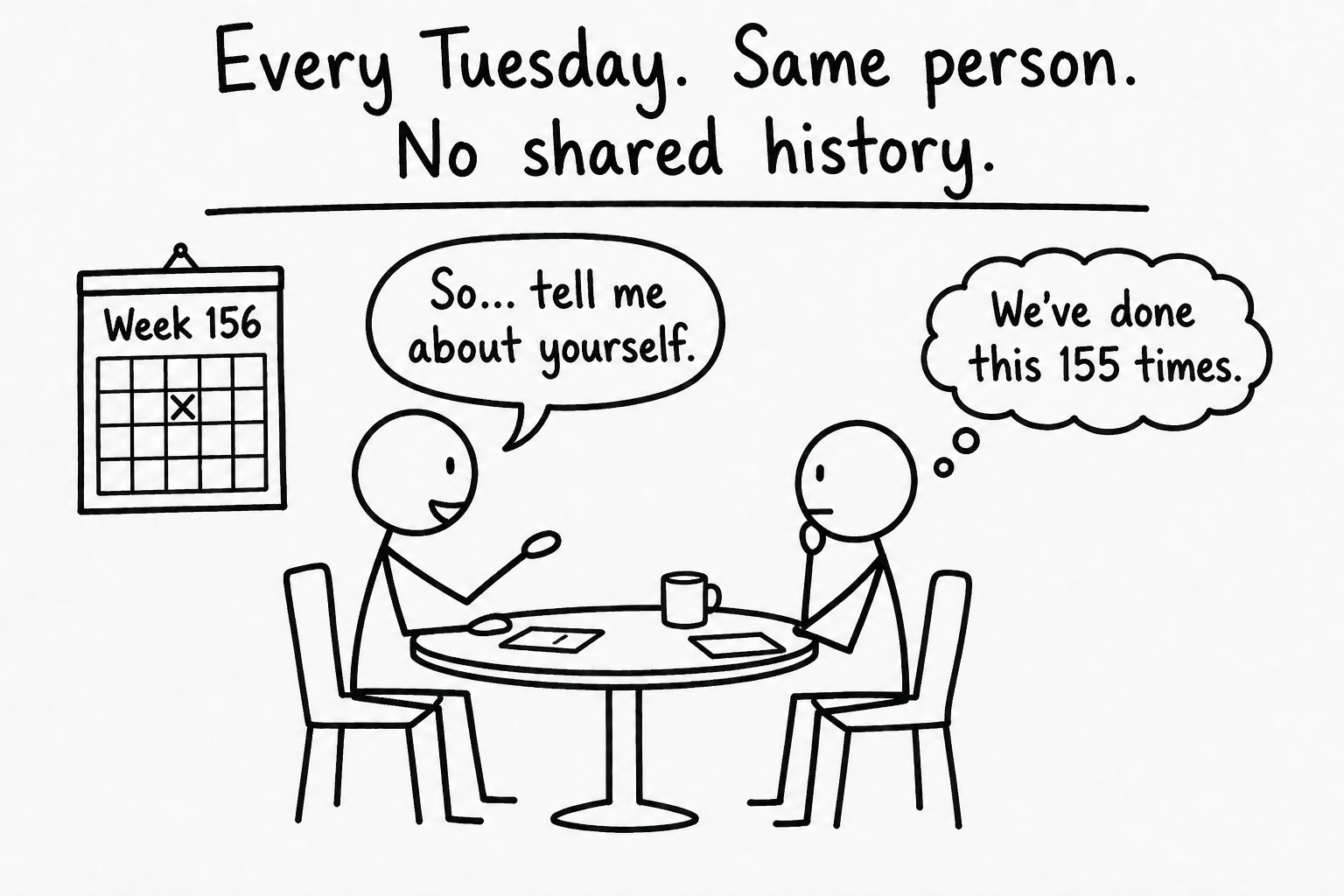
A writer who has published weekly for three years without once returning to a previous concept has 156 standalone performances and zero shared history with their reader.
Every Tuesday is a first date. Every single one. With the same person. Who showed up 156 times. And still gets the “so, tell me about yourself” treatment every single week.
(At a certain point, the content calendar stops explaining the behavior and starts covering for it.)
Most writers treat every post as a clean slate. New topic. New angle. New performance. Which means every send restarts the relationship from zero. No concepts accumulate weight. No vocabulary compounds. The archive is a storage unit the writer visits once a week to shove something in and never opens again.
The fix is the simplest move in this entire series: before your next post, look at your archive.
What have you already planted that could be raised? What concept gets heavier with a new example, a new complication, an angle you didn’t have the first time? What vocabulary have you already coined that your returning readers are already carrying?
The Breaking Bad writers’ room kept a corkboard tracking every planted element. When they needed a beat, they looked at what existed before inventing from scratch. Vince Gilligan’s rule: mine the shelf. (I keep returning to this principle because it is, operationally, the single most underused move in newsletter writing. Entire seasons of prestige television was built on the discipline of inventorying planted material before generating new material. Solo newsletter writers have the same shelf. They just pretend it’s a junk drawer. Like a gym membership in February.)
And this is where AI collaboration without voice documentation does the most invisible damage. Out of the box, AI has no memory of your archive. It doesn’t know what you planted in March. It can’t raise a concept from six posts ago unless you’ve built the infrastructure to feed it that context. Most writers haven’t. Without that infrastructure, AI produces standalone posts by default (every session starts from zero, even if the writer isn’t), and the result is predictable: threads go cold, the archive fragments, and the reader stops feeling like they’re inside a conversation and starts feeling like they’re watching auditions for a role the writer already earned.
The voice drifts without anyone noticing. Most writers never gave the AI what came before. Every undocumented session is a first date with your own publishing history. And the throughline, which was the whole point, quietly dissolves while the writer wonders why the open rate is doing something strange.
The throughline isn’t built by publishing more. It’s built by deepening what’s already there.
Now think about what happened to you over the last four posts.
You didn’t need me to explain “photos two through six“ when it showed up without context. You didn’t need a footnote for the raccoon’s countersuit. You didn’t need a recap or an “as I discussed previously” for any of it. The vocabulary just landed. Because it was already yours.
(This is either very clever or moderately pretentious. I have made peace with both possibilities. My therapist has not, but she charges by the hour so her concerns are structurally incentivized.)
This series didn’t explain the cross-post throughline. It built one. With you. In real time.
And now I have a question I can’t answer for you.
🧉 What have you planted in your archive that’s still sitting on the shelf, waiting to be raised? What did you name once and never use again? What concept has been quietly accumulating weight across your posts without you noticing, because you’ve been too busy inventing from scratch every Tuesday to look at what’s already there?
Your reader has been running a tab you never opened.
Go look at the tally.
Crafted with love (and AI),
Nick “156 First Dates, One Ongoing Conversation” Quick

PS... If you’re still rewriting half of every AI draft by hand, the problem isn’t the AI. It’s that nobody taught it what you sound like. The Ink Sync Workshop is free and fixes that in about an hour.
PPS... Like it. Restack it. Subscribe. Comment something. Send it to a writer who publishes regularly and has never once referenced a previous post. Send it to a writer who only references previous posts and makes each one feel like a hostage negotiation. Print all four parts and bind them with a binder clip you stole from the office supply closet. Leave the bound manuscript on a park bench with a sticky note that says “this is the throughline now.” Mail it to your senator. The senator won’t read it but their intern will, and that intern is three months from starting their own newsletter, and your restack just altered the trajectory of American political publishing, and you didn’t even put pants on.