
143 Bodies. Zero Autopsies.
What happens when you finally investigate your own creative crime scenes.

Your worst writing contains your best data.
Not the published stuff. Success is a lousy teacher. When something works, you don’t stop to ask why. You hit publish, feel good for about six minutes, then move on to the next blank page so you can feel like a fraud all over again. There’s no friction to analyze. No resistance to map. Just forward motion and intermittent despair.
The real patterns live in the posts you killed. The drafts you couldn’t finish. The ideas that died mid-sentence, gasping for air while you stared at the blinking cursor and felt nothing but a vague wrongness you couldn’t name.
That’s where your voice shows its teeth.
I’ve got a drafts folder that’s been silently judging me for years. Just sitting there, keeping score. We had an understanding: I don’t open it, and it doesn’t remind me who I really am.
Today, I opened it anyway.
Turns out I’ve been sitting on 143 unsolved murders.
The Crime You Keep Committing
Every abandoned draft is a verdict.
You didn’t just stop working on it. You ruled against it. Something in your creative operating system looked at those words and pronounced them dead on arrival.
That ruling contains information. Specific, actionable, pattern-revealing information. And you threw it away like a detective shredding case files because paperwork is annoying AF.
Your taste is a filter. It lets some things through and murders others in the drafts folder. Cold-blooded, really. No trial. No appeal. Just sudden death by apathy.
Most writers spend years building this filter without ever asking what it’s actually filtering for.
The answer is sitting in your evidence locker. Decomposing. Full of clues.
Time to reopen some cold cases.
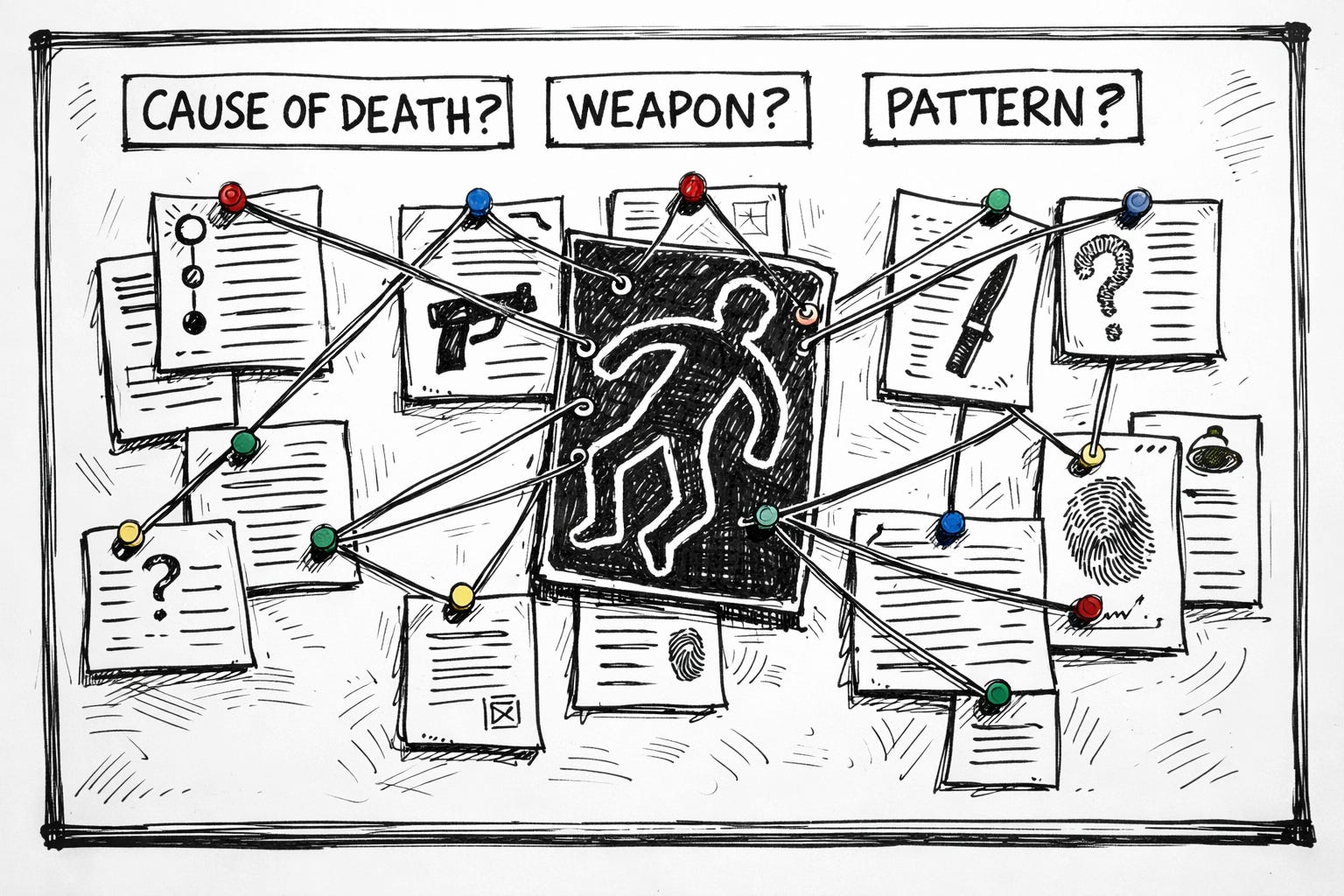
The Forensics
I went back through 31 corpses with a single question: What killed you?
Not “what was wrong with the writing.” That’s too vague. That’s the 11pm excuse. “I’ll come back to it tomorrow.” You won’t. You know you won’t. You knew it when you said it. Premeditated drafticide.
I wanted the specific cause of death. The murder weapon. The motive.
Patterns emerged. Horrifying, revealing, extremely useful patterns:
Cause of Death #1: Energy mismatch
Eleven drafts died because my internal state and the piece’s required state were at war. Trying to write punchy when I felt like wet cardboard decomposing behind a 7-Eleven dumpster—pissed on by dogs, cats, and at least one man who’s lost custody of something or someone. The piece needed vulnerability and I showed up in full tactical gear. The words came out technically correct but vibrationally wrong. Like a eulogy written by someone who’s secretly relieved.
Cause of Death #2: Phantom audience
Eight drafts died because I was writing for critics who don’t exist. Hedging everything. Adding disclaimers nobody asked for. Explaining myself to imaginary skeptics who weren’t in the room and never would be. (Academia did this to people. The entire dissertation-industrial complex is just training humans to preemptively apologize for having an original thought.)
Cause of Death #3: Borrowed containers
The mutilated corpses? Posts where I shoved my ideas into someone else’s framework. “This should be structured like [successful person’s] thing.” Except I’m not them. My ideas don’t fit their architecture. It’s like forcing a confession that doesn’t match the evidence. Technically complete. Obviously wrong.
Your causes of death won’t match mine. That’s the whole point.
The Hesitation File
The most valuable corpses aren’t the obvious homicides.
They’re the ones where you can’t determine cause of death.
You just... stopped. Something felt wrong. You couldn’t name it. You walked away.
That hesitation is evidence. Your subconscious left you a note and you never bothered to review it.
When I find a draft I can’t explain abandoning, I run a thought experiment: What if I published this right now?
Not eventually. Not after revisions. Right. Now.
What specifically makes me cringe?
Is it the opening? (Probably too slow. My tolerance for throat-clearing is approximately zero sentences.)
Is it a particular line? (Usually one where I’m performing instead of communicating.)
Is it the overall vibe? (Often means I was cosplaying expertise instead of just being honest.)
Get specific. “It doesn't feel right" is a drunk 911 call. "I'd be embarrassed if my smartest friend read paragraph two" is a body with an ID in its pocket.
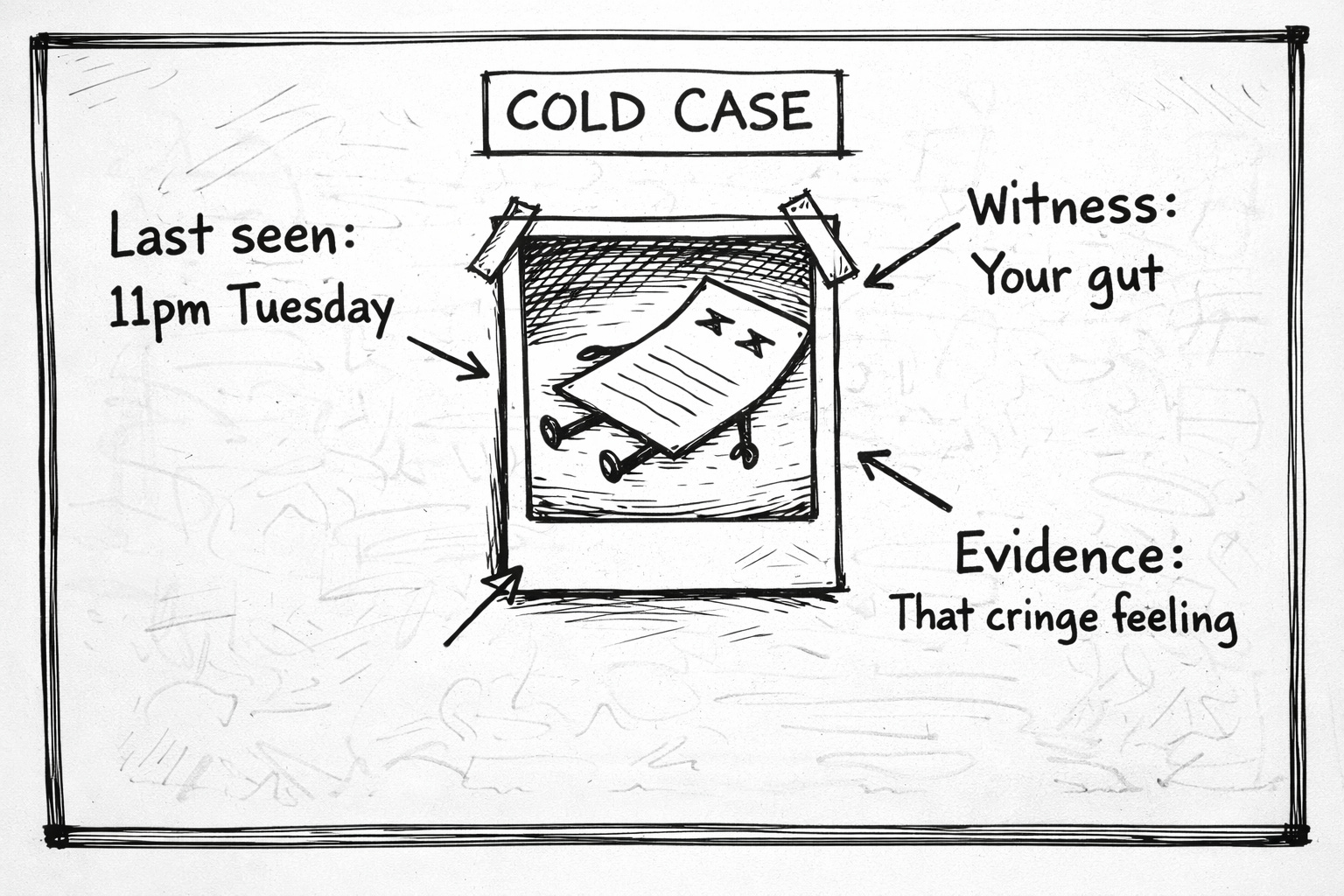
What the Bodies Told Me
For whatever it’s worth, here’s what my forensic investigation revealed:
I can’t write without a story first.
Every dead post was missing a concrete example in the opening. Every survivor has one. This isn’t preference. It’s structural. Without a story, I’m just a guy making assertions. With a story, I’m a guy who’s been somewhere. The second one is worth reading. The first is a LinkedIn thought leader post. (Lord help us all.)
I kill any sentence that starts with “It’s important to...”
Found it in eleven bodies. Zero survivors. My taste rejects that phrasing like a body rejecting a bad organ. Now I know to tell AI: use those words and the post dies. Non-negotiable.
I abandon posts when I’m performing smart.
The more jargon in a draft, the more likely it’s a corpse. When I’m writing well, I’m explaining to a specific friend. When I’m posturing, I’m trying to impress people who don’t exist and wouldn’t like me anyway.
These patterns existed for years. I just never ran the investigation.
From Evidence to Instructions
Here’s where forensics becomes practical:
Once you identify your kill patterns, you can document them. Explicitly. Like case law for your creative decisions.
Instead of vague descriptions like “my writing is conversational” (meaningless—everyone says that, including people who write like they’re translating a Soviet tractor manual.), you end up with specific rulings:
“Posts die when the opening exceeds three sentences. First three or death row.”
“Anything that sounds like lecturing gets executed. Bar voice only.”
“No concrete example by word 200 means no pulse by word 400.”
These aren’t journal entries about your creative journey. They’re instructions.
And here’s where co-writing gets interesting:
You can hand these rulings directly to AI. Not as vague vibes. As explicit constraints.
Before forensics, your prompt looks like:
“Write this in my voice. Make it conversational and engaging.”
That’s asking AI to guess. AI guesses toward the average. The average is slop.
After forensics, your prompt looks like:
“Opening must hook within three sentences—no throat-clearing. Use a concrete example or story before word 200. Bar voice, not podium. If any sentence starts with ‘It’s important to,’ delete it and try again.”
That’s not a vibe. That’s a perimeter. AI can work inside a perimeter.
You’re not hoping AI gets lucky. You’re handing it the case file on what you’ll reject—so it stops producing DOA drafts you’ll abandon anyway.
The kill patterns you extract from your graveyard become the guardrails that keep AI tethered to your voice instead of its factory settings.
One is gambling. The other is profiling.
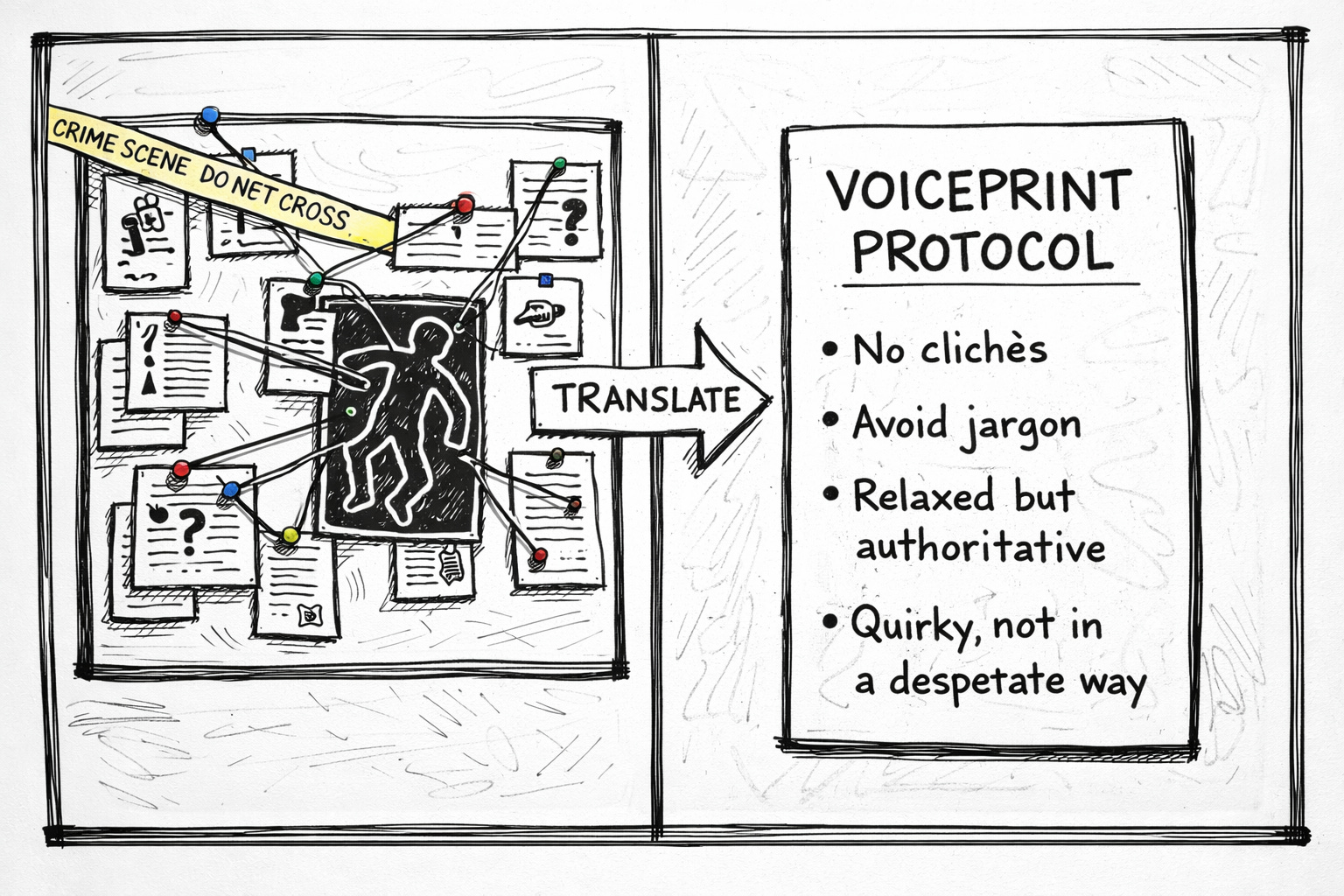
The Assignment
Go find 10 abandoned drafts. Doesn’t matter how old. Doesn’t matter how decomposed. The worse the better. Shame is just evidence with an emotional wrapper.
For each corpse, document:
Topic (two words max)
Time of death (beginning, middle, almost finished)
Suspected cause (first instinct only—don’t overthink)
The cringe (what specifically makes you wince now)
Then look for patterns.
You’re not trying to resurrect these posts. Necromancy is above your pay grade. You’re trying to extract the rulings, then hand them to your AI co-writer so it stops guessing and starts collaborating.
143 bodies. Zero autopsies. Your drafts folder has been waiting for someone to work the case. Might as well be you.
Discussion Thread: What’s your most common cause of death? I’m curious if we’re all committing the same crimes or if everyone’s got their own signature M.O.
Crafted with love (and AI),
Nick “Cold Case Investigator” Quick

PS…One post a day. Every day. For over a month. I’m as surprised as you are. Subscribe before I burn out or wise up (whichever comes first.)
I guess it's a good thing I toast my drafts before CSI gets on scene... ;) I connected with a lot of those (energy, no story, writing for no one and yet everyone), so the next step is to figure out where the bodies are buried and get the clues.